Decision comparison
Alation vs Collibra
Choose Alation when broad, natural-language discovery and a collaborative catalog are central to making analytics and AI teams productive across many connected systems. Choose Collibra when a regulated enterprise needs a federated governance operating model, semantic graph, formal workflow automation, and compliance-oriented traceability.
Direct comparison. These are reviewed substitutes bought for the same job, so the differences below are the ones that decide between them.
All 2 are data catalogs.
Quick Comparison
| Decision factor | Alation | Collibra |
|---|---|---|
| Best For | Enterprise teams prioritizing searchable data discovery, trusted analytics, metadata-aware AI agents, and collaborative cataloging across 120+ connected systems. | Highly regulated enterprises needing federated governance, semantic business context, compliance automation, cross-platform traceability, and governed data product architectures. |
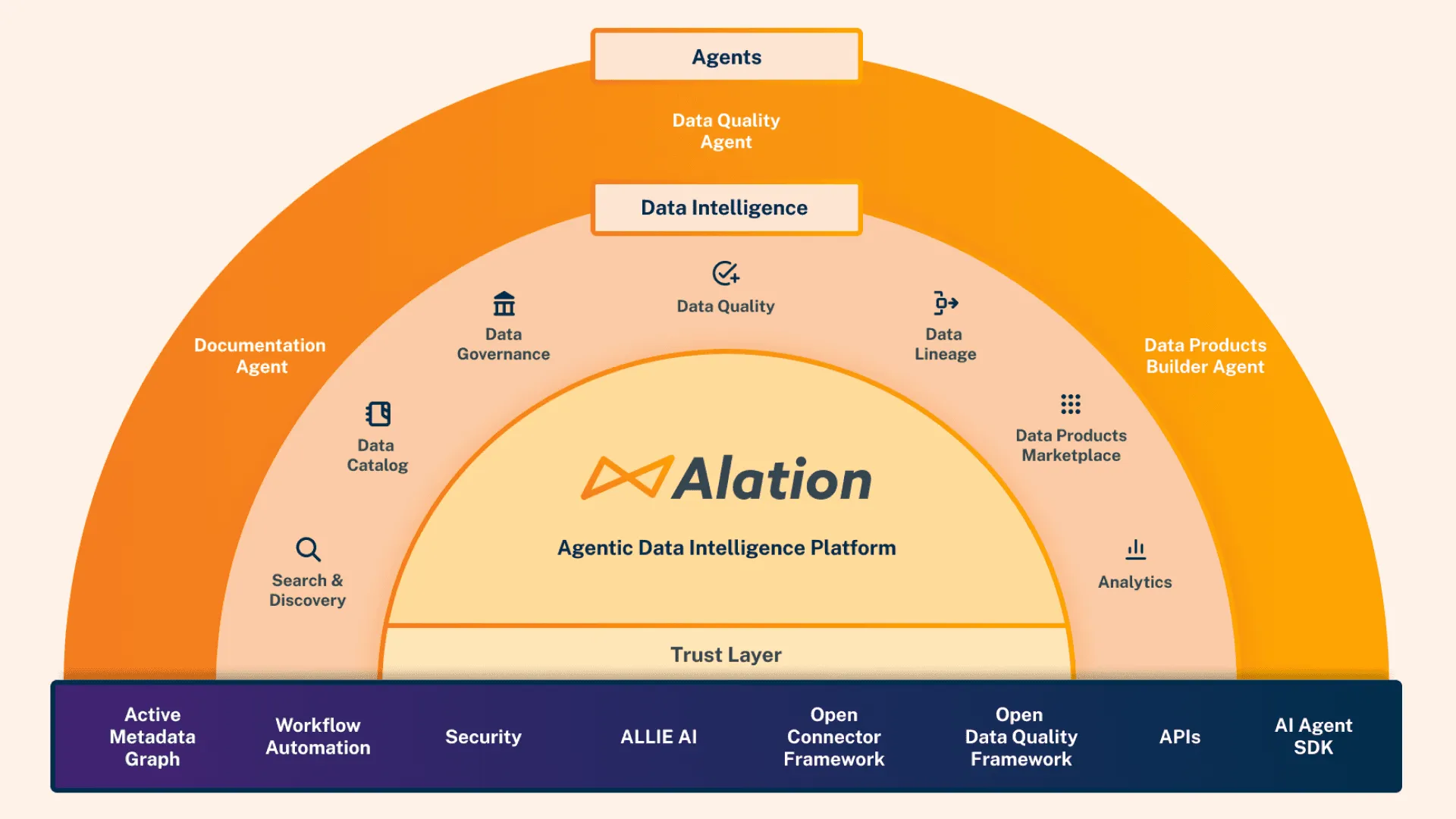
| Architecture | Agentic Data Intelligence Platform unifies catalog, governance, lineage, quality, marketplace, behavioral analysis, open interfaces, and metadata-aware AI workflows. | Cloud-based governance platform organized around a semantic graph, workflows, lineage, data quality observation, AI registry, contracts, integrations, and APIs. |
| Pricing Model | Alation publishes no pricing. alation.com/pricing resolves to a contact form, and no plan or edition names are published either, so every figure is set in a quote. | Contact for pricing |
| Ease of Use | Natural-language discovery, wiki-like documentation, trust markers, and collaboration support self-service; users also cite user experience and data flow limitations. | Intuitive workflow designer, data notebooks, and Collibra Everywhere embed context in business tools; users report ease-of-use but also quick-access concerns. |
| Scalability | Supports enterprise-wide metadata discovery through 120+ connectors, centralized governance, AI-ready data products, and automated documentation and policy workflows. | Designed for rigorous regulated-industry security, scalability, and flexibility, with federated operating models and automated risk reporting across complex data sources. |
| Community/Support | Vendor-led enterprise support and professional services; user rating is 9.3/10 from 50 reviews; Apache-2.0 Alation API library has 19 GitHub stars. | Collibra Community and University provide practitioner resources and learning paths; user rating is 8/10 from 18 reviews; Apache-2.0 MCP Server has 36 GitHub stars. |
Alation
- Best For:
- Enterprise teams prioritizing searchable data discovery, trusted analytics, metadata-aware AI agents, and collaborative cataloging across 120+ connected systems.
- Architecture:
- Agentic Data Intelligence Platform unifies catalog, governance, lineage, quality, marketplace, behavioral analysis, open interfaces, and metadata-aware AI workflows.
- Pricing Model:
- Alation publishes no pricing. alation.com/pricing resolves to a contact form, and no plan or edition names are published either, so every figure is set in a quote.
- Ease of Use:
- Natural-language discovery, wiki-like documentation, trust markers, and collaboration support self-service; users also cite user experience and data flow limitations.
- Scalability:
- Supports enterprise-wide metadata discovery through 120+ connectors, centralized governance, AI-ready data products, and automated documentation and policy workflows.
- Community/Support:
- Vendor-led enterprise support and professional services; user rating is 9.3/10 from 50 reviews; Apache-2.0 Alation API library has 19 GitHub stars.
Collibra
- Best For:
- Highly regulated enterprises needing federated governance, semantic business context, compliance automation, cross-platform traceability, and governed data product architectures.
- Architecture:
- Cloud-based governance platform organized around a semantic graph, workflows, lineage, data quality observation, AI registry, contracts, integrations, and APIs.
- Pricing Model:
- Contact for pricing
- Ease of Use:
- Intuitive workflow designer, data notebooks, and Collibra Everywhere embed context in business tools; users report ease-of-use but also quick-access concerns.
- Scalability:
- Designed for rigorous regulated-industry security, scalability, and flexibility, with federated operating models and automated risk reporting across complex data sources.
- Community/Support:
- Collibra Community and University provide practitioner resources and learning paths; user rating is 8/10 from 18 reviews; Apache-2.0 MCP Server has 36 GitHub stars.
Public signals
Verified factual signals only. Bars appear only for like-for-like metrics with five weekly assessments for every tool; missing evidence stays explicit. These signals do not establish enterprise adoption, product quality, or total cost.
| Metric | Alation | Collibra |
|---|---|---|
| GitHub commits, 90d(Developer adoption) | 2 | 90 |
| GitHub stars(Developer adoption) | 19 | 37 |
| Search interest(Market interest) | Unavailable | 0 |
| Product Hunt comments(Community interest) | 0 | Not available |
| Product Hunt reviews(Community interest) | 0 | Not available |
| Product Hunt votes(Community interest) | 2 | Not available |
| Stack Overflow questions(Community interest) | 12 | 10 |
| Hacker News mentions, 90d(Community interest) | Not available | 0 |
As of October 5, 2026 — updated weekly.
Interface Preview
Alation
Feature Comparison
| Feature | Alation | Collibra |
|---|---|---|
| Discovery and business context | ||
| Data discovery | Natural-language catalog search spans 120+ connectors and trust signals. | Semantic graph connects raw technical assets with business meaning. |
| Documentation | Agentic workflows automate documentation alongside wiki-like asset articles. | Business context is organized as governed semantic graph relationships. |
| Collaboration | Interactive discussions and human insight enrich catalog metadata collaboratively. | Notebook assets share documented SQL, visualizations, and best practices. |
| Governance operating model | ||
| Governance workflows | Agentic processes automate stewardship, policy enforcement, and approvals. | Visual workflow designer standardizes governance decisions and closes knowledge gaps. |
| Operating model | Centralized governance ties stewardship controls to data assets and lineage. | Federated governance model adapts responsibilities to organizational requirements. |
| Policy enforcement | Access controls and data masking connect policies with quality and lineage. | Policies, ownership, quality, and context are unified for data products. |
| Lineage and traceability | ||
| Data lineage | Lineage appears with definitions, policies, quality signals, and source citations. | Cross-platform automated traceability maps data transformations and dependencies. |
| Impact and compliance evidence | Governance decisions are linked to lineage for provable compliance evidence. | Automated risk reporting covers every data source in complex organizations. |
| Data contracts | Data-product governance supplies explainable, audit-ready decision context. | Data contracts formalize expectations within governed data product architectures. |
| AI and analytics enablement | ||
| AI governance | Metadata-aware agents generate SQL, cite sources, and display lineage. | Unified AI registry supports productionized enterprise agents, models, and AI. |
| Data products | Marketplace embeds governance into AI-driven, reusable data products. | Data products unify ownership, context, quality, and policy controls. |
| Analytics workflow | Catalog search helps analysts locate trusted assets for self-service analytics. | Users query sources and collaborate without leaving Collibra notebooks. |
| Integration and adoption | ||
| Integration approach | Over 120 connectors and open interfaces connect distributed metadata ecosystems. | Supported integrations, partner integrations, and APIs connect enterprise systems. |
| In-workflow access | Unified catalog consolidates discovery across warehouses and BI tools. | Collibra Everywhere surfaces context in Salesforce, Databricks, Tableau, and Slack. |
| Adoption management | Behavioral Analysis Engine uses activity signals with human collaboration. | Real-time usage insights identify adoption opportunities and literacy gaps. |
Discovery and business context
Data discovery
Documentation
Collaboration
Governance operating model
Governance workflows
Operating model
Policy enforcement
Lineage and traceability
Data lineage
Impact and compliance evidence
Data contracts
AI and analytics enablement
AI governance
Data products
Analytics workflow
Integration and adoption
Integration approach
In-workflow access
Adoption management
Which to choose
Choose Alation when broad, natural-language discovery and a collaborative catalog are central to making analytics and AI teams productive across many connected systems. Choose Collibra when a regulated enterprise needs a federated governance operating model, semantic graph, formal workflow automation, and compliance-oriented traceability.
Best-fit scenarios
Choose Alation if:
Choose Alation for organizations that need an enterprise data catalog with natural-language search, 120+ connectors, automated documentation, trust signals, and metadata-aware AI agents that can generate SQL with cited sources.
Choose Collibra if:
Choose Collibra for regulated or complex enterprises that need semantic business context, federated governance, automated workflows, data contracts, AI registry capabilities, and context embedded in tools such as Salesforce, Databricks, Tableau, and Slack.
These scenarios reflect the available product evidence. Your requirements, existing stack, and team expertise should guide the final decision.
Frequently Asked Questions
What is the main difference between Alation and Collibra?
Alation is centered on agentic data intelligence: a unified catalog combines natural-language discovery, behavioral analysis, collaborative documentation, lineage, governance, and AI-ready data products. Its metadata-aware agents can handle SQL, cite sources, and expose relevant lineage and policies. Collibra is centered on governed business context at enterprise scale, using a semantic graph, a federated operating model, workflow automation, data contracts, cross-platform traceability, and a unified AI registry. Both support governance and lineage, but Alation emphasizes catalog-led discovery and Collibra emphasizes formalized enterprise governance.
Which is better for small teams?
Neither is positioned in the supplied information as a low-cost small-team product: both use enterprise commercial models, and Collibra has no public rate card in the supplied data. Alation publishes no prices either, so seats, connectors, add-ons, professional services and deployment are all set in a quote. A small team that is nevertheless part of a larger enterprise may find Alation’s natural-language catalog and collaborative discovery approachable, but should validate total implementation and licensing costs. Smaller independent teams should evaluate lower-cost alternatives separately.
Can I migrate from Alation to Collibra?
Yes, but this is an enterprise metadata and governance migration rather than a simple application swap. Inventory Alation catalog assets, glossary definitions, ownership assignments, policies, lineage relationships, trust markers, workflows, users, and connector configurations. Then map those concepts into Collibra’s semantic graph, domains, communities, governance workflows, lineage, data contracts, and access model. Run both systems in parallel for critical domains, reconcile metadata quality and ownership, test downstream BI and warehouse integrations, and train users on Collibra notebooks and embedded Collibra Everywhere experiences. The supplied data does not describe a vendor-provided automated migration utility.
What are the pricing differences?
Alation publishes no prices: alation.com/pricing is a contact form, and connectors, add-ons, professional services and deployment choices are all set in the quote. Collibra is enterprise sales-quoted, but the supplied information publishes no dollar amount, tier name, seat rate, or metering basis. Buyers therefore need a scoped Collibra quote and should compare implementation, integration, governance-design, and ongoing support costs alongside subscription pricing.