Decision comparison
Atlan vs Alation
Atlan and Alation both deliver strong data catalog and governance capabilities, but they serve different organizational profiles. Atlan is purpose-built for cloud-native data teams that need rapid deployment and AI-ready context infrastructure, while Alation is designed for large enterprises with established data estates that require deep governance, compliance workflows, and proven track records in regulated industries. Your choice depends on whether you prioritize speed-to-value and modern AI integration or enterprise-grade governance maturity and Fortune 100 validation.
Direct comparison. These are reviewed substitutes bought for the same job, so the differences below are the ones that decide between them.
All 2 are data catalogs.
Quick Comparison
| Decision factor | Atlan | Alation |
|---|---|---|
| Best For | Cloud-native data teams building AI-ready data stacks | Large enterprises requiring established data intelligence and compliance |
| Pricing Model | Atlan publishes no pricing. atlan.com/pricing resolves to a talk-to-sales contact form, and no plan or edition names are published, so both the tier structure and the figures come from a quote. | Alation publishes no pricing. alation.com/pricing resolves to a contact form, and no plan or edition names are published either, so every figure is set in a quote. |
| Deployment Speed | Days to weeks with self-service setup | 3 to 9 months with professional services |
| Data Catalog Approach | Enterprise Data Graph with 80+ connectors and active metadata | Behavioral Analysis Engine with 120+ connectors and natural-language search |
| AI Capabilities | Context Layer for AI with MCP server, certified context flows, and AI-bootstrapped documentation | Agentic workflows for documentation, policy enforcement, and natural-language data querying |
| Governance Model | Automated governance through Personas and Purposes framework with human-in-the-loop certification | Centralized governance with manual stewardship, access control, data masking, and approval workflows |
Atlan
- Best For:
- Cloud-native data teams building AI-ready data stacks
- Pricing Model:
- Atlan publishes no pricing. atlan.com/pricing resolves to a talk-to-sales contact form, and no plan or edition names are published, so both the tier structure and the figures come from a quote.
- Deployment Speed:
- Days to weeks with self-service setup
- Data Catalog Approach:
- Enterprise Data Graph with 80+ connectors and active metadata
- AI Capabilities:
- Context Layer for AI with MCP server, certified context flows, and AI-bootstrapped documentation
- Governance Model:
- Automated governance through Personas and Purposes framework with human-in-the-loop certification
Alation
- Best For:
- Large enterprises requiring established data intelligence and compliance
- Pricing Model:
- Alation publishes no pricing. alation.com/pricing resolves to a contact form, and no plan or edition names are published either, so every figure is set in a quote.
- Deployment Speed:
- 3 to 9 months with professional services
- Data Catalog Approach:
- Behavioral Analysis Engine with 120+ connectors and natural-language search
- AI Capabilities:
- Agentic workflows for documentation, policy enforcement, and natural-language data querying
- Governance Model:
- Centralized governance with manual stewardship, access control, data masking, and approval workflows
Public signals
Verified factual signals only. Bars appear only for like-for-like metrics with five weekly assessments for every tool; missing evidence stays explicit. These signals do not establish enterprise adoption, product quality, or total cost.
| Metric | Atlan | Alation |
|---|---|---|
| GitHub commits, 90d(Developer adoption) | 143 | 2 |
| GitHub stars(Developer adoption) | 22 | 19 |
| Search interest(Market interest) | 3 | Unavailable |
| Hacker News mentions, 90d(Community interest) | 0 | Not available |
| PyPI weekly downloads(Developer adoption) | 212.8k | Not available |
| Product Hunt comments(Community interest) | Not available | 0 |
| Product Hunt reviews(Community interest) | Not available | 0 |
| Product Hunt votes(Community interest) | Not available | 2 |
| Stack Overflow questions(Community interest) | Not available | 12 |
As of October 5, 2026 — updated weekly.
Health & risk evidence
Observed public-source checks for mapped package versions and repositories.
Atlan
October 5, 2026Package vulnerabilities
PyPI · pyatlan@11.4.0
0 vulnerabilities
across 1 package
Repository security score
Not available
Alation
Package vulnerabilities
Not available
Repository security score
Not available
Interface Preview
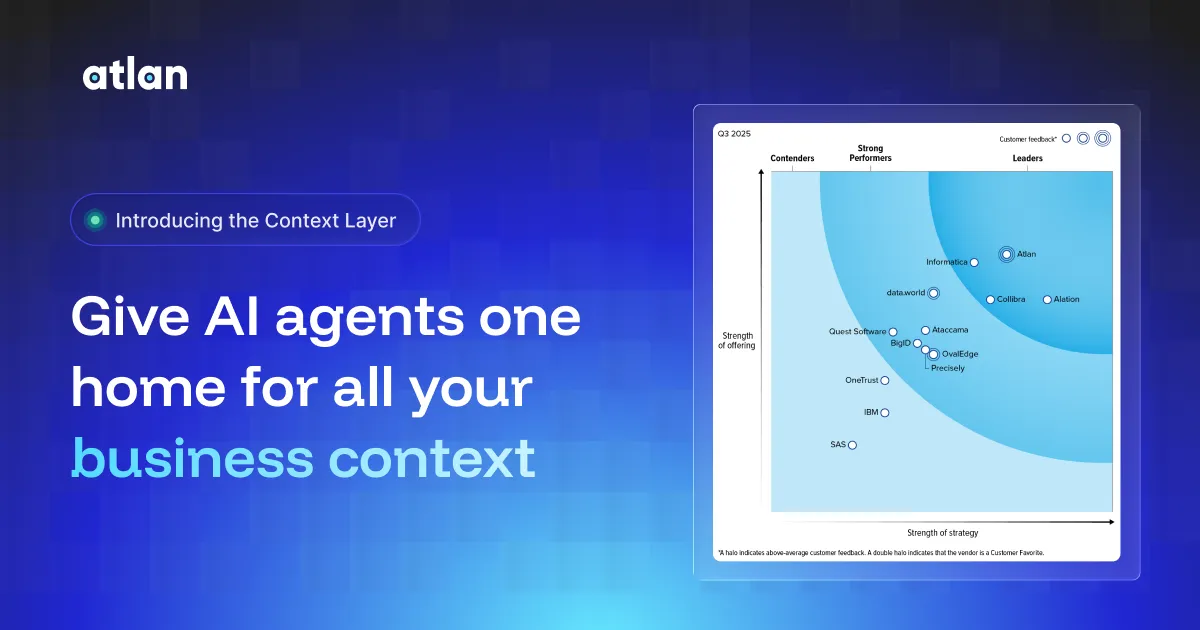
Atlan
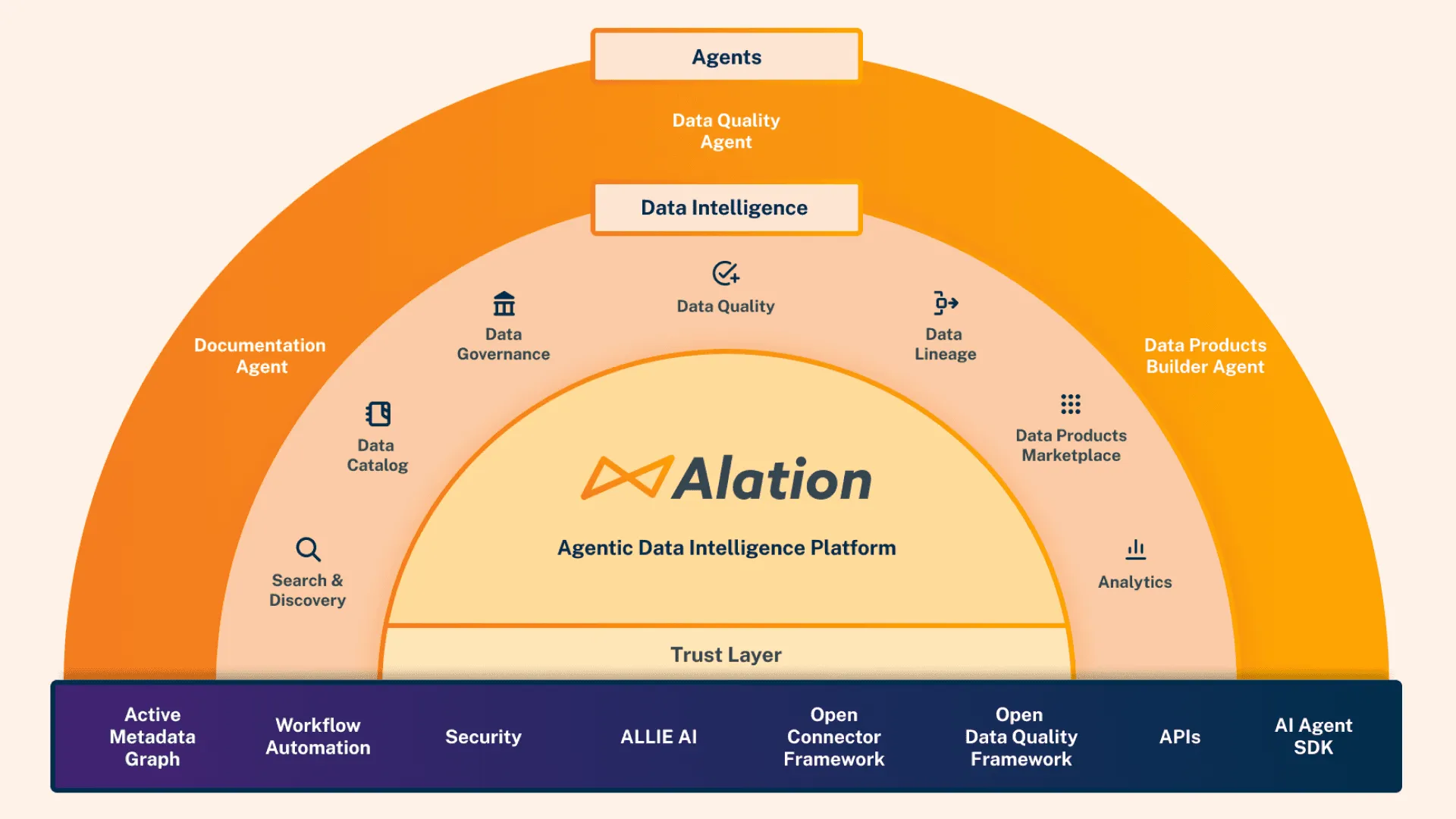
Alation
Feature Comparison
| Feature | Atlan | Alation |
|---|---|---|
| Data Discovery & Catalog | ||
| Connector Ecosystem | 80+ connectors via Enterprise Data Graph | 120+ connectors with Open Connector Framework |
| Search Capabilities | Contextual search with personalized asset views | Natural-language search powered by Behavioral Analysis Engine |
| Data Lineage | End-to-end visual lineage across Snowflake, dbt, Tableau, and more | End-to-end lineage with governance integration |
| Governance & Compliance | ||
| Governance Framework | Personas and Purposes model with automated policies | Centralized stewardship with access control and data masking |
| Business Glossary | Centralized glossary with ownership assignments and linked definitions | Wiki-like articles with trust markers and interactive discussions |
| Compliance Support | Automated compliance through certified context flows | Provable compliance with policies tied to lineage and quality |
| AI & Automation | ||
| AI Documentation | AI-bootstrapped context layer with human expert review and certification | Agentic workflows automate documentation and policy enforcement |
| AI Querying | Certified context serves AI agents via SQL, APIs, and MCP server | Natural-language querying with metadata-aware agents handling SQL |
| Automation Scope | Playbooks, auto-documentation, and active metadata pipelines | Active metadata extraction, pipeline code generation, and data fabric automation |
| Collaboration & Usability | ||
| User Interface | Modern, personalized homepages with curated asset views | Enterprise-grade interface with endorsement and trust signals |
| Collaboration Features | Domain experts resolve, annotate, and certify context collaboratively | Wiki-like articles, comments, endorsements, and shared SQL queries |
| Tool Integrations | Open APIs, MCP server, and multi-agent protocol support | Integrations with Excel, Slack, BI tools, and data platforms |
| Pricing & Deployment | ||
| Entry Price | Free tier available; paid plans scale from individual to enterprise | Enterprise contracts with base subscriptions and per-user licensing |
| Deployment Model | Cloud-native SaaS with rapid self-service onboarding | Cloud service (SaaS) or customer-managed/on-premises |
| Time to Value | Days to weeks with DIY setup | 3 to 9 months with professional services engagement |
Data Discovery & Catalog
Connector Ecosystem
Search Capabilities
Data Lineage
Governance & Compliance
Governance Framework
Business Glossary
Compliance Support
AI & Automation
AI Documentation
AI Querying
Automation Scope
Collaboration & Usability
User Interface
Collaboration Features
Tool Integrations
Pricing & Deployment
Entry Price
Deployment Model
Time to Value
Which to choose
Atlan and Alation both deliver strong data catalog and governance capabilities, but they serve different organizational profiles. Atlan is purpose-built for cloud-native data teams that need rapid deployment and AI-ready context infrastructure, while Alation is designed for large enterprises with established data estates that require deep governance, compliance workflows, and proven track records in regulated industries. Your choice depends on whether you prioritize speed-to-value and modern AI integration or enterprise-grade governance maturity and Fortune 100 validation.
Best-fit scenarios
Choose Atlan if:
We recommend Atlan for cloud-native data teams that need to move fast and build AI-ready data infrastructure. Atlan stands out with its modern architecture, rapid deployment timeline of days to weeks, and accessible pricing starting with a free tier. The Enterprise Data Graph and Context Layer for AI make it particularly strong for organizations investing in AI agents and needing certified context to flow across their stack. Teams that value self-service onboarding, personalized interfaces, and an open API-first approach will find Atlan delivers faster time-to-value without the overhead of lengthy professional services engagements.
Choose Alation if:
We recommend Alation for large enterprises operating in regulated industries where proven governance maturity and compliance are non-negotiable. Alation has earned recognition as a 5X Leader in the Gartner Magic Quadrant for Metadata Management Solutions, and 40% of the Fortune 100 rely on the platform. Its Behavioral Analysis Engine, 120+ connectors, and centralized stewardship workflows are built for organizations managing complex, multi-source data estates. Teams that need deep policy enforcement, audit-ready compliance, and natural-language search across massive data catalogs will benefit from Alation's enterprise-grade capabilities, provided they can invest the 3-to-9-month deployment timeline and enterprise-level budget.
These scenarios reflect the available product evidence. Your requirements, existing stack, and team expertise should guide the final decision.
Frequently Asked Questions
What is the main difference between Atlan and Alation?
Atlan is a cloud-native data workspace that positions itself as a Context Layer for AI, focusing on rapid deployment and modern data stack integration. Alation is an established agentic data intelligence platform built for enterprise-scale data cataloging, governance, and compliance. Atlan deploys in days to weeks while Alation typically requires 3 to 9 months with professional services.
How do Atlan and Alation compare on pricing?
Atlan publishes no pricing. Its pricing page resolves to a talk-to-sales contact form with no figures and no plan or edition names, so both the tier structure and the rates come from a quote. Ask for a quote scoped to your connector count and user roles, or the number will not be comparable with a competitor's published rate.
Which platform is better for AI and machine learning workflows?
Both platforms invest heavily in AI capabilities. Atlan's Context Layer for AI with its MCP server and certified context flows is designed to serve every AI agent across your stack. Alation's agentic workflows automate documentation and policy enforcement, with metadata-aware agents that handle SQL querying and cite sources. Atlan is stronger for teams building new AI infrastructure, while Alation excels at governing existing AI and analytics workflows.
Can Alation or Atlan integrate with modern cloud data stacks like Snowflake and dbt?
Both platforms support modern cloud data stacks. Atlan offers 80+ connectors through its Enterprise Data Graph with deep integrations for Snowflake, dbt, Tableau, and Fivetran. Alation provides 120+ connectors through its Open Connector Framework. However, external reviews note that Alation's architecture predates the Snowflake and dbt era, and some organizations find its integrations require more manual configuration compared to purpose-built alternatives like Atlan.
Which platform has better user reviews?
Alation holds a higher aggregate rating of 9.3 out of 10 based on 50 reviews, while Atlan scores 8.3 out of 10 based on 11 reviews. Alation users praise its secure data handling, query builder, and data management capabilities. Atlan users highlight its seamless integration with data sources, clean user interface, and data visualization features. Both platforms receive occasional feedback about areas for improvement in customer support and documentation.