Decision comparison
Atlan vs OpenMetadata
Atlan delivers a managed, AI-native context layer for enterprises that want governance-ready metadata with minimal infrastructure overhead, while OpenMetadata provides a free, open-source platform with broader connector coverage and full deployment flexibility.
Architecture choice. These take different approaches to the same problem. Read the table as a fit question rather than a feature race.
All 2 are data catalogs.
Quick Comparison
| Decision factor | Atlan | OpenMetadata |
|---|---|---|
| Best For | Enterprise teams needing an AI-native context layer with managed governance workflows and analyst collaboration | Organizations wanting a free, self-hosted metadata platform with API-first extensibility and community support |
| Pricing Model | Atlan publishes no pricing. atlan.com/pricing resolves to a talk-to-sales contact form, and no plan or edition names are published, so both the tier structure and the figures come from a quote. | Free and open-source under Apache 2.0 license |
| Data Connectors | 80+ connectors covering warehouses, BI tools, business applications, and transformation platforms like dbt | 120+ native connectors spanning databases, dashboards, pipelines, ML models, messaging, and storage services |
| Architecture | Managed cloud platform with Enterprise Data Graph, Metadata Lakehouse, Iceberg-native storage, and MCP server | Lightweight self-hosted stack with only 4 system components, API-first design, and standardized metadata schemas |
| Governance Approach | AI-bootstrapped context layer with human-in-the-loop certification, Personas and Purposes access controls | Metadata versioning with role-based access, data quality profiling, automated classification, and audit trails |
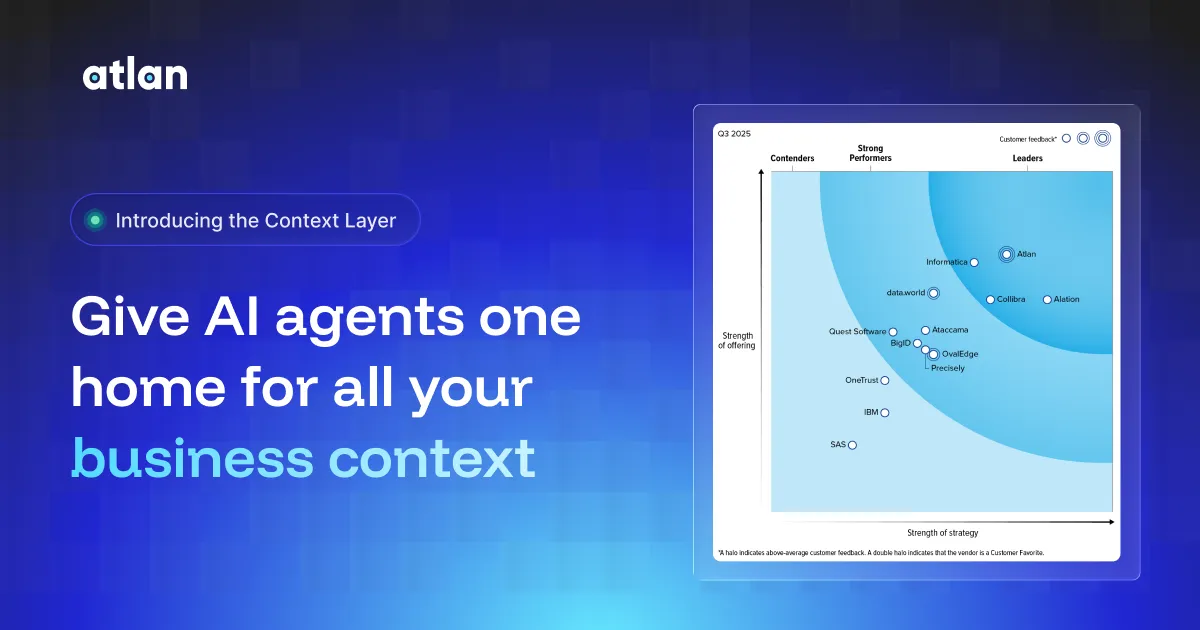
| Community & Recognition | Leader in 2025 and 2026 Gartner Magic Quadrant for Metadata Management, Forrester Wave Leader, 95% G2 approval | 15,000+ GitHub stars, 450+ code contributors, 4,000+ enterprise deployments, active open-source community |
Atlan
- Best For:
- Enterprise teams needing an AI-native context layer with managed governance workflows and analyst collaboration
- Pricing Model:
- Atlan publishes no pricing. atlan.com/pricing resolves to a talk-to-sales contact form, and no plan or edition names are published, so both the tier structure and the figures come from a quote.
- Data Connectors:
- 80+ connectors covering warehouses, BI tools, business applications, and transformation platforms like dbt
- Architecture:
- Managed cloud platform with Enterprise Data Graph, Metadata Lakehouse, Iceberg-native storage, and MCP server
- Governance Approach:
- AI-bootstrapped context layer with human-in-the-loop certification, Personas and Purposes access controls
- Community & Recognition:
- Leader in 2025 and 2026 Gartner Magic Quadrant for Metadata Management, Forrester Wave Leader, 95% G2 approval
OpenMetadata
- Best For:
- Organizations wanting a free, self-hosted metadata platform with API-first extensibility and community support
- Pricing Model:
- Free and open-source under Apache 2.0 license
- Data Connectors:
- 120+ native connectors spanning databases, dashboards, pipelines, ML models, messaging, and storage services
- Architecture:
- Lightweight self-hosted stack with only 4 system components, API-first design, and standardized metadata schemas
- Governance Approach:
- Metadata versioning with role-based access, data quality profiling, automated classification, and audit trails
- Community & Recognition:
- 15,000+ GitHub stars, 450+ code contributors, 4,000+ enterprise deployments, active open-source community
Public signals
Verified factual signals only. Bars appear only for like-for-like metrics with five weekly assessments for every tool; missing evidence stays explicit. These signals do not establish enterprise adoption, product quality, or total cost.
| Metric | Atlan | OpenMetadata |
|---|---|---|
| GitHub commits, 90d(Developer adoption) | 167 | Not available |
| GitHub stars(Developer adoption) | 22 | Not available |
| Search interest(Market interest) | 3 | 1 |
| Hacker News mentions, 90d(Community interest) | 0 | Not available |
| PyPI weekly downloads(Developer adoption) | 128.0k | Not available |
| Docker Hub pulls(Product adoption) | Not available | 5.3M |
| GitHub commits, 90d(Product adoption) | Not available | 2.0k |
| GitHub stars(Product adoption) | Not available | 15,000+ |
| PyPI weekly downloads(Product adoption) | Not available | 39.9k |
As of September 21, 2026 — updated weekly.
Health & risk evidence
Observed public-source checks for mapped package versions and repositories.
Atlan
September 21, 2026Package vulnerabilities
PyPI · pyatlan@11.4.0
0 vulnerabilities
across 1 package
Repository security score
Not available
OpenMetadata
September 21, 2026Package vulnerabilities
PyPI · openmetadata-ingestion@2.0.2.0
0 vulnerabilities
across 1 package
Repository security score
github.com/open-metadata/OpenMetadata
4.6/10
Interface Preview
Atlan
Feature Comparison
| Feature | Atlan | OpenMetadata |
|---|---|---|
| Data Discovery | ||
| Search & Navigation | AI-powered search across the Enterprise Data Graph with personalized homepages and curated asset views for each user role | Faceted search and preview across all data assets including tables, topics, dashboards, pipelines, and services |
| Data Lineage | End-to-end visual lineage across Snowflake, dbt, Tableau, Salesforce, and Fivetran with impact analysis | Column-level lineage and data transformation tracking with upstream and downstream dependency mapping |
| Business Glossary | Centralized linkable business glossary with ownership assignments, AI-generated term linkage, and certification workflows | Shared glossary with metadata versioning that tracks changes over time for governance and collaboration |
| Metadata Management | ||
| Active Metadata | Dynamic, continuously updated metadata that is actionable and feeds into AI agents through the context pipeline | Unified Metadata Graph centralizing all metadata for all data assets with extensible entity relationships |
| Automation | AI agents auto-generate descriptions, link business terms, surface top questions, and bootstrap 80% of context | Ingestion framework with 120+ native connectors for automated metadata collection from diverse data sources |
| API & Extensibility | Open APIs with SDK, SQL interface, and MCP server for serving certified context to downstream AI agents | API-first and schema-first architecture with standardized schemas enabling custom metadata entities and workflows |
| Data Governance | ||
| Access Control | Role-based access through Personas and Purposes model with policy enforcement and compliance workflows | Role-based access control with user management features and team-based permissions for data assets |
| Data Quality | Integrates with Great Expectations, Soda, and Monte Carlo through marketplace packages for quality profiling | Built-in data quality checks, data profiling, test suites, and observability alerts as native platform features |
| Compliance | Sensitive data classification, ownership identification, lineage-based impact analysis for regulatory compliance | Metadata versioning creates full audit trails of changes for governance compliance and accountability |
| Collaboration | ||
| Team Workflows | Context Pipeline with human-in-the-loop review: conflict resolution, annotation, labeling, and certification | Built-in collaboration between data producers and consumers with comments, tasks, and shared responsibility |
| Integration Ecosystem | Native JIRA and Slack integrations, App Framework marketplace, and connections to BI tools like Tableau and Looker | 120+ native connectors covering databases, dashboards, pipelines, ML models, messaging systems, and cloud storage |
| Documentation | AI-bootstrapped auto-documentation with domain expert review and certification before shipping to production | Collaborative asset documentation where both technical and non-technical users contribute descriptions and context |
| Deployment & Operations | ||
| Deployment Model | Fully managed cloud SaaS with enterprise-grade security, no self-hosting option publicly available | Self-hosted deployment, live sandbox for testing, and free managed SaaS option through Collate |
| Scalability | Enterprise-scale with customers cataloging 18 million+ assets and 1,300+ glossary terms in the first year | Proven at scale with 2+ million data assets at large deployments and 4,000+ enterprise installations |
| Setup Complexity | Managed service reduces operational burden but requires extensive initial configuration and governance planning | Streamlined architecture with only 4 system components makes deployment, operation, and upgrades simpler |
Data Discovery
Search & Navigation
Data Lineage
Business Glossary
Metadata Management
Active Metadata
Automation
API & Extensibility
Data Governance
Access Control
Data Quality
Compliance
Collaboration
Team Workflows
Integration Ecosystem
Documentation
Deployment & Operations
Deployment Model
Scalability
Setup Complexity
Which approach fits
Atlan delivers a managed, AI-native context layer for enterprises that want governance-ready metadata with minimal infrastructure overhead, while OpenMetadata provides a free, open-source platform with broader connector coverage and full deployment flexibility.
When each approach fits
Choose Atlan if:
Choose Atlan if your organization prioritizes a managed, AI-powered metadata platform that bootstraps governance at enterprise scale. Atlan excels when you need an AI context layer that auto-generates asset descriptions, links business terms, and serves certified metadata to downstream AI agents through its MCP server. Its Enterprise Data Graph unifies 80+ connectors into a living knowledge graph, and the human-in-the-loop certification pipeline ensures domain experts validate context before it reaches production. Atlan is the stronger pick for teams that want rapid time-to-value without managing infrastructure and are willing to invest in its SaaS pricing tiers.
Choose OpenMetadata if:
Choose OpenMetadata if you need a cost-free, open-source metadata platform with full control over your deployment and data. With 120+ native connectors, API-first architecture, and only 4 system components, OpenMetadata offers broader data source coverage and simpler self-hosted operations. Its built-in data quality checks, profiling, and observability come as native features rather than third-party integrations. The Apache 2.0 license means no vendor lock-in and complete customization through extensible metadata entities. OpenMetadata is ideal for engineering-driven teams comfortable with self-hosting who want a unified metadata platform without per-user licensing costs.
These scenarios reflect the available product evidence. Your requirements, existing stack, and team expertise should guide the final decision.
Frequently Asked Questions
Is OpenMetadata truly free to use in production?
OpenMetadata is completely free and open-source under the Apache 2.0 license, which permits commercial use without licensing fees. You can deploy it in your own environment at no cost. The project is backed by Collate, which offers an optional managed SaaS version for teams that prefer not to handle infrastructure themselves. The open-source version includes all core features: data discovery, lineage, quality checks, governance, and 120+ native connectors. With 4,000+ enterprise deployments already running the platform, it is production-proven at scale.
How do Atlan and OpenMetadata compare on data connector coverage?
OpenMetadata offers 120+ native connectors spanning databases, dashboards, pipelines, ML models, messaging systems, and cloud storage services, with new connectors added every release. Atlan provides 80+ connectors that pull context from warehouses, BI definitions, and business applications into its Enterprise Data Graph. While OpenMetadata covers a wider range of data services out of the box, Atlan focuses on deeper integration between connected sources through its unified knowledge graph and AI-powered context enrichment, linking metadata across sources automatically.
Which platform is better for AI agent integration?
Atlan has invested heavily in AI agent integration through its Context Pipeline and MCP server. The platform positions itself as the context layer for enterprise AI, serving certified metadata to downstream agents through SQL, APIs, and MCP. Atlan AI agents also bootstrap descriptions, link terms, and generate semantic views. OpenMetadata supports MCP as well (listed in its GitHub topics) and offers a standardized API-first architecture that any AI system can consume. However, Atlan's end-to-end AI context pipeline with human certification is more mature for production AI agent deployments.
Can smaller teams with limited budgets use Atlan effectively?
Atlan publishes no pricing. Its pricing page resolves to a talk-to-sales contact form with no figures and no plan or edition names, so both the tier structure and the rates come from a quote. Ask for a quote scoped to your connector count and user roles, or the number will not be comparable with a competitor's published rate.