Decision comparison
Atlan vs Alation vs OpenMetadata
Atlan fits cloud-native teams needing fast AI-driven catalogs, active metadata, and deployment measured in days to weeks. Alation is the premium choice for regulated enterprises with deep compliance budgets, centralized stewardship, and governance workflows that may require professional services. OpenMetadata wins for engineering teams wanting open-source with zero licensing cost, standardized APIs, and full infrastructure control. The clearest dividing line is whether speed and managed experience, enterprise governance depth, or self-hosted flexibility matters most.
Category comparison
Three catalog approaches: collaborative SaaS, enterprise governance, or open source
Atlan emphasizes collaborative metadata workflows for modern data teams, Alation brings an established enterprise governance and stewardship practice, and OpenMetadata offers an open-source catalog you host and extend yourself. Licensing model and governance maturity usually decide it. If you have narrowed to Atlan and Alation, the dedicated head-to-head covers that pair.
Pick Atlan when
the catalog must fit collaborative workflows across analysts, engineers, and stakeholders.
Pick Alation when
formal stewardship, governance process, and enterprise procurement requirements lead.
Pick OpenMetadata when
you want to self-host, avoid per-seat licensing, and extend the catalog in code.
All 3 are data catalogs, so the differences below are the ones that decide between them.
Quick Comparison
| Decision factor | Atlan | Alation | OpenMetadata |
|---|---|---|---|
| Best For | Cloud-native teams wanting fast deployment, AI-driven metadata automation, and a modern developer experience, especially across Snowflake, dbt, or Databricks. | Large enterprises in regulated industries needing the deepest governance workflows and proven compliance, with centralized stewardship, masking, approvals, and audit-ready lineage. | Engineering-led organizations wanting full control, zero licensing costs, and open-source flexibility, backed by standardized schemas, APIs, and self-hosted infrastructure. |
| Pricing | Atlan publishes no pricing. atlan.com/pricing resolves to a talk-to-sales contact form, and no plan or edition names are published, so both the tier structure and the figures come from a quote. | Alation publishes no pricing. alation.com/pricing resolves to a contact form, and no plan or edition names are published either, so every figure is set in a quote. | Free and open-source under Apache 2.0 license |
| Open-source licensing | Proprietary SaaS, with open APIs and portable context intended to integrate across agents, models, clouds, SQL, APIs, and MCP. | Proprietary enterprise platform, using open interfaces alongside its Behavioral Analysis Engine and agentic workflows for metadata, governance, and collaboration. | Apache 2.0, enabling free self-hosting and open-source flexibility through an API-first metadata platform with standardized schemas and APIs. |
| Time to operational | Days to weeks, supported by 80+ connectors that unify warehouse SQL, BI definitions, business applications, lineage, and governance context. | 3-9 months with pro services, reflecting enterprise deployment, governance configuration, connector setup, and operational adoption across data contributors. | Depends on infra team, because self-hosting requires deployment and operations; its ingestion framework supports connectors for 100+ data services. |
| Key features | Enterprise Data Graph, active metadata, personalization, visual end-to-end lineage, business glossary, certification workflows, AI-native context, and MCP-enabled downstream delivery. | Natural-language catalog search, 120+ connectors, agentic documentation and policy workflows, lineage, stewardship, access controls, masking, approvals, and AI-ready data products. | Unified metadata platform with discovery, search, column-level lineage, transformation tracking, versioning, governance, observability, collaboration, profiling, and 100+ service connectors. |
| Public GitHub evidence | Official Python SDK: 22 stars, Apache-2.0 license, latest release 11.0.0 on 2026-08-26, and last push on 2026-08-27. | Python library for Alation API agentic workflows: 19 stars, Apache-2.0 license, and last push on 2026-08-04. | OpenMetadata repository: 15,121 stars, Apache-2.0 license, TypeScript primary language, release 2.0.1-release on 2026-09-02, last push 2026-09-07. |
Atlan
- Best For:
- Cloud-native teams wanting fast deployment, AI-driven metadata automation, and a modern developer experience, especially across Snowflake, dbt, or Databricks.
- Pricing:
- Atlan publishes no pricing. atlan.com/pricing resolves to a talk-to-sales contact form, and no plan or edition names are published, so both the tier structure and the figures come from a quote.
- Open-source licensing:
- Proprietary SaaS, with open APIs and portable context intended to integrate across agents, models, clouds, SQL, APIs, and MCP.
- Time to operational:
- Days to weeks, supported by 80+ connectors that unify warehouse SQL, BI definitions, business applications, lineage, and governance context.
- Key features:
- Enterprise Data Graph, active metadata, personalization, visual end-to-end lineage, business glossary, certification workflows, AI-native context, and MCP-enabled downstream delivery.
- Public GitHub evidence:
- Official Python SDK: 22 stars, Apache-2.0 license, latest release 11.0.0 on 2026-08-26, and last push on 2026-08-27.
Alation
- Best For:
- Large enterprises in regulated industries needing the deepest governance workflows and proven compliance, with centralized stewardship, masking, approvals, and audit-ready lineage.
- Pricing:
- Alation publishes no pricing. alation.com/pricing resolves to a contact form, and no plan or edition names are published either, so every figure is set in a quote.
- Open-source licensing:
- Proprietary enterprise platform, using open interfaces alongside its Behavioral Analysis Engine and agentic workflows for metadata, governance, and collaboration.
- Time to operational:
- 3-9 months with pro services, reflecting enterprise deployment, governance configuration, connector setup, and operational adoption across data contributors.
- Key features:
- Natural-language catalog search, 120+ connectors, agentic documentation and policy workflows, lineage, stewardship, access controls, masking, approvals, and AI-ready data products.
- Public GitHub evidence:
- Python library for Alation API agentic workflows: 19 stars, Apache-2.0 license, and last push on 2026-08-04.
OpenMetadata
- Best For:
- Engineering-led organizations wanting full control, zero licensing costs, and open-source flexibility, backed by standardized schemas, APIs, and self-hosted infrastructure.
- Pricing:
- Free and open-source under Apache 2.0 license
- Open-source licensing:
- Apache 2.0, enabling free self-hosting and open-source flexibility through an API-first metadata platform with standardized schemas and APIs.
- Time to operational:
- Depends on infra team, because self-hosting requires deployment and operations; its ingestion framework supports connectors for 100+ data services.
- Key features:
- Unified metadata platform with discovery, search, column-level lineage, transformation tracking, versioning, governance, observability, collaboration, profiling, and 100+ service connectors.
- Public GitHub evidence:
- OpenMetadata repository: 15,121 stars, Apache-2.0 license, TypeScript primary language, release 2.0.1-release on 2026-09-02, last push 2026-09-07.
Public signals
Verified factual signals only. Bars appear only for like-for-like metrics with five weekly assessments for every tool; missing evidence stays explicit. These signals do not establish enterprise adoption, product quality, or total cost.
| Metric | Atlan | Alation | OpenMetadata |
|---|---|---|---|
| GitHub commits, 90d(Developer adoption) | 167 | 2 | Not available |
| GitHub stars(Developer adoption) | 22 | 19 | Not available |
| Search interest(Market interest) | 3 | Unavailable | 1 |
| Hacker News mentions, 90d(Community interest) | 0 | Not available | Not available |
| PyPI weekly downloads(Developer adoption) | 128.0k | Not available | Not available |
| Product Hunt comments(Community interest) | Not available | 0 | Not available |
| Product Hunt reviews(Community interest) | Not available | 0 | Not available |
| Product Hunt votes(Community interest) | Not available | 2 | Not available |
| Stack Overflow questions(Community interest) | Not available | 12 | Not available |
| Docker Hub pulls(Product adoption) | Not available | Not available | 5.3M |
| GitHub commits, 90d(Product adoption) | Not available | Not available | 2.0k |
| GitHub stars(Product adoption) | Not available | Not available | 15,000+ |
| PyPI weekly downloads(Product adoption) | Not available | Not available | 39.9k |
As of September 21, 2026 — updated weekly.
Health & risk evidence
Observed public-source checks for mapped package versions and repositories.
Atlan
September 21, 2026Package vulnerabilities
PyPI · pyatlan@11.4.0
0 vulnerabilities
across 1 package
Repository security score
Not available
Alation
Package vulnerabilities
Not available
Repository security score
Not available
OpenMetadata
September 21, 2026Package vulnerabilities
PyPI · openmetadata-ingestion@2.0.2.0
0 vulnerabilities
across 1 package
Repository security score
github.com/open-metadata/OpenMetadata
4.6/10
Interface Preview
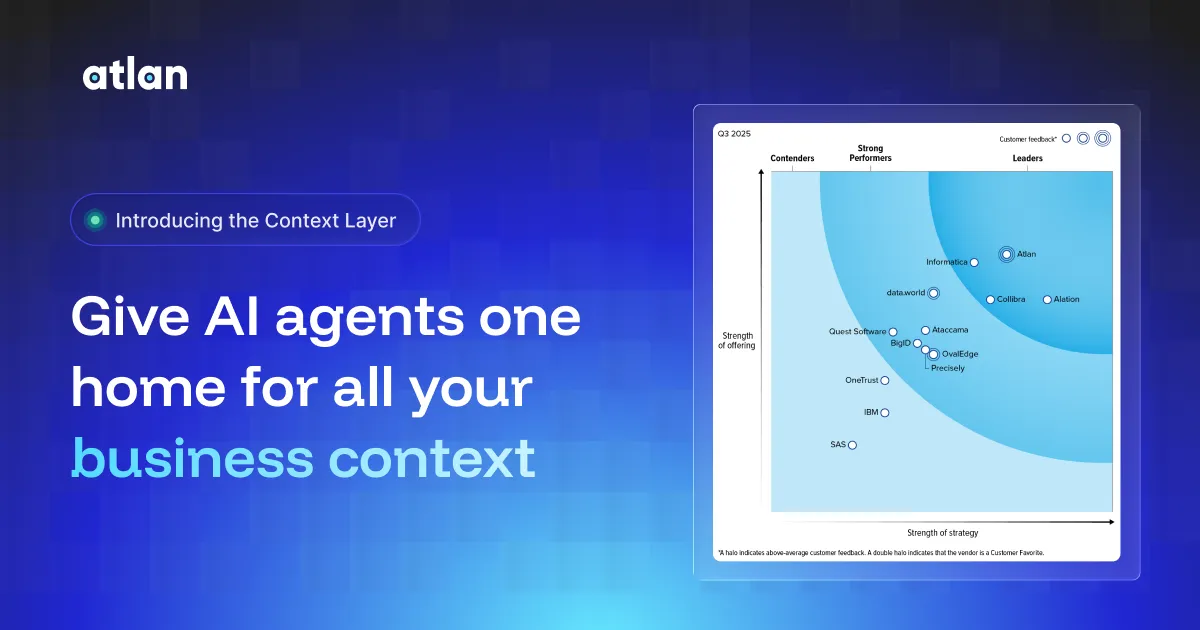
Atlan
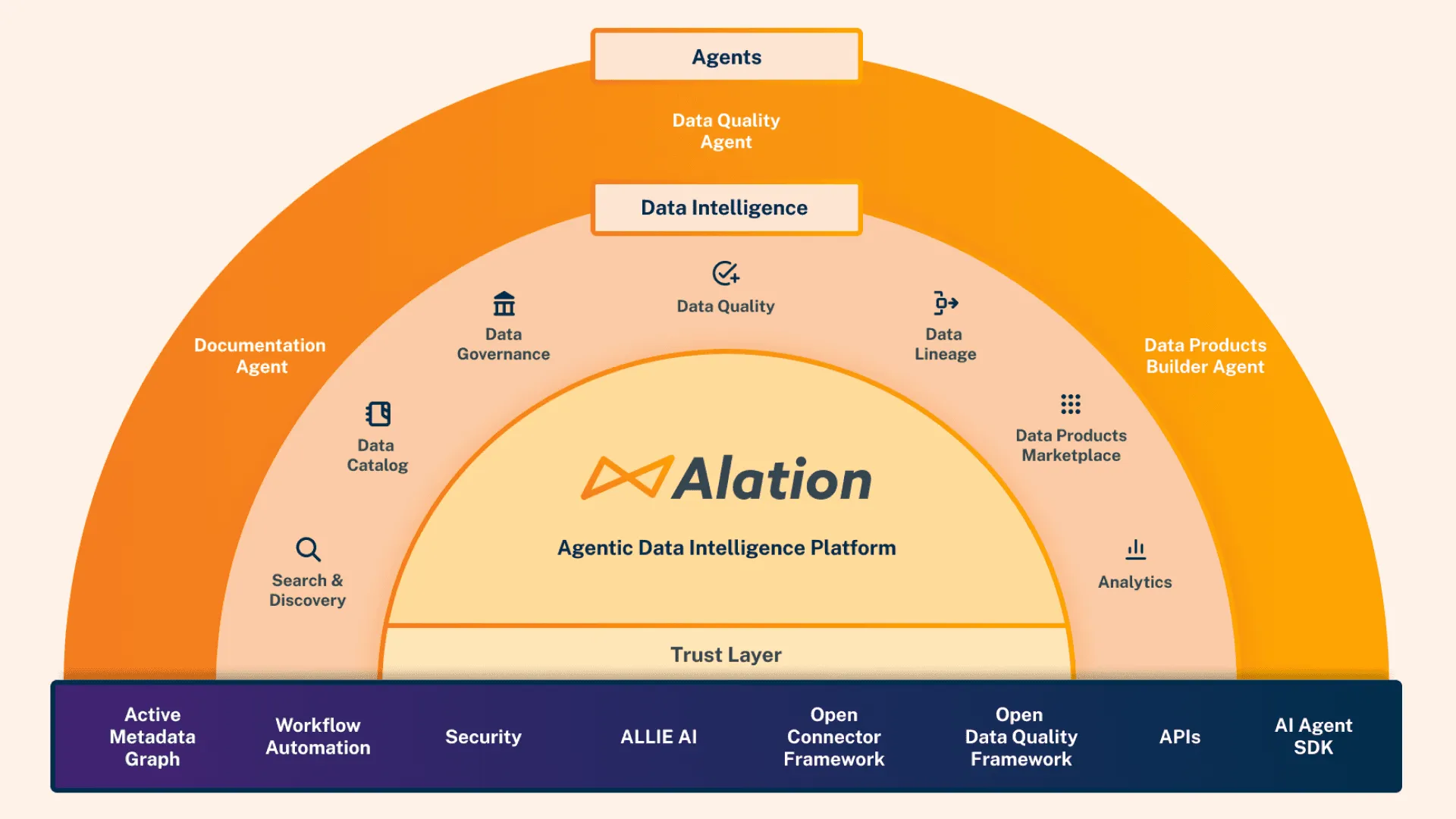
Alation
Feature Comparison
| Feature | Atlan | Alation | OpenMetadata |
|---|---|---|---|
| Deployment & Cost | |||
| Open-source licensing | Proprietary SaaS | Proprietary enterprise | Apache 2.0 |
| Time to operational | Days to weeks | 3-9 months with pro services | Depends on infra team |
| Annual TCO for mid-size enterprise | Low-to-mid five figures | Several hundred thousand | Infrastructure-only |
| Metadata & Discovery | |||
| Automated metadata cataloging | AI-native context pipeline | Behavioral Analysis Engine | Schema-first ingestion framework |
| Natural language search | Full-text + semantic graph | Natural-language search across definitions | Full-text search across entities |
| Data lineage | Column-level, bidirectional sync | End-to-end with behavioral signals | Column-level with extensible schemas |
| Governance & AI | |||
| Automated policy enforcement | Via certified context | Native framework with approval workflows | Built-in hybrid RBAC + ABAC with UI-managed, tag-based rules |
| Data masking | Full support | Native data masking | Built-in PII masking and tag-based deny rules |
| AI agents / MCP support | MCP server for AI tool context | Metadata-aware agents for SQL & lineage | API and MCP extensibility; managed Collate edition adds AI agents |
| Glossary review and approval | Not assessed in this comparison | Built-in approval workflows | Built-in steward review and approval workflow |
| NLP PII / sensitive-data classification | Not assessed in this comparison | Not assessed in this comparison | Built-in NLP auto-classification for PII and sensitive data |
| Ecosystem & Validation | |||
| Connector count | 80+ native connectors | 120+ native connectors | 120+ native connectors |
| Analyst recognition | Gartner MQ Leader; Forrester Wave Leader | 5X Gartner MQ Leader | Community-validated; 4,000+ enterprise deployments |
| User rating | 8.3/10 (11 reviews) | 9.3/10 (50 reviews) | Not rated; no collected reviews |
Deployment & Cost
Open-source licensing
Time to operational
Annual TCO for mid-size enterprise
Metadata & Discovery
Automated metadata cataloging
Natural language search
Data lineage
Governance & AI
Automated policy enforcement
Data masking
AI agents / MCP support
Glossary review and approval
NLP PII / sensitive-data classification
Ecosystem & Validation
Connector count
Analyst recognition
User rating
What each one does
Atlan fits cloud-native teams needing fast AI-driven catalogs, active metadata, and deployment measured in days to weeks. Alation is the premium choice for regulated enterprises with deep compliance budgets, centralized stewardship, and governance workflows that may require professional services. OpenMetadata wins for engineering teams wanting open-source with zero licensing cost, standardized APIs, and full infrastructure control. The clearest dividing line is whether speed and managed experience, enterprise governance depth, or self-hosted flexibility matters most.
What each one is for
Choose Atlan if:
Choose Atlan if you run Snowflake, dbt, or Databricks and need to be operational in days with AI-powered metadata automation. Its free tier supports one user, while Pro is $15/mo and Team is $30/mo before Enterprise custom pricing.
Choose Alation if:
Choose Alation if you operate in a regulated industry such as finance or healthcare with 50+ data contributors and a six-figure governance budget. Its enterprise pricing starts at $60,000-$198,000 yearly, with connectors, add-ons, and services potentially adding cost.
Choose OpenMetadata if:
Choose OpenMetadata if you have strong infra engineers, want zero licensing fees, and prefer to avoid vendor lock-in entirely. It is Apache-2.0 open source and free to self-host, while managed SaaS is available through Collate.
These scenarios reflect the available product evidence. Your requirements, existing stack, and team expertise should guide the final decision.
Frequently Asked Questions
How do the deployment timelines compare between Atlan, Alation, and OpenMetadata?
Deployment timelines vary dramatically across these three platforms. Atlan is designed for rapid deployment and can be operational in days to weeks with a DIY setup process, making it the fastest commercial option for teams that need quick time-to-value. Alation, by contrast, typically requires 3 to 9 months of implementation with professional services involvement, including architecture design, connector setup, workflow customization, and training. This extended timeline reflects Alation's enterprise complexity and the depth of governance configuration required. OpenMetadata falls in the middle with deployment possible in weeks, though it requires your team to provision and manage the infrastructure. Its streamlined 4-component architecture simplifies setup compared to other open-source alternatives, but you still need engineering resources to handle installation, upgrades, and ongoing operations.
Which platform offers the best data lineage capabilities for complex data ecosystems?
Atlan delivers the most comprehensive lineage experience for modern cloud-native stacks. It provides cross-system automated lineage out of the box covering dbt, Airflow, Fivetran, Looker, and Tableau, with bidirectional sync that writes enriched context back into Snowflake and Databricks. Alation provides strong source-to-destination lineage tracking with the advantage of tying policies directly to lineage for compliance purposes, which matters in regulated industries. OpenMetadata offers column-level lineage with data transformation tracking across its 100+ connected services, and its open-source nature means you can extend lineage capabilities through the API. For teams running complex multi-tool ecosystems where lineage needs to propagate governance tags automatically, Atlan's active metadata engine gives it an edge. For compliance-focused lineage where every data flow must be auditable, Alation's policy-tied approach is stronger.
Can OpenMetadata realistically replace Atlan or Alation for enterprise use cases?
OpenMetadata can replace commercial catalogs for organizations with strong engineering teams willing to invest in self-management. With 4,000+ enterprise deployments, 450+ code contributors, and backing from the founders of Apache Hadoop, Apache Atlas, and Uber Databook, the platform has proven enterprise viability. Companies like PayU Finance, inDrive, and ZenBusiness use it in production. However, OpenMetadata lacks the built-in AI automation that Atlan and Alation provide, such as AI-generated descriptions, agentic workflows, and intelligent curation. It also does not include automated policy enforcement or data masking capabilities out of the box. Organizations in heavily regulated industries that need provable compliance documentation and automated stewardship will find gaps that require custom development. The cost savings are substantial, going from $200,000+ per year to near-zero licensing, but you must factor in the engineering hours for deployment, maintenance, upgrades, and building governance workflows that commercial tools include by default.
How do the AI and automation capabilities compare across these three platforms?
Atlan leads in AI-native capabilities with its Context Pipeline approach. Its AI agents read your Enterprise Data Graph, including SQL query history, BI semantics, and pipeline code, then automatically generate asset descriptions, link business terms, and surface top business questions. Atlan claims this bootstraps 80% of your context layer before human review. The platform also features an MCP server that feeds certified context to downstream AI agents. Alation takes an agentic approach with its Agentic Data Intelligence Platform, where workflows automate documentation, enforce policies, and streamline data product delivery. Its ALLIE AI recommends metadata descriptions for intelligent curation, and metadata-aware agents handle SQL generation while citing sources and showing lineage. OpenMetadata's automation relies primarily on its API-first architecture and ingestion framework rather than built-in AI. You can build automation through its standardized schemas and APIs, but description generation, intelligent curation, and agentic workflows require custom development or third-party integrations.