Decision comparison
DataHub vs OpenMetadata
Choose DataHub when AI-agent context, MCP connectivity, federated governance, proactive quality controls, and lineage-assisted incident resolution are central requirements. Choose OpenMetadata when an API-first metadata architecture, standardized schemas, column-level lineage, metadata versioning, and connectors for 100+ services are the stronger priorities. Both provide Apache-2.0 open-source self-hosting.
Direct comparison. These are reviewed substitutes bought for the same job, so the differences below are the ones that decide between them.
All 2 are data catalogs.
Quick Comparison
| Decision factor | DataHub | OpenMetadata |
|---|---|---|
| Best For | Enterprises needing AI-agent-ready context, federated governance, observability, lineage-driven troubleshooting, and infrastructure-cost optimization across complex data ecosystems. | Teams wanting an API-first, open metadata foundation with standardized schemas, broad service ingestion, collaboration, profiling, and column-level lineage. |
| Architecture | Extensible unified metadata platform for enterprise context, federated governance, observability, data discovery, and MCP-connected AI agents. | API-first unified metadata platform using standardized schemas and APIs, a central metadata store, and connector-based ingestion architecture. |
| Pricing Model | Free Professional tier (up to 20 saved searches, daily email alerts), Enterprise tier contact sales, Open Source self-hosted free (Apache-2.0) | Free and open-source under Apache 2.0 license |
| Ease of Use | Developer-oriented discovery and natural-language metadata queries; AI chat and lineage are designed to accelerate issue investigation and adoption. | A single source of truth and connectors for 100+ data services simplify onboarding data sources, pipelines, products, and practitioners. |
| Scalability | Enterprise-grade metadata management supports federated governance, proactive monitoring, impact analysis, and trusted context across broad data and AI stacks. | Designed for high-quality data assets at scale, with centralized metadata across services and reported adoption in 3,000+ enterprise deployments. |
| Community/Support | Open-source Apache community and Slack community; GitHub reports 12,643 stars, with version v1.7.0.1 released September 2026. | Global open-source community with Slack; website cites 11,000+ members, while GitHub reports 15,121 stars and September 2026 release. |
DataHub
- Best For:
- Enterprises needing AI-agent-ready context, federated governance, observability, lineage-driven troubleshooting, and infrastructure-cost optimization across complex data ecosystems.
- Architecture:
- Extensible unified metadata platform for enterprise context, federated governance, observability, data discovery, and MCP-connected AI agents.
- Pricing Model:
- Free Professional tier (up to 20 saved searches, daily email alerts), Enterprise tier contact sales, Open Source self-hosted free (Apache-2.0)
- Ease of Use:
- Developer-oriented discovery and natural-language metadata queries; AI chat and lineage are designed to accelerate issue investigation and adoption.
- Scalability:
- Enterprise-grade metadata management supports federated governance, proactive monitoring, impact analysis, and trusted context across broad data and AI stacks.
- Community/Support:
- Open-source Apache community and Slack community; GitHub reports 12,643 stars, with version v1.7.0.1 released September 2026.
OpenMetadata
- Best For:
- Teams wanting an API-first, open metadata foundation with standardized schemas, broad service ingestion, collaboration, profiling, and column-level lineage.
- Architecture:
- API-first unified metadata platform using standardized schemas and APIs, a central metadata store, and connector-based ingestion architecture.
- Pricing Model:
- Free and open-source under Apache 2.0 license
- Ease of Use:
- A single source of truth and connectors for 100+ data services simplify onboarding data sources, pipelines, products, and practitioners.
- Scalability:
- Designed for high-quality data assets at scale, with centralized metadata across services and reported adoption in 3,000+ enterprise deployments.
- Community/Support:
- Global open-source community with Slack; website cites 11,000+ members, while GitHub reports 15,121 stars and September 2026 release.
Public signals
Verified factual signals only. Bars appear only for like-for-like metrics with five weekly assessments for every tool; missing evidence stays explicit. These signals do not establish enterprise adoption, product quality, or total cost.
| Metric | DataHub | OpenMetadata |
|---|---|---|
| Docker Hub pulls(Product adoption) | 5.3M | 5.2M |
| GitHub commits, 90d(Product adoption) | 1.1k | 1.9k |
| GitHub stars(Product adoption) | 12,000+ | 15,000+ |
| Search interest(Market interest) | 0 | 1 |
| Hacker News mentions, 90d(Community interest) | 0 | Not available |
| Product Hunt comments(Community interest) | 1 | Not available |
| Product Hunt reviews(Community interest) | 0 | Not available |
| Product Hunt votes(Community interest) | 0 | Not available |
| PyPI weekly downloads(Product adoption) | 1.0M | 36.4k |
As of September 14, 2026 — updated weekly.
Health & risk evidence
Observed public-source checks for mapped package versions and repositories.
DataHub
September 19, 2026Package vulnerabilities
PyPI · acryl-datahub@1.7.0.10
0 vulnerabilities
across 1 package
Repository security score
github.com/datahub-project/datahub
6.2/10
OpenMetadata
September 19, 2026Package vulnerabilities
PyPI · openmetadata-ingestion@2.0.1.0
0 vulnerabilities
across 1 package
Repository security score
github.com/open-metadata/OpenMetadata
4.6/10
Interface Preview
DataHub
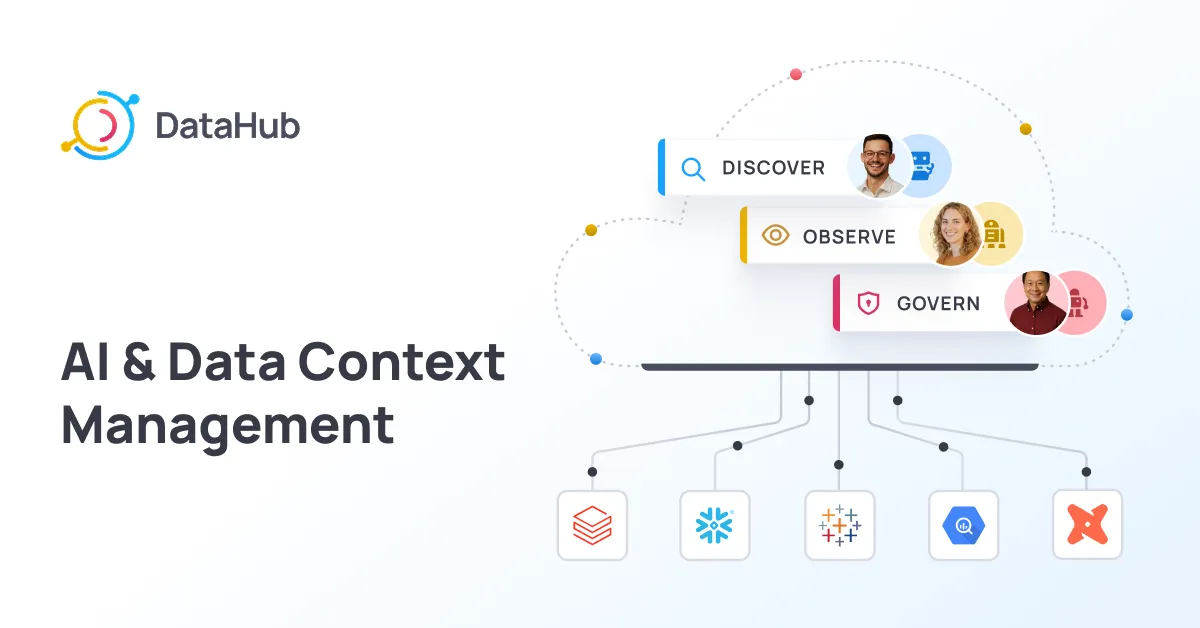
Feature Comparison
| Feature | DataHub | OpenMetadata |
|---|---|---|
| Discovery and context | ||
| Asset discovery | Finds trusted data for team members and AI agents | Searches tables, topics, dashboards, pipelines, and services centrally |
| Context delivery | Transforms enterprise metadata into trusted human and agent context | Creates a single source of truth for data practitioners |
| Metadata querying | Queries metadata through natural-language interactions with AI capabilities | Exposes metadata through standardized APIs and schemas |
| Governance and collaboration | ||
| Governance model | Applies federated governance across distributed enterprise data assets | Uses metadata versioning to support governance and collaboration |
| Policy enforcement | Automates continuous policy enforcement across data assets | Uses standardized schemas and APIs for consistent metadata management |
| Collaboration support | Delivers trusted context for teams working across complex ecosystems | Supports people collaboration around governed metadata and assets |
| Lineage, quality, and observability | ||
| Lineage analysis | Uses lineage and AI chat to debug discrepancies | Tracks column-level lineage and data transformations |
| Data quality workflow | Runs proactive monitoring and quality checks before decisions | Supports data quality, observability, and metadata profiling |
| Impact and issue resolution | Identifies change impact, unused pipelines, and redundant data | Centralizes metadata for tracing assets, pipelines, and services |
| Integration and AI readiness | ||
| AI agent integration | Connects AI agents through Model Context Protocol integration | Builds trusted context and business semantics for AI agents |
| Data-service ingestion | Extensible platform unifies metadata across the data ecosystem | Ingestion framework provides connectors for 100+ data services |
| Interface strategy | Combines metadata discovery with natural-language querying capabilities | Provides API-first access through standardized schemas and APIs |
| Open-source ecosystem | ||
| License | Apache-2.0 licensed platform available for free self-hosting | Apache-2.0 licensed platform available for free self-hosting |
| Primary repository language | GitHub repository lists Python as the primary language | GitHub repository lists TypeScript as the primary language |
| Release activity | Released v1.7.0.1 on September 3, 2026 | Released 2.0.1-release on September 2, 2026 |
Discovery and context
Asset discovery
Context delivery
Metadata querying
Governance and collaboration
Governance model
Policy enforcement
Collaboration support
Lineage, quality, and observability
Lineage analysis
Data quality workflow
Impact and issue resolution
Integration and AI readiness
AI agent integration
Data-service ingestion
Interface strategy
Open-source ecosystem
License
Primary repository language
Release activity
Which to choose
Choose DataHub when AI-agent context, MCP connectivity, federated governance, proactive quality controls, and lineage-assisted incident resolution are central requirements. Choose OpenMetadata when an API-first metadata architecture, standardized schemas, column-level lineage, metadata versioning, and connectors for 100+ services are the stronger priorities. Both provide Apache-2.0 open-source self-hosting.
Best-fit scenarios
Choose DataHub if:
Choose DataHub for organizations building AI-agent workflows around metadata, needing federated policy enforcement, or seeking lineage-based debugging and infrastructure-waste analysis.
Choose OpenMetadata if:
Choose OpenMetadata for teams standardizing metadata through APIs and schemas, integrating many data services, and emphasizing collaboration, versioning, profiling, and column-level lineage.
These scenarios reflect the available product evidence. Your requirements, existing stack, and team expertise should guide the final decision.
Frequently Asked Questions
What is the main difference between DataHub and OpenMetadata?
Both are Apache-2.0 open metadata platforms covering discovery, governance, lineage, quality, and observability. DataHub is positioned around enterprise context management, federated governance, proactive policy enforcement, natural-language metadata queries, and Model Context Protocol connectivity for AI agents. OpenMetadata is positioned around an API-first central metadata store, standardized schemas and APIs, metadata versioning, collaboration, column-level lineage, profiling, and connectors for more than 100 data services.
Which is better for small teams?
For a small team, OpenMetadata can be a strong fit when broad ingestion coverage and a standardized API-first metadata foundation are immediate needs, because its framework supports connectors for 100+ data services. DataHub can be a stronger fit when the team specifically wants AI-agent metadata access, natural-language querying, or lineage-assisted troubleshooting. Both can be self-hosted free under Apache 2.0, so implementation capacity and required integrations should drive the decision.
Can I migrate from DataHub to OpenMetadata?
A migration is possible in principle, but the supplied product information does not describe an official DataHub-to-OpenMetadata migration utility or a guaranteed direct conversion path. Treat it as a metadata re-platforming project: inventory sources, ownership, glossary terms, tags, lineage, quality rules, and governance policies; map them to OpenMetadata schemas; validate connector coverage; then reconcile results before switching users and downstream integrations. API and schema differences require deliberate mapping.
What are the pricing differences?
DataHub offers free Apache-2.0 self-hosting and a free Professional tier limited to up to 20 saved searches and daily email alerts. Its Enterprise tier requires a sales quote; the supplied information does not publish a dollar rate, usage meter, or contract minimum. OpenMetadata is free and open source under Apache 2.0 for self-hosting. The supplied OpenMetadata pricing information lists no paid tiers, metered usage, or public rate card.