Decision comparison
DataHub vs Elementary
DataHub is the stronger choice for enterprise-wide metadata management and data governance, while Elementary excels at dbt-native data observability with faster setup and deeper pipeline monitoring capabilities.
Used together. These are normally used together rather than chosen between. The comparison explains what each one does in the stack.
Applies to: Teams deciding whether they primarily need enterprise metadata governance across the whole estate, or dbt-native observability that catches pipeline failures early.
These are different kinds of product — Data Catalog and Data Observability.
Quick Comparison
| Decision factor | DataHub | Elementary |
|---|---|---|
| Best For | Enterprise metadata management, data discovery, and federated governance across large multi-tool data ecosystems | dbt-native data observability with automated anomaly detection, pipeline monitoring, and code-first configuration |
| Pricing | Free Professional tier (up to 20 saved searches, daily email alerts), Enterprise tier contact sales, Open Source self-hosted free (Apache-2.0) | Elementary publishes no amounts. Its open-source dbt package is free and self-hosted. Elementary Cloud is priced by seats and environments: Scale covers up to 10 editor seats and 1K tables, Enterprise up to 20 editor and 40 viewer seats and 3K tables, and Unlimited removes the seat caps; extra tables are charged per additional 1K. A free trial covers the Essentials feature set. Every paid tier is quote-only. |
| Ease of Setup | Moderate complexity — Java-based platform requires infrastructure planning for self-hosted; cloud version simplifies onboarding | Fast setup — installs as a dbt package, leverages existing dbt project structure, cloud monitors activate automatically |
| Open Source | Apache 2.0 license with 12,000+ GitHub stars, active community of 3,000+ organizations, Java-based extensible architecture | Apache 2.0 license with 2,000+ GitHub stars, trusted by 5,000+ data professionals, dbt-native package integration |
| Integrations | 80+ production-grade connectors covering data warehouses, BI tools, orchestrators, and AI agents via Model Context Protocol | Integrates with Snowflake, BigQuery, Redshift, Databricks, Postgres plus BI tools like Tableau and Looker |
| Core Strength | Unified metadata catalog with AI-powered discovery, cross-platform lineage, and automated governance at enterprise scale | Automated pipeline monitoring with ML-based anomaly detection, column-level lineage, and actionable alerting for data teams |
DataHub
- Best For:
- Enterprise metadata management, data discovery, and federated governance across large multi-tool data ecosystems
- Pricing:
- Free Professional tier (up to 20 saved searches, daily email alerts), Enterprise tier contact sales, Open Source self-hosted free (Apache-2.0)
- Ease of Setup:
- Moderate complexity — Java-based platform requires infrastructure planning for self-hosted; cloud version simplifies onboarding
- Open Source:
- Apache 2.0 license with 12,000+ GitHub stars, active community of 3,000+ organizations, Java-based extensible architecture
- Integrations:
- 80+ production-grade connectors covering data warehouses, BI tools, orchestrators, and AI agents via Model Context Protocol
- Core Strength:
- Unified metadata catalog with AI-powered discovery, cross-platform lineage, and automated governance at enterprise scale
Elementary
- Best For:
- dbt-native data observability with automated anomaly detection, pipeline monitoring, and code-first configuration
- Pricing:
- Elementary publishes no amounts. Its open-source dbt package is free and self-hosted. Elementary Cloud is priced by seats and environments: Scale covers up to 10 editor seats and 1K tables, Enterprise up to 20 editor and 40 viewer seats and 3K tables, and Unlimited removes the seat caps; extra tables are charged per additional 1K. A free trial covers the Essentials feature set. Every paid tier is quote-only.
- Ease of Setup:
- Fast setup — installs as a dbt package, leverages existing dbt project structure, cloud monitors activate automatically
- Open Source:
- Apache 2.0 license with 2,000+ GitHub stars, trusted by 5,000+ data professionals, dbt-native package integration
- Integrations:
- Integrates with Snowflake, BigQuery, Redshift, Databricks, Postgres plus BI tools like Tableau and Looker
- Core Strength:
- Automated pipeline monitoring with ML-based anomaly detection, column-level lineage, and actionable alerting for data teams
Public signals
Verified factual signals only. Bars appear only for like-for-like metrics with five weekly assessments for every tool; missing evidence stays explicit. These signals do not establish enterprise adoption, product quality, or total cost.
| Metric | DataHub | Elementary |
|---|---|---|
| Docker Hub pulls(Product adoption) | 5.4M | Not available |
| GitHub commits, 90d(Product adoption) | 1.1k | 19 |
| GitHub stars(Product adoption) | 12,000+ | 2,000+ |
| Search interest(Market interest) | 0 | Unavailable |
| Hacker News mentions, 90d(Community interest) | 0 | Not available |
| Product Hunt comments(Community interest) | 1 | Not available |
| Product Hunt reviews(Community interest) | 0 | Not available |
| Product Hunt votes(Community interest) | 0 | Not available |
| PyPI weekly downloads(Product adoption) | 1.0M | 215.3k |
As of September 21, 2026 — updated weekly.
Health & risk evidence
Observed public-source checks for mapped package versions and repositories.
DataHub
September 21, 2026Package vulnerabilities
PyPI · acryl-datahub@1.7.0.11
0 vulnerabilities
across 1 package
Repository security score
github.com/datahub-project/datahub
6.2/10
Elementary
September 21, 2026Package vulnerabilities
PyPI · elementary-data@0.26.0
0 vulnerabilities
across 1 package
Repository security score
github.com/elementary-data/elementary
7.4/10
Interface Preview
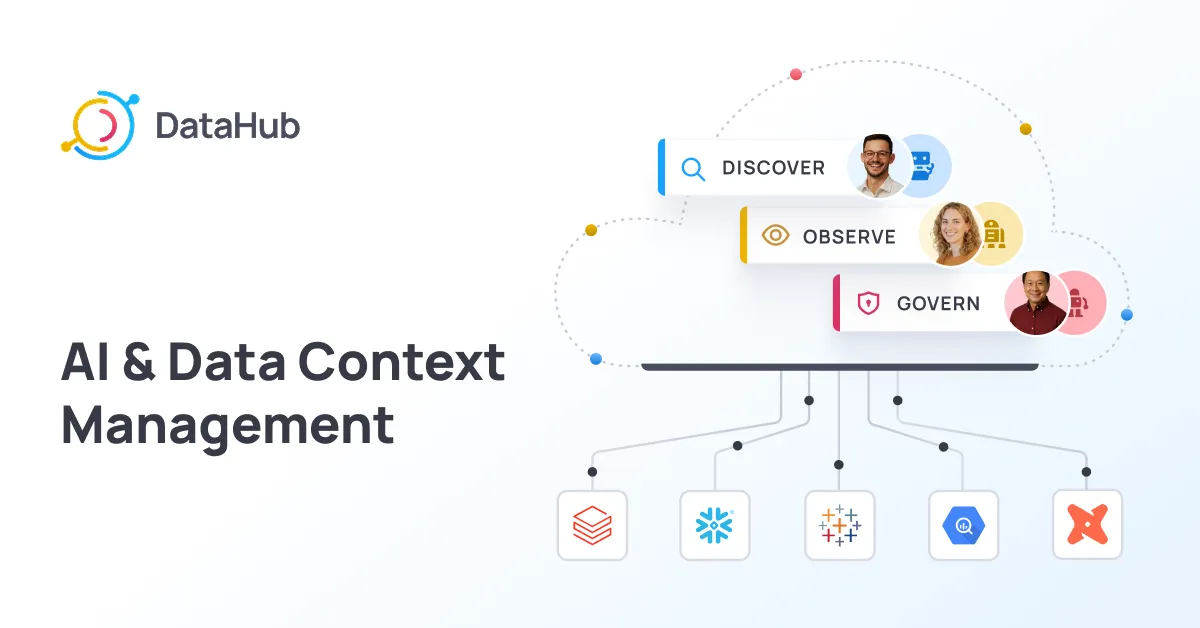
DataHub
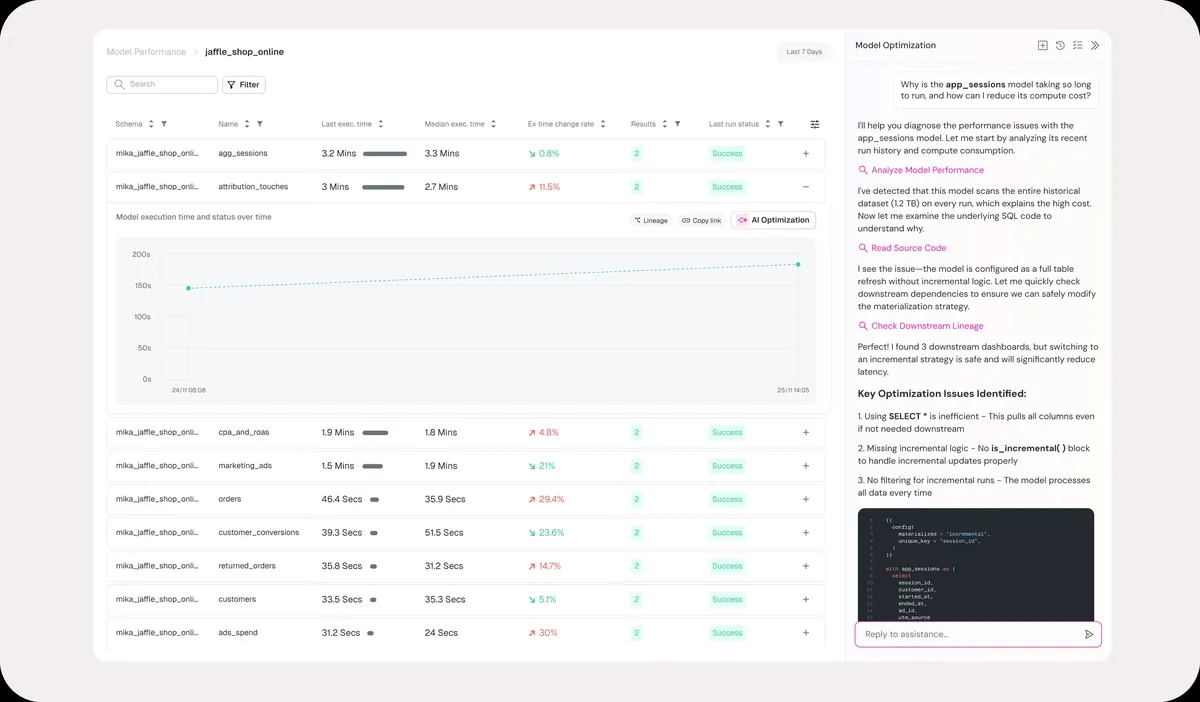
Elementary
Feature Comparison
| Feature | DataHub | Elementary |
|---|---|---|
| Data Discovery & Catalog | ||
| Metadata Catalog | Centralized metadata platform with AI-powered search, natural language querying, and federated governance across 80+ production-grade connectors | Asset catalog maintained in code with descriptions, tags, owners, health status, and conversational AI interface |
| Data Lineage | Cross-platform lineage at both table and column level with impact analysis for debugging quality issues | End-to-end column-level lineage from code to BI tools, enriched with test results to show incidents across the DAG |
| Search & Discovery | AI-powered discovery enabling teams and AI agents to find data through natural-language search with natural language queries | Code-based asset exploration with health scores, dependencies, ownership info, and AI-assisted data understanding |
| Data Quality & Monitoring | ||
| Automated Monitoring | Proactive monitoring and quality checks that catch problems before they affect downstream decisions | ML-based out-of-the-box monitors for freshness, volume, and schema changes activated automatically without configuration |
| Anomaly Detection | AI-driven anomaly detection integrated into the metadata platform to notify teams about potential data issues | Detects anomalies in nullness, distribution, dimensions, and completeness with configurable seasonality and sensitivity |
| Data Testing | Quality assessments integrated into governance workflows with automated policy enforcement across data assets | Unified test framework supporting dbt tests, Elementary tests, dbt-expectations, dbt-utils, and custom tests in one solution |
| Governance & Compliance | ||
| Access Control | Enterprise-grade federated governance with policy enforcement, AI-based classification, and smart propagation methods | SSO and RBAC available on Enterprise tier with role-based permissions for editors and viewers |
| Data Documentation | GenAI-powered documentation generation with automated asset classification to minimize manual governance workload | Code-first documentation maintained in dbt project with version control, code review, and CI/CD integration |
| Policy Management | Continuous automated policy enforcement across all data assets without manual overhead or audit anxiety | Configuration as code approach where all observability rules are versioned, reviewed, and deployed through CI/CD |
| Alerting & Incident Management | ||
| Alert Routing | Notifications integrated into the metadata platform workflow for data quality issues and governance violations | Context-aware alerts routed to Slack, Microsoft Teams, Opsgenie, and PagerDuty based on ownership and severity |
| Incident Management | Lineage-based debugging with AI chat agent to resolve quality problems and metric discrepancies in half the time | Groups related failures into managed incidents with ownership assignment, severity levels, and resolution tracking |
| Performance Monitoring | Identifies unused pipelines and redundant data to reduce infrastructure costs and prevent expensive mistakes | Tracks model run duration, performance trends, and compute costs to identify slow or expensive operations |
| AI & Extensibility | ||
| AI Agent Support | Connects AI agents to metadata via Model Context Protocol (MCP) for context management in agentic AI workflows | MCP Server exposes context layer and agents, making lineage, metadata, and data health available in any AI tool |
| Developer Experience | Java-based extensible architecture with REST and GraphQL APIs, supporting custom metadata models and integrations | dbt-native package installs directly into existing projects with code-first configuration and version-controlled setup |
| Deployment Options | Open-source self-hosted deployment or fully managed DataHub Cloud with enterprise security and support | Open-source self-hosted Elementary or cloud service with Scale, Enterprise, and Unlimited tiers |
Data Discovery & Catalog
Metadata Catalog
Data Lineage
Search & Discovery
Data Quality & Monitoring
Automated Monitoring
Anomaly Detection
Data Testing
Governance & Compliance
Access Control
Data Documentation
Policy Management
Alerting & Incident Management
Alert Routing
Incident Management
Performance Monitoring
AI & Extensibility
AI Agent Support
Developer Experience
Deployment Options
How they fit together
DataHub is the stronger choice for enterprise-wide metadata management and data governance, while Elementary excels at dbt-native data observability with faster setup and deeper pipeline monitoring capabilities.
What each one handles
Use DataHub for:
Choose DataHub when your organization needs a comprehensive metadata catalog that spans the entire data stack. DataHub is ideal for enterprises managing complex data ecosystems with dozens of data sources, where centralized discovery, federated governance, and AI-powered search deliver the most value. Its 80+ production-grade connectors and enterprise-grade governance features make it the right fit for teams that prioritize data cataloging, compliance automation, and cross-platform lineage tracking across large organizations.
Use Elementary for:
Choose Elementary when your team runs dbt as the core transformation layer and needs purpose-built data observability. Elementary is the better fit for data and analytics engineers who want automated pipeline monitoring, ML-based anomaly detection, and actionable alerting without leaving their dbt workflow. Its code-first configuration, fast setup via dbt packages, and deep integration with data warehouses like Snowflake, BigQuery, and Redshift make it ideal for teams that need operational data quality monitoring rather than broad metadata governance.
These roles reflect the available product evidence. Most teams run both; which one owns a given job depends on your stack and team.
Frequently Asked Questions
What is the main difference between DataHub and Elementary?
DataHub is a unified metadata platform focused on data discovery, governance, and cataloging across the entire data stack. It serves as a central hub where teams find, understand, and govern data assets using AI-powered search and 80+ production-grade connectors. Elementary is a dbt-native data observability platform focused on monitoring data pipeline health. It provides automated anomaly detection, data testing, and alerting specifically designed for teams using dbt as their transformation layer. The key distinction is scope: DataHub manages metadata and governance broadly, while Elementary monitors data quality and pipeline reliability deeply within dbt workflows.
Can DataHub and Elementary be used together?
Yes, DataHub and Elementary serve complementary purposes and work well together in a modern data stack. Elementary handles the operational side of data quality — detecting anomalies, running tests, and alerting teams when pipelines break within the dbt workflow. DataHub provides the broader metadata management layer — cataloging all data assets, managing governance policies, and enabling discovery across the organization. Teams often use Elementary for day-to-day pipeline monitoring and DataHub for enterprise-wide data cataloging and governance, creating a comprehensive data management setup that covers both operational reliability and strategic metadata management.
Which tool is easier to set up and maintain?
Elementary is significantly easier to set up if your team already uses dbt. It installs as a dbt package and activates automated monitors without manual configuration, allowing teams to start monitoring data pipelines within minutes. The code-first approach means all configuration lives in your existing dbt project. DataHub requires more infrastructure planning, especially for self-hosted deployments of its Java-based platform. DataHub Cloud simplifies this with a managed service, but the platform's broader scope — covering discovery, governance, and observability — naturally involves a longer setup process. For teams with limited DevOps resources and an existing dbt workflow, Elementary provides the faster path to value.
How do DataHub and Elementary compare on pricing?
Both tools follow a freemium model with open-source cores under the Apache 2.0 license. DataHub offers a free self-hosted deployment of its open-source platform and a DataHub Cloud is a managed enterprise service with pricing and deployment options discussed through a personalized demo. Elementary Cloud offers three tiers — Scale (up to 10 editor seats, 5K tables), Enterprise (up to 20 editors, 40 viewers, 10K tables with SSO and RBAC), and Unlimited (unlimited seats, 15K tables with dedicated CS engineer) — all requiring you to contact their sales team for pricing. Both tools charge based on usage scale, but Elementary's pricing is more transparently structured around seat counts and table limits.