Decision comparison
Atlan vs DataHub
Atlan and DataHub both deliver enterprise-grade metadata management but serve fundamentally different organizational profiles. Atlan excels as a polished commercial platform with a mature AI context layer, strong analyst recognition from Gartner and Forrester, and a UI that drives adoption across technical and business teams. DataHub wins on openness, community momentum with 12,000+ GitHub stars, and flexibility for developer-led organizations that want full control over their metadata infrastructure.
Direct comparison. These are reviewed substitutes bought for the same job, so the differences below are the ones that decide between them.
All 2 are data catalogs.
Quick Comparison
| Decision factor | Atlan | DataHub |
|---|---|---|
| Best For | AI-forward enterprises needing a context layer with 80+ connectors, active metadata, and certified governance workflows | Developer-led teams wanting an open-source metadata platform with 80+ production-grade connectors backed by 12,000+ GitHub stars |
| Architecture | Proprietary SaaS with Enterprise Data Graph, Iceberg-native Metadata Lakehouse, knowledge graph, and vector storage built for AI | Open-source Java-based extensible metadata platform under Apache 2.0, available self-hosted or as fully managed DataHub Cloud |
| Pricing Model | Atlan publishes no pricing. atlan.com/pricing resolves to a talk-to-sales contact form, and no plan or edition names are published, so both the tier structure and the figures come from a quote. | Free Professional tier (up to 20 saved searches, daily email alerts), Enterprise tier contact sales, Open Source self-hosted free (Apache-2.0) |
| Ease of Use | Clean modern UI rated 8.3/10 on PeerSpot with intuitive navigation; advanced workflows like mass-tagging have a learning curve | Developer-oriented platform requiring technical setup for self-hosted; DataHub Cloud adds managed simplicity with AI-powered discovery |
| Scalability | Serves large enterprises with 53% of users from large enterprise segment; cataloged 18 million assets for one customer in a year | Proven at Netflix, Visa, and Airtel scale; Airtel runs 30+ PB and 10K+ jobs with DataHub as its metadata management backbone |
| Community/Support | Leader in 2025 and 2026 Gartner Magic Quadrants, Forrester Wave leader, 95% of G2 users see Atlan as a true partner | 3,000+ organizations use the open-source project; 12,000+ GitHub stars; active Slack community with contributions from Netflix |
Atlan
- Best For:
- AI-forward enterprises needing a context layer with 80+ connectors, active metadata, and certified governance workflows
- Architecture:
- Proprietary SaaS with Enterprise Data Graph, Iceberg-native Metadata Lakehouse, knowledge graph, and vector storage built for AI
- Pricing Model:
- Atlan publishes no pricing. atlan.com/pricing resolves to a talk-to-sales contact form, and no plan or edition names are published, so both the tier structure and the figures come from a quote.
- Ease of Use:
- Clean modern UI rated 8.3/10 on PeerSpot with intuitive navigation; advanced workflows like mass-tagging have a learning curve
- Scalability:
- Serves large enterprises with 53% of users from large enterprise segment; cataloged 18 million assets for one customer in a year
- Community/Support:
- Leader in 2025 and 2026 Gartner Magic Quadrants, Forrester Wave leader, 95% of G2 users see Atlan as a true partner
DataHub
- Best For:
- Developer-led teams wanting an open-source metadata platform with 80+ production-grade connectors backed by 12,000+ GitHub stars
- Architecture:
- Open-source Java-based extensible metadata platform under Apache 2.0, available self-hosted or as fully managed DataHub Cloud
- Pricing Model:
- Free Professional tier (up to 20 saved searches, daily email alerts), Enterprise tier contact sales, Open Source self-hosted free (Apache-2.0)
- Ease of Use:
- Developer-oriented platform requiring technical setup for self-hosted; DataHub Cloud adds managed simplicity with AI-powered discovery
- Scalability:
- Proven at Netflix, Visa, and Airtel scale; Airtel runs 30+ PB and 10K+ jobs with DataHub as its metadata management backbone
- Community/Support:
- 3,000+ organizations use the open-source project; 12,000+ GitHub stars; active Slack community with contributions from Netflix
Public signals
Verified factual signals only. Bars appear only for like-for-like metrics with five weekly assessments for every tool; missing evidence stays explicit. These signals do not establish enterprise adoption, product quality, or total cost.
| Metric | Atlan | DataHub |
|---|---|---|
| GitHub commits, 90d(Developer adoption) | 167 | Not available |
| GitHub stars(Developer adoption) | 22 | Not available |
| Search interest(Market interest) | 3 | 0 |
| Hacker News mentions, 90d(Community interest) | 0 | 0 |
| PyPI weekly downloads(Developer adoption) | 128.0k | Not available |
| Docker Hub pulls(Product adoption) | Not available | 5.4M |
| GitHub commits, 90d(Product adoption) | Not available | 1.1k |
| GitHub stars(Product adoption) | Not available | 12,000+ |
| Product Hunt comments(Community interest) | Not available | 1 |
| Product Hunt reviews(Community interest) | Not available | 0 |
| Product Hunt votes(Community interest) | Not available | 0 |
| PyPI weekly downloads(Product adoption) | Not available | 1.0M |
As of September 21, 2026 — updated weekly.
Health & risk evidence
Observed public-source checks for mapped package versions and repositories.
Atlan
September 21, 2026Package vulnerabilities
PyPI · pyatlan@11.4.0
0 vulnerabilities
across 1 package
Repository security score
Not available
DataHub
September 21, 2026Package vulnerabilities
PyPI · acryl-datahub@1.7.0.11
0 vulnerabilities
across 1 package
Repository security score
github.com/datahub-project/datahub
6.2/10
Interface Preview
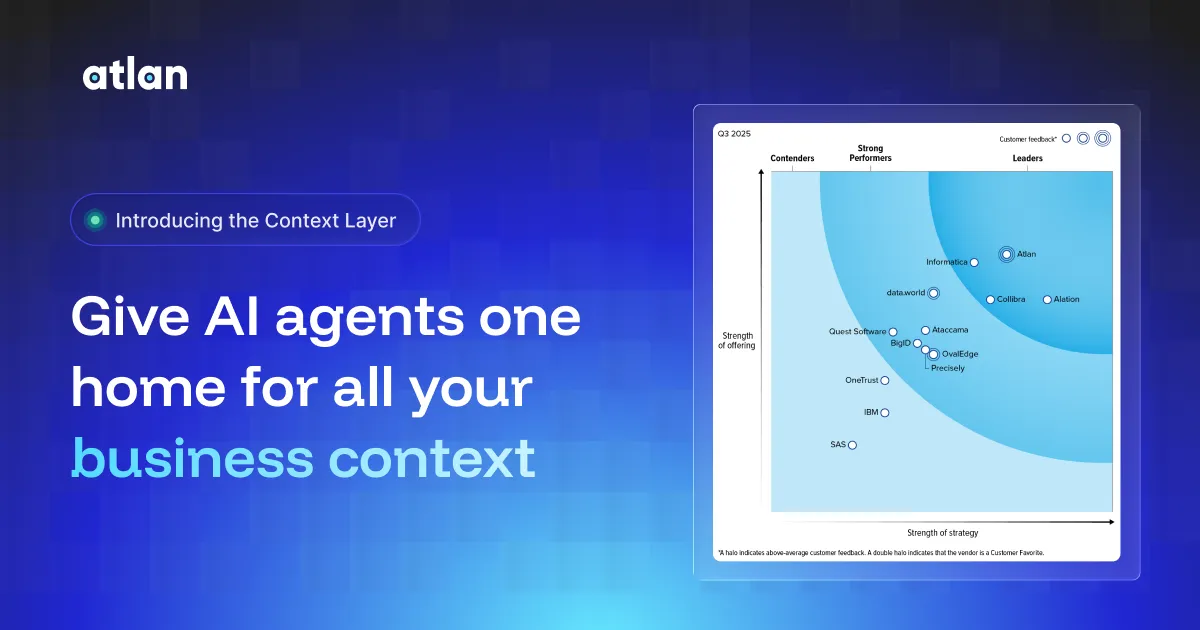
Atlan
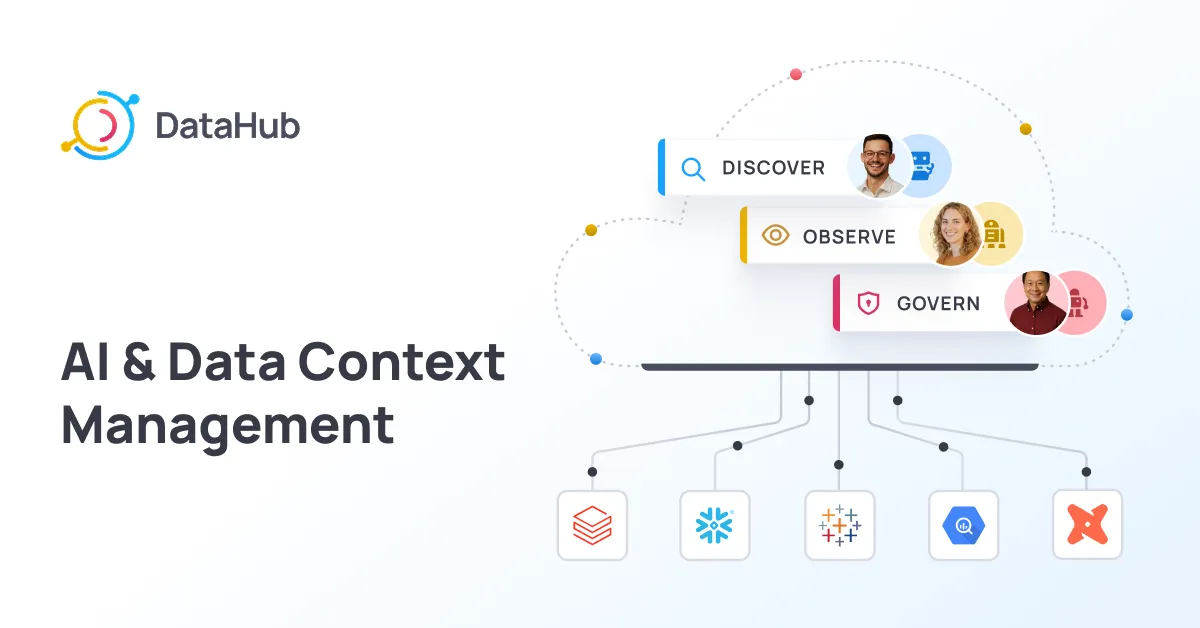
DataHub
Feature Comparison
| Feature | Atlan | DataHub |
|---|---|---|
| Data Discovery | ||
| Search & Discovery | AI-powered personalized homepages with curated asset views tailored to user roles across engineers, analysts, and business stakeholders | AI-powered discovery with natural-language queries and MCP integration |
| Metadata Management | Active Metadata that is dynamic, continuously updated, and actionable through the Enterprise Data Graph with 80+ connectors | Unified metadata platform with 80+ production-grade connectors providing comprehensive business, operational, and technical context |
| Data Lineage | End-to-end visual lineage tracing data flows across Snowflake, dbt, Tableau, Salesforce, and Fivetran ecosystems | Cross-platform and column-level lineage tracking with an AI chat agent to debug quality problems and metric discrepancies |
| Data Governance | ||
| Policy Enforcement | Personas and Purposes model for role-based access control with sensitive data classification and ownership identification | Automated continuous policy enforcement across all data assets with dynamic classification that minimizes manual workload |
| Business Glossary | Centralized linkable business glossary with assigned ownership per definition; one customer defined over 1,300 glossary terms | Federated governance model enabling teams to define and manage metadata through self-serve workflows for flexibility |
| Compliance Workflows | Certified Context Flows where domain experts resolve conflicts, annotate edge cases, and certify production-ready context | Governance processes with GenAI documentation, AI-based classification, and intelligent propagation for compliance automation |
| AI & Automation | ||
| AI Agent Integration | MCP server that serves certified context to every downstream AI agent via SQL, APIs, and SDK with evals, traces, and memory | Model Context Protocol support enabling AI agents to connect directly to DataHub for querying metadata with natural language |
| Automated Documentation | AI agents read the Enterprise Data Graph to auto-generate asset descriptions, link business terms, and surface top business questions | GenAI-powered documentation generation with AI-based anomaly detection that notifies teams about potential data issues |
| Workflow Automation | Playbooks and auto-documentation features that reduce repetitive tasks with automation triggered by metadata events | Self-serve metadata workflows used by Netflix for defining and managing metadata, improving flexibility and governance at scale |
| Data Quality & Observability | ||
| Quality Monitoring | Integrates with Great Expectations and Soda via Marketplace packages for data profiling and quality metric ingestion | Built-in automated data quality assessments with AI-driven anomaly detection and proactive monitoring that catches problems early |
| Incident Management | Platform-based issue discussion with built-in lineage tool, data catalog review, and native JIRA and Slack integrations | Lineage-powered root cause analysis with detailed documentation and ownership information that streamlines incident resolution |
| Observability | Data quality status toggles on assets with pipeline monitoring through connected data profiling metrics from external systems | Unified discovery, governance, and observability platform that identifies unused pipelines and redundant data to reduce costs |
| Integration & Extensibility | ||
| Connector Ecosystem | 80+ connectors spanning warehouse SQL, BI definitions, and business applications unified into the Enterprise Data Graph | 80+ production-grade connectors covering modern data stack tools with an extensible architecture built on Java and open APIs |
| API & Developer Access | Open APIs by default avoiding vendor lock-in with extension capability and highly capable REST APIs for custom integrations | Full open-source codebase under Apache 2.0 with API-powered metadata management used by Visa to scale governance globally |
| Platform Openness | Open and portable philosophy where context moves freely across agents, models, and clouds without single-vendor lock-in | Fully open-source core with Apache 2.0 license; 12,000+ GitHub stars and active community contributions from major tech companies |
Data Discovery
Search & Discovery
Metadata Management
Data Lineage
Data Governance
Policy Enforcement
Business Glossary
Compliance Workflows
AI & Automation
AI Agent Integration
Automated Documentation
Workflow Automation
Data Quality & Observability
Quality Monitoring
Incident Management
Observability
Integration & Extensibility
Connector Ecosystem
API & Developer Access
Platform Openness
Which to choose
Atlan and DataHub both deliver enterprise-grade metadata management but serve fundamentally different organizational profiles. Atlan excels as a polished commercial platform with a mature AI context layer, strong analyst recognition from Gartner and Forrester, and a UI that drives adoption across technical and business teams. DataHub wins on openness, community momentum with 12,000+ GitHub stars, and flexibility for developer-led organizations that want full control over their metadata infrastructure.
Best-fit scenarios
Choose Atlan if:
Choose Atlan if your organization prioritizes a fully managed, enterprise-ready platform with minimal infrastructure overhead. Atlan is the stronger choice for teams that need rapid deployment across business and technical users, proven governance workflows with the Personas and Purposes model, and an AI context pipeline that automatically generates descriptions and links business terms. Its recognition as a Leader in the 2025 and 2026 Gartner Magic Quadrants and the Forrester Wave validates its maturity. The 80+ connectors and certified context flows make it ideal for organizations investing in AI agents that need production-ready business context.
Choose DataHub if:
Choose DataHub if your team values open-source flexibility, community-driven development, and full control over your metadata stack. DataHub is the right fit for engineering-heavy organizations that prefer self-hosting under the Apache 2.0 license or want a managed option with DataHub Cloud. Its 3,000+ organization adoption, production deployments at Netflix, Visa, Slack, and Pinterest, and 80+ production-grade connectors prove enterprise readiness without vendor lock-in. The built-in data observability, AI-driven anomaly detection, and MCP support give developer teams everything they need to build a modern metadata platform on their own terms.
These scenarios reflect the available product evidence. Your requirements, existing stack, and team expertise should guide the final decision.
Frequently Asked Questions
What is the main difference between Atlan and DataHub?
Atlan is a proprietary SaaS platform that positions itself as a context layer for enterprise AI, built around its Enterprise Data Graph with 80+ connectors, active metadata, and certified governance workflows. DataHub is an open-source metadata platform under the Apache 2.0 license with 12,000+ GitHub stars, offering both a free self-hosted option and a managed DataHub Cloud service. The core difference is ownership model: Atlan provides a fully managed experience with analyst-recognized governance maturity, while DataHub gives organizations full control over their metadata infrastructure with community-driven development.
Which platform offers better pricing value for smaller teams?
Atlan publishes no pricing. Its pricing page resolves to a talk-to-sales contact form with no figures and no plan or edition names, so both the tier structure and the rates come from a quote. Ask for a quote scoped to your connector count and user roles, or the number will not be comparable with a competitor's published rate.
How do Atlan and DataHub compare for AI agent integration?
Both platforms support the Model Context Protocol for AI agent integration. Atlan serves certified context to downstream AI agents through its MCP server, SQL, APIs, and SDK, with evals, traces, and memory feeding back into the context pipeline. Its AI agents automatically generate asset descriptions, link business terms, and surface key business questions from the Enterprise Data Graph. DataHub enables AI agents to connect via MCP and query metadata with natural language. It uses GenAI documentation, AI-based classification, and anomaly detection. Atlan emphasizes human-in-the-loop certification before context ships to agents, while DataHub focuses on developer-driven extensibility.
Which platform has better enterprise adoption and industry recognition?
Atlan holds stronger analyst recognition, named a Leader in the 2025 Gartner Magic Quadrant for Metadata Management Solutions, the 2026 Gartner Magic Quadrant for Data and Analytics Governance, and the Forrester Wave for Data and Analytics Governance Solutions and Enterprise Data Catalogs. It has a 4.6 rating on Gartner Peer Insights with 150 ratings and 95% of G2 users consider it a true partner. DataHub claims enterprise credibility through production deployments at Netflix, Visa, Slack, Pinterest, Foursquare, Deutsche Telekom, Chime, Airtel, and Notion. With 3,000+ organizations using the open-source platform and 4.4 on Gartner with 14 ratings, DataHub demonstrates strong adoption among technology-forward companies.