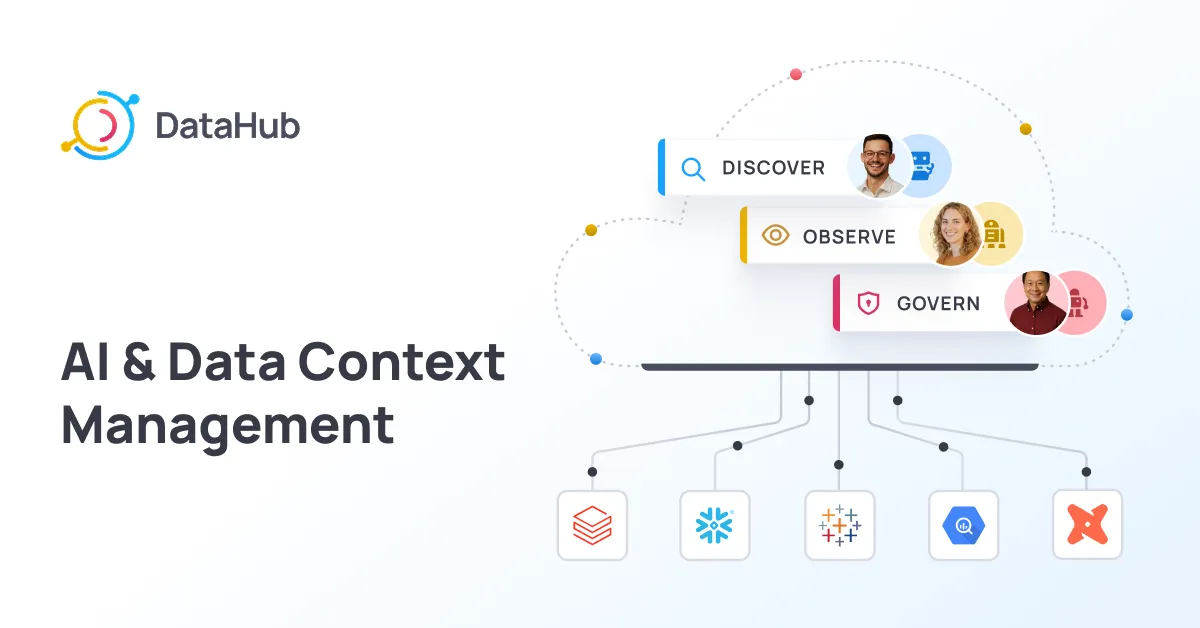
DataHub: product and architecture
This DataHub review covers the leading open-source data catalog that helps teams discover, understand, and govern their data assets across the modern data stack. Built originally at LinkedIn and released under the Apache 2.0 license, DataHub has grown into a platform trusted by over 3,000 organizations including Netflix, Visa, Slack, Pinterest, and Deutsche Telekom. The platform combines data discovery, data observability, and federated governance into a single extensible metadata system. We assess DataHub's architecture, use cases, managed cloud offering, and how it compares to commercial alternatives like Alation, Collibra, and Secoda for teams building their metadata management strategy.
Overview
DataHub is an open-source metadata platform that positions itself as the number one open-source AI data catalog. The project has accumulated 11,815 stars on GitHub, is written primarily in Java, and is licensed under Apache 2.0. The latest release is v1.6.0, released on May 21, 2026, with active development continuing. The GitHub repository tags include data-catalog, data-discovery, data-governance, and metadata.
The platform serves as an enterprise context management layer, transforming enterprise data into trusted context for both humans and AI agents. DataHub supports 80+ production-grade connectors, connecting to data warehouses, lakes, dashboards, pipelines, and ML platforms. Organizations like Netflix use it for self-serve metadata workflows, Visa replaced its custom catalog with DataHub's API-powered metadata to scale governance across global teams, and Slack collapsed 6 years of metadata complexity into 3 days of progress using DataHub.
DataHub is available in two modes: a free open-source self-hosted version and DataHub Cloud, a fully managed SaaS offering with additional enterprise features including AI-powered discovery, observability, and governance capabilities. The platform has a Gartner Peer Insights rating of 4.4 out of 5 based on 14 ratings.
Key Features and Architecture
DataHub's architecture is built on a unified metadata graph that connects datasets, dashboards, pipelines, ML models, and business glossary terms into a single searchable layer.
Data Discovery empowers team members and AI agents to find data 10 times faster. The platform provides full-text search across metadata, dataset previews, schema documentation, ownership information, and usage statistics. DataHub supports querying metadata with natural language and connects AI agents to the platform via the Model Context Protocol (MCP).
Data Observability uses lineage tracking with an AI chat agent to debug quality problems and metric discrepancies. The platform provides proactive monitoring and quality checks that catch problems before they affect downstream decisions. Automated assessments of data quality and AI-driven anomaly detection notify teams about potential issues.
Federated Governance automates policy enforcement across all data assets. DataHub classifies dynamic assets using GenAI documentation, AI-based classification, and intelligent propagation methods, significantly reducing manual governance workload. The system supports column-level lineage tracking for fine-grained impact analysis.
Extensible Integration Framework provides 80+ production-grade connectors for platforms including Snowflake, BigQuery, Redshift, Airflow, Spark, dbt, Tableau, and Looker. The REST API and GraphQL API enable custom integrations, and the platform supports push-based and pull-based metadata ingestion patterns.
Enterprise Context Management presents a comprehensive view of business, operational, and technical contexts. This makes DataHub function as the central nervous system for the data stack, providing lineage details, documentation, and ownership information that facilitate efficient problem resolution across teams.
Ideal Use Cases
DataHub is best suited for data platform teams at mid-to-large organizations managing hundreds or thousands of datasets across multiple data sources. Teams of 10-100 data engineers, analysts, and scientists who need a central place to discover and understand their data will benefit most from DataHub's catalog capabilities.
Organizations with complex data governance requirements that need to track lineage, enforce policies, and maintain compliance across federated data teams represent DataHub's core audience. Airtel, for example, scaled data governance and discovery across 30+ petabytes and 10,000+ jobs using DataHub.
Companies building AI and agentic workflows that need trusted metadata context for their AI agents should consider DataHub Cloud. The platform's MCP server and natural language metadata querying make it a strong foundation for AI-powered data operations.
Teams running on tight budgets that want a production-quality data catalog without enterprise license fees should start with the open-source version. Self-hosting is free under Apache 2.0, though it requires engineering investment for setup and maintenance.
DataHub is not the best fit for small teams with fewer than 50 datasets where the overhead of running a metadata platform exceeds the discovery benefit. It is also not ideal for organizations that need a turnkey solution without engineering resources, as the open-source version requires infrastructure management.
Strengths & Trade-offs
Pros:
- Open-source under Apache 2.0 with a thriving community of 3,000+ organizations, removing vendor lock-in risk
- 11,815 GitHub stars and active development with the latest v1.5.0.2 release in April 2026
- Over 70 native integrations covering the full modern data stack including Snowflake, BigQuery, Airflow, dbt, and Tableau
- Production-proven at scale by Netflix, Visa, Slack, Pinterest, and Deutsche Telekom
- AI-native features including MCP server, natural language queries, and GenAI-powered classification
- Column-level lineage provides fine-grained impact analysis for governance
Cons:
- Self-hosted deployment requires significant engineering investment for setup, tuning, and ongoing maintenance
- The learning curve is steep for non-technical users who need catalog access
- DataHub Cloud pricing is opaque with no published dollar amounts for the Enterprise tier
- The Java-based architecture can be resource-intensive, requiring substantial infrastructure for large deployments