Decision comparison
DataHub vs Monte Carlo
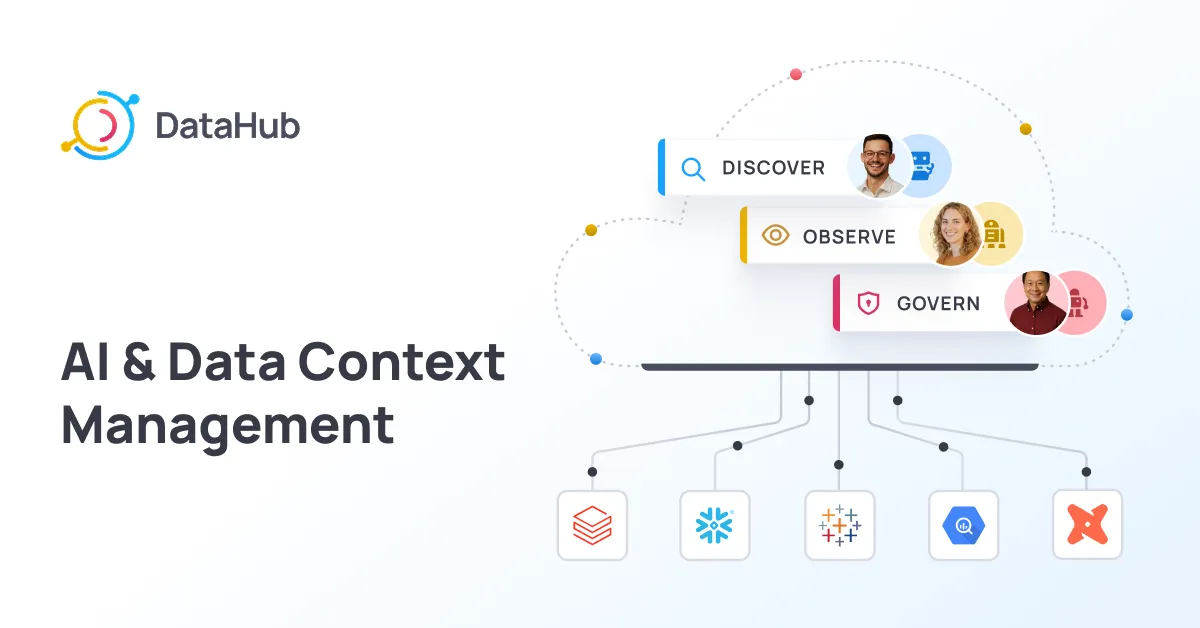
DataHub and Monte Carlo address different layers of the modern data stack. DataHub operates as a unified metadata platform that combines data discovery, governance, and observability under one roof, with the added advantage of an open-source core licensed under Apache 2.0. Monte Carlo focuses exclusively on data and AI observability, delivering ML-driven anomaly detection, automated incident management, and production-grade agent monitoring. The right choice depends on whether your team needs a comprehensive metadata catalog with governance capabilities or a dedicated observability platform purpose-built for monitoring data reliability and AI outputs at enterprise scale.
Architecture choice. These take different approaches to the same problem. Read the table as a fit question rather than a feature race.
These are different kinds of product — Data Catalog and Data Observability.
Quick Comparison
| Decision factor | DataHub | Monte Carlo |
|---|---|---|
| Primary Focus | Metadata platform for data discovery, observability, and governance | Data and AI observability platform for monitoring data pipelines and agent outputs |
| Pricing Model | Free Professional tier (up to 20 saved searches, daily email alerts), Enterprise tier contact sales, Open Source self-hosted free (Apache-2.0) | Monte Carlo publishes no amounts. Its tiers are Start, Scale, Enterprise and Business Critical, purchased as credits, and all are quote-only. Every tier includes agent, ML and data observability. |
| Open Source | Yes — Apache 2.0 license with 12,000+ GitHub stars | No — fully commercial SaaS platform |
| Deployment | Self-hosted open source or fully managed DataHub Cloud | SaaS-only with self-hosted storage option on Scale tier and above |
| Best For | Teams that need a unified metadata catalog combining discovery, governance, and observability in one platform | Enterprise teams focused on data reliability, incident management, and AI agent monitoring in production |
| Data Lineage | Cross-platform and column-level lineage tracking with automated assessments | End-to-end column-level lineage with visual tracking across the full data ecosystem |
| AI/Agent Support | Connects AI agents via Model Context Protocol (MCP); supports natural language metadata queries | Agent Observability monitors AI inputs and outputs from source to agent; ML Observability included in all tiers |
| Integrations | 80+ production-grade connectors across data warehouses, BI tools, and ETL pipelines | Deep integrations across data warehouses, lakes, BI tools, ETL, Salesforce, Databricks, Snowflake, and more |
| User Rating | 10/10 (2 reviews) | 9/10 (4 reviews) |
DataHub
- Primary Focus:
- Metadata platform for data discovery, observability, and governance
- Pricing Model:
- Free Professional tier (up to 20 saved searches, daily email alerts), Enterprise tier contact sales, Open Source self-hosted free (Apache-2.0)
- Open Source:
- Yes — Apache 2.0 license with 12,000+ GitHub stars
- Deployment:
- Self-hosted open source or fully managed DataHub Cloud
- Best For:
- Teams that need a unified metadata catalog combining discovery, governance, and observability in one platform
- Data Lineage:
- Cross-platform and column-level lineage tracking with automated assessments
- AI/Agent Support:
- Connects AI agents via Model Context Protocol (MCP); supports natural language metadata queries
- Integrations:
- 80+ production-grade connectors across data warehouses, BI tools, and ETL pipelines
- User Rating:
- 10/10 (2 reviews)
Monte Carlo
- Primary Focus:
- Data and AI observability platform for monitoring data pipelines and agent outputs
- Pricing Model:
- Monte Carlo publishes no amounts. Its tiers are Start, Scale, Enterprise and Business Critical, purchased as credits, and all are quote-only. Every tier includes agent, ML and data observability.
- Open Source:
- No — fully commercial SaaS platform
- Deployment:
- SaaS-only with self-hosted storage option on Scale tier and above
- Best For:
- Enterprise teams focused on data reliability, incident management, and AI agent monitoring in production
- Data Lineage:
- End-to-end column-level lineage with visual tracking across the full data ecosystem
- AI/Agent Support:
- Agent Observability monitors AI inputs and outputs from source to agent; ML Observability included in all tiers
- Integrations:
- Deep integrations across data warehouses, lakes, BI tools, ETL, Salesforce, Databricks, Snowflake, and more
- User Rating:
- 9/10 (4 reviews)
Public signals
Verified factual signals only. Bars appear only for like-for-like metrics with five weekly assessments for every tool; missing evidence stays explicit. These signals do not establish enterprise adoption, product quality, or total cost.
| Metric | DataHub | Monte Carlo |
|---|---|---|
| Docker Hub pulls(Product adoption) | 5.3M | Not available |
| GitHub commits, 90d(Product adoption) | 1.1k | Not available |
| GitHub stars(Product adoption) | 12,000+ | Not available |
| Search interest(Market interest) | 0 | 0 |
| Hacker News mentions, 90d(Community interest) | 0 | 0 |
| Product Hunt comments(Community interest) | 1 | Not available |
| Product Hunt reviews(Community interest) | 0 | Not available |
| Product Hunt votes(Community interest) | 0 | Not available |
| PyPI weekly downloads(Product adoption) | 1.0M | Not available |
| GitHub commits, 90d(Developer adoption) | Not available | 243 |
| GitHub stars(Developer adoption) | Not available | 2 |
| PyPI weekly downloads(Developer adoption) | Not available | 38.1k |
As of September 14, 2026 — updated weekly.
Health & risk evidence
Observed public-source checks for mapped package versions and repositories.
DataHub
September 19, 2026Package vulnerabilities
PyPI · acryl-datahub@1.7.0.10
0 vulnerabilities
across 1 package
Repository security score
github.com/datahub-project/datahub
6.2/10
Monte Carlo
September 19, 2026Package vulnerabilities
PyPI · montecarlodata@0.175.0
0 vulnerabilities
across 1 package
Repository security score
Not available
Interface Preview
DataHub
Monte Carlo

Feature Comparison
| Feature | DataHub | Monte Carlo |
|---|---|---|
| Data Discovery & Catalog | ||
| Metadata Search and Discovery | Provides a unified metadata search engine across all connected data assets with natural language queries, saved searches, and AI-powered discovery that serves both human users and AI agents | Does not operate as a data catalog; focuses on observability rather than search-based discovery of data assets across the organization |
| Data Asset Documentation | Generates and maintains documentation through GenAI-powered auto-documentation, classification, and intelligent propagation across connected metadata assets | Provides contextual metadata through lineage and monitoring data but does not serve as a primary documentation or cataloging tool for data assets |
| Federated Data Governance | Implements federated governance with dynamic asset classification, policy enforcement, ownership assignment, and continuous compliance automation across all data assets | Supports domain-based data mesh organization on Scale tier and above with data products and domains, but governance is secondary to observability |
| Data Observability & Monitoring | ||
| Automated Anomaly Detection | Runs automated data quality assessments and AI-driven anomaly detection to notify teams about potential issues across connected data assets | Deploys ML-driven anomaly detection with automatic baseline coverage for freshness, volume, and schema; monitors are created and deployed in seconds with AI-powered recommendations |
| Incident Management and Alerting | Delivers proactive monitoring and quality checks that catch problems before they affect decisions, with lineage-based debugging via an AI chat agent | Runs a full incident management workflow with granular alert routing, automated lineage grouping, root-cause insights, and configurable notification channels per team and domain |
| Data Freshness and Volume Monitoring | Monitors data pipeline health and catches quality issues through automated checks, though primary focus remains on metadata management and discovery | Provides out-of-the-box automatic freshness and volume monitoring with AI-powered baselines that scale automatically as the data environment grows |
| Lineage & Impact Analysis | ||
| Cross-Platform Lineage | Maps cross-platform and column-level lineage across data sources, pipelines, and dashboards through 80+ production-grade connectors with the metadata platform | Provides end-to-end column-level lineage with visual tracking from ingestion through transformation to consumption across the full data ecosystem |
| Impact Analysis for Downstream Systems | Uses lineage data combined with ownership information to assess change impact, identify unused pipelines, and eliminate waste across the data infrastructure | Assesses the downstream impact of data issues on dashboards, reports, and business processes with enriched lineage and root-cause data attached to every alert |
| Root Cause Analysis | Provides lineage-based debugging through an AI chat agent that helps teams resolve quality problems and metric discrepancies across connected data assets | Automates root cause analysis with dedicated agents that trace issues through the full lineage graph, identify the source of failures, and surface resolution steps |
| AI & Agent Support | ||
| AI Agent Integration | Connects AI agents to the metadata platform via Model Context Protocol (MCP), enabling agents to discover, query, and act on enterprise metadata programmatically | Includes Agent Observability in all tiers to monitor AI agent inputs, outputs, context, performance, and behavior in production environments |
| AI-Powered Automation | Uses AI for GenAI documentation, automated classification, intelligent metadata propagation, and natural language querying of the metadata catalog | Deploys a fleet of AI agents for automated monitor creation, troubleshooting, root cause analysis, and data quality rule generation across the entire environment |
| Unstructured Data Support | Catalogs and governs metadata across structured and unstructured data sources through its extensible metadata platform and 80+ production-grade connectors | Monitors unstructured data fields with AI-powered checks and supports unstructured file types in Snowflake, Databricks, and BigQuery environments |
| Deployment & Administration | ||
| Deployment Flexibility | Offers both self-hosted open-source deployment (Apache 2.0) and fully managed DataHub Cloud, giving teams full control over infrastructure and customization | Operates as a SaaS-only platform with optional self-hosted storage on Scale tier and above; connects to existing infrastructure without requiring on-premise deployment |
| Enterprise Security and Access Control | Provides enterprise-grade metadata management with role-based access controls, ownership policies, and compliance automation through the managed cloud offering | Includes SSO, SCIM provisioning, PII filtering, audit logging, and self-hosted storage options starting at the Scale tier with enterprise cost attribution on Enterprise tier |
| API Access and Programmatic Control | Exposes a metadata API that allows teams and AI agents to programmatically ingest, query, and manage metadata across the platform with support for custom integrations | Provides tiered API access with 10,000 calls per day on Start, 50,000 on Scale, and 100,000 on Enterprise; supports webhooks and data exports for automation workflows |
Data Discovery & Catalog
Metadata Search and Discovery
Data Asset Documentation
Federated Data Governance
Data Observability & Monitoring
Automated Anomaly Detection
Incident Management and Alerting
Data Freshness and Volume Monitoring
Lineage & Impact Analysis
Cross-Platform Lineage
Impact Analysis for Downstream Systems
Root Cause Analysis
AI & Agent Support
AI Agent Integration
AI-Powered Automation
Unstructured Data Support
Deployment & Administration
Deployment Flexibility
Enterprise Security and Access Control
API Access and Programmatic Control
Which approach fits
DataHub and Monte Carlo address different layers of the modern data stack. DataHub operates as a unified metadata platform that combines data discovery, governance, and observability under one roof, with the added advantage of an open-source core licensed under Apache 2.0. Monte Carlo focuses exclusively on data and AI observability, delivering ML-driven anomaly detection, automated incident management, and production-grade agent monitoring. The right choice depends on whether your team needs a comprehensive metadata catalog with governance capabilities or a dedicated observability platform purpose-built for monitoring data reliability and AI outputs at enterprise scale.
When each approach fits
Choose DataHub if:
We recommend DataHub for organizations that need a unified metadata platform combining data discovery, governance, and observability in a single solution. Its open-source core under Apache 2.0 with 12,000+ GitHub stars means teams can self-host and customize the platform without vendor lock-in, while DataHub Cloud provides a fully managed option for teams that prefer not to maintain infrastructure. DataHub is particularly strong for teams that want to empower every user and AI agent to find and understand data assets through natural language search and Model Context Protocol integration.
Choose Monte Carlo if:
We recommend Monte Carlo for enterprise teams that prioritize data reliability and need a purpose-built observability platform with ML-driven anomaly detection and automated incident management. Its consumption-based pricing model with tiered plans from Start through Business Critical scales from small teams to large enterprises, and its Agent Observability capabilities make it uniquely suited for organizations running AI agents in production. Monte Carlo is the stronger choice when the primary goal is reducing data downtime, automating quality coverage, and monitoring the full lifecycle from data inputs to AI outputs.
These scenarios reflect the available product evidence. Your requirements, existing stack, and team expertise should guide the final decision.
Frequently Asked Questions
Can DataHub replace Monte Carlo for data observability?
DataHub includes data observability features such as automated quality assessments, AI-driven anomaly detection, and proactive monitoring that catch problems before they affect downstream decisions. However, Monte Carlo is a purpose-built observability platform with deeper capabilities in ML-driven anomaly detection, automated incident management with granular alert routing, and dedicated root cause analysis agents. Organizations with straightforward monitoring needs may find DataHub's built-in observability sufficient, but teams managing complex data pipelines at enterprise scale with strict reliability SLAs will benefit from Monte Carlo's specialized focus on data downtime reduction and automated quality coverage.
How do the pricing models compare between DataHub and Monte Carlo?
DataHub Core is available under Apache 2.0, while DataHub Cloud is a separate managed service whose pricing and deployment options are discussed with the vendor. Monte Carlo is a commercial observability service with tiered, usage-oriented procurement. For either option, request a proposal covering the relevant data sources, monitored assets, support, identity requirements, implementation services, and renewal terms. A self-hosted DataHub deployment should also include the engineering and infrastructure effort required to operate it.
Which platform is better for monitoring AI agents in production?
Monte Carlo provides dedicated Agent Observability that monitors AI agent inputs, outputs, context, performance, and behavior in production environments, included in all pricing tiers. Its platform closes the loop between data inputs and agent outputs, enabling teams to trace, troubleshoot, and ensure reliability across the full AI lifecycle. DataHub takes a different approach by connecting AI agents to the metadata platform via Model Context Protocol, allowing agents to discover and query enterprise metadata programmatically. DataHub serves as the context management layer that feeds agents trusted data, while Monte Carlo monitors whether those agents produce reliable outputs once deployed.
Can DataHub and Monte Carlo be used together?
DataHub and Monte Carlo address complementary layers of the data stack and can be deployed together effectively. DataHub serves as the central metadata catalog where teams discover data assets, manage governance policies, and maintain documentation, while Monte Carlo monitors the reliability of data pipelines, detects anomalies, and manages incidents when quality issues arise. Monte Carlo's Enterprise tier integrates with data catalogs as part of its enterprise productivity and governance integrations. This combination gives organizations a unified view of what data exists and how to use it through DataHub, alongside real-time visibility into whether that data is fresh, complete, and accurate through Monte Carlo.