Decision comparison
Bigeye vs Monte Carlo
Both Bigeye and Monte Carlo are enterprise-grade data observability platforms, but they serve different strategic priorities. Bigeye focuses on combining data observability with AI trust and governance, making it the stronger choice for organizations prioritizing sensitive data discovery and regulatory compliance. Monte Carlo offers a broader observability platform with tiered pricing, AI agent tracing, and deeper data mesh support, making it better suited for scaling data teams that need flexible deployment and consumption-based costs.
Direct comparison. These are reviewed substitutes bought for the same job, so the differences below are the ones that decide between them.
All 2 are data observability.
Quick Comparison
| Decision factor | Bigeye | Monte Carlo |
|---|---|---|
| Best For | Large enterprises with complex data estates and AI trust requirements | Scaling data teams needing unified data and AI observability |
| Pricing Model | Contact for pricing | Monte Carlo publishes no amounts. Its tiers are Start, Scale, Enterprise and Business Critical, purchased as credits, and all are quote-only. Every tier includes agent, ML and data observability. |
| Anomaly Detection | ML-powered with reinforcement learning to reduce false positives | ML-driven with agentic monitoring recommendations |
| Data Lineage | End-to-end column-level lineage across modern and legacy stacks | End-to-end column-level lineage with impact analysis for dashboards |
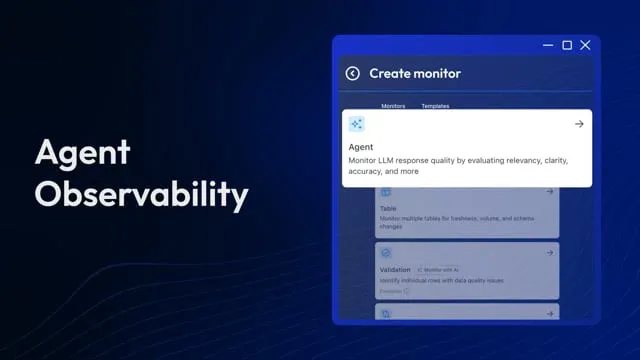
| AI Observability | AI Trust Platform with sensitive data discovery and governance | Agent observability for tracing and troubleshooting AI agents in production |
| Deployment | SaaS with enterprise security controls | SaaS with self-hosted storage option on Scale tier and above |
Bigeye
- Best For:
- Large enterprises with complex data estates and AI trust requirements
- Pricing Model:
- Contact for pricing
- Anomaly Detection:
- ML-powered with reinforcement learning to reduce false positives
- Data Lineage:
- End-to-end column-level lineage across modern and legacy stacks
- AI Observability:
- AI Trust Platform with sensitive data discovery and governance
- Deployment:
- SaaS with enterprise security controls
Monte Carlo
- Best For:
- Scaling data teams needing unified data and AI observability
- Pricing Model:
- Monte Carlo publishes no amounts. Its tiers are Start, Scale, Enterprise and Business Critical, purchased as credits, and all are quote-only. Every tier includes agent, ML and data observability.
- Anomaly Detection:
- ML-driven with agentic monitoring recommendations
- Data Lineage:
- End-to-end column-level lineage with impact analysis for dashboards
- AI Observability:
- Agent observability for tracing and troubleshooting AI agents in production
- Deployment:
- SaaS with self-hosted storage option on Scale tier and above
Public signals
Verified factual signals only. Bars appear only for like-for-like metrics with five weekly assessments for every tool; missing evidence stays explicit. These signals do not establish enterprise adoption, product quality, or total cost.
| Metric | Bigeye | Monte Carlo |
|---|---|---|
| Search interest(Market interest) | Unavailable | 0 |
| Hacker News mentions, 90d(Community interest) | 0 | 0 |
| PyPI weekly downloads(Developer adoption) | 5.3k | 41.2k |
| GitHub commits, 90d(Developer adoption) | Not available | 231 |
| GitHub stars(Developer adoption) | Not available | 2 |
As of September 21, 2026 — updated weekly.
Health & risk evidence
Observed public-source checks for mapped package versions and repositories.
Bigeye
September 21, 2026Package vulnerabilities
PyPI · bigeye-sdk@0.11.12
0 vulnerabilities
across 1 package
Repository security score
Not available
Monte Carlo
September 21, 2026Package vulnerabilities
PyPI · montecarlodata@0.175.0
0 vulnerabilities
across 1 package
Repository security score
Not available
Interface Preview
Monte Carlo
Feature Comparison
| Feature | Bigeye | Monte Carlo |
|---|---|---|
| Data Quality Monitoring | ||
| Automated Freshness & Volume Checks | Yes — ML-based baselines with reinforcement learning | Yes — automatic baseline coverage out of the box |
| Schema Change Detection | Full support | Full support |
| Custom SQL Monitors | Yes — SQL knowledge recommended for advanced use | Yes — SQL, codeless UI, or observability agents |
| Lineage & Root Cause Analysis | ||
| Column-Level Lineage | Yes — across modern and legacy enterprise stacks | Yes — end-to-end with impact analysis |
| Visual Lineage Graphs | Yes — trace errors to root cause visually | Yes — enriched lineage with root-cause insights |
| Downstream Impact Analysis | Yes — lineage-enabled triage | Yes — dashboard and BI layer impact analysis |
| Alerting & Incident Management | ||
| Alert Routing & Noise Reduction | Yes — reinforcement-learning-tuned alerts | Yes — granular routing with automated lineage grouping |
| Slack Integration | Full support | Full support |
| Incident Triaging Workflows | Manual triage with lineage context | Automated triaging with root cause analysis agents |
| AI & Governance | ||
| AI Agent Observability | AI Trust Platform — governance and policy enforcement | Agent Observability — trace and troubleshoot agents in production |
| Sensitive Data Discovery (PII/PHI/PCI) | Yes — automated hidden sensitive data detection | PII Filtering available on Scale tier and above |
| Data Mesh / Domain Support | Not explicitly listed | Yes — unlimited data products and domains on Scale+ |
| Integrations & Scalability | ||
| Warehouse Connectors | Snowflake, Databricks, cloud storage | Snowflake, Databricks, BigQuery, Oracle, SAP Hana, Teradata, Microsoft Fabric |
| CI/CD & API Access | API available | YAML-based CI/CD, API (10K–100K calls/day by tier) |
| Enterprise Productivity Integrations | Slack, enterprise security controls | ServiceNow, data catalogs, Salesforce Data Cloud, webhooks |
Data Quality Monitoring
Automated Freshness & Volume Checks
Schema Change Detection
Custom SQL Monitors
Lineage & Root Cause Analysis
Column-Level Lineage
Visual Lineage Graphs
Downstream Impact Analysis
Alerting & Incident Management
Alert Routing & Noise Reduction
Slack Integration
Incident Triaging Workflows
AI & Governance
AI Agent Observability
Sensitive Data Discovery (PII/PHI/PCI)
Data Mesh / Domain Support
Integrations & Scalability
Warehouse Connectors
CI/CD & API Access
Enterprise Productivity Integrations
Which to choose
Both Bigeye and Monte Carlo are enterprise-grade data observability platforms, but they serve different strategic priorities. Bigeye focuses on combining data observability with AI trust and governance, making it the stronger choice for organizations prioritizing sensitive data discovery and regulatory compliance. Monte Carlo offers a broader observability platform with tiered pricing, AI agent tracing, and deeper data mesh support, making it better suited for scaling data teams that need flexible deployment and consumption-based costs.
Best-fit scenarios
Choose Bigeye if:
Choose Bigeye if your organization runs complex data estates across modern and legacy systems and needs a unified platform for data observability, sensitive data discovery, and AI governance. Bigeye's reinforcement-learning-tuned alerting and automated PII/PHI/PCI detection make it particularly valuable for enterprises in regulated industries where data trust and compliance are non-negotiable.
Choose Monte Carlo if:
Choose Monte Carlo if your team needs usage-based pricing flexibility, AI agent observability for production LLM workflows, and deep integrations spanning warehouses, BI tools, and enterprise systems like ServiceNow and Salesforce. Monte Carlo's tiered consumption model and agentic monitoring recommendations help scaling organizations expand coverage without proportional cost increases.
These scenarios reflect the available product evidence. Your requirements, existing stack, and team expertise should guide the final decision.
Frequently Asked Questions
What are the main differences between Bigeye and Monte Carlo?
Bigeye positions itself as an AI Trust Platform that combines data observability with sensitive data discovery and AI governance. Monte Carlo focuses on end-to-end data and AI observability with agent tracing, tiered pricing, and broader integration coverage including ServiceNow, Salesforce, and legacy enterprise data warehouses.
How does pricing compare between Bigeye and Monte Carlo?
Bigeye uses enterprise pricing with no publicly listed tiers — organizations must contact sales for a quote. Monte Carlo offers a consumption-based credit model across four tiers: Start (up to 10 users, 1,000 monitors), Scale (unlimited users, SSO, data mesh), Enterprise (multi-workspace, chargebacks), and Business Critical (maximum availability). Cost per credit varies by tier.
Which platform has better AI observability capabilities?
Monte Carlo provides dedicated Agent Observability that lets teams monitor, trace, and troubleshoot AI agents in production, supporting frameworks like LangChain, Snowflake Intelligence, and Databricks Genie. Bigeye takes a governance-first approach through its AI Trust Platform, focusing on ensuring data quality for AI systems and discovering hidden sensitive data before it reaches AI models.
Can Bigeye or Monte Carlo integrate with legacy enterprise data systems?
Both platforms support modern cloud warehouses like Snowflake and Databricks. Monte Carlo has a wider set of legacy connectors available at the Enterprise tier, including Oracle, SAP Hana, Teradata, and Microsoft Fabric, along with a fully customizable bring-your-own-integration option. Bigeye supports both modern and legacy enterprise data stacks through its lineage technology.