Decision comparison
Bigeye vs Great Expectations
Bigeye and Great Expectations serve fundamentally different needs in the data quality space. Bigeye is a comprehensive enterprise observability platform that automates monitoring, lineage, and governance for large organizations with complex data environments. Great Expectations is an open-source validation framework that gives data teams full control over defining and enforcing data quality rules in code. Your choice depends on whether you need automated, end-to-end observability with minimal manual effort, or a flexible, code-first validation framework that integrates deeply into your existing workflows.
Architecture choice. These take different approaches to the same problem. Read the table as a fit question rather than a feature race.
These are different kinds of product — Data Observability and Data Validation Framework.
Quick Comparison
| Decision factor | Bigeye | Great Expectations |
|---|---|---|
| Best For | Large enterprises needing automated data observability across modern and legacy stacks | Data teams wanting fine-grained, code-defined data validation with no vendor lock-in |
| Pricing Model | AWS Marketplace lists scoped 12-month contracts: Starter $45,000 for 100 active monitored tables; Enterprise Starter $75,000 for 300. Both include two Core Lineage Plus connectors and the browser extension. Additional AWS infrastructure costs may apply. These are specific packages, not a universal minimum or an all-module subscription; request a quote for other scope. Checked October 24, 2026: https://aws.amazon.com/marketplace/pp/prodview-w4yis4dzpm4u2. | Free and Open-Source, Paid upgrades available |
| Deployment | Fully managed SaaS platform with enterprise-grade security and role-based access controls | Self-hosted Python framework (GX Core) or managed GX Cloud; works with SQL, Pandas, and Spark backends |
| Core Approach | Automated ML-driven anomaly detection, data lineage mapping, and dependency-driven monitoring | Codified expectation suites that define explicit data quality rules validated at pipeline runtime |
| Learning Curve | Moderate; intuitive UI for basic checks but SQL knowledge needed for advanced configurations | Steeper initial setup; requires Python proficiency and manual definition of expectation suites |
| Community & Ecosystem | Proprietary platform with integrations for Snowflake, BigQuery, Redshift, Databricks, Slack, and PagerDuty | 11,000+ GitHub stars, Apache-2.0 license, active open-source community, integrations with Airflow, Dagster, and Prefect |
Bigeye
- Best For:
- Large enterprises needing automated data observability across modern and legacy stacks
- Pricing Model:
- AWS Marketplace lists scoped 12-month contracts: Starter $45,000 for 100 active monitored tables; Enterprise Starter $75,000 for 300. Both include two Core Lineage Plus connectors and the browser extension. Additional AWS infrastructure costs may apply. These are specific packages, not a universal minimum or an all-module subscription; request a quote for other scope. Checked October 24, 2026: https://aws.amazon.com/marketplace/pp/prodview-w4yis4dzpm4u2.
- Deployment:
- Fully managed SaaS platform with enterprise-grade security and role-based access controls
- Core Approach:
- Automated ML-driven anomaly detection, data lineage mapping, and dependency-driven monitoring
- Learning Curve:
- Moderate; intuitive UI for basic checks but SQL knowledge needed for advanced configurations
- Community & Ecosystem:
- Proprietary platform with integrations for Snowflake, BigQuery, Redshift, Databricks, Slack, and PagerDuty
Great Expectations
- Best For:
- Data teams wanting fine-grained, code-defined data validation with no vendor lock-in
- Pricing Model:
- Free and Open-Source, Paid upgrades available
- Deployment:
- Self-hosted Python framework (GX Core) or managed GX Cloud; works with SQL, Pandas, and Spark backends
- Core Approach:
- Codified expectation suites that define explicit data quality rules validated at pipeline runtime
- Learning Curve:
- Steeper initial setup; requires Python proficiency and manual definition of expectation suites
- Community & Ecosystem:
- 11,000+ GitHub stars, Apache-2.0 license, active open-source community, integrations with Airflow, Dagster, and Prefect
Public signals
Verified factual signals only. Bars appear only for like-for-like metrics with five weekly assessments for every tool; missing evidence stays explicit. These signals do not establish enterprise adoption, product quality, or total cost.
| Metric | Bigeye | Great Expectations |
|---|---|---|
| Search interest(Market interest) | Unavailable | 0 |
| Hacker News mentions, 90d(Community interest) | 0 | 0 |
| PyPI weekly downloads(Developer adoption) | 5.5k | Not available |
| GitHub commits, 90d(Product adoption) | Not available | 175 |
| GitHub stars(Product adoption) | Not available | 11,000+ |
| PyPI weekly downloads(Product adoption) | Not available | 4.5M |
| Stack Overflow questions(Community interest) | Not available | 148 |
As of October 19, 2026 — updated weekly.
Health & risk evidence
Observed public-source checks for mapped package versions and repositories.
Bigeye
October 19, 2026Package vulnerabilities
PyPI · bigeye-sdk@0.11.15
0 vulnerabilities
across 1 package
Repository security score
Not available
Great Expectations
October 19, 2026Package vulnerabilities
PyPI · great-expectations@1.24.0
0 vulnerabilities
across 1 package
Repository security score
Not available
Interface Preview
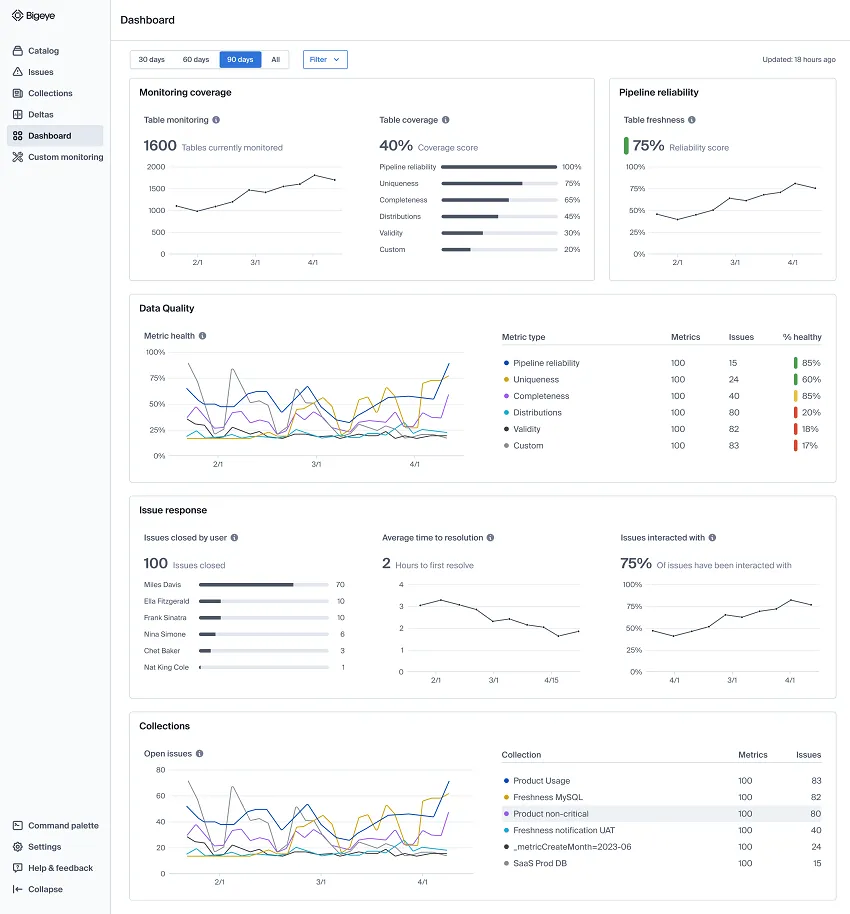
Bigeye
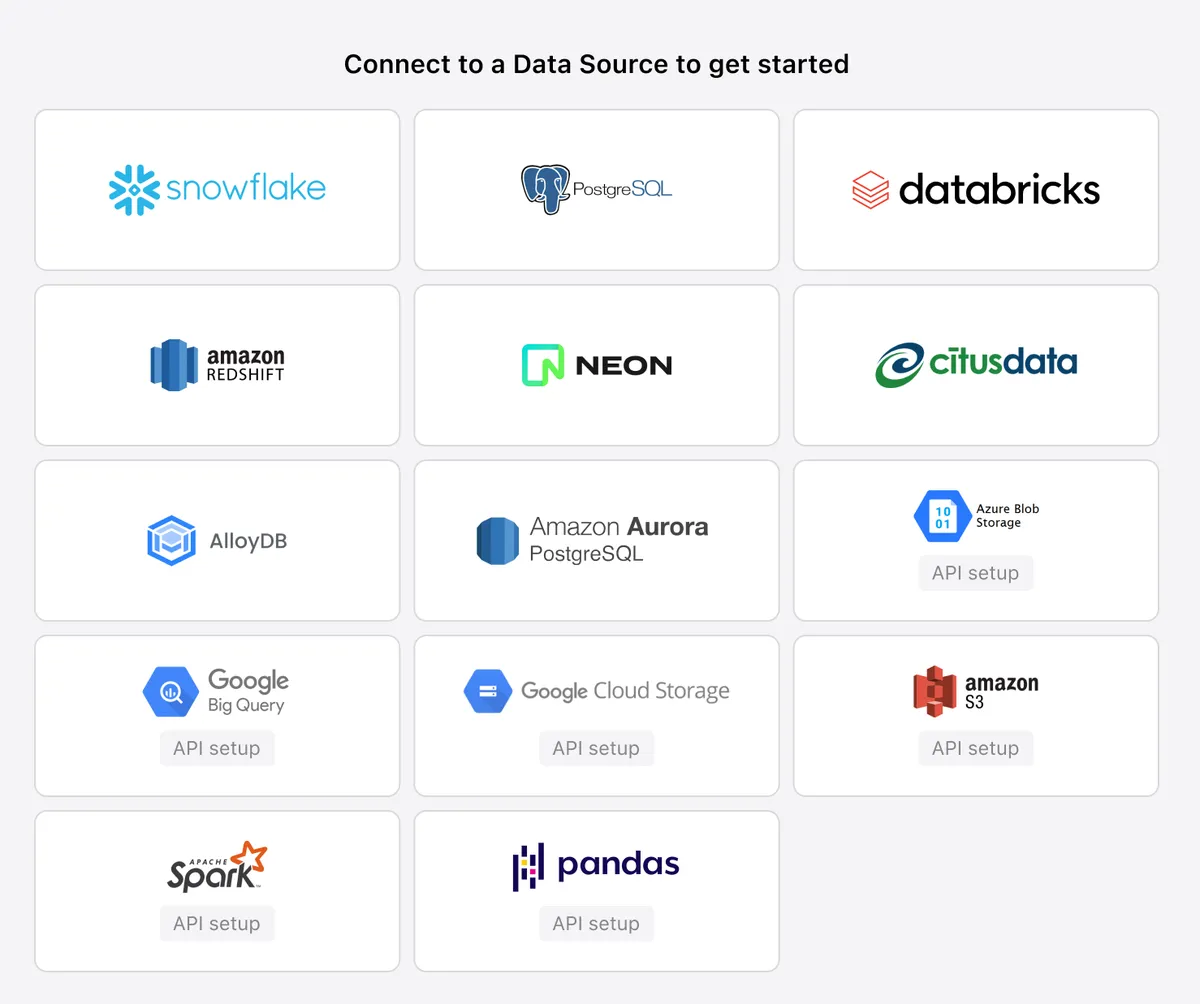
Great Expectations
Feature Comparison
| Feature | Bigeye | Great Expectations |
|---|---|---|
| Data Quality & Monitoring | ||
| Automated Anomaly Detection | ML-driven anomaly detection with reinforcement learning that adapts alerts based on user feedback | Not built-in; users define explicit threshold-based expectations manually or use ExpectAI for auto-generation |
| Schema & Volume Monitoring | Automatic schema change detection, row count monitoring, null rate tracking, and freshness checks | Supported through expectation suites; users define schema, volume, and freshness rules in code |
| Data Quality SLAs | Built-in health scores for tables and dashboards with business-centric SLA tracking over time | No native SLA tracking; teams build custom reporting around validation results |
| Data Lineage & Observability | ||
| End-to-End Data Lineage | Cross-source column-level lineage for modern and legacy stacks, acquired through Data Advantage Group in 2023 | No built-in lineage; relies on external tools like dbt or orchestrators for lineage tracking |
| Root Cause Analysis | Visual lineage graphs trace errors upstream; dependency-driven monitoring identifies impact across pipelines | Validation results pinpoint which expectations failed, but root cause tracing requires external tooling |
| Real-Time Alerting | Slack, email, and PagerDuty integrations with incident timelines and ownership assignment | No native alerting; teams integrate validation results with external notification systems |
| Governance & Compliance | ||
| Sensitive Data Discovery | Automated scanning and classification of PII, PHI, PCI across structured and unstructured data | Not available; focused on data validation rather than data classification |
| Data Governance Tools | Built-in certification, stewardship, business glossary, semantic layer, and AI Guardian for policy enforcement | Data Docs auto-generates documentation from validation results; no governance workflow tools |
| Audit Trail & RBAC | Role-based access controls, auditable logging, compliance support for EU AI Act and ISO 42001 | Basic access controls in GX Cloud; open-source version relies on infrastructure-level security |
| Integration & Extensibility | ||
| Warehouse Connectivity | Snowflake, BigQuery, Redshift, Databricks, and cloud storage with broad enterprise connector support | SQL, Pandas, and Spark backends; connects to any data source accessible through Python |
| Pipeline Orchestration | API-based integration with Airflow, dbt, and other pipeline tools | Native integrations with Airflow, Dagster, and Prefect for embedding validation into pipeline steps |
| Open Source & Extensibility | Proprietary platform; not open-source; extensible through APIs | Fully open-source core under Apache-2.0; extensible with custom expectations and plugins |
| Usability & Documentation | ||
| Setup & Onboarding | Managed SaaS with guided setup; reviewers praise smooth install/configure process with vendor assistance | Set up in minutes with pip install; GX Cloud requires sign-up but offers quick start guides |
| Auto-Generated Documentation | Dashboard-based reporting with health scores and incident timelines; no standalone docs generation | Data Docs feature auto-generates HTML documentation from expectation suites and validation results |
| AI-Assisted Features | ML-based monitoring learns data patterns over time; reinforcement learning reduces false positives | ExpectAI auto-generates test expectations; GX Cloud provides real-time monitoring capabilities |
Data Quality & Monitoring
Automated Anomaly Detection
Schema & Volume Monitoring
Data Quality SLAs
Data Lineage & Observability
End-to-End Data Lineage
Root Cause Analysis
Real-Time Alerting
Governance & Compliance
Sensitive Data Discovery
Data Governance Tools
Audit Trail & RBAC
Integration & Extensibility
Warehouse Connectivity
Pipeline Orchestration
Open Source & Extensibility
Usability & Documentation
Setup & Onboarding
Auto-Generated Documentation
AI-Assisted Features
Which approach fits
Bigeye and Great Expectations serve fundamentally different needs in the data quality space. Bigeye is a comprehensive enterprise observability platform that automates monitoring, lineage, and governance for large organizations with complex data environments. Great Expectations is an open-source validation framework that gives data teams full control over defining and enforcing data quality rules in code. Your choice depends on whether you need automated, end-to-end observability with minimal manual effort, or a flexible, code-first validation framework that integrates deeply into your existing workflows.
When each approach fits
Choose Bigeye if:
We recommend Bigeye for large enterprises that need automated data observability across complex, hybrid data environments. If your organization manages hundreds of data pipelines, requires sensitive data discovery and compliance with regulations like the EU AI Act, and wants ML-driven anomaly detection that reduces manual monitoring effort, Bigeye delivers the most value. Customers report reducing detection times from 3+ days to under 24 hours and catching 1-2 major customer-impacting issues per month that get resolved in hours instead of days. The enterprise pricing model means Bigeye works best for organizations where the cost of data failures justifies the investment in a comprehensive observability platform.
Choose Great Expectations if:
We recommend Great Expectations for data teams that want fine-grained control over data quality validation without vendor lock-in. If your team is comfortable writing Python, values open-source flexibility, and needs to embed validation checks directly into orchestrated pipelines with tools like Airflow, Dagster, or Prefect, Great Expectations is the stronger choice. The open-source core with 11,400+ GitHub stars means you get a battle-tested framework at no cost, with the option to upgrade to GX Cloud for managed monitoring. Great Expectations is particularly strong for teams that treat data quality as code, want auto-generated documentation through Data Docs, and prefer explicit, version-controlled expectations over automated anomaly detection.
These scenarios reflect the available product evidence. Your requirements, existing stack, and team expertise should guide the final decision.
Frequently Asked Questions
Is Great Expectations free to use?
Yes, Great Expectations Core (GX Core) is completely free and open-source under the Apache-2.0 license. You can install it via pip and use the full Python-based validation framework at no cost. GX Cloud offers a free Developer tier for managed monitoring, with paid Team and Enterprise plans available for teams that need additional collaboration features and scalability.
How much does Bigeye cost?
Bigeye's AWS Marketplace listing offers a Starter package at $45,000 / 12 months for 100 active monitored tables and an Enterprise Starter package at $75,000 / 12 months for 300. Both include two Core Lineage Plus connectors and the browser extension. Additional AWS infrastructure costs may apply. These are scoped packages, not a universal minimum or an all-module subscription. Request a quote for other scope and compare it with your monitoring requirements and operating costs. See [Bigeye pricing](/tools/bigeye/pricing) for the source and package details.
Can Bigeye and Great Expectations be used together?
Yes, the two tools are complementary rather than directly competing. Great Expectations handles explicit, code-defined validation checks at the pipeline level, while Bigeye provides automated observability, anomaly detection, and lineage across the broader data environment. Teams sometimes use Great Expectations for granular data contract enforcement within pipelines and Bigeye for enterprise-wide monitoring and incident management.
Which tool is better for small data teams?
Team size alone does not settle the choice. Compare GX Core's license-free, self-managed approach with Bigeye's scoped monitoring package and any required additions. Include the work to define checks, run validation and maintain integrations. A free software license does not establish a lower total cost, and Bigeye's published package is not a quote for every deployment.
What data sources do Bigeye and Great Expectations support?
Bigeye connects to major cloud warehouses including Snowflake, BigQuery, Redshift, and Databricks, with broad connector support for both modern and legacy enterprise data stacks. Great Expectations supports SQL, Pandas, and Spark backends, meaning it can connect to virtually any data source accessible through Python. Both tools integrate with pipeline orchestration platforms like Airflow, though Great Expectations also has native support for Dagster and Prefect.