Decision comparison
Castor vs Monte Carlo
Castor and Monte Carlo solve fundamentally different problems in the data quality ecosystem. Castor (now Coalesce Catalog) is an AI-powered data catalog and governance platform that helps organizations discover, document, and understand their data assets. Monte Carlo is an end-to-end data and AI observability platform that monitors pipelines, detects anomalies, and manages incidents across the entire data stack. These tools are complementary rather than directly competitive, and many enterprise data teams use a data catalog alongside a data observability solution. The right choice depends on whether your primary challenge is data discovery and governance or data reliability and incident management.
Architecture choice. These take different approaches to the same problem. Read the table as a fit question rather than a feature race.
These are different kinds of product — Data Catalog and Data Observability.
Quick Comparison
| Decision factor | Castor | Monte Carlo |
|---|---|---|
| Best For | Organizations needing AI-powered data cataloging, governance, and self-service analytics | Enterprise data teams needing end-to-end data and AI observability across their stack |
| Core Focus | Data discovery, documentation, governance, and natural language data access | Data observability, anomaly detection, incident management, and pipeline monitoring |
| Pricing Model | Contact for pricing | Monte Carlo publishes no amounts. Its tiers are Start, Scale, Enterprise and Business Critical, purchased as credits, and all are quote-only. Every tier includes agent, ML and data observability. |
| AI Capabilities | Natural language search, AI-driven data trust assessments, natural language to SQL conversion | ML-driven anomaly detection, AI-powered monitoring agents, automated root cause analysis |
| Deployment | Cloud-based SaaS platform | Cloud-based SaaS with self-hosted storage option on Scale tier and above |
| Learning Curve | Low; conversational AI interface designed for business users and data teams alike | Moderate; fast setup with out-of-the-box monitoring, enterprise features require deeper configuration |
Castor
- Best For:
- Organizations needing AI-powered data cataloging, governance, and self-service analytics
- Core Focus:
- Data discovery, documentation, governance, and natural language data access
- Pricing Model:
- Contact for pricing
- AI Capabilities:
- Natural language search, AI-driven data trust assessments, natural language to SQL conversion
- Deployment:
- Cloud-based SaaS platform
- Learning Curve:
- Low; conversational AI interface designed for business users and data teams alike
Monte Carlo
- Best For:
- Enterprise data teams needing end-to-end data and AI observability across their stack
- Core Focus:
- Data observability, anomaly detection, incident management, and pipeline monitoring
- Pricing Model:
- Monte Carlo publishes no amounts. Its tiers are Start, Scale, Enterprise and Business Critical, purchased as credits, and all are quote-only. Every tier includes agent, ML and data observability.
- AI Capabilities:
- ML-driven anomaly detection, AI-powered monitoring agents, automated root cause analysis
- Deployment:
- Cloud-based SaaS with self-hosted storage option on Scale tier and above
- Learning Curve:
- Moderate; fast setup with out-of-the-box monitoring, enterprise features require deeper configuration
Public signals
Verified factual signals only. Bars appear only for like-for-like metrics with five weekly assessments for every tool; missing evidence stays explicit. These signals do not establish enterprise adoption, product quality, or total cost.
| Metric | Castor | Monte Carlo |
|---|---|---|
| Search interest(Market interest) | Unavailable | 0 |
| Product Hunt comments(Community interest) | 11 | Not available |
| Product Hunt reviews(Community interest) | 0 | Not available |
| Product Hunt votes(Community interest) | 144 | Not available |
| PyPI weekly downloads(Developer adoption) | 1.7k | 41.2k |
| GitHub commits, 90d(Developer adoption) | Not available | 231 |
| GitHub stars(Developer adoption) | Not available | 2 |
| Hacker News mentions, 90d(Community interest) | Not available | 0 |
As of September 21, 2026 — updated weekly.
Health & risk evidence
Observed public-source checks for mapped package versions and repositories.
Castor
September 21, 2026Package vulnerabilities
PyPI · castor-extractor@0.26.101
0 vulnerabilities
across 1 package
Repository security score
Not available
Monte Carlo
September 21, 2026Package vulnerabilities
PyPI · montecarlodata@0.175.0
0 vulnerabilities
across 1 package
Repository security score
Not available
Interface Preview
Monte Carlo
Feature Comparison
| Feature | Castor | Monte Carlo |
|---|---|---|
| Data Discovery & Cataloging | ||
| Data Catalog | Full AI-powered data catalog with automated metadata ingestion, business glossary, and collaborative cataloging | Not a data catalog; focuses on observability and monitoring rather than data discovery |
| Natural Language Search | AI-powered natural language search for finding datasets, metrics, and documentation across the data stack | Not available; users interact through monitoring dashboards and incident management interfaces |
| Data Documentation | Automated documentation with crowdsourced enrichment; reduces data discovery time from 45 minutes to seconds | Not a documentation tool; provides metadata context within observability alerts and lineage views |
| Data Quality & Monitoring | ||
| Anomaly Detection | AI-driven data trust assessments that evaluate data reliability and quality scores | ML-driven anomaly detection across freshness, volume, schema, and distribution with automated baselining |
| Pipeline Monitoring | Not a pipeline monitoring tool; focuses on data understanding and governance | End-to-end monitoring from ingestion to consumption with automated scaling across the entire data environment |
| Incident Management | Not available; governance and compliance workflows rather than incident response | Full incident management with intelligent alerting, granular routing, automated lineage grouping, and root cause insights |
| Data Governance & Compliance | ||
| Access Control & Security | Sensitive data classification, modular role-based permissions, and detailed audit trails for compliance at scale | SSO, SCIM, self-hosted storage, PII filtering, and audit logging available on Scale tier and above |
| Data Governance | Core capability; includes data catalog, business glossary, lineage, security, and compliance management | Supports governance through observability data; integrates with ServiceNow and data catalogs on Enterprise tier |
| Regulatory Compliance | Enhances compliance with legal and regulatory standards through governance controls and sensitive data management | SOC 2 compliance; enterprise-grade security features; PII filtering to protect sensitive data in monitoring |
| Lineage & Impact Analysis | ||
| Data Lineage | Automated column-level data lineage mapping across the data stack | End-to-end column-level lineage tracking data flow and dependencies across the entire data ecosystem |
| Impact Analysis | Lineage-based understanding of data dependencies for governance and documentation purposes | Dedicated impact analysis for assessing how data issues affect downstream dashboards, reports, and business processes |
| Root Cause Analysis | Not a primary capability; focuses on data understanding rather than incident investigation | Automated root cause analysis with lineage-enriched context to identify why data and AI issues occur and who to notify |
| Integration & Ecosystem | ||
| Data Warehouse Integration | Integrates across the data stack for automated metadata ingestion and cataloging | Deep integrations with Snowflake, Databricks, BigQuery, Redshift, plus lakes, databases, and enterprise data warehouses |
| BI Tool Integration | Connects with BI and analytics tools to provide context and governance across the visualization layer | Monitors BI layer health; lineage extends to dashboards for impact analysis when upstream data breaks |
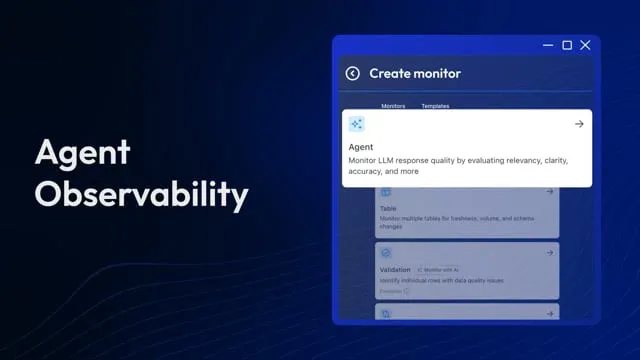
| AI & Agent Support | AI assistant powered by data governance for conversational data access and natural language to SQL conversion | Agent observability for monitoring AI inputs and outputs; fleet of agents for monitor creation, troubleshooting, and root cause analysis |
Data Discovery & Cataloging
Data Catalog
Natural Language Search
Data Documentation
Data Quality & Monitoring
Anomaly Detection
Pipeline Monitoring
Incident Management
Data Governance & Compliance
Access Control & Security
Data Governance
Regulatory Compliance
Lineage & Impact Analysis
Data Lineage
Impact Analysis
Root Cause Analysis
Integration & Ecosystem
Data Warehouse Integration
BI Tool Integration
AI & Agent Support
Which approach fits
Castor and Monte Carlo solve fundamentally different problems in the data quality ecosystem. Castor (now Coalesce Catalog) is an AI-powered data catalog and governance platform that helps organizations discover, document, and understand their data assets. Monte Carlo is an end-to-end data and AI observability platform that monitors pipelines, detects anomalies, and manages incidents across the entire data stack. These tools are complementary rather than directly competitive, and many enterprise data teams use a data catalog alongside a data observability solution. The right choice depends on whether your primary challenge is data discovery and governance or data reliability and incident management.
When each approach fits
Choose Castor if:
Organizations where the primary challenge is data discovery, documentation, and governance. Choose Castor when data teams spend excessive time searching for data, answering repetitive questions from stakeholders, or struggling with undocumented data assets. Castor is particularly strong for companies that want to empower self-service analytics across the organization, reduce dependency on data teams for basic data questions, and establish a governed, searchable single source of truth for all data knowledge.
Choose Monte Carlo if:
Enterprise data teams that need to ensure data reliability, detect pipeline issues before they reach stakeholders, and manage data incidents at scale. Choose Monte Carlo when data downtime and quality incidents directly impact business operations, reporting accuracy, or AI agent outputs. Monte Carlo is the stronger choice for organizations running large-scale data pipelines across multiple systems that need automated anomaly detection, intelligent alerting, and end-to-end observability from ingestion to consumption.
These scenarios reflect the available product evidence. Your requirements, existing stack, and team expertise should guide the final decision.
Frequently Asked Questions
Can Castor and Monte Carlo be used together?
Yes. Castor and Monte Carlo address different parts of the data quality lifecycle. Castor handles data discovery, documentation, and governance while Monte Carlo handles data observability and incident management. Monte Carlo integrates with data catalogs on its Enterprise tier, making it possible to combine observability alerts with catalog context for a more complete data management strategy.
Is Castor the same as CastorDoc?
CastorDoc has been rebranded to Coalesce Catalog. The platform retains the same core capabilities including AI-powered data cataloging, natural language search, automated documentation, and data governance. We refer to it as Castor throughout this comparison for consistency with its established identity in the data tooling ecosystem.
Does Monte Carlo offer a free tier?
Monte Carlo offers tiered pricing across Start, Scale, Enterprise, and Business Critical plans. All tiers include access to Agent Observability, ML Observability, Data Observability, and a fleet of automation agents. The Start tier supports up to 10 users and up to 1,000 monitors. Pricing is credit-based with consumption rates varying by tier. You need to request pricing directly from Monte Carlo for specific costs.
Which tool provides better data lineage?
Both tools offer column-level data lineage, but they use it for different purposes. Castor provides automated lineage as part of its data catalog to help users understand data origins and dependencies for governance and documentation. Monte Carlo uses lineage as a core component of its observability platform, enriching it with incident data, root cause analysis, and impact analysis to show exactly which downstream dashboards and business processes are affected when upstream data breaks.
Which tool is better for AI agent monitoring?
Monte Carlo is the clear choice for AI agent monitoring. Its Agent Observability capability monitors AI inputs and outputs from source to agent, helping enterprise teams trace, troubleshoot, and ensure reliability of AI agents in production. Castor focuses on making data AI-ready through governance and cataloging rather than monitoring AI system outputs. Enterprises like Axios use Monte Carlo specifically to monitor across their data and AI lifecycle including agent context, performance, behavior, and outputs.