Decision comparison
Castor vs Elementary
Castor and Elementary solve different problems in the data stack and are often complementary rather than direct substitutes. Castor is suited to an enterprise-wide scenario where analysts and business users need to find, understand, and govern data through an AI-powered catalog and self-service experience. Elementary is suited to dbt-centric engineering scenarios where teams need to detect freshness, volume, schema, and statistical-quality issues before dashboards or downstream models are affected. Choose based on whether the immediate operating problem is organization-wide data discovery and governance or pipeline-level observability and quality control.
Architecture choice. These take different approaches to the same problem. Read the table as a fit question rather than a feature race.
These are different kinds of product — Data Catalog and Data Observability.
Quick Comparison
| Decision factor | Castor | Elementary |
|---|---|---|
| Primary Focus | Data catalog and governance, centered on AI-powered discovery, documentation, trust controls, and self-service analytics across organizational data assets. | Data observability and quality monitoring, combining automated monitors, anomaly detection, lineage, tests, alerts, governance, and discovery in one control plane. |
| Pricing Model | Contact for pricing | Elementary publishes no amounts. Its open-source dbt package is free and self-hosted. Elementary Cloud is priced by seats and environments: Scale covers up to 10 editor seats and 1K tables, Enterprise up to 20 editor and 40 viewer seats and 3K tables, and Unlimited removes the seat caps; extra tables are charged per additional 1K. A free trial covers the Essentials feature set. Every paid tier is quote-only. |
| Open Source | No; Castor is presented as a commercial enterprise data-governance and catalog platform rather than an open-source, self-hosted project. | Yes (Apache-2.0); the dbt-native observability repository is self-hostable, has 2,406 GitHub stars, and released v0.25.1 on 2026-07-08. |
| dbt Integration | Supported via integrations; its catalog and discovery approach provides documented organizational context alongside technical data assets and analytics workflows. | dbt-native, built as a dbt package; incorporates existing dbt tests and ecosystem packages such as dbt-expectations and dbt-utils without duplicating logic. |
| Best For | Organizations needing centralized data discovery and governance, especially enterprises enabling business-user self-service while maintaining privacy, compliance, and control. | Data engineering teams running dbt pipelines that need code-first health monitoring, automated anomaly detection, alerting, lineage, and incident context. |
| Key Capabilities | AI-powered data discovery, automated cataloging, document indexing, self-service analytics, data trust controls, compliance support, and privacy-risk management. | Automated freshness, volume, and schema monitors; anomaly detection for nullness, distributions, dimensions, and completeness; column-level lineage and routed alerts. |
Castor
- Primary Focus:
- Data catalog and governance, centered on AI-powered discovery, documentation, trust controls, and self-service analytics across organizational data assets.
- Pricing Model:
- Contact for pricing
- Open Source:
- No; Castor is presented as a commercial enterprise data-governance and catalog platform rather than an open-source, self-hosted project.
- dbt Integration:
- Supported via integrations; its catalog and discovery approach provides documented organizational context alongside technical data assets and analytics workflows.
- Best For:
- Organizations needing centralized data discovery and governance, especially enterprises enabling business-user self-service while maintaining privacy, compliance, and control.
- Key Capabilities:
- AI-powered data discovery, automated cataloging, document indexing, self-service analytics, data trust controls, compliance support, and privacy-risk management.
Elementary
- Primary Focus:
- Data observability and quality monitoring, combining automated monitors, anomaly detection, lineage, tests, alerts, governance, and discovery in one control plane.
- Pricing Model:
- Elementary publishes no amounts. Its open-source dbt package is free and self-hosted. Elementary Cloud is priced by seats and environments: Scale covers up to 10 editor seats and 1K tables, Enterprise up to 20 editor and 40 viewer seats and 3K tables, and Unlimited removes the seat caps; extra tables are charged per additional 1K. A free trial covers the Essentials feature set. Every paid tier is quote-only.
- Open Source:
- Yes (Apache-2.0); the dbt-native observability repository is self-hostable, has 2,406 GitHub stars, and released v0.25.1 on 2026-07-08.
- dbt Integration:
- dbt-native, built as a dbt package; incorporates existing dbt tests and ecosystem packages such as dbt-expectations and dbt-utils without duplicating logic.
- Best For:
- Data engineering teams running dbt pipelines that need code-first health monitoring, automated anomaly detection, alerting, lineage, and incident context.
- Key Capabilities:
- Automated freshness, volume, and schema monitors; anomaly detection for nullness, distributions, dimensions, and completeness; column-level lineage and routed alerts.
Public signals
Verified factual signals only. Bars appear only for like-for-like metrics with five weekly assessments for every tool; missing evidence stays explicit. These signals do not establish enterprise adoption, product quality, or total cost.
| Metric | Castor | Elementary |
|---|---|---|
| Product Hunt comments(Community interest) | 11 | Not available |
| Product Hunt reviews(Community interest) | 0 | Not available |
| Product Hunt votes(Community interest) | 144 | Not available |
| PyPI weekly downloads(Developer adoption) | 1.7k | Not available |
| GitHub commits, 90d(Product adoption) | Not available | 19 |
| GitHub stars(Product adoption) | Not available | 2,000+ |
| PyPI weekly downloads(Product adoption) | Not available | 215.3k |
As of September 21, 2026 — updated weekly.
Health & risk evidence
Observed public-source checks for mapped package versions and repositories.
Castor
September 21, 2026Package vulnerabilities
PyPI · castor-extractor@0.26.101
0 vulnerabilities
across 1 package
Repository security score
Not available
Elementary
September 21, 2026Package vulnerabilities
PyPI · elementary-data@0.26.0
0 vulnerabilities
across 1 package
Repository security score
github.com/elementary-data/elementary
7.4/10
Interface Preview
Elementary
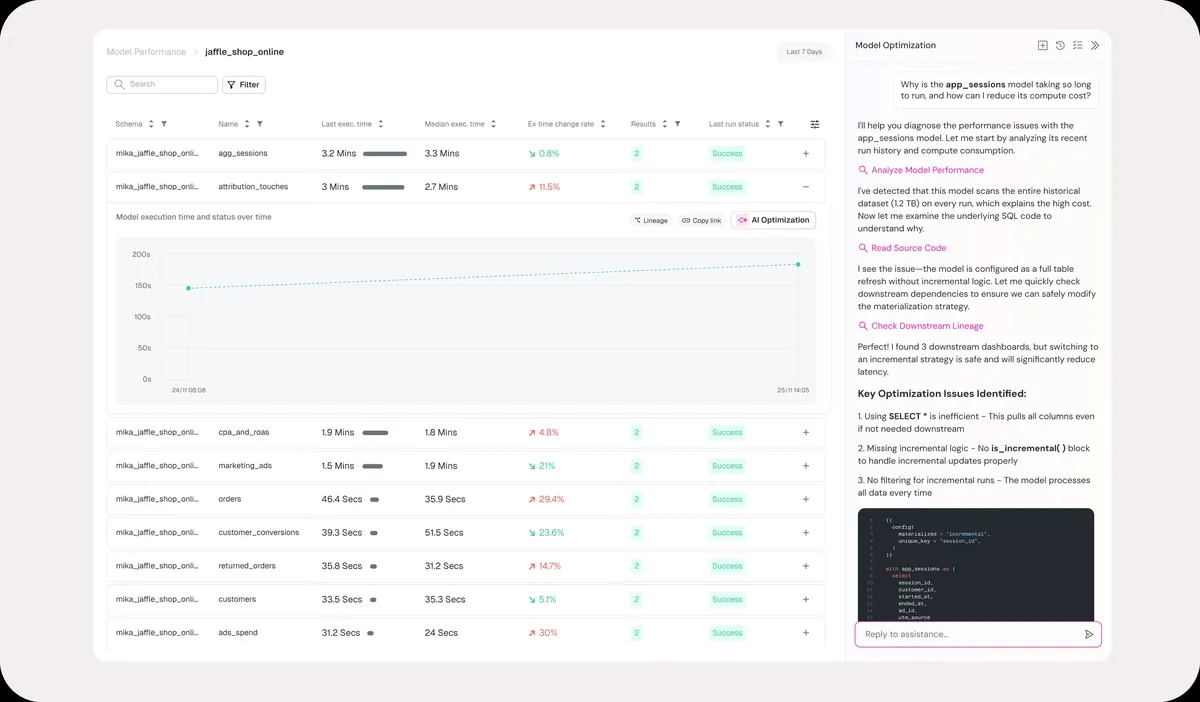
Feature Comparison
| Feature | Castor | Elementary |
|---|---|---|
| Data Discovery & Catalog | ||
| Natural Language Data Search | AI-powered natural language search across data assets | Catalog with conversational asset exploration |
| Automated Documentation | AI-driven automated metadata ingestion and documentation | Code-managed descriptions, tags, and owners in dbt |
| Business Glossary | Full business glossary with collaborative cataloging | Not verified |
| Data Quality & Observability | ||
| Automated Monitors | AI-driven data trust assessments | Out-of-the-box monitors for freshness, volume, and schema changes |
| Anomaly Detection | Not a primary feature | ML-based anomaly detection for nullness, distribution, dimensions, and completeness |
| Data Testing | Not verified | Unified solution for dbt tests, Elementary tests, and custom tests |
| Incident Management | Not verified | Groups related failures into managed incidents with context-aware routing |
| Lineage & Governance | ||
| Data Lineage | Automated column-level data lineage | End-to-end column-level lineage from code to BI tools |
| Access Control & Compliance | Sensitive data classification, role-based access, audit trails | SSO and RBAC available on Enterprise tier |
| Data Health Scores | Not verified | Health scores across domains, teams, and assets |
| Developer Experience | ||
| Code-First Configuration | UI-first approach with API integrations | All configurations managed in dbt code with version control and CI/CD |
| Natural Language to SQL | AI-powered natural language to SQL conversion | Not verified |
| Alerting | Not a primary feature | Actionable alerts to Slack, Teams, Opsgenie, and PagerDuty |
| Integrations & Deployment | ||
| BI Tool Integrations | Integrates with major data stack tools | Tableau, Looker, and more with lineage tracking |
| Data Warehouse Support | Multiple warehouse integrations | Snowflake, BigQuery, Redshift, Databricks, and Postgres |
| MCP Server | Not verified | Exposes context layer and agents through standard MCP Server interface |
Data Discovery & Catalog
Natural Language Data Search
Automated Documentation
Business Glossary
Data Quality & Observability
Automated Monitors
Anomaly Detection
Data Testing
Incident Management
Lineage & Governance
Data Lineage
Access Control & Compliance
Data Health Scores
Developer Experience
Code-First Configuration
Natural Language to SQL
Alerting
Integrations & Deployment
BI Tool Integrations
Data Warehouse Support
MCP Server
Which approach fits
Castor and Elementary solve different problems in the data stack and are often complementary rather than direct substitutes. Castor is suited to an enterprise-wide scenario where analysts and business users need to find, understand, and govern data through an AI-powered catalog and self-service experience. Elementary is suited to dbt-centric engineering scenarios where teams need to detect freshness, volume, schema, and statistical-quality issues before dashboards or downstream models are affected. Choose based on whether the immediate operating problem is organization-wide data discovery and governance or pipeline-level observability and quality control.
When each approach fits
Choose Castor if:
Choose Castor when your primary challenge is helping teams across the organization find, understand, and trust data. It is ideal for enterprises needing a centralized catalog, governance controls, privacy and compliance support, and AI-powered self-service analytics for technical and business users.
Choose Elementary if:
Choose Elementary when your priority is monitoring dbt pipeline health and catching quality issues before they reach downstream consumers. Its Apache-2.0 core, automated monitors, anomaly detection, dbt-test coverage, lineage, and actionable alerts fit code-first data engineering workflows.
These scenarios reflect the available product evidence. Your requirements, existing stack, and team expertise should guide the final decision.
Frequently Asked Questions
What is the main difference between Castor and Elementary?
Castor (now Coalesce Catalog) is an AI-powered data catalog and governance platform designed for data discovery and self-service analytics. Elementary is a dbt-native data observability platform focused on monitoring data pipeline quality, detecting anomalies, and managing data incidents. They address different stages of the data lifecycle: Castor helps teams find and understand data, while Elementary ensures data pipelines produce reliable output.
Can I use Castor and Elementary together?
Yes, Castor and Elementary serve complementary functions and can work alongside each other in a modern data stack. Castor provides the data catalog and governance layer for data discovery, while Elementary monitors pipeline health and data quality. Using both gives teams visibility into what data exists and whether that data is trustworthy.
Is Elementary free to use?
Elementary offers an open-source core under the Apache-2.0 license that teams can self-host at no cost. The open-source dbt package provides automated monitors, anomaly detection, lineage, and alerting. Elementary Cloud adds premium features like AI agents, incident management, BI integrations, and health scores across three paid tiers: Scale, Enterprise, and Unlimited. All cloud tiers require contacting Elementary for pricing.
Does Castor require dbt to work?
No, Castor does not require dbt. It operates as a standalone data catalog and governance platform that integrates with various tools across the data stack through automated metadata ingestion. Elementary, by contrast, is built as a dbt package and is deeply integrated with the dbt workflow, making dbt a core dependency for its observability features.
Which tool is better for non-technical business users?
Castor is better suited for non-technical users. Its AI-powered natural language search lets business users find data without writing code, and its natural language to SQL conversion enables ad-hoc queries without SQL knowledge. Elementary is designed primarily for data and analytics engineers who work with dbt and prefer code-first configuration.