Decision comparison
Atlan vs Elementary
Atlan and Elementary solve different layers of the modern data stack. Atlan is a comprehensive data catalog and governance platform that builds an AI-ready context layer across your entire data estate, while Elementary is a dbt-native observability tool that monitors pipeline health, detects anomalies, and enforces data quality through code-first workflows. Organizations that need enterprise-wide data discovery, a business glossary, and a governance framework to power AI agents will find Atlan is the stronger fit. Teams running dbt pipelines that need automated monitoring, anomaly detection, and CI/CD-integrated quality checks will get more immediate value from Elementary. Many data teams use both tools together, with Elementary handling pipeline-level observability and Atlan providing the broader catalog and governance layer.
Architecture choice. These take different approaches to the same problem. Read the table as a fit question rather than a feature race.
These are different kinds of product — Data Catalog and Data Observability.
Quick Comparison
| Decision factor | Atlan | Elementary |
|---|---|---|
| Primary Focus | Data catalog, governance, and context layer for AI agents across the enterprise | Data observability and quality monitoring built natively for dbt pipelines |
| Architecture | Cloud-native SaaS platform with 80+ connectors building a unified Enterprise Data Graph | Open-source dbt package plus cloud SaaS control plane; code-first and version-controlled |
| AI Capabilities | AI agents bootstrap context by generating descriptions, linking business terms, and building semantic views | AI agents for data quality validation, issue triage, metadata enrichment, and test coverage improvement |
| Lineage | End-to-end lineage across Snowflake, dbt, Tableau, Salesforce, Fivetran, and more with visual tracing | Column-level lineage from code, warehouse, sources, and BI tools with test result enrichment |
| Pricing Model | Atlan publishes no pricing. atlan.com/pricing resolves to a talk-to-sales contact form, and no plan or edition names are published, so both the tier structure and the figures come from a quote. | Elementary publishes no amounts. Its open-source dbt package is free and self-hosted. Elementary Cloud is priced by seats and environments: Scale covers up to 10 editor seats and 1K tables, Enterprise up to 20 editor and 40 viewer seats and 3K tables, and Unlimited removes the seat caps; extra tables are charged per additional 1K. A free trial covers the Essentials feature set. Every paid tier is quote-only. |
| Best For | Organizations needing a collaborative data catalog with governance, business glossary, and AI-ready context | Data engineering teams running dbt who want code-first observability, anomaly detection, and quality monitoring |
Atlan
- Primary Focus:
- Data catalog, governance, and context layer for AI agents across the enterprise
- Architecture:
- Cloud-native SaaS platform with 80+ connectors building a unified Enterprise Data Graph
- AI Capabilities:
- AI agents bootstrap context by generating descriptions, linking business terms, and building semantic views
- Lineage:
- End-to-end lineage across Snowflake, dbt, Tableau, Salesforce, Fivetran, and more with visual tracing
- Pricing Model:
- Atlan publishes no pricing. atlan.com/pricing resolves to a talk-to-sales contact form, and no plan or edition names are published, so both the tier structure and the figures come from a quote.
- Best For:
- Organizations needing a collaborative data catalog with governance, business glossary, and AI-ready context
Elementary
- Primary Focus:
- Data observability and quality monitoring built natively for dbt pipelines
- Architecture:
- Open-source dbt package plus cloud SaaS control plane; code-first and version-controlled
- AI Capabilities:
- AI agents for data quality validation, issue triage, metadata enrichment, and test coverage improvement
- Lineage:
- Column-level lineage from code, warehouse, sources, and BI tools with test result enrichment
- Pricing Model:
- Elementary publishes no amounts. Its open-source dbt package is free and self-hosted. Elementary Cloud is priced by seats and environments: Scale covers up to 10 editor seats and 1K tables, Enterprise up to 20 editor and 40 viewer seats and 3K tables, and Unlimited removes the seat caps; extra tables are charged per additional 1K. A free trial covers the Essentials feature set. Every paid tier is quote-only.
- Best For:
- Data engineering teams running dbt who want code-first observability, anomaly detection, and quality monitoring
Public signals
Verified factual signals only. Bars appear only for like-for-like metrics with five weekly assessments for every tool; missing evidence stays explicit. These signals do not establish enterprise adoption, product quality, or total cost.
| Metric | Atlan | Elementary |
|---|---|---|
| GitHub commits, 90d(Developer adoption) | 167 | Not available |
| GitHub stars(Developer adoption) | 22 | Not available |
| Search interest(Market interest) | 3 | Unavailable |
| Hacker News mentions, 90d(Community interest) | 0 | Not available |
| PyPI weekly downloads(Developer adoption) | 128.0k | Not available |
| GitHub commits, 90d(Product adoption) | Not available | 19 |
| GitHub stars(Product adoption) | Not available | 2,000+ |
| PyPI weekly downloads(Product adoption) | Not available | 215.3k |
As of September 21, 2026 — updated weekly.
Health & risk evidence
Observed public-source checks for mapped package versions and repositories.
Atlan
September 21, 2026Package vulnerabilities
PyPI · pyatlan@11.4.0
0 vulnerabilities
across 1 package
Repository security score
Not available
Elementary
September 21, 2026Package vulnerabilities
PyPI · elementary-data@0.26.0
0 vulnerabilities
across 1 package
Repository security score
github.com/elementary-data/elementary
7.4/10
Interface Preview
Atlan
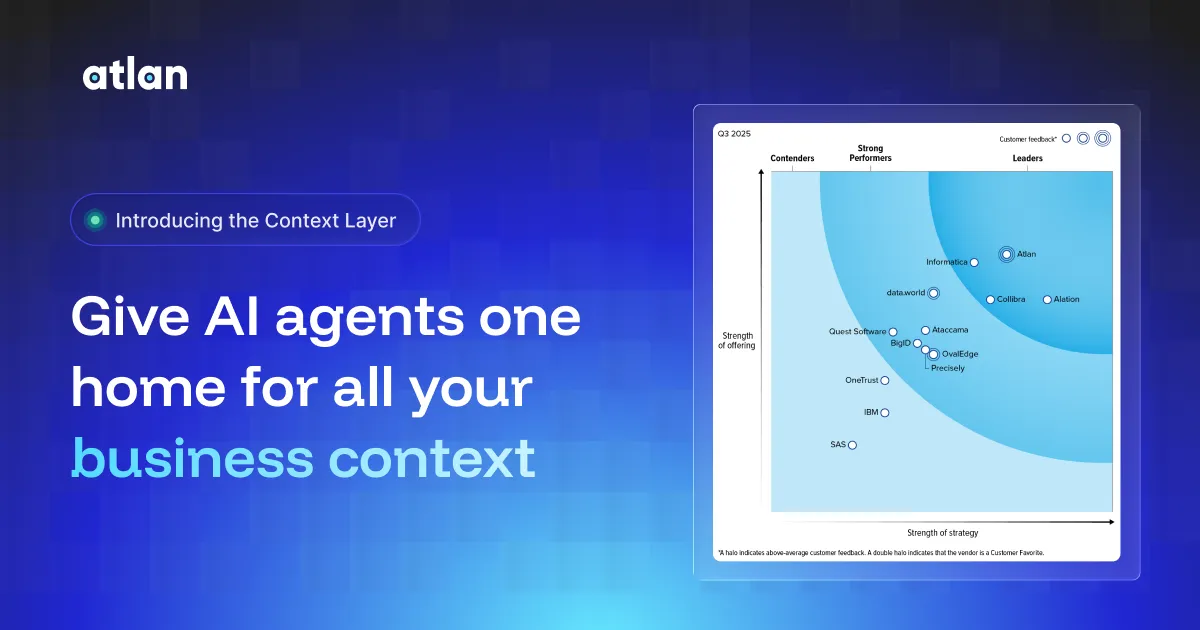
Elementary
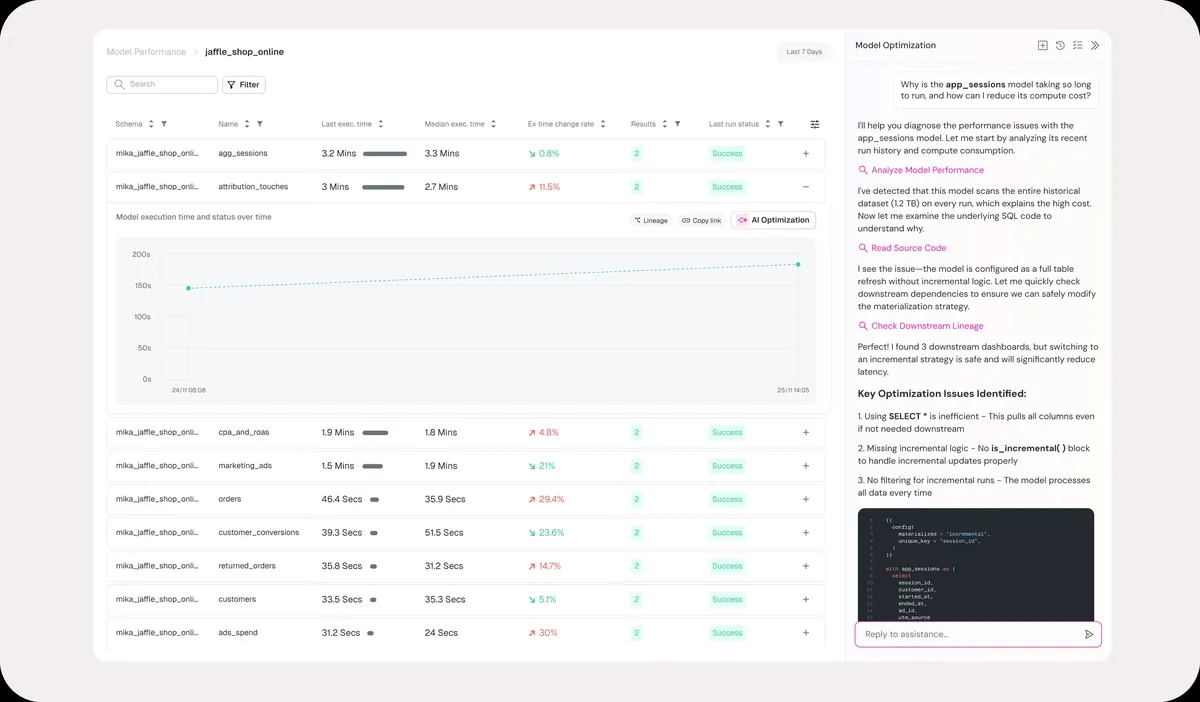
Feature Comparison
| Feature | Atlan | Elementary |
|---|---|---|
| Data Catalog & Discovery | ||
| Data Catalog | Full-featured catalog with AI-powered search, automated metadata cataloging, and 80+ data source connectors | Built-in catalog for exploring data assets with health scores, ownership, descriptions, and underlying code |
| Business Glossary | Centralized and linkable glossary with ownership assignments, certification workflows, and cross-asset linking | Not a core capability; metadata and descriptions are managed in dbt code rather than a dedicated glossary |
| Data Discovery | AI-powered discovery with personalized homepages, curated views, and natural language search across all assets | AI-first discovery where users can ask conversational questions about assets, usage, reliability, and ownership |
| Data Observability & Quality | ||
| Automated Monitoring | Integrates with external quality tools like Great Expectations, Soda, and Monte Carlo for monitoring | Out-of-the-box automated monitors for freshness, volume, and schema changes with zero manual configuration |
| Anomaly Detection | Relies on partner integrations for anomaly detection rather than built-in detection capabilities | ML-based anomaly detection for nullness, distribution, dimensions, and completeness with configurable sensitivity |
| Data Testing | Supports ingestion of test results from external systems like dbt tests and Monte Carlo into the catalog | Unified testing across dbt tests, Elementary monitors, and custom tests with full ecosystem support including dbt-expectations and dbt-utils |
| Governance & Collaboration | ||
| Access Control | Role-based access with Personas and Purposes model, sensitive data classification, and policy enforcement | SSO and RBAC available on Enterprise and Unlimited plans; ownership-based alert routing |
| Collaboration Features | Built-in discussion threads, JIRA and Slack integrations, annotation workflows, and certification pipelines | Incident management with grouped failures, context-aware alerts routed to Slack, Teams, Opsgenie, and PagerDuty |
| Configuration Management | UI-driven configuration with API access; metadata managed through the platform interface and automation playbooks | Code-first approach where all configurations live in dbt code with version control, code review, and CI/CD |
| Lineage & Integration | ||
| Lineage Depth | End-to-end visual lineage across the full data estate including warehouses, dbt, BI tools, and business applications | Column-level lineage from code to BI tools enriched with test results and incident data across the DAG |
| Integration Ecosystem | 80+ connectors spanning warehouses, BI tools, transformation layers, and business applications | Integrations with Snowflake, BigQuery, Redshift, Databricks, Postgres, Tableau, Looker, GitHub, and GitLab |
| MCP Server Support | Production MCP server that serves certified context to every downstream AI agent across the stack | MCP server interface exposing lineage, metadata, and data health to any AI tool |
| Performance & Operations | ||
| Performance Monitoring | Not a core capability; focuses on metadata management rather than query or model performance | Model run duration tracking, performance trend analysis, bottleneck detection, and cost optimization |
| Data CI/CD | Supports automation playbooks and API-driven workflows for metadata operations | Pull request-level data quality checks that prevent breaking changes from reaching production |
| Health Scoring | Asset-level quality signals aggregated from ingested external test results and metadata completeness | Data health scores across domains, teams, and assets measuring all core data quality dimensions |
Data Catalog & Discovery
Data Catalog
Business Glossary
Data Discovery
Data Observability & Quality
Automated Monitoring
Anomaly Detection
Data Testing
Governance & Collaboration
Access Control
Collaboration Features
Configuration Management
Lineage & Integration
Lineage Depth
Integration Ecosystem
MCP Server Support
Performance & Operations
Performance Monitoring
Data CI/CD
Health Scoring
Which approach fits
Atlan and Elementary solve different layers of the modern data stack. Atlan is a comprehensive data catalog and governance platform that builds an AI-ready context layer across your entire data estate, while Elementary is a dbt-native observability tool that monitors pipeline health, detects anomalies, and enforces data quality through code-first workflows. Organizations that need enterprise-wide data discovery, a business glossary, and a governance framework to power AI agents will find Atlan is the stronger fit. Teams running dbt pipelines that need automated monitoring, anomaly detection, and CI/CD-integrated quality checks will get more immediate value from Elementary. Many data teams use both tools together, with Elementary handling pipeline-level observability and Atlan providing the broader catalog and governance layer.
When each approach fits
Choose Atlan if:
We recommend Atlan for organizations that need a centralized data catalog serving both technical and business users across the enterprise. Atlan excels when your priority is building a shared understanding of your data estate through its Enterprise Data Graph, which unifies metadata from 80+ connectors into a single living graph. The AI-native context pipeline automates the heavy lifting of generating descriptions, linking business terms, and surfacing key questions, getting you to 80% context coverage before a human reviews a single line. The Personas and Purposes access model, combined with the business glossary and certification workflows, makes Atlan a strong choice for organizations with governance requirements or compliance mandates. If you are investing in AI agents and need a production-ready context layer that serves certified metadata through SQL, APIs, and an MCP server, Atlan provides the foundation. The platform has earned recognition as a Leader in both the 2025 and 2026 Gartner Magic Quadrant for Metadata Management Solutions and Data & Analytics Governance, and 95% of G2 users view Atlan as a true partner.
Choose Elementary if:
We recommend Elementary for data and analytics engineering teams that run dbt as their transformation layer and want observability that fits naturally into their existing workflow. Elementary stands out with its code-first approach where all monitoring configuration lives in your dbt project, enabling version control, code review, and CI/CD integration for your observability setup. The automated monitors detect freshness, volume, and schema issues across production tables without manual configuration, and the ML-based anomaly detection catches unexpected changes in nullness, distribution, and completeness. Column-level lineage enriched with test results gives you precise root cause analysis when incidents occur. The open-source dbt package means you can start monitoring for free and upgrade to Cloud plans when you need advanced features like AI agents, incident management, and BI integrations. With 2,000+ GitHub stars and an Apache-2.0 license, Elementary has strong community backing. The unified control plane covering observability, quality, governance, and discovery makes it a comprehensive solution that grows with your data platform.
These scenarios reflect the available product evidence. Your requirements, existing stack, and team expertise should guide the final decision.
Frequently Asked Questions
What is the main difference between Atlan and Elementary?
Atlan is a data catalog and governance platform that creates an AI-ready context layer across your entire data estate. It connects 80+ data sources into a unified Enterprise Data Graph and provides business glossary, data discovery, and metadata management capabilities for both technical and business users. Elementary is a dbt-native data observability platform focused on monitoring pipeline health, detecting data quality anomalies, and enforcing testing standards through code-first configuration. Atlan answers the question of what data you have and what it means, while Elementary answers whether that data is fresh, accurate, and reliable. Many organizations deploy both tools together for complementary coverage.
Can Atlan and Elementary be used together?
Yes, Atlan and Elementary serve complementary functions in the modern data stack and work well together. Elementary handles pipeline-level observability by monitoring freshness, volume, schema changes, and data quality anomalies in your dbt pipelines. Atlan provides the broader catalog, governance, and context layer where teams discover, understand, and trust their data assets. Both tools offer MCP server support, enabling AI agents to access lineage, metadata, and data health information. Using Elementary for operational monitoring alongside Atlan for enterprise catalog and governance gives data teams comprehensive coverage from pipeline execution through business-level data understanding.
How does pricing compare between Atlan and Elementary?
Atlan publishes no pricing. Its pricing page resolves to a talk-to-sales contact form with no figures and no plan or edition names, so both the tier structure and the rates come from a quote. Ask for a quote scoped to your connector count and user roles, or the number will not be comparable with a competitor's published rate.
Which tool is better for dbt-based data teams?
Elementary is purpose-built for dbt teams and offers the tighter integration. The Elementary dbt package installs directly into your dbt project, and all monitoring configuration is managed as code alongside your models. This means your observability setup goes through the same version control, code review, and CI/CD processes as your dbt transformations. Elementary also supports dbt ecosystem test packages like dbt-expectations and dbt-utils natively. Atlan integrates with dbt as one of its 80+ connectors and can ingest dbt test results and metadata into its catalog. For teams whose primary concern is dbt pipeline reliability and data quality, Elementary provides deeper native functionality. For teams that also need enterprise catalog, governance, and cross-tool discovery beyond dbt, Atlan provides the broader platform.
What AI capabilities does each tool offer?
Atlan uses AI agents to bootstrap your context layer by reading the Enterprise Data Graph and automatically generating asset descriptions, linking business terms, building semantic views, and surfacing top business questions. The goal is to get 80% of your context layer ready before human review. Atlan also provides an MCP server so certified context flows to every AI agent across your stack. Elementary deploys AI agents for operational tasks including data quality validation, issue triage and resolution, metadata enrichment, test coverage analysis, prevention of breaking changes, and query performance optimization. Elementary also exposes its context layer through an MCP server interface. Atlan focuses AI on building and maintaining enterprise context, while Elementary focuses AI on keeping data reliable and helping engineers work faster.