Secoda: product and architecture
Our Secoda review verdict: Secoda is a strong fit for data teams that need one searchable home for metadata, documentation, lineage, and governed data knowledge, especially when business users also need access to trusted answers. Its value is in consolidating discovery and context rather than being a narrowly specialized quality-monitoring product. We recommend Secoda for teams that want to make data assets easier to find and explain; teams seeking a dedicated, metrics-heavy observability platform should evaluate more specialized options first.
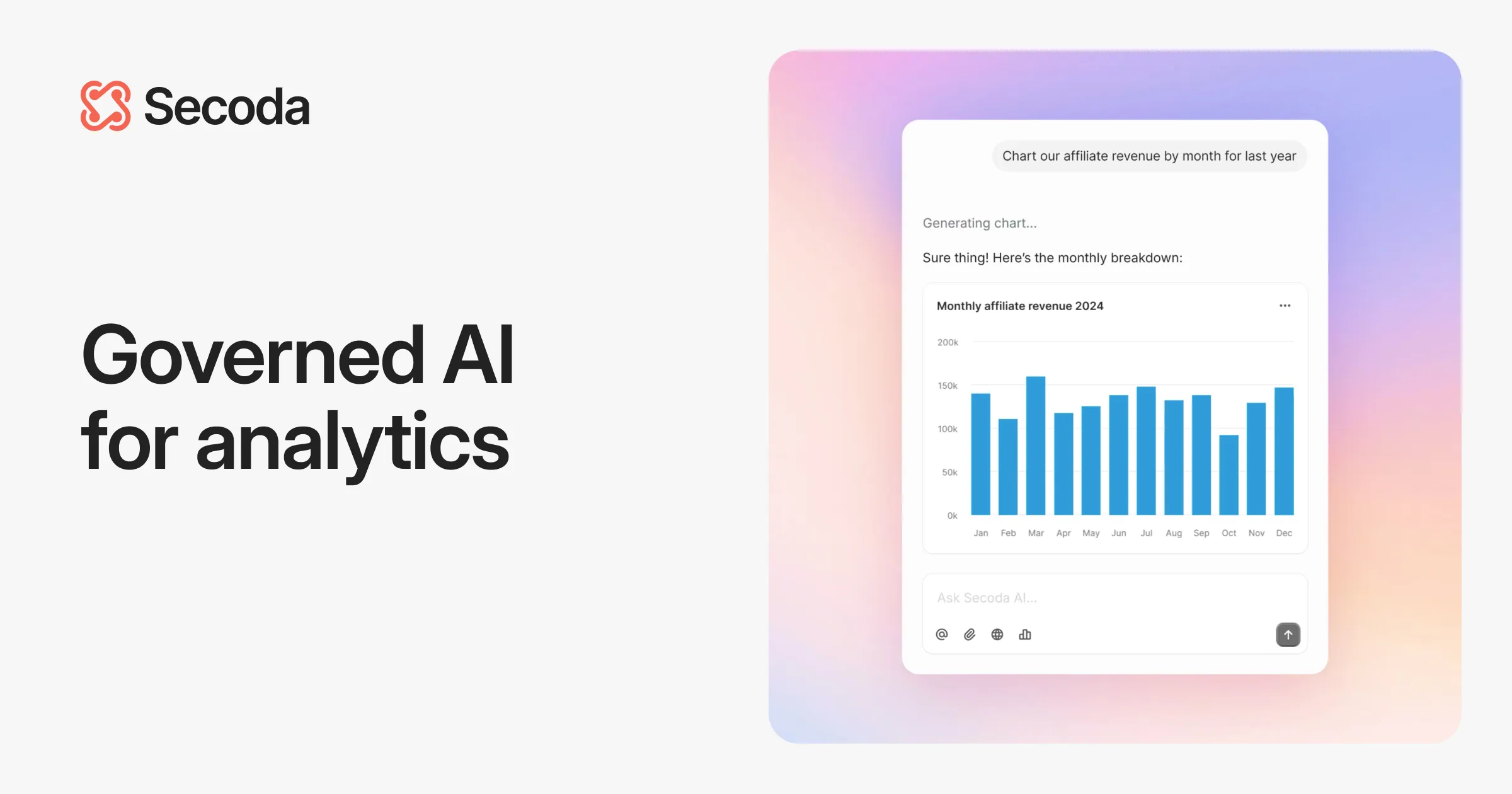
Secoda positions itself as an AI platform for data and analytics built on enterprise data governance and context across the data stack. The product brings a data catalog, lineage, documentation, dictionary, analysis, and data requests into one collaborative platform. Atlassian’s acquisition of Secoda is a meaningful market signal, but it should not replace a technical evaluation of the product’s controls, deployment model, and source coverage.
Overview
Secoda is a Data Enablement Platform designed around a practical data-management problem: people cannot reliably use data they cannot locate, interpret, or trust. Its product description emphasizes searching, documenting, and managing data through a unified workspace rather than spreading those workflows across separate catalog, documentation, and request-management tools. For analytics engineers, that means the product is intended to make definitions and metadata discoverable alongside the assets they describe.
The platform’s stated foundation includes data cataloging, lineage, observability, and quality, enriched by business context. That positioning matters because Secoda is not framed solely as a catalog or solely as a data-quality tool. Instead, it aims to connect data-source information, documentation, and organizational knowledge so users can ask questions and find governed answers through a single experience.
The primary evaluator question is whether your organization needs a knowledge layer over its data estate. If the answer is yes, Secoda is compelling: it combines catalog management, searchable documentation, lineage, and data requests in the same product. If your immediate priority is detecting warehouse failures, measuring freshness, or enforcing quality tests through a dedicated operational workflow, Secoda’s broader platform scope can be a trade-off rather than an advantage.
The available evidence supports a clear target audience: data teams that serve both technical users and nontechnical stakeholders, including revenue teams. Secoda explicitly presents data discovery as something that should be as straightforward as Google search. That is useful when definitions, ownership, and documentation are scattered, but it also means successful adoption depends on teams maintaining the context that makes search results trustworthy.
Secoda’s public positioning includes “trusted answers fast and at scale,” AI-powered search, and direct connections to data sources for lineage, documentation, and metadata. Those are meaningful product claims, but the supplied information does not provide benchmark timings, supported-source counts, customer counts, or independent accuracy measurements. We would therefore treat the product’s AI and scalability claims as evaluation areas to test in a proof of concept, not as quantified performance guarantees.
Key Features and Architecture
Secoda’s architecture is organized around a common data-knowledge layer: it connects to data sources, gathers lineage, documentation, and metadata, then makes that context accessible through search, cataloging, and AI-assisted workflows. The product does not provide implementation-level details in the supplied information about storage, compute, synchronization cadence, or connector mechanics. That missing technical evidence matters for organizations with strict residency, latency, or metadata-ingestion requirements.
Its key capabilities include:
-
AI assistance: Secoda AI is positioned to uncover insights and automate repetitive work. The practical value is reducing manual discovery and documentation effort, but the data provided does not specify which actions are automated, how suggestions are reviewed, or what controls govern AI-generated output.
-
Search: The search capability is designed to help users quickly find relevant data. Secoda describes it as access across the data landscape, making it central to the product rather than an auxiliary catalog filter. This is most valuable when users need a shared way to find existing assets and knowledge without navigating several tools.
-
Data lineage: Secoda provides lineage intended to trace a data asset’s journey from start to finish. The official pricing information specifically lists column- and table-level lineage in the Core plan, which is a concrete distinction: teams can assess relationships at both broader table and more granular column levels.
-
Data catalog: The catalog organizes data assets in one location so users can find, understand, and manage them. The Core plan includes a full data catalog, placing catalog functionality in the foundational paid offering rather than reserving it for the highest tier.
-
Documentation and dictionary workflows: Secoda includes documentation and a data dictionary as part of its platform description. These capabilities are important because a lineage graph alone does not explain business meaning; the tool is intended to bring descriptive knowledge and technical asset context together.
-
Chrome extension: Secoda offers an AI-powered Chrome extension for in-browser data discovery, metadata editing, and AI search across tools. This is a distinctive workflow feature for teams that spend time in multiple browser-based systems and want discovery or metadata changes closer to their normal work.
-
Automations and API access: Both are included in the Core tier. Automations provide a way to operationalize repeated platform workflows, while API access matters for organizations that need Secoda to participate in their wider tooling environment. The supplied data does not define available API endpoints, rate limits, or automation triggers.
-
Governance controls: Premium adds policies, PII scanning, guest accounts, single-tenant deployment, and a Data Quality Score. Enterprise adds custom roles, self-hosted deployment, access request management, SIEM logging, priority support, and a dedicated account manager.
The architecture is therefore strongest when metadata discovery and governance need to meet in one working surface. The trade-off is breadth: Secoda gathers catalog, lineage, quality, policy, and request-management concerns into one platform, so buyers should verify that its specific workflows match their existing operating model instead of assuming every included category has the same depth as a dedicated point solution.
Ideal Use Cases
Secoda is suited to organizations that want data cataloging, lineage, monitoring, governance, and AI-powered workflows in one platform. Its Core plan includes a full data catalog, column- and table-level lineage, automations, API access, workspace analytics, SAML, SSH or reverse SSH, and role-based access controls.
It is also relevant for teams building a more formal governance program. Premium adds policies, PII scanning, guest accounts, a Data Quality Score, VPC peering, single-tenant deployment, and premium support. Enterprise adds custom roles, self-hosted deployment, access request management, SIEM logging, unlimited integrations, disaster-recovery support, professional services, and a dedicated account manager.
The published plan structure is Core, Premium, and Enterprise. The supplied evidence does not provide public prices, plan limits for a free tier, or a stated trial or pilot allowance. Buyers evaluating rollout scope should therefore confirm the applicable licensing terms, editor and administrator allocation, workspace terms, and any quote details directly with Secoda.
The supplied evidence lists monitoring, data profiling, schema-change alerts, impact and root-cause analysis, and automated monitoring workflows, but it does not describe test types, alerting behavior, incident workflows, or performance benchmarks. Teams whose decision depends on those operational specifics should obtain that detail during evaluation.
Strengths & Trade-offs
Secoda presents cataloging, documentation, lineage, monitoring, governance, and workflow capabilities in one product. Its published plans are Core, Premium, and Enterprise; the supplied pricing evidence names those plans and lists their features, but does not disclose public price amounts or terms.
Pros
-
Core includes a broad set of foundational capabilities. The plan lists a full data catalog, column- and table-level lineage, automations, API access, workspace analytics, SAML, SSH or reverse SSH, and RBAC.
-
The feature set spans discovery and monitoring. The published comparison includes data catalog, data lineage, data requests, live queries in docs, Secoda AI, data dictionary, schema-change alerts, data profiling, usage insights, and no-code data monitoring.
-
Premium adds named governance and deployment features. These include policies, PII scanning, guest accounts, a Data Quality Score, VPC peering, single-tenant deployment, and premium support.
-
Enterprise adds controls and services for more demanding deployments. Listed features include custom roles, self-hosted deployment, access request management, SIEM logging, unlimited integrations, disaster-recovery support, professional services, priority support, and a dedicated account manager.
-
The platform lists integrations for collaboration and productivity tools. Slack and Microsoft Teams are listed as collaboration integrations, while Confluence, Git, Jira, GitHub, Linear, and PagerDuty are listed as productivity extensions.
Cons
-
Public pricing details are absent from the supplied evidence. Although Core, Premium, and Enterprise are named, no amount, currency, billing term, or plan-specific quote process is provided. Buyers should confirm licensing, included users, workspace terms, and any quote details with Secoda.
-
Operational monitoring detail is limited in the available material. Data monitoring, data profiling, schema-change alerts, and a Data Quality Score are listed, but the evidence does not specify check types, alerting behavior, incident workflows, or performance metrics.
-
AI governance details are not described. Secoda AI, an AI documentation generator, AI chat in Slack, and AI personas are listed, but the supplied evidence does not define model behavior, approval workflows, output-quality measures, or data-handling controls.
-
Connector implementation detail is not provided. The evidence lists integration categories and some supported tools, but does not state refresh patterns or metadata-ingestion limits.
The available evidence supports Secoda as a broad platform for data knowledge, governance, lineage, and monitoring. A buyer needing transparent pricing or detailed operational and AI-control documentation should confirm those requirements directly during evaluation.