Decision comparison
Great Expectations vs Secoda
Great Expectations and Secoda solve fundamentally different problems in the modern data stack. Great Expectations is a specialized data validation framework that excels at pipeline-level quality testing, while Secoda is a broad data enablement platform focused on discovery, cataloging, and AI-powered governance. Most teams will not choose one over the other — they complement each other well. However, if you must pick one, your decision hinges on whether your primary pain point is data correctness at the pipeline level or data discoverability and governance across your organization.
Used together. These are normally used together rather than chosen between. The comparison explains what each one does in the stack.
These are different kinds of product — Data Validation Framework and Data Catalog.
Quick Comparison
| Decision factor | Great Expectations | Secoda |
|---|---|---|
| Primary Focus | Data validation and quality testing | Data discovery, cataloging, and AI-powered governance |
| Pricing Model | Free and Open-Source, Paid upgrades available | Free tier with 1 editor, 500 resources, 2 integrations; Premium starts at $99/month, Enterprise contact for pricing |
| Deployment | Self-hosted or GX Cloud | Cloud-hosted, self-hosted available on Enterprise |
| Best For | Data engineers who need pipeline-level validation | Teams needing a unified data catalog with AI search and governance |
| Learning Curve | Moderate — requires Python knowledge and test authoring | Low — browser-based UI with AI-assisted search and documentation |
| Integration Depth | Deep pipeline integration with Airflow, Dagster, Prefect | Broad stack integration for metadata, lineage, and monitoring |
Great Expectations
- Primary Focus:
- Data validation and quality testing
- Pricing Model:
- Free and Open-Source, Paid upgrades available
- Deployment:
- Self-hosted or GX Cloud
- Best For:
- Data engineers who need pipeline-level validation
- Learning Curve:
- Moderate — requires Python knowledge and test authoring
- Integration Depth:
- Deep pipeline integration with Airflow, Dagster, Prefect
Secoda
- Primary Focus:
- Data discovery, cataloging, and AI-powered governance
- Pricing Model:
- Free tier with 1 editor, 500 resources, 2 integrations; Premium starts at $99/month, Enterprise contact for pricing
- Deployment:
- Cloud-hosted, self-hosted available on Enterprise
- Best For:
- Teams needing a unified data catalog with AI search and governance
- Learning Curve:
- Low — browser-based UI with AI-assisted search and documentation
- Integration Depth:
- Broad stack integration for metadata, lineage, and monitoring
Public signals
Verified factual signals only. Bars appear only for like-for-like metrics with five weekly assessments for every tool; missing evidence stays explicit. These signals do not establish enterprise adoption, product quality, or total cost.
| Metric | Great Expectations | Secoda |
|---|---|---|
| GitHub commits, 90d(Product adoption) | 153 | Not available |
| GitHub stars(Product adoption) | 11,000+ | Not available |
| Search interest(Market interest) | 0 | 0 |
| Hacker News mentions, 90d(Community interest) | 0 | 0 |
| PyPI weekly downloads(Product adoption) | 4.5M | Not available |
| Stack Overflow questions(Community interest) | 147 | Not available |
| Product Hunt comments(Community interest) | Not available | 45 |
| Product Hunt rating(Community interest) | Not available | 3.7/5 |
| Product Hunt reviews(Community interest) | Not available | 3 |
| Product Hunt votes(Community interest) | Not available | 154 |
As of September 14, 2026 — updated weekly.
Health & risk evidence
Observed public-source checks for mapped package versions and repositories.
Great Expectations
September 14, 2026Package vulnerabilities
PyPI · great-expectations@1.23.0
0 vulnerabilities
across 1 package
Repository security score
Not available
Secoda
Package vulnerabilities
Not available
Repository security score
Not available
Interface Preview
Secoda
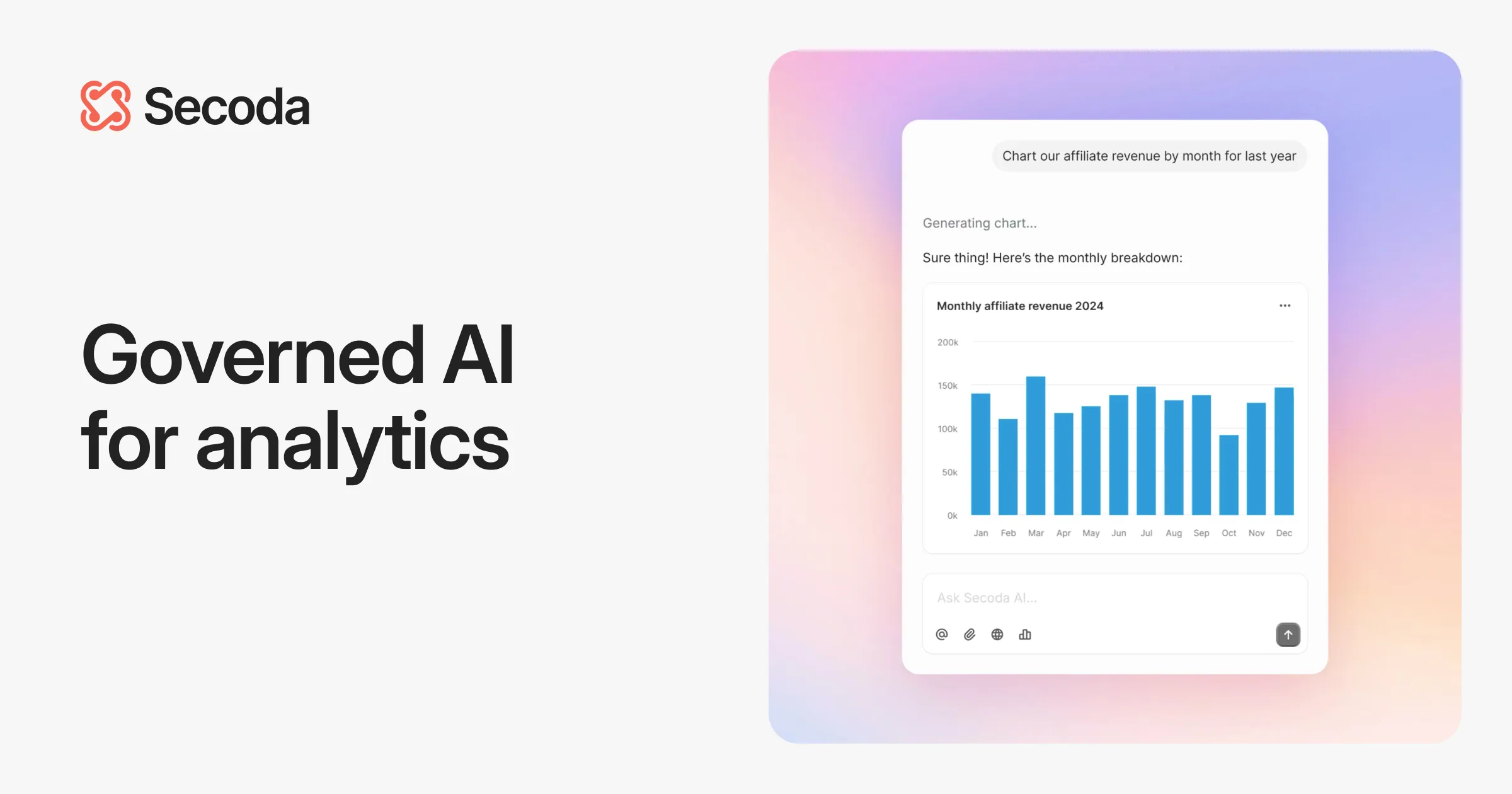
Feature Comparison
| Feature | Great Expectations | Secoda |
|---|---|---|
| Data Quality & Validation | ||
| Expectation-based data testing | Core strength — define, execute, and reuse expectation suites | Data Quality Score for monitoring but no custom test authoring |
| Automated anomaly detection | Alert-based validation failures in pipelines | Real-time monitoring and anomaly detection across the data stack |
| Data profiling | Built-in profilers for automatic expectation generation | Metadata enrichment and quality scoring |
| Data Cataloging & Discovery | ||
| Data catalog | Not included — focused on validation only | Full data catalog with search, tagging, and organization |
| AI-powered search | Not verified | AI search across entire data landscape with natural language queries |
| Data lineage | Not included natively | End-to-end generated lineage from source to dashboard |
| Governance & Compliance | ||
| Access control (RBAC) | Managed at infrastructure level, not built in | Built-in RBAC, SAML, SSO, and access request management |
| PII scanning | Not included | Available on Premium tier with automated identification |
| Policy enforcement | Enforced via expectation suites in CI/CD pipelines | Dedicated policy engine with automated rules and real-time alerts |
| Documentation & Collaboration | ||
| Auto-generated documentation | Data Docs — auto-generated HTML reports of validation results | AI Documentation Agent generates descriptions for all data assets |
| Data dictionary | Not included | Built-in data dictionary with searchable definitions |
| Knowledge repository | Not included | Searchable Q&A repository eliminates repetitive data requests |
| Developer & Platform | ||
| Open-source core | Yes — Apache-2.0 license, 11,000+ GitHub stars | No — proprietary SaaS platform |
| API access | Python API for programmatic test creation and execution | REST API available on all paid tiers |
| AI agents and automation | ExpectAI for auto-generating tests from data | Nine specialized AI agents for analysis, search, governance, and more |
Data Quality & Validation
Expectation-based data testing
Automated anomaly detection
Data profiling
Data Cataloging & Discovery
Data catalog
AI-powered search
Data lineage
Governance & Compliance
Access control (RBAC)
PII scanning
Policy enforcement
Documentation & Collaboration
Auto-generated documentation
Data dictionary
Knowledge repository
Developer & Platform
Open-source core
API access
AI agents and automation
How they fit together
Great Expectations and Secoda solve fundamentally different problems in the modern data stack. Great Expectations is a specialized data validation framework that excels at pipeline-level quality testing, while Secoda is a broad data enablement platform focused on discovery, cataloging, and AI-powered governance. Most teams will not choose one over the other — they complement each other well. However, if you must pick one, your decision hinges on whether your primary pain point is data correctness at the pipeline level or data discoverability and governance across your organization.
What each one handles
Use Great Expectations for:
We recommend Great Expectations for teams whose primary challenge is catching bad data before it reaches downstream systems. If you run complex ETL/ELT pipelines and need granular, code-defined validation rules that integrate directly with orchestrators like Airflow or Dagster, Great Expectations delivers unmatched depth. Its open-source model means zero licensing cost for the core framework, making it especially attractive for budget-conscious teams with strong Python skills.
Use Secoda for:
We recommend Secoda for organizations where the bigger challenge is helping people find, understand, and trust data across the company. If your team spends too much time answering ad-hoc data questions, lacks a centralized catalog, or needs to enforce governance policies at scale, Secoda addresses all of these with a single platform. Its AI-powered search and nine specialized agents dramatically reduce manual effort, making it the stronger choice for teams that need both technical and non-technical users to access data confidently.
These roles reflect the available product evidence. Most teams run both; which one owns a given job depends on your stack and team.
Frequently Asked Questions
Can Great Expectations and Secoda be used together?
Yes, and many data teams do exactly that. Great Expectations handles the pipeline-level data validation — catching schema drift, null violations, and statistical anomalies before data reaches your warehouse. Secoda then serves as the discovery and governance layer on top, cataloging validated data assets, tracking lineage, and making everything searchable for the broader organization. The two tools address different layers of the data quality problem and complement each other well.
Which tool is better for a small data team just getting started?
It depends on your most pressing need. If your pipelines are breaking and you need immediate data validation, Great Expectations is free to start with and integrates directly into your existing Python workflows.
Does Great Expectations offer a managed cloud service?
Yes. GX Cloud is the managed offering from the Great Expectations team. It provides a hosted environment for running validations, managing expectation suites, and viewing Data Docs without maintaining your own infrastructure. GX Cloud includes collaboration features and observability tools beyond what the open-source GX Core framework provides on its own.
How does Secoda handle data quality compared to Great Expectations?
Secoda approaches data quality from a monitoring and scoring perspective rather than a testing perspective. It provides a Data Quality Score that gives an instant view of data health, along with real-time monitoring and anomaly detection. However, it does not offer the granular, code-defined expectation suites that Great Expectations provides. For teams that need both deep validation logic and broad observability, combining the two tools covers both angles.