Decision comparison
Secoda vs Soda
Secoda and Soda tackle different problems within the data quality ecosystem. Secoda is a comprehensive data enablement platform that centralizes discovery, cataloging, lineage, governance, and documentation under one roof with nine AI agents. Soda is a focused data quality automation platform built around data contracts, anomaly detection, and root cause analytics with an open-source core. Your choice depends on whether you need a broad data knowledge platform for your entire organization or a specialized data quality engine for your engineering team.
Used together. These are normally used together rather than chosen between. The comparison explains what each one does in the stack.
These are different kinds of product — Data Catalog and Data Validation Framework.
Quick Comparison
| Decision factor | Secoda | Soda |
|---|---|---|
| Best For | Organizations needing a unified AI-powered data enablement platform that combines data cataloging, lineage, governance, monitoring, and documentation in one workspace | Data engineering teams needing collaborative data contracts with AI-powered quality checks, record-level anomaly detection, and root cause analytics |
| Architecture | Closed-source SaaS platform with optional self-hosted deployment; built on a metadata control plane powering nine specialized AI agents for discovery, governance, and automation | Open-source Python core (2,000+ GitHub stars) with SaaS cloud layer; security-by-design approach keeps data in your cloud environment |
| Pricing Model | Free tier with 1 editor, 500 resources, 2 integrations; Premium starts at $99/month, Enterprise contact for pricing | Free tier at $0 per month, Team tier at $750 per month, with enterprise features available |
| Ease of Use | Google-like AI-powered search across the entire data landscape; Chrome extension for in-browser discovery; with public review listings | Engineers work in Git with YAML-based data contracts; business users collaborate through a no-code UI; AI co-pilot generates contracts with one click from plain English |
| Scalability | Scales from individual contributors on the free tier to unlimited editors and resources on Enterprise; supports unlimited integrations and custom workspaces at the Enterprise level | Anomaly detection algorithms scale to 1 billion rows in 64 seconds with 70% fewer false positives than Facebook Prophet; built-in backfilling analyzes one year of historical data |
| Community/Support | SOC 2 compliant with SAML, SSO, and MFA; email and live chat support on Core tier; Slack support and dedicated account manager on Premium and Enterprise; recently acquired by Atlassian | Open-source community with 2,000+ GitHub stars; active development with v4.7.0 released April 2026; premium support and SSO on Team tier and above |
Secoda
- Best For:
- Organizations needing a unified AI-powered data enablement platform that combines data cataloging, lineage, governance, monitoring, and documentation in one workspace
- Architecture:
- Closed-source SaaS platform with optional self-hosted deployment; built on a metadata control plane powering nine specialized AI agents for discovery, governance, and automation
- Pricing Model:
- Free tier with 1 editor, 500 resources, 2 integrations; Premium starts at $99/month, Enterprise contact for pricing
- Ease of Use:
- Google-like AI-powered search across the entire data landscape; Chrome extension for in-browser discovery; with public review listings
- Scalability:
- Scales from individual contributors on the free tier to unlimited editors and resources on Enterprise; supports unlimited integrations and custom workspaces at the Enterprise level
- Community/Support:
- SOC 2 compliant with SAML, SSO, and MFA; email and live chat support on Core tier; Slack support and dedicated account manager on Premium and Enterprise; recently acquired by Atlassian
Soda
- Best For:
- Data engineering teams needing collaborative data contracts with AI-powered quality checks, record-level anomaly detection, and root cause analytics
- Architecture:
- Open-source Python core (2,000+ GitHub stars) with SaaS cloud layer; security-by-design approach keeps data in your cloud environment
- Pricing Model:
- Free tier at $0 per month, Team tier at $750 per month, with enterprise features available
- Ease of Use:
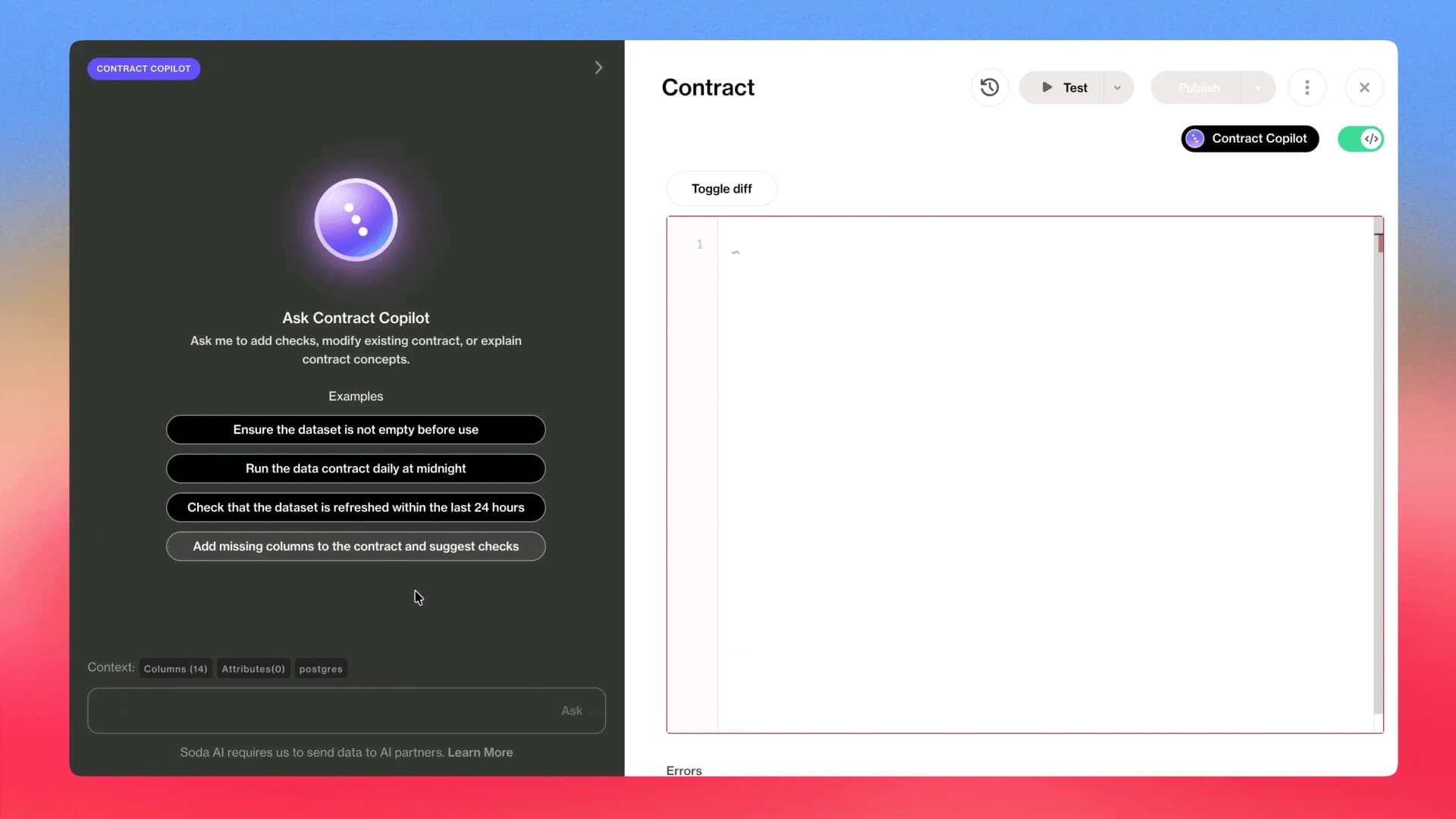
- Engineers work in Git with YAML-based data contracts; business users collaborate through a no-code UI; AI co-pilot generates contracts with one click from plain English
- Scalability:
- Anomaly detection algorithms scale to 1 billion rows in 64 seconds with 70% fewer false positives than Facebook Prophet; built-in backfilling analyzes one year of historical data
- Community/Support:
- Open-source community with 2,000+ GitHub stars; active development with v4.7.0 released April 2026; premium support and SSO on Team tier and above
Public signals
Verified factual signals only. Bars appear only for like-for-like metrics with five weekly assessments for every tool; missing evidence stays explicit. These signals do not establish enterprise adoption, product quality, or total cost.
| Metric | Secoda | Soda |
|---|---|---|
| Search interest(Market interest) | 0 | 0 |
| Hacker News mentions, 90d(Community interest) | 0 | Not available |
| Product Hunt comments(Community interest) | 45 | Not available |
| Product Hunt rating(Community interest) | 3.7/5 | Not available |
| Product Hunt reviews(Community interest) | 3 | Not available |
| Product Hunt votes(Community interest) | 154 | Not available |
| GitHub commits, 90d(Product adoption) | Not available | 81 |
| GitHub stars(Product adoption) | Not available | 2,000+ |
| PyPI weekly downloads(Product adoption) | Not available | 405.8k |
As of September 21, 2026 — updated weekly.
Health & risk evidence
Observed public-source checks for mapped package versions and repositories.
Secoda
Package vulnerabilities
Not available
Repository security score
Not available
Soda
September 21, 2026Package vulnerabilities
PyPI · soda-core@4.24.0
0 vulnerabilities
across 1 package
Repository security score
Not available
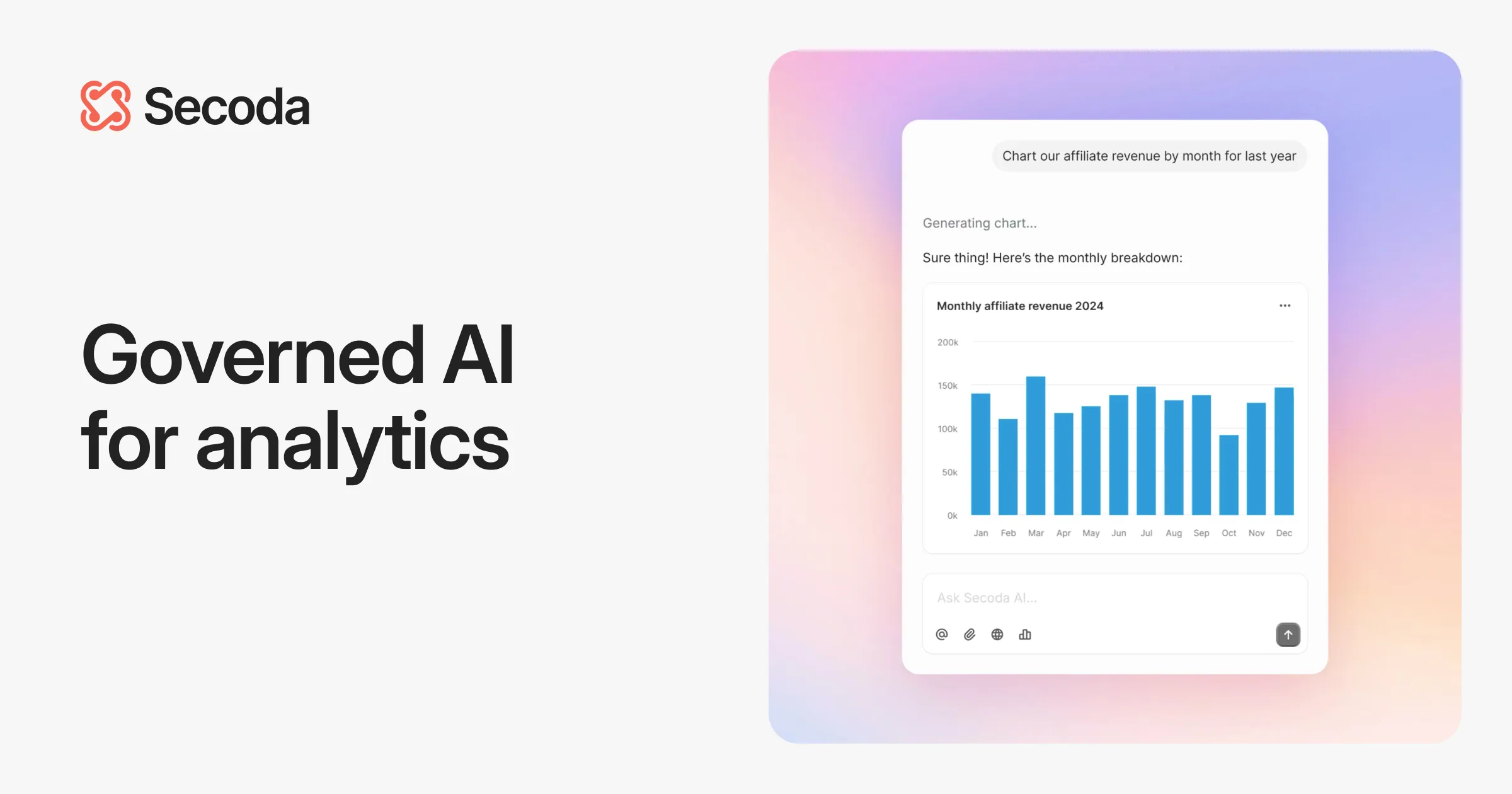
Interface Preview
Secoda
Soda
Feature Comparison
| Feature | Secoda | Soda |
|---|---|---|
| Data Discovery and Cataloging | ||
| Data Catalog | Full data catalog with automated metadata enrichment, searchable repository, and Chrome extension for in-browser data discovery across all connected sources | No built-in data catalog; integrates with external catalog tools via catalog integrations available on paid tiers |
| AI-Powered Search | Google-like AI search across the entire data landscape with context-aware results powered by governance metadata and lineage | No dedicated search feature; focuses on data quality checks and contracts rather than data discovery |
| Data Lineage | Generated column and table-level lineage from end to end with complete visibility into query usage, performance, and dependencies | Complete traceability through diagnostics warehouse capturing all failed records, anomaly logs, and contract violations for auditing |
| Data Quality and Monitoring | ||
| Anomaly Detection | Real-time monitoring and anomaly detection across the data stack with quality scoring to prioritize fixes on critical data assets | Record-level anomaly detection with peer-reviewed algorithms published in NeurIPS, JAIR, and ACML; scales to 1 billion rows in 64 seconds |
| Data Contracts | No dedicated data contracts engine; relies on policies, automations, and governance rules to enforce data standards | Dedicated data contracts engine with collaborative workflows where engineers define YAML contracts in Git and business users contribute via no-code UI |
| Data Quality Scoring | Built-in Data Quality Score on Premium tier providing instant visibility into data health to certify integrity of critical data at scale | Quality checks enforced through data contracts with automated validation; failed records stored in diagnostics warehouse for root cause analysis |
| AI and Automation | ||
| AI Agents | Nine specialized AI agents: Analysis, Automation, Search, Memory, Observability, Governance, Documentation, Visualization, and Cataloging | AI co-pilot generates data contracts and quality checks from plain English; AI automations handle contract creation with one click |
| Workflow Automation | Automated data processes and workflows for bulk updates, PII tagging, tech debt management, and custom integrations | Automated quality checks run in pipelines; alerting and ticketing integrations trigger workflows on contract violations |
| Documentation Generation | Dedicated Documentation Agent that automatically generates descriptions for all data assets; eliminates manual table and column documentation | No automated documentation generation; focuses on data contracts and quality checks rather than asset documentation |
| Governance and Security | ||
| Access Control | RBAC with SAML, SSO, MFA, and access request management; custom roles and SIEM logging on Enterprise tier | Custom roles, RBAC, and audit logs on Team tier; SSO and private deployment included; no SIEM logging mentioned |
| Policy Enforcement | Automated policy definition, enforcement, and monitoring across the entire data stack with real-time alerts on Premium tier | Governance by design through data contracts with complete auditability and permission control built into the contracts workflow |
| Deployment Options | SaaS with single-tenant deployment on Premium tier and full self-hosted deployment on Enterprise; VPC peering and SSH tunneling available | SaaS with private deployment on Team tier; open-source CLI for self-hosted use; data stays in your cloud environment |
| Developer Experience | ||
| Open Source | Closed-source platform; API access available on all tiers for programmatic integration | Open-source Python core with 2,000+ GitHub stars and active development; latest release v4.7.0 in April 2026 |
| Code-Based Workflows | API-driven integration with Data CI/CD for automated testing, alerts, and impact analysis; Chrome extension for in-browser workflows | YAML-based data contracts managed through Git with versioned proposals and diffs; CLI integrates directly into CI/CD pipelines |
| Historical Data Analysis | Query monitoring with automated insights and visualizations for historical query performance and compliance tracking | Built-in backfilling and backtesting instantly analyzes one year of historical data to reveal patterns and trends |
Data Discovery and Cataloging
Data Catalog
AI-Powered Search
Data Lineage
Data Quality and Monitoring
Anomaly Detection
Data Contracts
Data Quality Scoring
AI and Automation
AI Agents
Workflow Automation
Documentation Generation
Governance and Security
Access Control
Policy Enforcement
Deployment Options
Developer Experience
Open Source
Code-Based Workflows
Historical Data Analysis
How they fit together
Secoda and Soda tackle different problems within the data quality ecosystem. Secoda is a comprehensive data enablement platform that centralizes discovery, cataloging, lineage, governance, and documentation under one roof with nine AI agents. Soda is a focused data quality automation platform built around data contracts, anomaly detection, and root cause analytics with an open-source core. Your choice depends on whether you need a broad data knowledge platform for your entire organization or a specialized data quality engine for your engineering team.
What each one handles
Use Secoda for:
Choose Secoda when your organization needs a single platform where data teams and business users can discover, understand, and govern data assets across the entire stack. Secoda is the right fit if you want AI-powered search that works like Google for your internal data, automated metadata enrichment that eliminates manual documentation, and end-to-end lineage that traces every column and table dependency. With nine specialized AI agents handling everything from analysis and visualization to governance and cataloging, Secoda is built for organizations that want to reduce ad-hoc data requests and make data self-service a reality. Its pricing tiers scale from a free tier for individual contributors to Enterprise plans with self-hosted deployment, SIEM logging, and unlimited integrations. Secoda is particularly strong for teams that value a polished UI, broad integrations with existing data stacks, and SOC 2 compliance with SAML and SSO out of the box.
Use Soda for:
Choose Soda when your data engineering team needs a developer-first data quality platform built around collaborative data contracts and automated quality checks. Soda is ideal if your engineers prefer defining quality rules in YAML through Git workflows rather than through a graphical interface. Its open-source Python core with 2,335 GitHub stars gives teams the ability to inspect, extend, and self-host the platform. Soda's AI algorithms are backed by peer-reviewed research published in NeurIPS, JAIR, and ACML, delivering record-level anomaly detection that scales to 1 billion rows in 64 seconds with 70% fewer false positives than Facebook Prophet. The free tier includes pipeline testing, metrics observability, and alerting integrations for unlimited users, while the Team tier at $750/mo adds data contracts, no-code interface, RBAC, and SSO. Soda excels for organizations that need focused data quality automation with built-in backfilling, root cause analytics, and a security-by-design architecture where data never leaves your cloud.
These roles reflect the available product evidence. Most teams run both; which one owns a given job depends on your stack and team.
Frequently Asked Questions
What is the main difference between Secoda and Soda?
Secoda is an AI-powered data enablement platform that combines data cataloging, lineage, documentation, governance, monitoring, and AI-powered search into a single workspace. It is designed for entire organizations to discover, understand, and manage data assets through nine specialized AI agents. Soda is a focused data quality automation platform built around data contracts, anomaly detection, and root cause analytics. It targets data engineering teams with a code-first approach where quality checks are defined in YAML and managed through Git. Secoda focuses on breadth across the data management lifecycle, while Soda goes deeper on data quality validation and automated testing. Secoda has a catalog-first approach; Soda has a contracts-first approach.
How do Secoda and Soda compare on pricing?
Both offer free tiers but with different value propositions. The Premium tier starts at $99/mo billed yearly and adds Data Quality Score, PII scanning, policies, and single-tenant deployment. Enterprise pricing is custom. Soda's free tier at $0/mo includes pipeline testing, metrics observability, alerting and ticketing integrations, and unlimited users. The Team tier at $750/mo adds collaborative data contracts, a no-code interface, advanced AI features, RBAC, SSO, and private deployment. Enterprise pricing is custom with volume discounts.
Which tool is better for data governance and compliance?
Secoda offers a more comprehensive governance suite out of the box. Its governance capabilities include automated policy enforcement across the entire data stack, access request management, RBAC with custom roles, SIEM logging on Enterprise tier, PII scanning on Premium, and SOC 2 compliance with SAML, SSO, and MFA. Secoda's Governance Agent enforces policies while enabling team productivity. Soda approaches governance through its data contracts engine with built-in auditability and permission controls. It provides RBAC, audit logs, and custom roles on the Team tier, with SSO and private deployment included. Soda's governance-by-design philosophy means standards are enforced through versioned contracts rather than top-down policies. For organizations that need broad data governance with compliance reporting, Secoda is the stronger choice. For teams that want governance baked into engineering workflows through data contracts, Soda delivers a more developer-centric approach.
Can Secoda and Soda be used together?
Yes, Secoda and Soda address complementary concerns and can work alongside each other effectively. Secoda serves as the data knowledge layer where teams discover assets, trace lineage, manage documentation, and govern access across the entire data stack. Soda serves as the data quality enforcement layer where engineers define and automate quality checks through data contracts. An organization could use Secoda for data discovery, cataloging, and governance while using Soda for pipeline testing, anomaly detection, and data contract management. Soda's alerting and ticketing integrations can feed quality signals into Secoda's monitoring dashboard, giving teams unified visibility. This combination makes sense for organizations that want both a broad data enablement platform and deep, code-native data quality automation.