Decision comparison
Castor vs Soda
Castor and Soda serve fundamentally different roles in the modern data stack. Castor is the right choice when your primary challenge is helping people find, understand, and trust your data assets through a centralized catalog. Soda is the right choice when your primary challenge is catching, explaining, and resolving data quality issues before they reach production. Many organizations use both tools together since data cataloging and data quality monitoring are complementary capabilities.
Used together. These are normally used together rather than chosen between. The comparison explains what each one does in the stack.
These are different kinds of product — Data Catalog and Data Validation Framework.
Quick Comparison
| Decision factor | Castor | Soda |
|---|---|---|
| Primary Focus | Data catalog and governance | Data quality and observability |
| Pricing Model | Contact for pricing | Free tier at $0 per month, Team tier at $750 per month, with enterprise features available |
| Best For | Teams needing unified data discovery and documentation | Teams enforcing data quality checks across pipelines |
| AI Capabilities | Natural language search, NL-to-SQL, AI trust assessments | AI-powered data contracts, anomaly detection, metrics monitoring |
| Open Source | No | Yes (soda-core on GitHub, 2,000+ stars) |
| Deployment | Cloud-based SaaS | Cloud SaaS with data staying in your environment |
Castor
- Primary Focus:
- Data catalog and governance
- Pricing Model:
- Contact for pricing
- Best For:
- Teams needing unified data discovery and documentation
- AI Capabilities:
- Natural language search, NL-to-SQL, AI trust assessments
- Open Source:
- No
- Deployment:
- Cloud-based SaaS
Soda
- Primary Focus:
- Data quality and observability
- Pricing Model:
- Free tier at $0 per month, Team tier at $750 per month, with enterprise features available
- Best For:
- Teams enforcing data quality checks across pipelines
- AI Capabilities:
- AI-powered data contracts, anomaly detection, metrics monitoring
- Open Source:
- Yes (soda-core on GitHub, 2,000+ stars)
- Deployment:
- Cloud SaaS with data staying in your environment
Public signals
Verified factual signals only. Bars appear only for like-for-like metrics with five weekly assessments for every tool; missing evidence stays explicit. These signals do not establish enterprise adoption, product quality, or total cost.
| Metric | Castor | Soda |
|---|---|---|
| Search interest(Market interest) | Unavailable | 0 |
| Product Hunt comments(Community interest) | 11 | Not available |
| Product Hunt reviews(Community interest) | 0 | Not available |
| Product Hunt votes(Community interest) | 144 | Not available |
| PyPI weekly downloads(Developer adoption) | 1.7k | Not available |
| GitHub commits, 90d(Product adoption) | Not available | 81 |
| GitHub stars(Product adoption) | Not available | 2,000+ |
| PyPI weekly downloads(Product adoption) | Not available | 405.8k |
As of September 21, 2026 — updated weekly.
Health & risk evidence
Observed public-source checks for mapped package versions and repositories.
Castor
September 21, 2026Package vulnerabilities
PyPI · castor-extractor@0.26.101
0 vulnerabilities
across 1 package
Repository security score
Not available
Soda
September 21, 2026Package vulnerabilities
PyPI · soda-core@4.24.0
0 vulnerabilities
across 1 package
Repository security score
Not available
Interface Preview
Soda
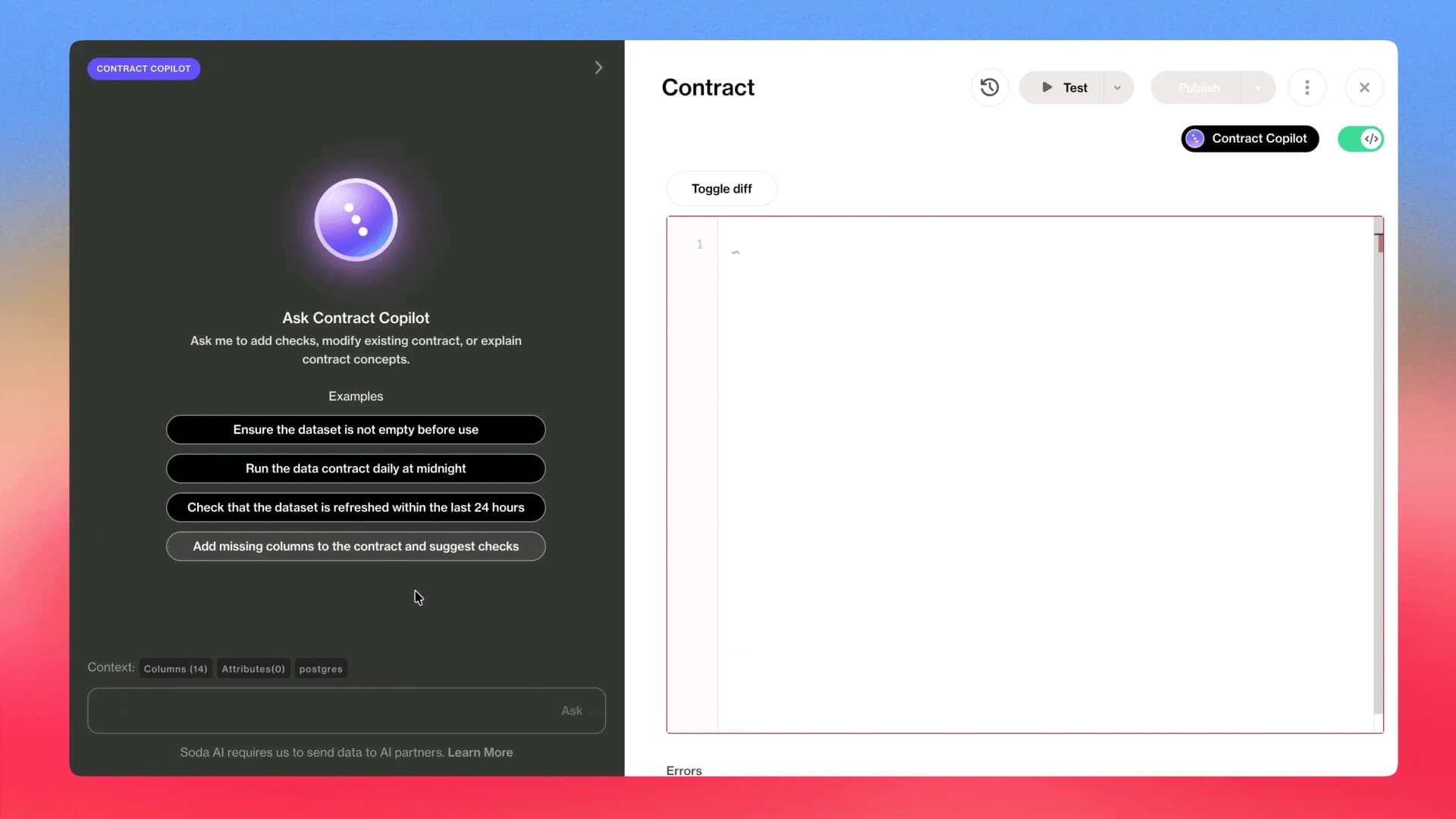
Feature Comparison
| Feature | Castor | Soda |
|---|---|---|
| Data Discovery & Cataloging | ||
| Natural Language Data Search | Full AI-powered search across all data assets | Not verified |
| Automated Data Cataloging | Automated metadata ingestion and cataloging | Not verified |
| Business Glossary | Built-in collaborative business glossary | Not verified |
| Data Quality & Monitoring | ||
| Automated Data Quality Checks | AI-driven data trust assessments | Full automated quality checks with data contracts |
| Anomaly Detection | Not verified | Record-level anomaly detection with AI |
| Metrics Monitoring | Not verified | Scales to 1B rows in 64 seconds with 70% fewer false positives |
| Data Contracts | Not verified | AI-powered data contracts with automated generation |
| Backfilling & Backtesting | Not verified | Built-in historical data analysis |
| Governance & Collaboration | ||
| Data Lineage | Automated column-level lineage | Not verified |
| Access Control & RBAC | Modular role-based permissions with audit trails | Custom roles and RBAC (Team tier and above) |
| Natural Language to SQL | Built-in NL-to-SQL conversion | Not verified |
| Collaborative Workflows | Crowdsourced documentation model | Engineers in Git, business users in UI, versioned changes |
| Root Cause Analysis | Not verified | Diagnostics warehouse with complete traceability |
| Sensitive Data Classification | Built-in classification and privacy management | Not verified |
Data Discovery & Cataloging
Natural Language Data Search
Automated Data Cataloging
Business Glossary
Data Quality & Monitoring
Automated Data Quality Checks
Anomaly Detection
Metrics Monitoring
Data Contracts
Backfilling & Backtesting
Governance & Collaboration
Data Lineage
Access Control & RBAC
Natural Language to SQL
Collaborative Workflows
Root Cause Analysis
Sensitive Data Classification
How they fit together
Castor and Soda serve fundamentally different roles in the modern data stack. Castor is the right choice when your primary challenge is helping people find, understand, and trust your data assets through a centralized catalog. Soda is the right choice when your primary challenge is catching, explaining, and resolving data quality issues before they reach production. Many organizations use both tools together since data cataloging and data quality monitoring are complementary capabilities.
What each one handles
Use Castor for:
We recommend Castor for organizations where data discovery and governance are the core priorities. If your team spends significant time searching for the right datasets, answering repetitive questions from stakeholders, or struggling with undocumented data assets, Castor addresses these problems directly. Its AI-powered natural language search reduces data discovery time from minutes to seconds, and its automated documentation and business glossary create a single source of truth. Castor is particularly strong for enterprises that need column-level data lineage, sensitive data classification, and compliance features like audit trails and role-based access control. The platform works well for organizations with a mix of technical and non-technical users who all need to interact with data assets confidently.
Use Soda for:
We recommend Soda for data engineering teams that need to enforce data quality standards across their pipelines and prevent bad data from reaching production. Soda excels at automated quality checks through its data contracts engine, record-level anomaly detection, and metrics monitoring that scales to billions of rows. The freemium pricing model with an open-source core (2,335 GitHub stars) makes it accessible for teams to start small and scale up. Soda is particularly strong when engineers and business users need to collaborate on data quality standards, since engineers can work in Git while business users interact through the UI. The built-in backfilling and backtesting capabilities allow teams to analyze historical data patterns immediately, and the diagnostics warehouse provides full traceability for root cause analysis of data issues.
These roles reflect the available product evidence. Most teams run both; which one owns a given job depends on your stack and team.
Frequently Asked Questions
Can Castor and Soda be used together?
Yes, Castor and Soda address different layers of the data stack and are complementary. Castor handles data discovery, cataloging, and governance, while Soda handles data quality monitoring and enforcement. Organizations often pair a data catalog with a data quality tool to create a complete data trust framework where data assets are both discoverable and validated.
Which tool is better for data governance?
Castor is the stronger choice for comprehensive data governance. It provides data lineage, sensitive data classification, access control with role-based permissions, audit trails, and a business glossary. Soda includes governance features like audit logs and RBAC in its Team tier, but its governance capabilities are focused specifically on data quality standards through data contracts rather than broad catalog-level governance.
Does Soda have a free tier?
Yes, Soda offers a free tier at $0 per month that includes pipeline testing, metrics observability, and alerting and ticketing integrations with unlimited users. The Team tier at $750 per month adds collaborative data contracts, a no-code interface, advanced AI features, audit logs, custom roles, RBAC, private deployment, and SSO. Enterprise pricing is custom.
Is Soda open source?
Soda has an open-source component called soda-core, which is available on GitHub with over 2,335 stars and is written in Python. The open-source engine focuses on data quality checks and data contracts. The full Soda platform with the UI, advanced AI features, collaborative workflows, and enterprise capabilities requires a paid subscription.
What integrations does Castor support?
Castor integrates with a wide range of data tools across the modern data stack. It supports automated metadata ingestion from various data sources and provides column-level lineage mapping across connected systems. The platform is designed to work with your existing data infrastructure, including data warehouses, BI tools, and transformation frameworks.