Decision comparison
Immuta vs Alation
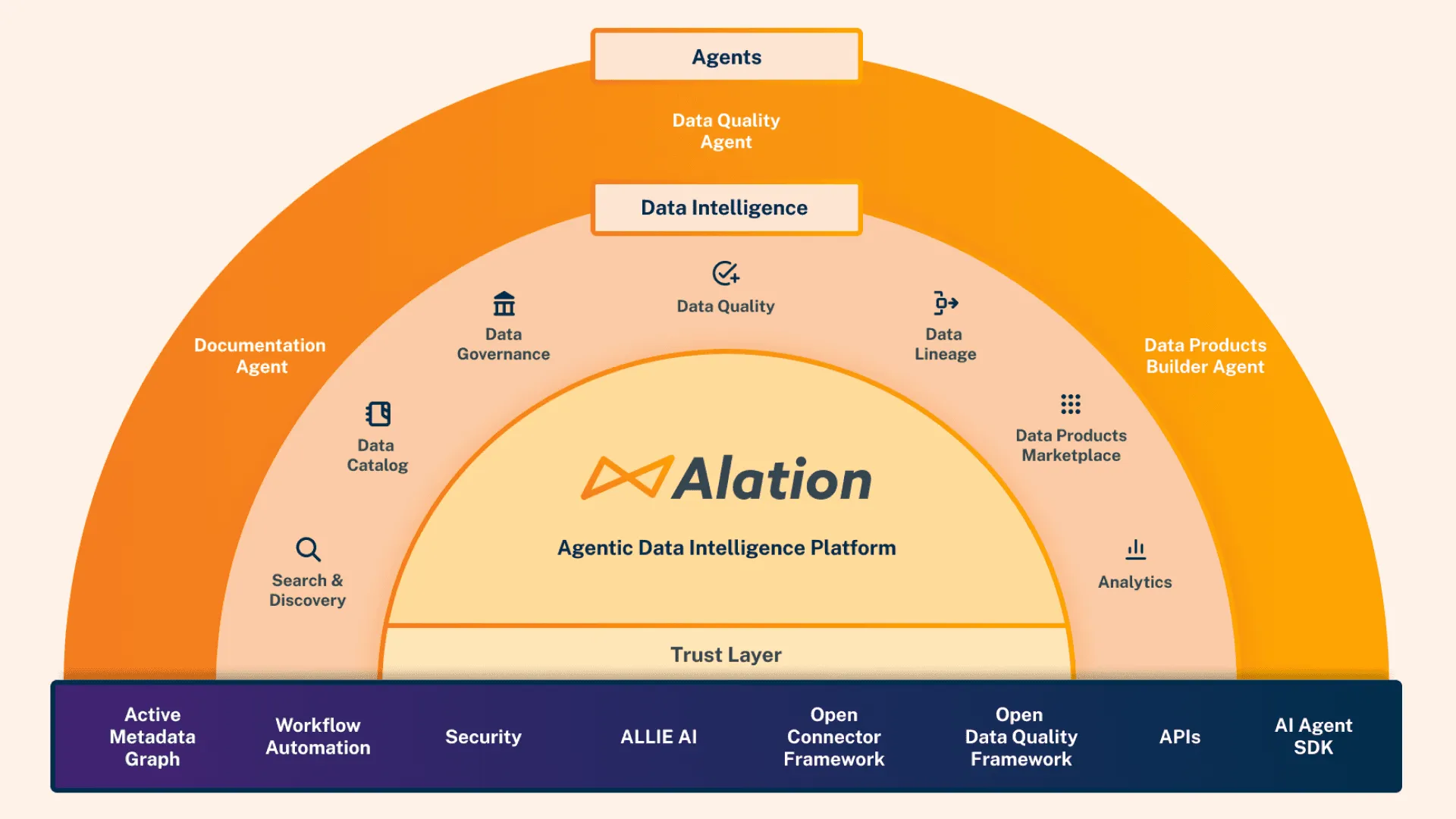
Immuta and Alation serve fundamentally different roles in the modern data stack. Immuta is the data access and provisioning layer that automates policy enforcement and data security across cloud platforms, while Alation is the data intelligence and cataloging hub that helps organizations discover, understand, and govern their data assets.
Architecture choice. These take different approaches to the same problem. Read the table as a fit question rather than a feature race.
These are different kinds of product — Data Access Control and Data Catalog.
Quick Comparison
| Decision factor | Immuta | Alation |
|---|---|---|
| Primary Focus | Data access control, policy enforcement, and automated provisioning across cloud platforms | Data cataloging, metadata management, governance, and agentic data intelligence workflows |
| Pricing Model | Contact for pricing | Alation publishes no pricing. alation.com/pricing resolves to a contact form, and no plan or edition names are published either, so every figure is set in a quote. |
| Data Platform Integrations | Native connectors for Databricks, Snowflake, BigQuery, Starburst/Trino, Redshift, and more | 120+ pre-built connectors spanning databases, BI tools, file systems, and cloud platforms |
| AI Capabilities | Conversational AI for natural data interactions and automated policy-driven access management | Agentic workflows automating documentation, ALLIE AI for metadata curation, natural language search |
| Implementation Timeline | Faster deployment with native integrations and policy-based automation reducing setup overhead | Typical deployments require 3 to 9 months with professional services involvement |
| Best For | DataOps and engineering teams needing automated data provisioning with fine-grained access controls | Large enterprises needing a unified data catalog with governance, lineage, and collaboration tools |
Immuta
- Primary Focus:
- Data access control, policy enforcement, and automated provisioning across cloud platforms
- Pricing Model:
- Contact for pricing
- Data Platform Integrations:
- Native connectors for Databricks, Snowflake, BigQuery, Starburst/Trino, Redshift, and more
- AI Capabilities:
- Conversational AI for natural data interactions and automated policy-driven access management
- Implementation Timeline:
- Faster deployment with native integrations and policy-based automation reducing setup overhead
- Best For:
- DataOps and engineering teams needing automated data provisioning with fine-grained access controls
Alation
- Primary Focus:
- Data cataloging, metadata management, governance, and agentic data intelligence workflows
- Pricing Model:
- Alation publishes no pricing. alation.com/pricing resolves to a contact form, and no plan or edition names are published either, so every figure is set in a quote.
- Data Platform Integrations:
- 120+ pre-built connectors spanning databases, BI tools, file systems, and cloud platforms
- AI Capabilities:
- Agentic workflows automating documentation, ALLIE AI for metadata curation, natural language search
- Implementation Timeline:
- Typical deployments require 3 to 9 months with professional services involvement
- Best For:
- Large enterprises needing a unified data catalog with governance, lineage, and collaboration tools
Public signals
Verified factual signals only. Bars appear only for like-for-like metrics with five weekly assessments for every tool; missing evidence stays explicit. These signals do not establish enterprise adoption, product quality, or total cost.
| Metric | Immuta | Alation |
|---|---|---|
| GitHub commits, 90d(Developer adoption) | 0 | 2 |
| GitHub stars(Developer adoption) | 0 | 19 |
| Search interest(Market interest) | 0 | Unavailable |
| Hacker News mentions, 90d(Community interest) | 0 | Not available |
| Product Hunt comments(Community interest) | Not available | 0 |
| Product Hunt reviews(Community interest) | Not available | 0 |
| Product Hunt votes(Community interest) | Not available | 2 |
| Stack Overflow questions(Community interest) | Not available | 12 |
As of September 21, 2026 — updated weekly.
Interface Preview
Alation
Feature Comparison
| Feature | Immuta | Alation |
|---|---|---|
| Data Access & Security | ||
| Attribute-Based Access Control (ABAC) | Native ABAC with dynamic policy enforcement across all supported platforms | Access control through governance policies and stewardship workflows |
| Dynamic Data Masking | Built-in dynamic masking to protect sensitive data without copying or moving it | Data masking through governance module as a paid add-on capability |
| Unified Audit Logging | Unified audit with structured logs, filtering, and automatic push to external systems | Usage tracking and analytics for monitoring data access and consumption patterns |
| Data Discovery & Cataloging | ||
| Natural Language Search | Data marketplace with search and filtering to discover available data assets | ML-powered natural language search across the entire data catalog with trust signals |
| Metadata Management | Metadata registry integrating with external sources and auto-updating on data changes | Active metadata graph connecting technical, business, operational, and social metadata |
| Data Lineage | Audit-based lineage tracking through policy enforcement and access logs | End-to-end data lineage from source to destination with visual mapping and impact analysis |
| Governance & Compliance | ||
| Policy Authoring | Plain-language policy authoring with real-time orchestration across all data platforms | Centralized governance policies with automated stewardship and approval workflows |
| Regulatory Framework Support | Automated data classification and categorization according to regulatory frameworks | Compliance built into governance workflows with lineage-tied policy enforcement |
| Data Domain Management | Dedicated data domains with local owner approvals and usage visibility within domains | Multi-domain support in Enterprise tier for organizing data across business units |
| Collaboration & Productivity | ||
| Self-Service Data Access | Automated provisioning with request workflows and time-bound conditional approvals | Self-service analytics with catalog integration into Excel, Slack, Teams, and BI tools |
| SQL Capabilities | Focuses on data access layer rather than direct SQL editing tools | Built-in SQL editor (Compose) for writing, sharing, and reusing queries across teams |
| AI-Assisted Workflows | Conversational AI enabling humans and agents to manage data access at scale | ALLIE AI for intelligent curation and agentic workflows for automated documentation |
| Integration & Deployment | ||
| Cloud Platform Coverage | Native integrations with Databricks, Snowflake, BigQuery, Starburst/Trino, AWS, and Azure services | 120+ connectors covering databases, BI tools, file systems, cloud platforms, and applications |
| Identity Provider Integration | Integrates with Active Directory, Okta, SailPoint, SAML, OpenID, LDAP, and HR systems | Standard enterprise identity integrations through the platform's access control layer |
| Deployment Options | Cloud-native platform operating natively within customer data platforms | Alation Cloud Service (SaaS) or customer-managed on-premises deployment |
Data Access & Security
Attribute-Based Access Control (ABAC)
Dynamic Data Masking
Unified Audit Logging
Data Discovery & Cataloging
Natural Language Search
Metadata Management
Data Lineage
Governance & Compliance
Policy Authoring
Regulatory Framework Support
Data Domain Management
Collaboration & Productivity
Self-Service Data Access
SQL Capabilities
AI-Assisted Workflows
Integration & Deployment
Cloud Platform Coverage
Identity Provider Integration
Deployment Options
Which approach fits
Immuta and Alation serve fundamentally different roles in the modern data stack. Immuta is the data access and provisioning layer that automates policy enforcement and data security across cloud platforms, while Alation is the data intelligence and cataloging hub that helps organizations discover, understand, and govern their data assets.
When each approach fits
Choose Immuta if:
Choose Immuta if your primary challenge is managing data access at scale across multiple cloud platforms. Immuta excels when your organization needs automated policy enforcement, dynamic data masking, and streamlined provisioning workflows. It is particularly strong for DataOps and engineering teams working with Databricks, Snowflake, or BigQuery who need to eliminate ticket queues and enforce fine-grained access controls without moving or copying data. Organizations reporting 80% fewer policies and 90% fewer tickets after adoption confirm its operational efficiency.
Choose Alation if:
Choose Alation if your organization needs a comprehensive data catalog with strong discovery, governance, and collaboration capabilities. Alation is the better fit when your teams need natural language search across data assets, end-to-end data lineage visualization, and a collaborative environment where business users and analysts can find and trust data. As a 5X Gartner Magic Quadrant Leader for Metadata Management with 120+ connectors and adoption by 40% of the Fortune 100, Alation is proven at enterprise scale for organizations investing in long-term data intelligence infrastructure.
These scenarios reflect the available product evidence. Your requirements, existing stack, and team expertise should guide the final decision.
Frequently Asked Questions
What is the main difference between Immuta and Alation?
Immuta and Alation solve different problems in the data stack. Immuta focuses on data access control and automated provisioning, enforcing policies across cloud platforms like Databricks and Snowflake so that data consumers get access without manual ticket queues. Alation focuses on data cataloging, discovery, and intelligence, providing a searchable catalog with metadata management, data lineage, and governance workflows. Many organizations actually use both tools together, with Immuta handling the access enforcement layer and Alation serving as the catalog and discovery interface. Immuta even lists Alation as one of its catalog integration partners.
How do Immuta and Alation compare on pricing?
Both Immuta and Alation use enterprise pricing models that require contacting sales for a quote. Immuta does not publicly disclose pricing details. Alation has more pricing visibility, with base subscriptions starting around $60,000 to $198,000 per year for 25 Creator seats. Alation deployments for mid-sized enterprises can reach significantly higher annual costs when factoring in connectors, governance add-ons, and professional services. Both tools represent significant enterprise investments and we recommend obtaining competing quotes during evaluation.
Can Immuta and Alation be used together?
Yes, Immuta and Alation are complementary tools that integrate with each other. Immuta lists Alation as a supported catalog integration, meaning organizations can use Alation for data discovery and cataloging while relying on Immuta for access control and policy enforcement. In this setup, Alation serves as the front door where users discover and understand data assets, while Immuta operates behind the scenes to enforce who can access what data and under which conditions. This combination gives organizations both strong discovery capabilities and automated security controls across their cloud data platforms.
Which tool is better for regulatory compliance?
Both tools support compliance but from different angles. Immuta approaches compliance through automated data access controls, dynamic data masking, and continuous audit monitoring. It categorizes data according to regulatory frameworks and enforces policies in real time across all supported platforms, reducing the manual effort of recertification by 50% and auditing by 70% according to the vendor. Alation approaches compliance through data governance workflows, data lineage tracking, and stewardship programs that tie policies to data quality and lineage for provable compliance. For organizations where access control enforcement is the primary compliance concern, Immuta is stronger. For organizations focused on metadata governance, lineage documentation, and audit-ready reporting, Alation has the edge.
How long does it take to implement each platform?
Implementation timelines differ between the two platforms. Immuta emphasizes faster deployment through native integrations with cloud data platforms like Databricks, Snowflake, and BigQuery, operating directly within those platforms rather than requiring a separate infrastructure layer. Alation typically requires 3 to 9 months for deployment with professional services involvement, according to multiple industry sources. The difference stems from their architectures: Immuta plugs into existing compute platforms natively, while Alation requires connector setup, metadata harvesting, workflow configuration, and user onboarding across the organization before delivering full value.