Decision comparison
OpenMetadata vs Soda
OpenMetadata and Soda serve fundamentally different roles in the modern data stack. OpenMetadata operates as a unified metadata platform that brings discovery, lineage, governance, and quality together under one roof, while Soda focuses exclusively on automated data quality with AI-powered anomaly detection and a collaborative data contracts engine. Organizations that need a single catalog to organize and govern their entire data estate will find OpenMetadata delivers broader coverage at no licensing cost. Teams whose primary pain point is catching and resolving data quality issues before they reach production will benefit more from Soda's specialized quality automation and peer-reviewed ML algorithms.
Used together. These are normally used together rather than chosen between. The comparison explains what each one does in the stack.
These are different kinds of product — Data Catalog and Data Validation Framework.
Quick Comparison
| Decision factor | OpenMetadata | Soda |
|---|---|---|
| Primary Focus | Unified metadata platform covering discovery, observability, governance, and quality | AI-native data quality platform focused on detection, resolution, and data contracts |
| Pricing Model | Free and open-source under Apache 2.0 license | Free tier at $0 per month, Team tier at $750 per month, with enterprise features available |
| Deployment | Self-hosted with 4 system components or managed SaaS via Collate | SaaS platform where data stays in the customer's cloud environment |
| Data Quality Checks | Built-in data quality checks integrated into the metadata platform with profiler workflows | Automated quality checks with YAML-based definitions, anomaly detection, and AI-generated checks |
| Data Discovery | Full-text search across tables, topics, dashboards, pipelines, and services with faceted navigation | No metadata discovery layer; focused exclusively on data quality monitoring and validation |
| AI Capabilities | No dedicated AI engine for quality; relies on rule-based profiling and validation | Peer-reviewed AI algorithms for anomaly detection published in NeurIPS, JAIR, and ACML |
| Connector Ecosystem | 120+ native connectors spanning databases, dashboards, pipelines, ML models, and storage | Integrates with major data warehouses and catalogs; engineers define checks via code |
| Data Contracts | Supports data contracts as part of the governance workflow within the metadata graph | Dedicated data contracts engine with collaborative workflows between Git and UI interfaces |
| Open Source Model | Fully open source under Apache 2.0 with 370+ code contributors and 11,000+ community members | Open source CLI (soda-core) available; commercial SaaS platform adds AI and collaboration features |
| Best For | Teams needing a unified metadata catalog with built-in discovery, lineage, governance, and quality | Teams prioritizing automated data quality checks, AI-powered anomaly detection, and data contracts |
OpenMetadata
- Primary Focus:
- Unified metadata platform covering discovery, observability, governance, and quality
- Pricing Model:
- Free and open-source under Apache 2.0 license
- Deployment:
- Self-hosted with 4 system components or managed SaaS via Collate
- Data Quality Checks:
- Built-in data quality checks integrated into the metadata platform with profiler workflows
- Data Discovery:
- Full-text search across tables, topics, dashboards, pipelines, and services with faceted navigation
- AI Capabilities:
- No dedicated AI engine for quality; relies on rule-based profiling and validation
- Connector Ecosystem:
- 120+ native connectors spanning databases, dashboards, pipelines, ML models, and storage
- Data Contracts:
- Supports data contracts as part of the governance workflow within the metadata graph
- Open Source Model:
- Fully open source under Apache 2.0 with 370+ code contributors and 11,000+ community members
- Best For:
- Teams needing a unified metadata catalog with built-in discovery, lineage, governance, and quality
Soda
- Primary Focus:
- AI-native data quality platform focused on detection, resolution, and data contracts
- Pricing Model:
- Free tier at $0 per month, Team tier at $750 per month, with enterprise features available
- Deployment:
- SaaS platform where data stays in the customer's cloud environment
- Data Quality Checks:
- Automated quality checks with YAML-based definitions, anomaly detection, and AI-generated checks
- Data Discovery:
- No metadata discovery layer; focused exclusively on data quality monitoring and validation
- AI Capabilities:
- Peer-reviewed AI algorithms for anomaly detection published in NeurIPS, JAIR, and ACML
- Connector Ecosystem:
- Integrates with major data warehouses and catalogs; engineers define checks via code
- Data Contracts:
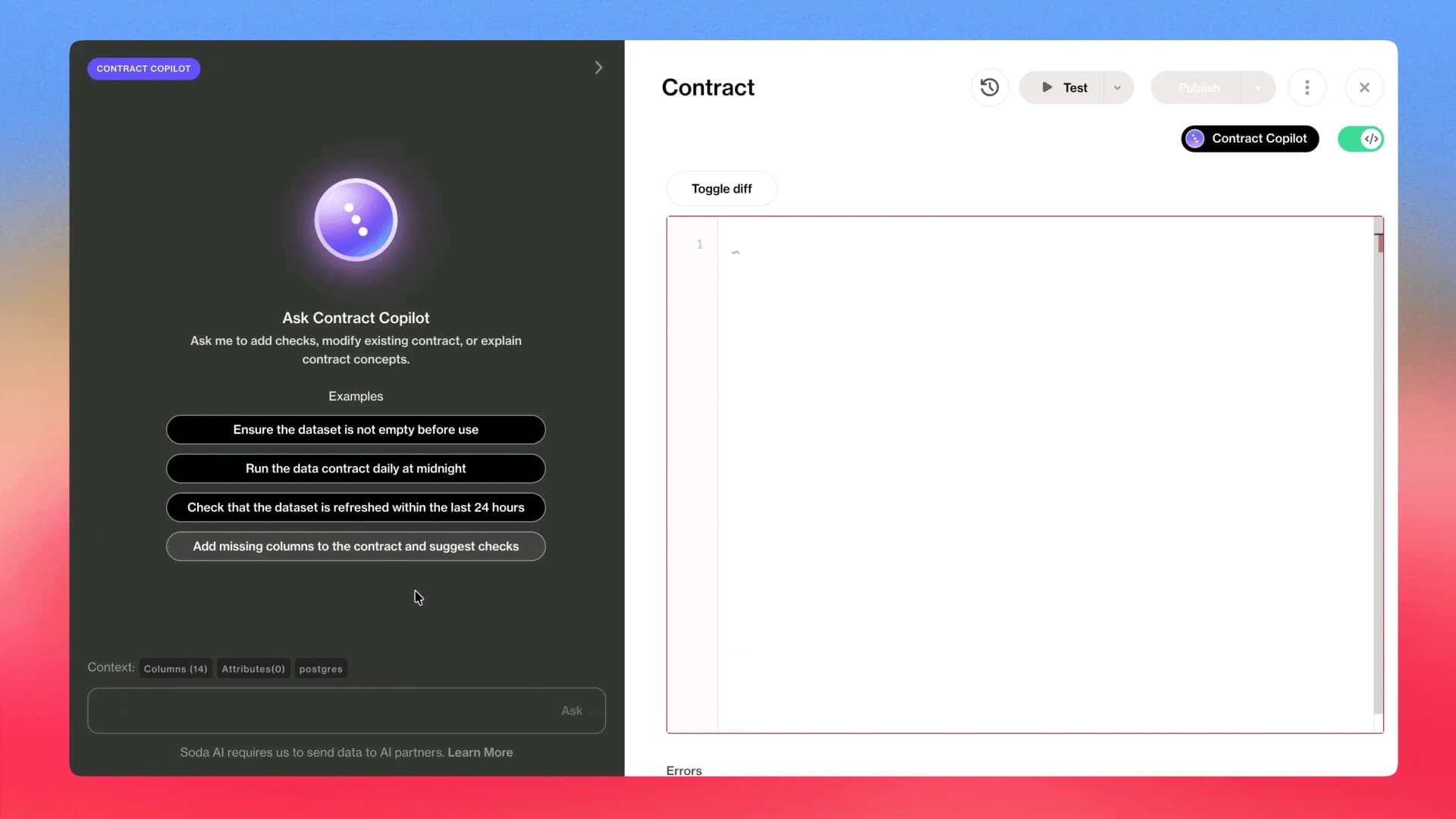
- Dedicated data contracts engine with collaborative workflows between Git and UI interfaces
- Open Source Model:
- Open source CLI (soda-core) available; commercial SaaS platform adds AI and collaboration features
- Best For:
- Teams prioritizing automated data quality checks, AI-powered anomaly detection, and data contracts
Public signals
Verified factual signals only. Bars appear only for like-for-like metrics with five weekly assessments for every tool; missing evidence stays explicit. These signals do not establish enterprise adoption, product quality, or total cost.
| Metric | OpenMetadata | Soda |
|---|---|---|
| Docker Hub pulls(Product adoption) | 5.3M | Not available |
| GitHub commits, 90d(Product adoption) | 2.0k | 81 |
| GitHub stars(Product adoption) | 15,000+ | 2,000+ |
| Search interest(Market interest) | 1 | 0 |
| PyPI weekly downloads(Product adoption) | 39.9k | 405.8k |
As of September 21, 2026 — updated weekly.
Health & risk evidence
Observed public-source checks for mapped package versions and repositories.
OpenMetadata
September 21, 2026Package vulnerabilities
PyPI · openmetadata-ingestion@2.0.2.0
0 vulnerabilities
across 1 package
Repository security score
github.com/open-metadata/OpenMetadata
4.6/10
Soda
September 21, 2026Package vulnerabilities
PyPI · soda-core@4.24.0
0 vulnerabilities
across 1 package
Repository security score
Not available
Interface Preview
Soda
Feature Comparison
| Feature | OpenMetadata | Soda |
|---|---|---|
| Data Quality & Validation | ||
| Automated Data Quality Checks | Provides built-in profiler workflows that run schema, completeness, and custom SQL checks against connected data assets within the metadata platform | Implements YAML-based check definitions with automated scheduling, freshness thresholds, schema validation, and AI-generated checks from plain English descriptions |
| Anomaly Detection | Offers threshold-based alerting through data profiler tests that flag deviations from expected patterns in column-level statistics | Deploys peer-reviewed ML algorithms that operate at both metrics and record level, claiming 70% fewer false positives than Facebook Prophet and scaling to 1B rows in 64 seconds |
| Data Profiling | Runs automated column-level profiling that captures statistics like null counts, distinct values, and distribution metrics across all connected data sources | Provides metrics monitoring with interactive visualizations, smart adaptive thresholds, and built-in backfilling that analyzes up to one year of historical data |
| Data Discovery & Catalog | ||
| Metadata Search & Discovery | Delivers full-text search with faceted navigation across tables, topics, dashboards, pipelines, and services through a unified metadata graph | Does not provide a metadata discovery or catalog layer; focuses exclusively on quality monitoring and validation of known datasets |
| Column-Level Lineage | Tracks column-level lineage and data transformations across the full data estate with automated lineage extraction from 100+ connected sources | Does not offer lineage tracking; relies on integration with external catalog tools for lineage context |
| Data Asset Documentation | Supports rich documentation with descriptions, tags, glossary terms, and ownership assignments directly on data assets within the catalog | Stores check definitions and contract metadata alongside datasets but does not serve as a general-purpose documentation platform |
| Governance & Collaboration | ||
| Data Contracts | Implements data contracts within the governance workflow allowing teams to define and enforce expectations on metadata entities through the platform | Provides a dedicated data contracts engine where engineers write contracts in Git while business users manage them through a no-code UI with versioning and diffs |
| Role-Based Access Control | Implements customizable roles, policies, and team-based access control for managing permissions across all metadata entities and operations | Offers custom roles, RBAC, audit logs, and SSO on the Enterprise tier with governance-by-design permission controls built into the contracts workflow |
| Collaboration Workflows | Enables conversations, tasks, and announcements on data assets with activity feeds and notification integrations for team coordination | Bridges engineering and business workflows where engineers work in Git and business users interact through the UI with shared versioned proposals |
| Integration & Architecture | ||
| Connector Ecosystem | Ships with 100+ turnkey connectors covering databases, dashboards, pipelines, ML models, messaging, and storage services with new connectors added each release | Connects to major data warehouses and orchestration tools with engineers defining data sources through YAML configuration files |
| API Architecture | Built on an API-first and schema-first architecture with standardized REST APIs and extensible metadata entities for custom integrations | Provides a Python-based open source CLI (soda-core) for programmatic check execution with integration hooks for CI/CD pipelines and orchestrators |
| Deployment Model | Deploys as a self-hosted platform with 4 system components or as a managed SaaS through Collate with a free tier sandbox available | Operates as a SaaS platform where the control plane runs in Soda's cloud while data processing stays within the customer's own cloud environment |
| Observability & Alerting | ||
| Data Observability Dashboard | Provides observability views within the metadata platform showing data freshness, pipeline status, and quality test results across all connected assets | Delivers interactive observability dashboards that monitor thousands of tables with drill-down capability from organization-wide views to individual anomalies |
| Alerting & Incident Management | Sends alerts through configurable notification channels when profiler tests or quality checks detect failures on monitored data assets | Routes alerts to ticketing integrations with a diagnostics warehouse that stores all failed records for root cause analysis and complete traceability |
| Root Cause Analysis | Supports investigation through lineage tracing and metadata version history to identify upstream changes that caused data quality issues | Automatically stores failed records in a diagnostics warehouse within the customer's environment and provides complete traceability logs for every anomaly |
Data Quality & Validation
Automated Data Quality Checks
Anomaly Detection
Data Profiling
Data Discovery & Catalog
Metadata Search & Discovery
Column-Level Lineage
Data Asset Documentation
Governance & Collaboration
Data Contracts
Role-Based Access Control
Collaboration Workflows
Integration & Architecture
Connector Ecosystem
API Architecture
Deployment Model
Observability & Alerting
Data Observability Dashboard
Alerting & Incident Management
Root Cause Analysis
How they fit together
OpenMetadata and Soda serve fundamentally different roles in the modern data stack. OpenMetadata operates as a unified metadata platform that brings discovery, lineage, governance, and quality together under one roof, while Soda focuses exclusively on automated data quality with AI-powered anomaly detection and a collaborative data contracts engine. Organizations that need a single catalog to organize and govern their entire data estate will find OpenMetadata delivers broader coverage at no licensing cost. Teams whose primary pain point is catching and resolving data quality issues before they reach production will benefit more from Soda's specialized quality automation and peer-reviewed ML algorithms.
What each one handles
Use OpenMetadata for:
OpenMetadata is the stronger choice for organizations that need a centralized metadata catalog alongside their data quality checks. It consolidates discovery, column-level lineage, governance, and quality profiling into a single open source platform with 120+ native connectors, making it practical for teams that want to eliminate metadata silos without paying licensing fees. The Apache 2.0 license and self-hosted deployment give engineering teams full control over their metadata infrastructure.
Use Soda for:
Soda is the stronger choice for teams that need dedicated, AI-powered data quality automation with minimal infrastructure overhead. Its peer-reviewed anomaly detection algorithms, collaborative data contracts engine, and diagnostics warehouse provide a depth of quality tooling that a general-purpose metadata platform cannot match. The SaaS deployment model and dual Git-plus-UI workflow make it accessible to both engineers and business stakeholders without requiring teams to operate additional infrastructure.
These roles reflect the available product evidence. Most teams run both; which one owns a given job depends on your stack and team.
Frequently Asked Questions
Can OpenMetadata replace Soda for data quality monitoring?
OpenMetadata includes built-in data quality checks through its profiler workflows, covering schema validation, completeness tests, and custom SQL checks across connected data sources. However, it lacks Soda's specialized AI-powered anomaly detection algorithms, record-level anomaly detection, and the dedicated diagnostics warehouse that stores failed records for root cause analysis. Organizations with straightforward quality requirements may find OpenMetadata's built-in checks sufficient, while teams dealing with complex quality issues at scale will likely need Soda's deeper quality tooling or a similar dedicated solution alongside their metadata catalog.
How do the data contracts implementations differ between OpenMetadata and Soda?
OpenMetadata implements data contracts as part of its broader governance workflow within the unified metadata graph, allowing teams to define and enforce expectations on metadata entities alongside lineage, documentation, and access policies. Soda provides a dedicated data contracts engine built specifically for quality enforcement, where engineers write contracts as YAML in Git while business users manage them through a no-code UI interface. Soda's implementation includes versioning with proposals and diffs visible in both views, AI-powered contract generation, and automated quality check enforcement tied directly to each contract definition.
What are the cost implications of running OpenMetadata versus Soda?
OpenMetadata is entirely free and open source under the Apache 2.0 license, though organizations bear the operational cost of self-hosting and maintaining the platform's four system components. A managed SaaS option is available through Collate for teams that prefer not to operate the infrastructure themselves. Soda offers a free tier at $0 per month for small projects with basic pipeline testing and metrics observability, a Team tier at $750 per month that adds collaborative data contracts and no-code interface features, and custom Enterprise pricing that includes advanced AI capabilities, SSO, RBAC, audit logs, and private deployment options.
Can OpenMetadata and Soda be used together in the same data stack?
OpenMetadata and Soda complement each other well when deployed together because they address different layers of the data management problem. OpenMetadata serves as the central metadata catalog providing discovery, lineage, and governance across the entire data estate, while Soda handles the specialized data quality monitoring with AI-driven anomaly detection and contract enforcement. Teams running both tools typically use OpenMetadata to organize and discover data assets and track lineage, while Soda monitors the quality of those assets with automated checks and routes failures to the diagnostics warehouse for investigation and resolution.