Decision comparison
Collibra vs Soda
Collibra delivers comprehensive enterprise data governance with AI registry, lineage, catalog and privacy modules, while Soda focuses on AI-native data quality monitoring with transparent pricing and open-source flexibility.
Used together. These are normally used together rather than chosen between. The comparison explains what each one does in the stack.
These are different kinds of product — Data Catalog and Data Validation Framework.
Quick Comparison
| Decision factor | Collibra | Soda |
|---|---|---|
| Best For | Enterprise-wide data governance across catalogs, lineage, privacy and AI with unified compliance workflows | AI-native data quality monitoring with automated checks, anomaly detection and data contracts for engineering teams |
| Pricing | Contact for pricing | Free tier at $0 per month, Team tier at $750 per month, with enterprise features available |
| Data Quality | Built-in data quality and observability module integrated with governance workflows and remediation processes | Core focus with AI-powered anomaly detection scaling to 1B rows in 64 seconds with 70% fewer false positives |
| Integration Approach | 100+ native integrations plus Collibra Everywhere browser extension for Salesforce, Databricks, Tableau and Slack | Open-source Python library with 2,335 GitHub stars, Git-based workflows and data warehouse diagnostics storage |
| AI Capabilities | Unified AI registry for cataloging models and agents, cross-platform traceability across Vertex AI and SageMaker | Peer-reviewed AI research published in NeurIPS, JAIR and ACML powering automated data contracts and checks |
| Governance Scope | Full-spectrum governance covering data catalog, privacy, lineage, marketplace and AI governance in one platform | Focused data quality governance through collaborative data contracts shared between engineering and business users |
Collibra
- Best For:
- Enterprise-wide data governance across catalogs, lineage, privacy and AI with unified compliance workflows
- Pricing:
- Contact for pricing
- Data Quality:
- Built-in data quality and observability module integrated with governance workflows and remediation processes
- Integration Approach:
- 100+ native integrations plus Collibra Everywhere browser extension for Salesforce, Databricks, Tableau and Slack
- AI Capabilities:
- Unified AI registry for cataloging models and agents, cross-platform traceability across Vertex AI and SageMaker
- Governance Scope:
- Full-spectrum governance covering data catalog, privacy, lineage, marketplace and AI governance in one platform
Soda
- Best For:
- AI-native data quality monitoring with automated checks, anomaly detection and data contracts for engineering teams
- Pricing:
- Free tier at $0 per month, Team tier at $750 per month, with enterprise features available
- Data Quality:
- Core focus with AI-powered anomaly detection scaling to 1B rows in 64 seconds with 70% fewer false positives
- Integration Approach:
- Open-source Python library with 2,335 GitHub stars, Git-based workflows and data warehouse diagnostics storage
- AI Capabilities:
- Peer-reviewed AI research published in NeurIPS, JAIR and ACML powering automated data contracts and checks
- Governance Scope:
- Focused data quality governance through collaborative data contracts shared between engineering and business users
Public signals
Verified factual signals only. Bars appear only for like-for-like metrics with five weekly assessments for every tool; missing evidence stays explicit. These signals do not establish enterprise adoption, product quality, or total cost.
| Metric | Collibra | Soda |
|---|---|---|
| GitHub commits, 90d(Developer adoption) | 107 | Not available |
| GitHub stars(Developer adoption) | 36 | Not available |
| Search interest(Market interest) | 0 | 0 |
| Hacker News mentions, 90d(Community interest) | 0 | Not available |
| Stack Overflow questions(Community interest) | 10 | Not available |
| GitHub commits, 90d(Product adoption) | Not available | 81 |
| GitHub stars(Product adoption) | Not available | 2,000+ |
| PyPI weekly downloads(Product adoption) | Not available | 405.8k |
As of September 21, 2026 — updated weekly.
Health & risk evidence
Observed public-source checks for mapped package versions and repositories.
Collibra
Package vulnerabilities
Not available
Repository security score
Not available
Soda
September 21, 2026Package vulnerabilities
PyPI · soda-core@4.24.0
0 vulnerabilities
across 1 package
Repository security score
Not available
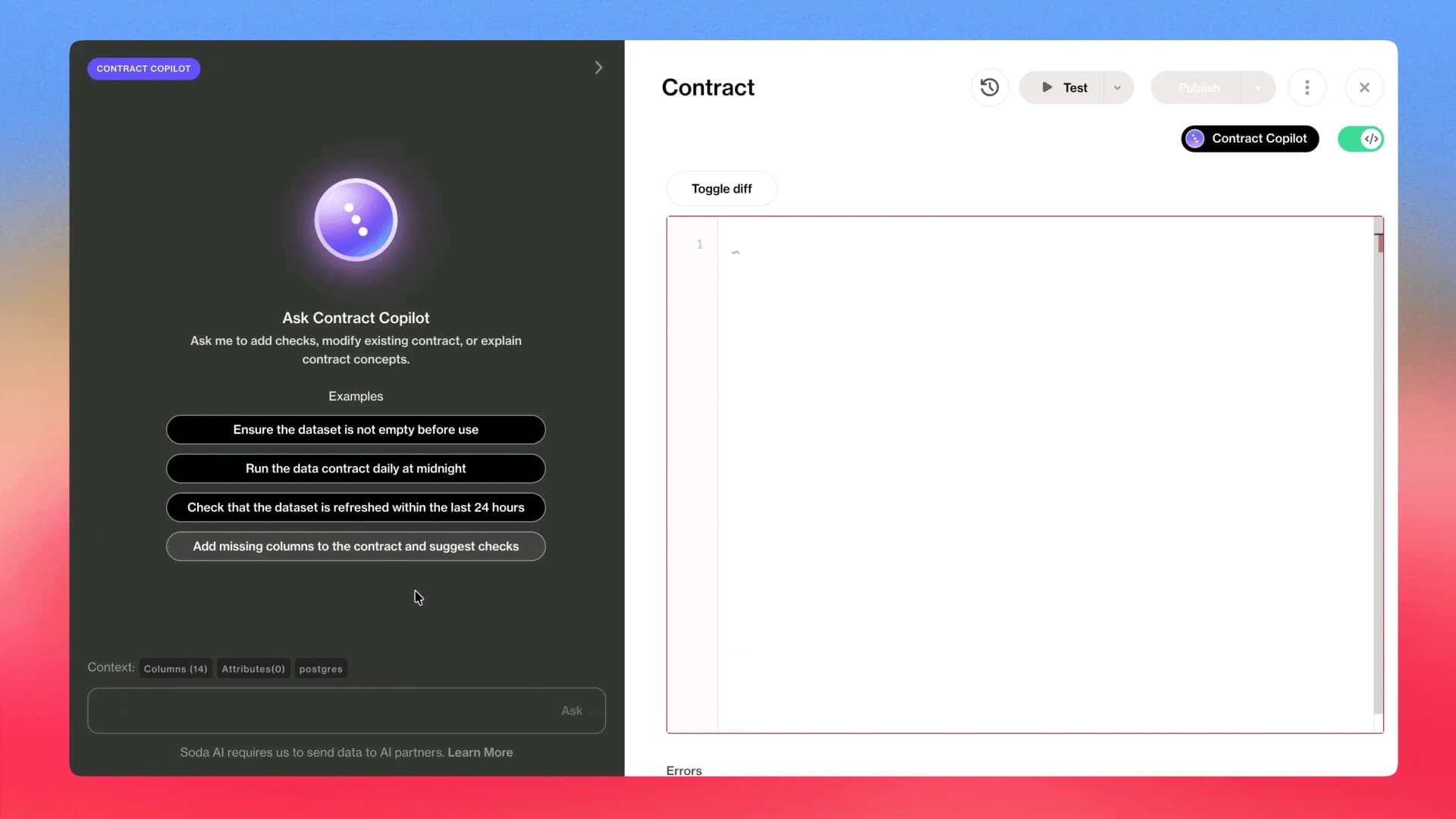
Interface Preview
Soda
Feature Comparison
| Feature | Collibra | Soda |
|---|---|---|
| Data Quality Monitoring | ||
| Automated Quality Checks | Integrated quality observability module monitors data and pipelines with remediation workflows | AI-powered automated checks with plain English definitions and one-click data contract generation |
| Anomaly Detection | Data observability layer detects quality issues across governed data assets | Record-level anomaly detection with algorithms that beat Facebook Prophet with 70% fewer false positives |
| Historical Analysis | Tracks data quality trends through governance workflows and compliance reporting | Built-in backfilling and backtesting analyzes up to one year of historical data instantly |
| Data Governance | ||
| Data Lineage | Automatic end-to-end lineage mapping across systems with cross-platform AI traceability | Complete traceability for data operations with every log and anomaly captured for auditing |
| Data Contracts | Data contracts promote team alignment and deliver consistent data products through automation | Collaborative data contracts with engineers in Git and business users in UI with versioned proposals |
| Compliance Management | Automated risk reporting across every data source with privacy workflows for global regulations | Governance by design with auditability and permission control plus audit logs and custom RBAC roles |
| AI and Automation | ||
| AI Governance | Unified AI registry catalogs use cases, models and agents across Vertex AI, SageMaker and Databricks | AI co-pilot creates full data contracts with one click and writes checks in plain English |
| Semantic Layer | Automatically generates semantic layer connecting physical data with business terms via semantic graph | Not a core feature; focuses on data quality semantics through contract definitions and check templates |
| Workflow Automation | Intuitive workflow designer automates governance processes for decisions and productivity | Automated detection-to-resolution pipeline catches, explains and resolves data quality issues instantly |
| Deployment and Integration | ||
| Platform Architecture | Cloud-based SaaS platform designed for highly regulated industries including financial services and healthcare | Security by design with data staying in your cloud, plus open-source Python library on GitHub |
| Ecosystem Integrations | 100+ native integrations with partner integrations and APIs connecting the entire data ecosystem | Works with existing data tools via Python library, supports dbt, Snowflake and major data warehouses |
| Developer Experience | Collibra Everywhere browser extension surfaces context in Salesforce, Databricks, Tableau and Slack | Engineers run checks as code in Git while business users work in no-code UI interface |
| Scalability and Performance | ||
| Enterprise Scale | Powers 100+ Fortune 500 companies with federated governance model for complex organizations | Monitors thousands of tables in seconds with metrics algorithms scaling to 1B rows in 64 seconds |
| Root Cause Analysis | Data observability supports rapid remediation of anomalies across governed data assets | Diagnostics warehouse stores all failed records from contracts and anomalies in your data warehouse |
| User Adoption | Collibra University learning paths and community hub drive adoption across data citizens | Dual interface for engineers in code and business in UI unites teams in one shared workflow |
Data Quality Monitoring
Automated Quality Checks
Anomaly Detection
Historical Analysis
Data Governance
Data Lineage
Data Contracts
Compliance Management
AI and Automation
AI Governance
Semantic Layer
Workflow Automation
Deployment and Integration
Platform Architecture
Ecosystem Integrations
Developer Experience
Scalability and Performance
Enterprise Scale
Root Cause Analysis
User Adoption
How they fit together
Collibra delivers comprehensive enterprise data governance with AI registry, lineage, catalog and privacy modules, while Soda focuses on AI-native data quality monitoring with transparent pricing and open-source flexibility.
What each one handles
Use Collibra for:
We recommend Collibra for organizations that need a unified data governance platform spanning catalog, lineage, privacy, compliance and AI governance. It is the stronger choice for Fortune 500 enterprises and highly regulated industries like financial services and healthcare that require a single platform to organize, govern and observe all data assets. Collibra's recognition as a Gartner Leader and its 100+ native integrations make it ideal for complex, multi-system environments where enterprise-wide data visibility matters most.
Use Soda for:
We recommend Soda for data engineering teams that need focused, AI-native data quality monitoring with a clear path from free to paid. Starting at $0/month with a Team tier at $750/month, Soda offers accessible entry points that Collibra's enterprise-only pricing does not. Its peer-reviewed AI algorithms, open-source Python library with 2,335 GitHub stars, and collaborative data contracts make it the better fit for teams that want code-first data quality checks, record-level anomaly detection and rapid time-to-value without a full governance overhaul.
These roles reflect the available product evidence. Most teams run both; which one owns a given job depends on your stack and team.
Frequently Asked Questions
What is the main difference between Collibra and Soda?
Collibra is a comprehensive enterprise data governance platform that spans data catalog, lineage, privacy, compliance and AI governance in a single unified system. Soda is an AI-native data quality platform focused specifically on automated quality checks, anomaly detection and data contracts. Collibra aims to govern all data assets across an organization, while Soda concentrates on catching and resolving data quality issues before they reach production. The two tools serve different primary use cases, with Collibra addressing broad governance needs and Soda targeting data quality monitoring.
Can Collibra and Soda be used together?
Yes, Collibra and Soda can complement each other in an enterprise data stack. Collibra provides the overarching governance layer with its data catalog, lineage tracking and compliance workflows, while Soda can handle the operational data quality monitoring with its AI-powered automated checks and record-level anomaly detection. Organizations often pair a governance platform like Collibra with a specialized quality tool like Soda to get both breadth of governance and depth of quality monitoring across their data pipelines.
How do pricing models compare between Collibra and Soda?
Collibra uses enterprise-only pricing that requires contacting their sales team for a custom quote based on organizational scale and requirements. Soda offers a freemium model with a free tier at $0/month that includes pipeline testing and metrics observability, a Team tier at $750/month that adds collaborative data contracts and advanced AI features, and a custom-priced Enterprise tier with SSO, premium support and private deployment. Soda's transparent pricing makes it more accessible for smaller teams, while Collibra's approach suits large enterprises with dedicated procurement budgets.
Which platform offers better AI capabilities for data teams?
Both platforms invest heavily in AI but in different directions. Collibra provides AI governance capabilities including a unified AI registry that catalogs AI use cases, models and agents across platforms like Vertex AI, SageMaker and Databricks, plus cross-platform automated traceability for end-to-end AI lineage. Soda focuses its AI on data quality with algorithms published in NeurIPS, JAIR and ACML that deliver 70% fewer false positives than Facebook Prophet and scale to 1B rows in 64 seconds. Collibra governs AI assets while Soda uses AI to actively improve data quality.