Decision comparison
Soda vs Elementary
Soda and Elementary are both strong data quality platforms in the modern data stack, but they serve different operational philosophies. Soda positions itself as an AI-native platform centered on data contracts that bridge business and engineering teams, with proprietary ML algorithms for anomaly detection. Elementary takes a dbt-native approach, embedding observability directly into your dbt project with column-level lineage, a built-in catalog, and configuration-as-code workflows. Teams heavily invested in dbt will find Elementary a natural fit, while organizations wanting a standalone data quality platform with advanced AI capabilities and data contracts will lean toward Soda.
Architecture choice. These take different approaches to the same problem. Read the table as a fit question rather than a feature race.
These are different kinds of product — Data Validation Framework and Data Observability.
Quick Comparison
| Decision factor | Soda | Elementary |
|---|---|---|
| Best For | Teams needing AI-powered data quality with data contracts across the full stack | dbt-first teams wanting native observability with lineage and catalog |
| Pricing Model | Free tier at $0 per month, Team tier at $750 per month, with enterprise features available | Elementary publishes no amounts. Its open-source dbt package is free and self-hosted. Elementary Cloud is priced by seats and environments: Scale covers up to 10 editor seats and 1K tables, Enterprise up to 20 editor and 40 viewer seats and 3K tables, and Unlimited removes the seat caps; extra tables are charged per additional 1K. A free trial covers the Essentials feature set. Every paid tier is quote-only. |
| Starting Price | Free; Team at $750/mo | Free open-source; cloud plans available |
| Architecture | Standalone SaaS platform | dbt-native package + optional cloud |
| Open Source | Yes (Soda Core, 2,000+ GitHub stars) | Yes (Apache-2.0, 2,000+ GitHub stars) |
Soda
- Best For:
- Teams needing AI-powered data quality with data contracts across the full stack
- Pricing Model:
- Free tier at $0 per month, Team tier at $750 per month, with enterprise features available
- Starting Price:
- Free; Team at $750/mo
- Architecture:
- Standalone SaaS platform
- Open Source:
- Yes (Soda Core, 2,000+ GitHub stars)
Elementary
- Best For:
- dbt-first teams wanting native observability with lineage and catalog
- Pricing Model:
- Elementary publishes no amounts. Its open-source dbt package is free and self-hosted. Elementary Cloud is priced by seats and environments: Scale covers up to 10 editor seats and 1K tables, Enterprise up to 20 editor and 40 viewer seats and 3K tables, and Unlimited removes the seat caps; extra tables are charged per additional 1K. A free trial covers the Essentials feature set. Every paid tier is quote-only.
- Starting Price:
- Free open-source; cloud plans available
- Architecture:
- dbt-native package + optional cloud
- Open Source:
- Yes (Apache-2.0, 2,000+ GitHub stars)
Public signals
Verified factual signals only. Bars appear only for like-for-like metrics with five weekly assessments for every tool; missing evidence stays explicit. These signals do not establish enterprise adoption, product quality, or total cost.
| Metric | Soda | Elementary |
|---|---|---|
| GitHub commits, 90d(Product adoption) | 81 | 19 |
| GitHub stars(Product adoption) | 2,000+ | 2,000+ |
| Search interest(Market interest) | 0 | Unavailable |
| PyPI weekly downloads(Product adoption) | 405.8k | 215.3k |
As of September 21, 2026 — updated weekly.
Health & risk evidence
Observed public-source checks for mapped package versions and repositories.
Soda
September 21, 2026Package vulnerabilities
PyPI · soda-core@4.24.0
0 vulnerabilities
across 1 package
Repository security score
Not available
Elementary
September 21, 2026Package vulnerabilities
PyPI · elementary-data@0.26.0
0 vulnerabilities
across 1 package
Repository security score
github.com/elementary-data/elementary
7.4/10
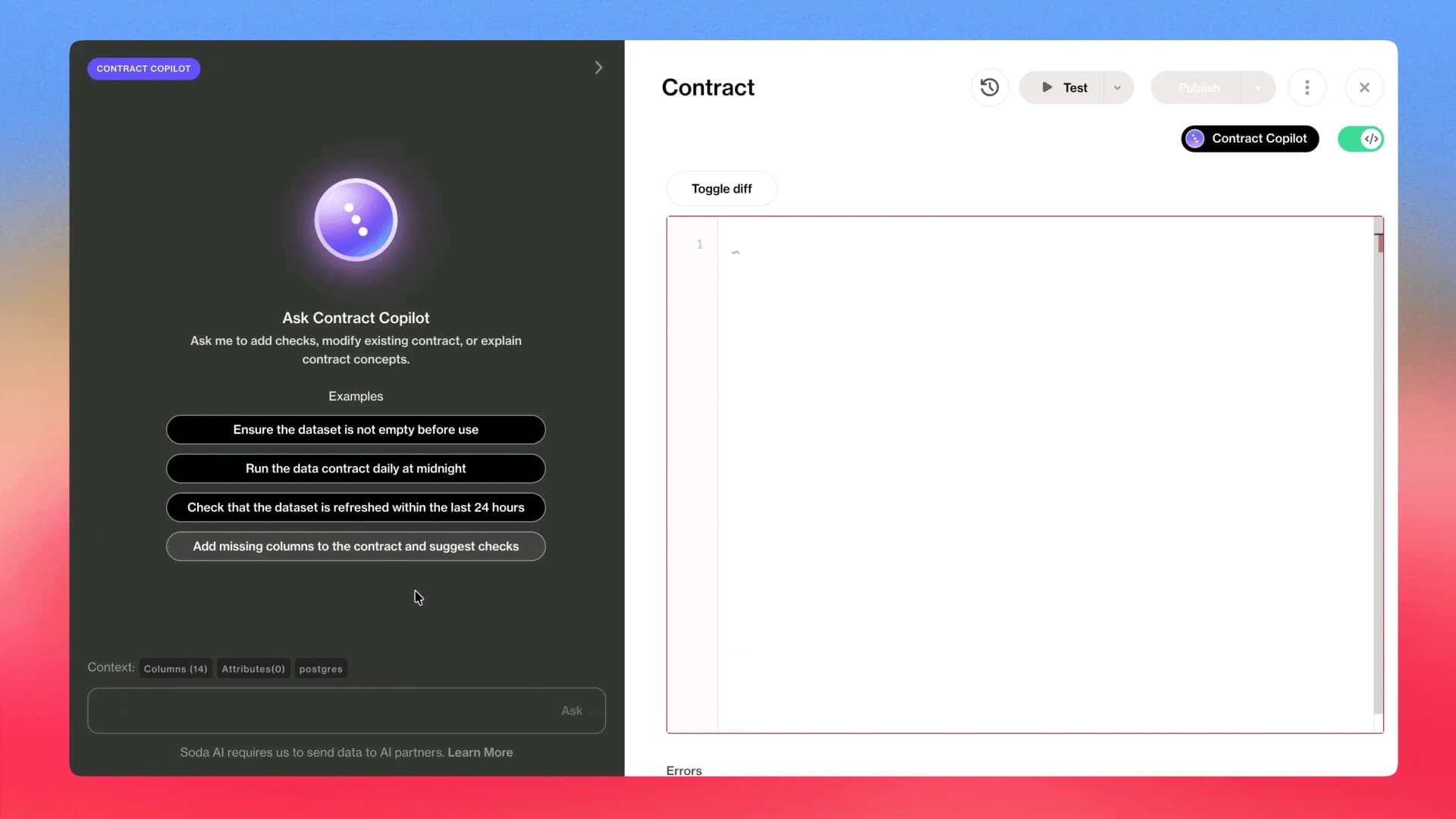
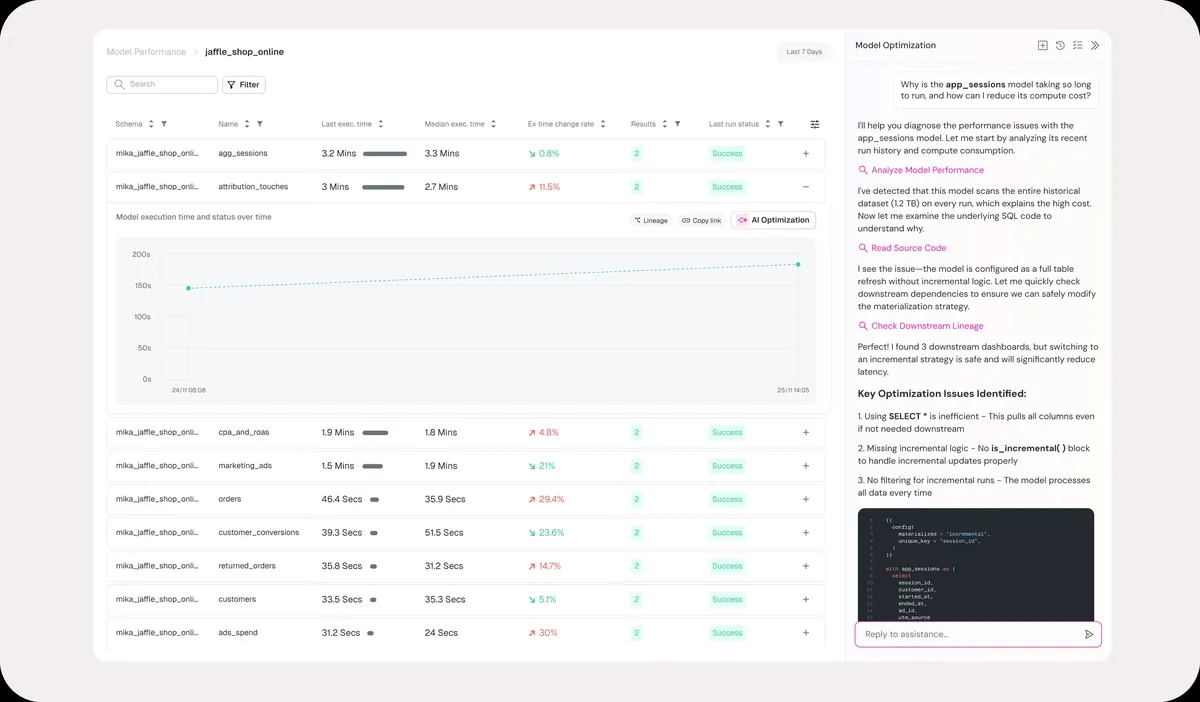
Interface Preview
Soda
Elementary
Feature Comparison
| Feature | Soda | Elementary |
|---|---|---|
| Data Quality Monitoring | ||
| Automated Quality Checks | AI-powered checks with plain-English rules and auto-generated data contracts | dbt-native tests with out-of-the-box monitors for freshness, volume, and schema changes |
| Anomaly Detection | Record-level anomaly detection with peer-reviewed ML algorithms; claims 70% fewer false positives than Facebook Prophet | ML-based anomaly detection across nullness, distribution, dimensions, and completeness with configurable seasonality |
| Historical Data Analysis | Built-in backfilling and backtesting to analyze up to one year of historical data instantly | Model run duration history and performance trends over time |
| Architecture & Integration | ||
| Core Architecture | Standalone SaaS platform with code and UI workflows; data stays in your cloud | dbt-native package that integrates directly into your dbt project; available as self-hosted or cloud |
| Configuration Approach | YAML-based data contracts with AI co-pilot for auto-generation; supports both Git and UI workflows | Configuration as code managed in dbt project with version control, code review, and CI/CD |
| Data Lineage | Not a primary focus; centered on data contracts and quality checks | End-to-end column-level lineage from code to BI tools, enriched with test results across the DAG |
| Collaboration & Governance | ||
| Business User Support | Collaborative workflows bridging engineers in Git and business users in the UI with shared data contracts | AI-first discovery and governance interface where business users can explore data assets and contribute validations |
| Governance Features | Data contracts with audit logs, custom roles, RBAC, and permission control on the Enterprise plan | Governance policies for compliance and security; SSO and RBAC available on Enterprise plan |
| Alerting & Incident Management | Alerting and ticketing integrations included across plans | Context-aware alerts routed by ownership and severity with incident grouping across Slack, Teams, Opsgenie, and PagerDuty |
| AI & Advanced Capabilities | ||
| AI Features | AI co-pilot for generating data contracts, plain-English check writing, and AI remediation (coming soon) | AI agents for validating data quality, triaging issues, enriching metadata, and analyzing test coverage |
| Root Cause Analysis | Diagnostics warehouse stores all failed records for traceability; complete audit logging | Column-level lineage traces issue origins and shows downstream impact across the pipeline |
| Data Catalog | Not a standalone catalog; focused on data contracts as the source of truth | Built-in catalog for exploring datasets with health scores, ownership, descriptions, and dependencies |
| Open Source & Community | ||
| Open Source Availability | Open-source Soda Core library on GitHub with 2,000+ stars; Python-based | Open-source dbt package on GitHub with 2,000+ stars; Apache-2.0 license |
| Deployment Options | SaaS cloud with data remaining in your environment; private deployment on Enterprise plan | Self-hosted open-source option or Elementary Cloud with Scale, Enterprise, and Unlimited tiers |
| MCP Server Support | Not verified | MCP Server exposes context layer and agents for integration with any AI tool |
Data Quality Monitoring
Automated Quality Checks
Anomaly Detection
Historical Data Analysis
Architecture & Integration
Core Architecture
Configuration Approach
Data Lineage
Collaboration & Governance
Business User Support
Governance Features
Alerting & Incident Management
AI & Advanced Capabilities
AI Features
Root Cause Analysis
Data Catalog
Open Source & Community
Open Source Availability
Deployment Options
MCP Server Support
Which approach fits
Soda and Elementary are both strong data quality platforms in the modern data stack, but they serve different operational philosophies. Soda positions itself as an AI-native platform centered on data contracts that bridge business and engineering teams, with proprietary ML algorithms for anomaly detection. Elementary takes a dbt-native approach, embedding observability directly into your dbt project with column-level lineage, a built-in catalog, and configuration-as-code workflows. Teams heavily invested in dbt will find Elementary a natural fit, while organizations wanting a standalone data quality platform with advanced AI capabilities and data contracts will lean toward Soda.
When each approach fits
Choose Soda if:
Organizations that need a standalone data quality platform with AI-powered data contracts, record-level anomaly detection, and collaborative workflows bridging business users and engineers -- especially those not exclusively tied to dbt.
Choose Elementary if:
dbt-first data teams that want native observability embedded in their existing workflow, with column-level lineage, a data catalog, and the flexibility of self-hosting via an open-source Apache-2.0 licensed package.
These scenarios reflect the available product evidence. Your requirements, existing stack, and team expertise should guide the final decision.
Frequently Asked Questions
Can Soda and Elementary work with dbt?
Both tools integrate with dbt, but in different ways. Elementary is dbt-native by design -- it runs as a dbt package directly in your project, making your existing dbt tests part of its coverage. Soda works alongside dbt as an independent platform and can be triggered in dbt workflows, but it is not embedded in the dbt DAG the way Elementary is.
Which tool is better for data lineage?
Elementary has a significant advantage in lineage. It provides end-to-end column-level lineage from code and data warehouses to BI tools, enriched with test results to show incidents across the DAG. Soda focuses primarily on data contracts and quality checks rather than lineage mapping.
Do both tools offer self-hosted options?
Yes. Elementary offers a fully self-hosted option through its open-source dbt package under the Apache-2.0 license, with a cloud service available for teams wanting managed features. Soda provides an open-source library called Soda Core for running checks locally, while its full platform runs as SaaS with data staying in your cloud environment. The Enterprise plan supports private deployment.
How do the AI features compare between Soda and Elementary?
Soda takes an AI-native approach with peer-reviewed ML research published in NeurIPS, JAIR, and ACML. Its AI co-pilot generates data contracts, writes checks in plain English, and provides record-level anomaly detection. Elementary uses AI agents for validating data quality, triaging issues, enriching metadata, and analyzing test coverage, with an optional AI Layer add-on for additional credit-based capabilities.
Which tool is more cost-effective for small teams?
Elementary is generally more accessible for small teams. Its open-source dbt package is free to self-host, and cloud plans start at affordable per-seat pricing. Soda offers a free tier suitable for small projects, but the Team plan jumps to $750 per month, which represents a significant cost increase when you outgrow the free tier.