Decision comparison
Great Expectations vs Elementary
Choose Great Expectations when your central need is precise, code-defined data assertions that must run across SQL, Pandas, or Spark and produce durable validation documentation. Choose Elementary when dbt is the operational center of your stack and you need automatic freshness, volume, schema, anomaly, lineage, and alerting workflows rather than a standalone validation framework.
Architecture choice. These take different approaches to the same problem. Read the table as a fit question rather than a feature race.
These are different kinds of product — Data Validation Framework and Data Observability.
Quick Comparison
| Decision factor | Great Expectations | Elementary |
|---|---|---|
| Best For | Teams needing explicit, reusable validation rules across SQL, Pandas, and Spark pipelines, with documented data contracts and no vendor lock-in. | dbt-centric analytics teams wanting automated warehouse monitoring, anomaly detection, lineage context, and routed alerts with minimal monitor configuration. |
| Architecture | Python-based open-source validation framework using Expectation Suites, execution backends, Data Docs, and external orchestrators such as Airflow, Dagster, or Prefect. | Open-source, dbt-native observability platform combining automated monitors, dbt and custom tests, metadata-driven anomaly detection, lineage, alerts, and cloud capabilities. |
| Pricing Model | Free and Open-Source, Paid upgrades available | Elementary publishes no amounts. Its open-source dbt package is free and self-hosted. Elementary Cloud is priced by seats and environments: Scale covers up to 10 editor seats and 1K tables, Enterprise up to 20 editor and 40 viewer seats and 3K tables, and Unlimited removes the seat caps; extra tables are charged per additional 1K. A free trial covers the Essentials feature set. Every paid tier is quote-only. |
| Ease of Use | Clear expectation-based workflow and generated documentation, but users report meaningful manual effort defining checks and arranging external orchestration. | Automated monitors activate without manual configuration and reuse existing dbt tests, reducing setup for teams already operating dbt projects. |
| Scalability | Runs validations through SQL, Pandas, and Spark backends, allowing teams to apply the same expectation model across warehouse and distributed workloads. | Uses information schema and query-history metadata for low-compute monitoring; Scale supports up to 5K tables and Enterprise up to 10K tables. |
| Community/Support | Apache-2.0 project with 11,773 GitHub stars; extensibility and orchestration integrations support self-managed teams, while GX Cloud offers commercial upgrades. | Apache-2.0 repository with 2,406 GitHub stars; self-hosted and cloud options, plus dedicated customer-success support on the Unlimited plan. |
Great Expectations
- Best For:
- Teams needing explicit, reusable validation rules across SQL, Pandas, and Spark pipelines, with documented data contracts and no vendor lock-in.
- Architecture:
- Python-based open-source validation framework using Expectation Suites, execution backends, Data Docs, and external orchestrators such as Airflow, Dagster, or Prefect.
- Pricing Model:
- Free and Open-Source, Paid upgrades available
- Ease of Use:
- Clear expectation-based workflow and generated documentation, but users report meaningful manual effort defining checks and arranging external orchestration.
- Scalability:
- Runs validations through SQL, Pandas, and Spark backends, allowing teams to apply the same expectation model across warehouse and distributed workloads.
- Community/Support:
- Apache-2.0 project with 11,773 GitHub stars; extensibility and orchestration integrations support self-managed teams, while GX Cloud offers commercial upgrades.
Elementary
- Best For:
- dbt-centric analytics teams wanting automated warehouse monitoring, anomaly detection, lineage context, and routed alerts with minimal monitor configuration.
- Architecture:
- Open-source, dbt-native observability platform combining automated monitors, dbt and custom tests, metadata-driven anomaly detection, lineage, alerts, and cloud capabilities.
- Pricing Model:
- Elementary publishes no amounts. Its open-source dbt package is free and self-hosted. Elementary Cloud is priced by seats and environments: Scale covers up to 10 editor seats and 1K tables, Enterprise up to 20 editor and 40 viewer seats and 3K tables, and Unlimited removes the seat caps; extra tables are charged per additional 1K. A free trial covers the Essentials feature set. Every paid tier is quote-only.
- Ease of Use:
- Automated monitors activate without manual configuration and reuse existing dbt tests, reducing setup for teams already operating dbt projects.
- Scalability:
- Uses information schema and query-history metadata for low-compute monitoring; Scale supports up to 5K tables and Enterprise up to 10K tables.
- Community/Support:
- Apache-2.0 repository with 2,406 GitHub stars; self-hosted and cloud options, plus dedicated customer-success support on the Unlimited plan.
Public signals
Verified factual signals only. Bars appear only for like-for-like metrics with five weekly assessments for every tool; missing evidence stays explicit. These signals do not establish enterprise adoption, product quality, or total cost.
| Metric | Great Expectations | Elementary |
|---|---|---|
| GitHub commits, 90d(Product adoption) | 169 | 19 |
| GitHub stars(Product adoption) | 11,000+ | 2,000+ |
| Search interest(Market interest) | 0 | Unavailable |
| Hacker News mentions, 90d(Community interest) | 0 | Not available |
| PyPI weekly downloads(Product adoption) | 4.5M | 215.3k |
| Stack Overflow questions(Community interest) | 148 | Not available |
As of September 21, 2026 — updated weekly.
Health & risk evidence
Observed public-source checks for mapped package versions and repositories.
Great Expectations
September 21, 2026Package vulnerabilities
PyPI · great-expectations@1.23.1
0 vulnerabilities
across 1 package
Repository security score
Not available
Elementary
September 21, 2026Package vulnerabilities
PyPI · elementary-data@0.26.0
0 vulnerabilities
across 1 package
Repository security score
github.com/elementary-data/elementary
7.4/10
Interface Preview
Elementary
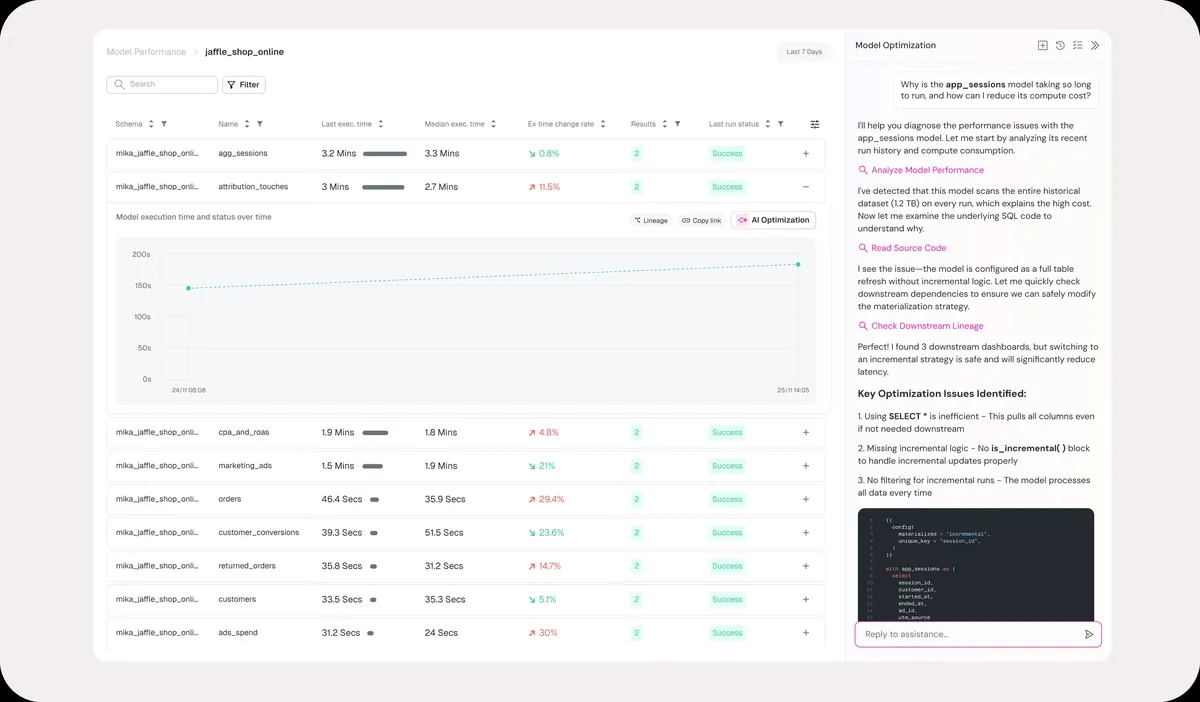
Feature Comparison
| Feature | Great Expectations | Elementary |
|---|---|---|
| Validation and testing model | ||
| Reusable rule definitions | Expectation Suites package explicit, reusable data validation rules | dbt, Elementary, and custom tests share one coverage view |
| Data quality checks | Fine-grained explicit checks execute against selected data backends | Tests detect nullness, distribution, dimensions, completeness, and anomalies |
| Test authoring workflow | Teams manually define expectations for critical data assertions | Tests can be added in code or Elementary UI |
| Automated observability | ||
| Freshness monitoring | Freshness expectations require explicitly authored validation logic | Automated monitors assess freshness across production tables |
| Volume and schema monitoring | Explicit expectations validate row counts and schema conditions | Automated monitors detect volume and schema changes |
| Adaptive anomaly detection | Not verified | Monitors adjust for update frequency, seasonality, and trends |
| Execution and integration | ||
| Data-processing backends | Executes validations through SQL, Pandas, and Spark backends | Runs as a dbt-native solution against warehouse project data |
| Orchestration integration | Integrates with Airflow, Dagster, and Prefect workflows | Uses dbt project execution and native testing workflows |
| Configuration approach | Expectation Suites define validation logic as reusable artifacts | Configuration as code targets data and analytics engineers |
| Context and incident response | ||
| Documentation | Data Docs automatically publish expectation and validation documentation | Discovery provides shared dataset context for adoption and trust |
| Lineage analysis | Not verified | Column-level lineage connects code, warehouse, sources, and BI tools |
| Alert routing | External orchestration handles scheduling and downstream notification workflows | Routes monitor and test alerts by recipient, owner, and channel |
| Deployment, governance, and commercial scope | ||
| Open-source licensing | Apache-2.0 framework supports self-hosted, extensible deployments | Apache-2.0 project supports self-hosted observability deployments |
| Managed offering | GX Cloud offers Developer, Team, and Enterprise options | Cloud service adds premium capabilities alongside self-hosting |
| Governance capabilities | Data Docs and shared expectations establish a common quality language | Enterprise adds SSO, RBAC, advanced deployment, and governance controls |
Validation and testing model
Reusable rule definitions
Data quality checks
Test authoring workflow
Automated observability
Freshness monitoring
Volume and schema monitoring
Adaptive anomaly detection
Execution and integration
Data-processing backends
Orchestration integration
Configuration approach
Context and incident response
Documentation
Lineage analysis
Alert routing
Deployment, governance, and commercial scope
Open-source licensing
Managed offering
Governance capabilities
Which approach fits
Choose Great Expectations when your central need is precise, code-defined data assertions that must run across SQL, Pandas, or Spark and produce durable validation documentation. Choose Elementary when dbt is the operational center of your stack and you need automatic freshness, volume, schema, anomaly, lineage, and alerting workflows rather than a standalone validation framework.
When each approach fits
Choose Great Expectations if:
Choose it for cross-backend data validation, formal reusable expectations, Data Docs, and teams willing to define checks explicitly and integrate scheduling through their existing orchestrator. User feedback specifically highlights fine-grained checks, documentation, orchestration integrations, and freedom from vendor lock-in; it also notes the manual-definition burden and lack of full observability.
Choose Elementary if:
Choose it for dbt-based analytics engineering teams that want automatically activated production-table monitors, anomaly detection, lineage enriched with test results, and targeted alerting. It is especially suitable when reducing manual monitor setup and investigating downstream impact are higher priorities than supporting Pandas or Spark validation workloads.
These scenarios reflect the available product evidence. Your requirements, existing stack, and team expertise should guide the final decision.
Frequently Asked Questions
What is the main difference between Great Expectations and Elementary?
Great Expectations is primarily a data validation framework: teams author explicit Expectation Suites, execute them through SQL, Pandas, or Spark, and publish Data Docs from the resulting checks. Elementary is a dbt-native observability platform that incorporates dbt, Elementary, and custom tests while also automatically monitoring freshness, volume, and schema changes. Elementary additionally emphasizes adaptive anomaly detection, column-level lineage, and routed alerts; Great Expectations emphasizes portable, fine-grained data assertions.
Which is better for small teams?
For a small team already standardized on dbt, Elementary is generally the quicker operational choice because its out-of-the-box monitors activate automatically, reuse existing dbt tests, and provide alerts and lineage context. Its stated free tier supports one user, and its paid plans are quoted per seat and per monitored table. Great Expectations can be the better fit for a small team that needs zero-cost Apache-2.0 self-hosting and explicit checks across Pandas, Spark, or SQL, but users report that authoring checks and arranging orchestration require more hands-on effort.
Can I migrate from Great Expectations to Elementary?
You can migrate the operating model, but it is not presented as a direct one-to-one automatic conversion. Great Expectations Expectation Suites are explicit framework-specific validation artifacts, whereas Elementary can surface dbt, Elementary, and custom tests in one coverage view. A practical migration would inventory critical Great Expectations rules, reimplement equivalent checks as dbt or Elementary tests where appropriate, then add Elementary automated monitors for freshness, volume, schema, and anomaly detection. Keep Great Expectations for non-dbt, Pandas, Spark, or multi-backend validation requirements.
What are the pricing differences?
Great Expectations is Apache-2.0 open source and can be self-hosted free of charge. GX Cloud has a free Developer option and paid Team and Enterprise upgrades, but the supplied official pricing information does not publish dollar rates. Elementary has a stated free tier for one user, with paid plans quoted per seat and per monitored table. Its published higher-level plans are Scale, Enterprise, and Unlimited, with capacity signals including up to 5K tables for Scale, 10K for Enterprise, and 15K for Unlimited, with seat, security, deployment, and support features listed per tier.