Decision comparison
DataHub vs Soda
DataHub and Soda address different layers of the data reliability challenge. DataHub operates as a comprehensive metadata catalog that unifies data discovery, governance, and observability across the entire data stack, while Soda focuses specifically on automated data quality testing, monitoring, and data contracts enforcement at the pipeline level.
Used together. These are normally used together rather than chosen between. The comparison explains what each one does in the stack.
These are different kinds of product — Data Catalog and Data Validation Framework.
Quick Comparison
| Decision factor | DataHub | Soda |
|---|---|---|
| Primary Focus | Metadata management, data discovery, and governance across the entire data stack | AI-native data quality testing, monitoring, and data contracts enforcement |
| Pricing Model | Free Professional tier (up to 20 saved searches, daily email alerts), Enterprise tier contact sales, Open Source self-hosted free (Apache-2.0) | Free tier at $0 per month, Team tier at $750 per month, with enterprise features available |
| Open Source | Yes, Apache-2.0 licensed with 12,000+ GitHub stars and active community of 3,000+ organizations | Yes, open-source core (soda-core) with 2,000+ GitHub stars focused on data quality checks |
| Best For | Organizations needing a unified metadata catalog to discover, govern, and observe data assets at scale | Data engineering teams needing automated quality checks, anomaly detection, and data contracts across pipelines |
| AI Capabilities | AI-powered data discovery, natural language metadata querying, GenAI documentation, AI-based classification, and MCP integration for AI agents | Peer-reviewed AI algorithms (published in NeurIPS, JAIR, ACML) for metrics monitoring with 70% fewer false positives than Facebook Prophet, AI-powered contract generation |
| Implementation Language | Java-based core platform with 80+ production-grade connectors across the data ecosystem | Python-based engine that integrates with dbt, Snowflake, and modern data stack tools |
| Data Contracts | Focuses on metadata-driven governance policies rather than dedicated data contract workflows | First-class data contracts engine with collaborative workflows where engineers use Git and business users use the UI |
| Community Size | 12,000+ GitHub stars with enterprise adoption by Netflix, Visa, Slack, Pinterest, Notion, and Deutsche Telekom | 2,000+ GitHub stars with enterprise adoption and published AI research in peer-reviewed venues |
DataHub
- Primary Focus:
- Metadata management, data discovery, and governance across the entire data stack
- Pricing Model:
- Free Professional tier (up to 20 saved searches, daily email alerts), Enterprise tier contact sales, Open Source self-hosted free (Apache-2.0)
- Open Source:
- Yes, Apache-2.0 licensed with 12,000+ GitHub stars and active community of 3,000+ organizations
- Best For:
- Organizations needing a unified metadata catalog to discover, govern, and observe data assets at scale
- AI Capabilities:
- AI-powered data discovery, natural language metadata querying, GenAI documentation, AI-based classification, and MCP integration for AI agents
- Implementation Language:
- Java-based core platform with 80+ production-grade connectors across the data ecosystem
- Data Contracts:
- Focuses on metadata-driven governance policies rather than dedicated data contract workflows
- Community Size:
- 12,000+ GitHub stars with enterprise adoption by Netflix, Visa, Slack, Pinterest, Notion, and Deutsche Telekom
Soda
- Primary Focus:
- AI-native data quality testing, monitoring, and data contracts enforcement
- Pricing Model:
- Free tier at $0 per month, Team tier at $750 per month, with enterprise features available
- Open Source:
- Yes, open-source core (soda-core) with 2,000+ GitHub stars focused on data quality checks
- Best For:
- Data engineering teams needing automated quality checks, anomaly detection, and data contracts across pipelines
- AI Capabilities:
- Peer-reviewed AI algorithms (published in NeurIPS, JAIR, ACML) for metrics monitoring with 70% fewer false positives than Facebook Prophet, AI-powered contract generation
- Implementation Language:
- Python-based engine that integrates with dbt, Snowflake, and modern data stack tools
- Data Contracts:
- First-class data contracts engine with collaborative workflows where engineers use Git and business users use the UI
- Community Size:
- 2,000+ GitHub stars with enterprise adoption and published AI research in peer-reviewed venues
Public signals
Verified factual signals only. Bars appear only for like-for-like metrics with five weekly assessments for every tool; missing evidence stays explicit. These signals do not establish enterprise adoption, product quality, or total cost.
| Metric | DataHub | Soda |
|---|---|---|
| Docker Hub pulls(Product adoption) | 5.4M | Not available |
| GitHub commits, 90d(Product adoption) | 1.1k | 81 |
| GitHub stars(Product adoption) | 12,000+ | 2,000+ |
| Search interest(Market interest) | 0 | 0 |
| Hacker News mentions, 90d(Community interest) | 0 | Not available |
| Product Hunt comments(Community interest) | 1 | Not available |
| Product Hunt reviews(Community interest) | 0 | Not available |
| Product Hunt votes(Community interest) | 0 | Not available |
| PyPI weekly downloads(Product adoption) | 1.0M | 405.8k |
As of September 21, 2026 — updated weekly.
Health & risk evidence
Observed public-source checks for mapped package versions and repositories.
DataHub
September 21, 2026Package vulnerabilities
PyPI · acryl-datahub@1.7.0.11
0 vulnerabilities
across 1 package
Repository security score
github.com/datahub-project/datahub
6.2/10
Soda
September 21, 2026Package vulnerabilities
PyPI · soda-core@4.24.0
0 vulnerabilities
across 1 package
Repository security score
Not available
Interface Preview
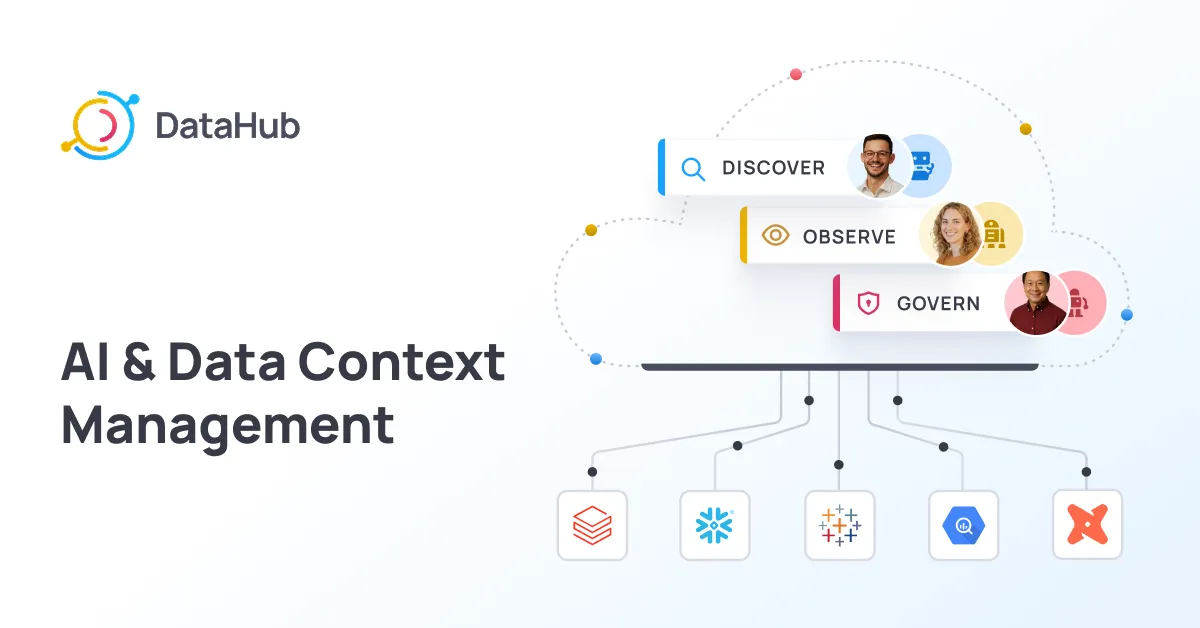
DataHub
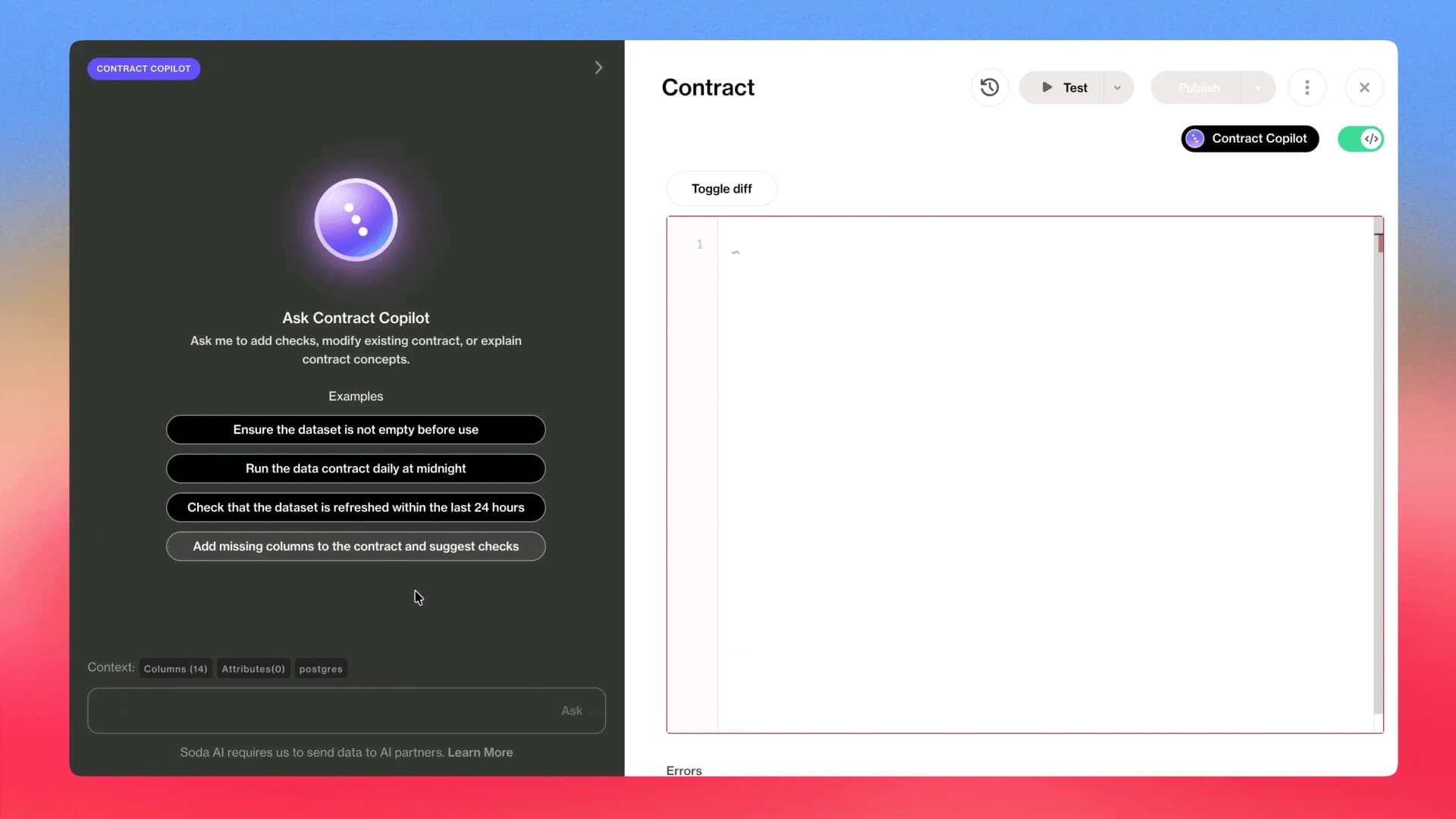
Soda
Feature Comparison
| Feature | DataHub | Soda |
|---|---|---|
| Data Discovery & Catalog | ||
| Metadata Search & Discovery | Full metadata catalog with search across 80+ production-grade connectors, column-level lineage, and AI-powered natural language querying | Not a data catalog; focuses on data quality checks rather than metadata discovery or search |
| Data Lineage Tracking | Cross-platform and column-level lineage tracking with visual lineage graphs to trace data flow and debug issues | Limited lineage; provides traceability logs for quality checks and anomalies but not full pipeline lineage mapping |
| Automated Data Classification | AI-based classification with smart propagation that automatically tags and categorizes data assets to reduce manual overhead | Classifies data quality issues (missing, duplicated, invalid records) but does not perform asset-level data classification |
| Data Quality & Monitoring | ||
| Automated Quality Checks | Provides data quality assessments and AI-driven anomaly detection as part of observability, integrated within the metadata platform | Core strength with dedicated check engine, pipeline testing, metrics observability, and record-level anomaly detection scaling to 1B rows in 64 seconds |
| Anomaly Detection | AI-driven anomaly detection integrated into the observability layer for proactive monitoring of metadata changes | Peer-reviewed AI algorithms published in NeurIPS, JAIR, and ACML with 70% fewer false positives than Facebook Prophet and row-level precision |
| Historical Backfilling & Backtesting | Not available as a built-in feature; focuses on current metadata state and forward-looking monitoring | Built-in backfilling and backtesting that instantly analyzes up to one year of historical data to reveal patterns and trends |
| Data Governance & Contracts | ||
| Data Contracts | Governance through metadata policies, ownership tracking, and automated compliance rather than explicit data contract workflows | First-class data contracts engine with versioned proposals and diffs, collaborative workflows in Git and UI, and AI-powered contract generation |
| Access Control & Permissions | Enterprise-grade governance with federated policies, ownership assignment, and continuous policy enforcement across all data assets | Role-based access control (RBAC), custom roles, audit logs, SSO integration, and permission controls available in Team and Enterprise tiers |
| Compliance & Audit Trail | Automated governance with GenAI documentation and smart propagation to maintain compliance with reduced manual overhead | Complete traceability with every log and anomaly captured for auditing, plus governance-by-design with auditability built into contract workflows |
| Integration & Deployment | ||
| Data Source Integrations | 80+ production-grade connectors covering databases, warehouses, dashboards, pipelines, and orchestration tools across the data ecosystem | Integrates with major data warehouses (Snowflake, Databricks), orchestrators (Airflow), dbt, and alerting/ticketing systems |
| Deployment Options | Self-hosted open-source deployment or fully managed DataHub Cloud with enterprise-ready SaaS option | SaaS platform with private deployment option available in Enterprise tier; data stays in the customer's cloud environment |
| API & Extensibility | Extensible metadata platform with API-powered metadata ingestion, Model Context Protocol (MCP) for AI agents, and custom integration support | Python-based open-source core (soda-core) with check definitions as code, catalog integrations, and alerting/ticketing API connections |
| AI & Automation | ||
| AI-Powered Automation | GenAI documentation generation, AI-based data classification, smart propagation of metadata, and natural language querying of the catalog | AI co-pilot that creates full data contracts with one click, AI-powered check writing in plain English, and upcoming AI remediation for fixing bad records |
| Root Cause Analysis | Lineage-based debugging with AI chat agent to trace quality problems and metric discrepancies back to their source | Diagnostics warehouse that stores all failed records automatically, enabling root cause analytics with complete traceability in the customer's environment |
| AI Agent Integration | Model Context Protocol (MCP) support that connects AI agents directly to DataHub for metadata-aware agentic workflows | AI automations built into the platform workflow but no dedicated AI agent protocol or external agent connectivity framework |
Data Discovery & Catalog
Metadata Search & Discovery
Data Lineage Tracking
Automated Data Classification
Data Quality & Monitoring
Automated Quality Checks
Anomaly Detection
Historical Backfilling & Backtesting
Data Governance & Contracts
Data Contracts
Access Control & Permissions
Compliance & Audit Trail
Integration & Deployment
Data Source Integrations
Deployment Options
API & Extensibility
AI & Automation
AI-Powered Automation
Root Cause Analysis
AI Agent Integration
How they fit together
DataHub and Soda address different layers of the data reliability challenge. DataHub operates as a comprehensive metadata catalog that unifies data discovery, governance, and observability across the entire data stack, while Soda focuses specifically on automated data quality testing, monitoring, and data contracts enforcement at the pipeline level.
What each one handles
Use DataHub for:
We recommend DataHub for organizations that need a centralized metadata platform to unify data discovery, governance, and observability across their entire data ecosystem. DataHub delivers the most value when teams struggle with finding trustworthy data across dozens of sources, need cross-platform and column-level lineage tracking, or want to automate governance policies at enterprise scale. Its 80+ production-grade connectors, MCP support for AI agents, and adoption by organizations like Netflix, Visa, and Slack demonstrate its maturity as an enterprise metadata backbone. The open-source Apache-2.0 core with optional managed cloud makes it accessible for teams that want to start self-hosted and scale to enterprise later.
Use Soda for:
We recommend Soda for data engineering teams that need dedicated, automated data quality testing and monitoring built directly into their pipelines. Soda excels when the primary challenge is catching data incidents before they reach production, enforcing data contracts between producers and consumers, and detecting anomalies at the record level with peer-reviewed AI algorithms. Its collaborative data contracts engine bridges engineering and business workflows through Git and UI interfaces, while the diagnostics warehouse stores failed records in the customer's own environment for root cause analysis. The $0 per month free tier and $750/month Team tier provide clear entry points for teams that want focused data quality tooling without adopting a full metadata platform.
These roles reflect the available product evidence. Most teams run both; which one owns a given job depends on your stack and team.
Frequently Asked Questions
Can DataHub and Soda be used together in the same data stack?
DataHub and Soda address complementary layers of data reliability and work well together in the same stack. DataHub serves as the centralized metadata catalog where teams discover, govern, and trace data assets across the organization, while Soda runs automated quality checks and data contracts directly in the pipeline. In practice, Soda monitors data quality at the source and flags issues as they occur, and DataHub provides the lineage and governance context to understand the broader impact of those issues. Many organizations use a metadata catalog alongside a dedicated quality testing tool because neither tool fully replaces the other. DataHub focuses on metadata management and discovery while Soda focuses on data validation and contract enforcement at the row and column level.
Which tool provides better data quality monitoring out of the box?
Soda provides more comprehensive data quality monitoring out of the box because that is its core purpose. Soda ships with a dedicated check engine, metrics observability, record-level anomaly detection, built-in backfilling and backtesting of up to one year of historical data, and AI algorithms that have been peer-reviewed and published in NeurIPS, JAIR, and ACML. These algorithms deliver 70% fewer false positives than Facebook Prophet and scale to 1 billion rows in 64 seconds. DataHub includes data quality assessments and AI-driven anomaly detection as part of its observability layer, but these features are integrated into a broader metadata platform rather than being the dedicated focus. For teams whose primary need is automated quality testing and monitoring, Soda provides deeper functionality in that specific domain.
How do the open-source offerings differ between DataHub and Soda?
DataHub's open-source project is a full metadata platform licensed under Apache-2.0 with 12,000+ GitHub stars and adoption by over 3,000 organizations. The open-source version includes data discovery, lineage tracking, governance features, and 80+ production-grade connectors, making it a complete self-hosted metadata catalog. Soda's open-source project (soda-core) is a Python-based data quality check engine with 2,335 GitHub stars that enables users to define and run data quality tests against their datasets. The open-source soda-core focuses on pipeline testing and quality checks, while features like the no-code interface, collaborative data contracts, advanced AI-powered anomaly detection, and the diagnostics warehouse are available in the commercial SaaS tiers. Both tools offer substantial open-source value, but DataHub's open-source version covers a broader set of catalog and governance features while Soda's open-source version targets a specific quality testing workflow.
What are the main pricing differences between DataHub and Soda?
DataHub offers a self-hosted open-source deployment at no cost under the Apache-2.0 license, a managed DataHub Cloud service with pricing and deployment options discussed through a personalized demo. The open-source option is fully functional but requires teams to manage hosting and maintenance themselves. Soda uses a three-tier SaaS model with a Free tier at $0 per month that includes pipeline testing and metrics observability, a Team tier at $750/month that adds collaborative data contracts, a no-code interface, advanced AI-powered quality features, RBAC, SSO, and premium support, and an Enterprise tier with custom pricing for business collaboration at scale. The key pricing distinction is that DataHub's cost primarily comes from infrastructure and maintenance for self-hosted deployments, while Soda's cost is a predictable monthly SaaS subscription tied to processing units and feature access.