Decision comparison
Anomalo vs DataBuck
Anomalo and DataBuck both reduce the rule-writing burden that sinks most data quality projects, and they aim at slightly different points in the stack. Anomalo learns normal behaviour from warehouse table history and explains which segment of the data moved when something changes, with a no-code interface. DataBuck derives checks from profiling and covers files and raw ingestion as well as warehouse tables, reporting a trust score per dataset.
Direct comparison. These are reviewed substitutes bought for the same job, so the differences below are the ones that decide between them.
All 2 are data observability.
Quick Comparison
| Decision factor | Anomalo | DataBuck |
|---|---|---|
| What it is | A no-code data quality platform that learns normal behaviour and flags deviations without written rules | An automated data quality validation tool that derives checks from the data and scores dataset trust |
| Detection approach | Unsupervised machine learning across table history, with validation rules layered on top | Automated profiling and rule generation, with manual rules for business logic |
| Who operates it | Built for analysts and data teams to use without writing code | Built for data engineering teams validating at scale across systems |
| Coverage | Warehouse tables, with deep column-level checking and root-cause context | Warehouse tables plus files in cloud object storage and data in motion |
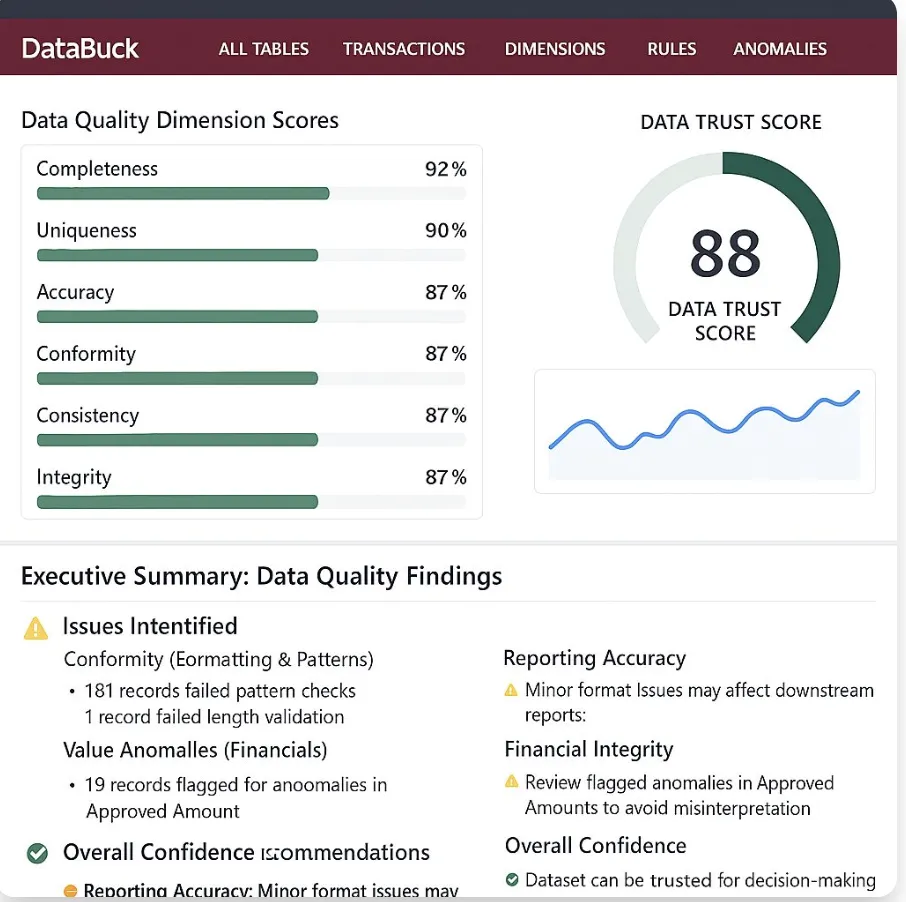
| Output | Alerts with explanations of which segments changed and why | Trust scores per dataset alongside specific check failures |
| Integration | Snowflake, BigQuery, Databricks and Redshift, with Slack and orchestration hooks | Warehouses, lakes, object storage and common pipeline tools |
| Best fit | Teams wanting broad automatic coverage of warehouse tables with minimal setup | Teams validating across warehouses and files, including raw ingestion |
Anomalo
- What it is:
- A no-code data quality platform that learns normal behaviour and flags deviations without written rules
- Detection approach:
- Unsupervised machine learning across table history, with validation rules layered on top
- Who operates it:
- Built for analysts and data teams to use without writing code
- Coverage:
- Warehouse tables, with deep column-level checking and root-cause context
- Output:
- Alerts with explanations of which segments changed and why
- Integration:
- Snowflake, BigQuery, Databricks and Redshift, with Slack and orchestration hooks
- Best fit:
- Teams wanting broad automatic coverage of warehouse tables with minimal setup
DataBuck
- What it is:
- An automated data quality validation tool that derives checks from the data and scores dataset trust
- Detection approach:
- Automated profiling and rule generation, with manual rules for business logic
- Who operates it:
- Built for data engineering teams validating at scale across systems
- Coverage:
- Warehouse tables plus files in cloud object storage and data in motion
- Output:
- Trust scores per dataset alongside specific check failures
- Integration:
- Warehouses, lakes, object storage and common pipeline tools
- Best fit:
- Teams validating across warehouses and files, including raw ingestion
Public signals
Verified factual signals only. Bars appear only for like-for-like metrics with five weekly assessments for every tool; missing evidence stays explicit. These signals do not establish enterprise adoption, product quality, or total cost.
| Metric | Anomalo | DataBuck |
|---|---|---|
| PyPI weekly downloads(Developer adoption) | 32.6k | Not available |
As of September 21, 2026 — updated weekly.
Health & risk evidence
Observed public-source checks for mapped package versions and repositories.
Anomalo
September 21, 2026Package vulnerabilities
PyPI · anomalo@0.52.0
0 vulnerabilities
across 1 package
Repository security score
Not available
DataBuck
Package vulnerabilities
Not available
Repository security score
Not available
Interface Preview
DataBuck
Feature Comparison
| Feature | Anomalo | DataBuck |
|---|---|---|
| Detection | ||
| Unsupervised anomaly detection | Full support | Full support |
| Automatically generated checks | Full support | Full support |
| Manual rule authoring | Full support | Full support |
| Segment-level root cause analysis | Full support | Partial support |
| Coverage | ||
| Warehouse table monitoring | Full support | Full support |
| File and object storage validation | Partial support | Full support |
| Schema change detection | Full support | Full support |
| Freshness and volume checks | Full support | Full support |
| Usability | ||
| No-code configuration | Full support | Partial support |
| Trust score per dataset | Partial support | Full support |
| Slack and email alerting | Full support | Full support |
| REST API access | Full support | Full support |
| Deployment | ||
| SaaS | Full support | Full support |
| Run in your own cloud account | Full support | Full support |
| Connects to Snowflake and BigQuery | Full support | Full support |
| Orchestration integration | Full support | Full support |
Detection
Unsupervised anomaly detection
Automatically generated checks
Manual rule authoring
Segment-level root cause analysis
Coverage
Warehouse table monitoring
File and object storage validation
Schema change detection
Freshness and volume checks
Usability
No-code configuration
Trust score per dataset
Slack and email alerting
REST API access
Deployment
SaaS
Run in your own cloud account
Connects to Snowflake and BigQuery
Orchestration integration
Which to choose
Anomalo and DataBuck both reduce the rule-writing burden that sinks most data quality projects, and they aim at slightly different points in the stack. Anomalo learns normal behaviour from warehouse table history and explains which segment of the data moved when something changes, with a no-code interface. DataBuck derives checks from profiling and covers files and raw ingestion as well as warehouse tables, reporting a trust score per dataset.
Best-fit scenarios
Choose Anomalo if:
Choose Anomalo when the monitored data lives in the warehouse and you want analysts, not only engineers, to own quality. Unsupervised detection covers tables without anyone authoring rules, and the segment-level explanations shorten the gap between an alert firing and someone understanding which slice of the data actually changed.
Choose DataBuck if:
Choose DataBuck when validation has to start before the warehouse — on files landing in cloud object storage, on raw ingestion, across systems that are not all SQL. Automatic rule generation gives broad coverage quickly, and the per-dataset trust score is a simple signal for downstream teams deciding whether to use a table.
These scenarios reflect the available product evidence. Your requirements, existing stack, and team expertise should guide the final decision.
Frequently Asked Questions
Does machine learning detection actually work without tuning?
It works well for the failures that show up as statistical change: volume drops, null rate spikes, distribution shifts, categories appearing or disappearing, freshness misses. It needs history to learn from, so newly created tables are weak for a while. And it will not catch an error where the data looks entirely normal but is wrong — for that you write a rule, on either platform.
What does segment-level root cause mean in practice?
When a metric moves, the useful question is which part of the data moved. An alert that says the null rate rose is a starting point; an alert that says it rose only for one region since a specific date points at the cause. Anomalo puts weight on that explanation step, which matters most when the people receiving alerts are not the people who built the pipeline.
Where should validation happen — at ingestion or in the warehouse?
Both, ideally, and the practical answer depends on where you can act. Validating at ingestion catches bad files before they contaminate anything, which is cheaper to fix. Validating in the warehouse catches transformation errors your source checks cannot see. DataBuck reaches further upstream; Anomalo concentrates on the warehouse, where most consumers actually read from.
Can non-engineers use these?
Anomalo is explicitly designed so an analyst can configure monitoring and interpret alerts without writing code, which matters when the people who know whether a number is wrong are not the people who maintain the pipeline. DataBuck is more engineering-facing. Neither removes the need for someone to own the response when an alert fires.
How do we avoid alert fatigue?
Scope tightly at the start. Monitor the tables whose failure someone would actually escalate, route alerts to a channel with a named owner, and spend the first few weeks tuning thresholds and suppressing known-noisy checks. Both tools support that, and both get muted if you turn on everything at once across a thousand tables.
How should we roll one of these out?
Start with the tables that feed decisions someone would notice being wrong: the revenue model, the executive dashboard, the tables a machine learning feature depends on. Put monitoring on those first, tune the alerts until they are trusted, and route them to a Slack channel an on-call owner actually reads. Expanding to the whole warehouse before the alerts are trusted produces noise, and a noisy data quality tool gets muted within a month.