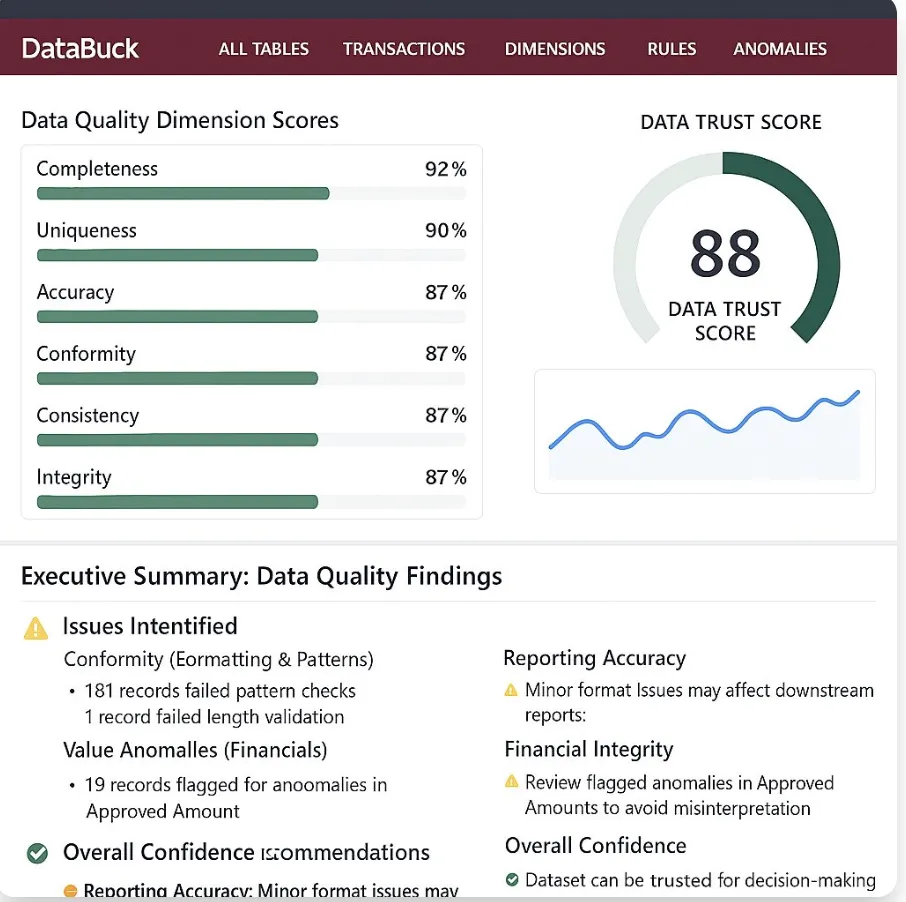
DataBuck: product and architecture
This DataBuck review examines FirstEigen's context-aware AI data quality platform for teams that need to discover validation rules, reconcile and remediate data-quality issues, detect subtle errors, and route findings into operational workflows. The assessment reflects DataBuck's public product documentation and Microsoft Marketplace listing reviewed on 2026-08-25; published commercial terms are limited, so the pricing discussion distinguishes documented facts from items that require a written proposal.
Overview
DataBuck is an enterprise data quality platform centered on context-aware AI. It uses that approach to discover validation rules, reconcile and remediate data-quality issues, and detect subtle errors across large-volume, cross-platform data environments. Rather than making a team author every assertion before monitoring begins, it can profile a dataset and recommend checks, while also supporting custom SQL checks and existing dbt tests through the API or user interface. That combination places it between a narrow test library and a broader governance platform: the product focuses on the health of data assets but also connects to orchestration, catalog, API, and webhook workflows.
The practical appeal is coverage across mixed estates. FirstEigen lists cloud data platforms including Databricks, Snowflake, BigQuery, Redshift, Amazon S3, Azure, and Cloudera, alongside operational databases and mainframe-oriented sources such as IBM Db2 for z/OS, VSAM, and COBOL. For a central data quality team supporting several business units, that breadth can reduce the number of separate monitoring patterns required across warehouse, lakehouse, and legacy workloads.
DataBuck is a vendor-led product rather than a self-service developer utility. Its public materials describe SaaS, customer VPC or VNet, and on-premises options, plus enterprise controls such as role-based access, SSO/SAML/SCIM, masking, audit trails, and private-network deployment. Buyers should validate the exact edition, connector availability, implementation scope, and security controls in the contract and technical evaluation.
Key Features and Architecture
DataBuck organizes data quality work around profiling, rules, dimensions, and anomalies. FirstEigen documents checks for freshness, schema drift, volume, completeness, uniqueness, conformity, consistency, and validity. It also documents data, drift, distribution, micro-segment, value, and inter-column anomaly detection. This creates a useful distinction between declared policy checks and data-driven monitoring: teams can encode a known business rule while also surfacing unexpected changes that were not represented in an existing test suite.
For teams with established engineering practices, custom SQL and dbt paths matter. DataBuck documents custom SQL checks and the ability to migrate or run existing dbt tests through its API or user interface. That does not remove the need to own critical business definitions, but it means a migration can start from existing validation work instead of recreating every test in a separate framework. The platform also documents integrations with dbt, Airflow, Azure Data Factory, Unity Catalog, Alation, Collibra, APIs, and webhooks, which suits a workflow where quality findings must reach a catalog, orchestrator, or incident process.
The deployment choice is another architectural consideration. A shared SaaS service is the simplest operating model for some teams, while a customer VPC/VNet or on-premises deployment addresses environments where data access and network isolation have stricter requirements. Product pages describe least-privilege connectors, masking, customer-managed keys, audit trails, and identity controls. These are decision criteria rather than proof of fit: security and platform teams should test the data path, credential model, supported source version, and access boundaries for the intended deployment.
Ideal Use Cases
DataBuck is a strong candidate for enterprise data organizations that must monitor quality across both cloud and legacy sources. A team operating Snowflake and Databricks for analytics while retaining Oracle, SQL Server, or mainframe systems can use one product evaluation to cover a wider estate. The most relevant question is not whether every listed connector exists, but which sources hold the data that drives reporting, customer operations, risk, or machine-learning outputs.
It also fits teams that want automated profiling before investing extensive time in hand-authored rules. This is useful when a central data platform inherits many datasets with incomplete documentation, or when a new domain needs an initial quality baseline. DataBuck can supplement that starting point with custom SQL checks and dbt tests for business-critical transformations. The product is therefore more aligned with a program that combines discovery, ongoing monitoring, and escalation than with a small project that only needs assertions in a transformation repository.
A third fit is governed workflows that need quality results to travel beyond the monitoring screen. The documented Airflow, Azure Data Factory, catalog, API, and webhook integrations give buyers a basis for evaluating whether a failed rule can inform pipeline handling, stewardship, or incident response. Teams should define ownership and remediation routes before rollout; a score or anomaly is only useful when someone can decide whether to fix data, revise a rule, or accept an exception.
Strengths & Trade-offs
Pros
- Combines automated profiling and anomaly detection with conventional validation checks, so teams can cover both expected rules and unexpected changes.
- Documents custom SQL checks and dbt test paths, which can make an existing engineering investment easier to bring into a broader quality workflow.
- Lists connectors across cloud warehouses, operational databases, Hadoop-era platforms, and mainframe-oriented sources.
- Offers SaaS, customer VPC/VNet, and on-premises deployment options for organizations with different data-access constraints.
- Connects to orchestration, catalogs, APIs, and webhooks, supporting quality workflows outside the product interface.
Cons
- Public materials provide no self-service production price card, public plan matrix, or usage-rate calculator.
- A serious evaluation requires vendor engagement to confirm implementation scope, connectors, deployment details, and commercial terms.
- The breadth of the platform can be unnecessary for a team that only needs a lightweight, code-first test library in a single warehouse.
- Teams still need clear ownership and remediation processes; automated checks do not decide which business exceptions are acceptable.