Decision comparison
DataBuck vs Validio
Choose DataBuck when the evaluation centers on automated data-quality validation, rule discovery, custom SQL checks, dbt test support, and SaaS, private-cloud, or on-premises deployment. Choose Validio when data observability across pipelines and business metrics, lineage context, catalog ownership, and anomaly investigation are central to team operations. DataBuck fits a quality program spanning platforms such as Databricks, Snowflake, BigQuery, Redshift, AWS S3, Azure, and Cloudera. Validio fits teams prioritizing automated monitoring across streams, lakes, warehouses, transformations, and catalogs.
Direct comparison. These are reviewed substitutes bought for the same job, so the differences below are the ones that decide between them.
All 2 are data observability.
Quick Comparison
| Decision factor | DataBuck | Validio |
|---|---|---|
| Primary focus | Enterprise data-quality validation, profiling, and monitoring, using context-aware AI to discover rules, reconcile issues, and detect subtle errors across large-scale environments. | Data observability, quality monitoring, lineage, and catalog context, helping enterprise teams make data AI-ready and resolve issues before they become business issues. |
| Rule and anomaly workflow | No-code recommendations plus custom SQL and dbt test support, combining autonomous validation and rule discovery with checks for drift, anomalies, completeness, uniqueness, and consistency. | Automated monitoring and anomaly investigation across data and metrics, using AI-powered segmented anomaly detection to identify hidden issues and accelerate investigation. |
| Deployment | SaaS, customer VPC or VNet, and on-premises options, supporting enterprise deployment requirements across cloud, private-cloud, and self-managed environments. | Hosted service or self-hosted VPC deployment, providing deployment flexibility for teams that require managed observability or private-cloud infrastructure. |
| Pricing approach | DataBuck uses contact-sales pricing. FirstEigen did not publish self-service plan prices on the DataBuck product page when reviewed on 2026-08-25. Its Microsoft Marketplace offer includes a free trial, with duration and usage limits that vary by offer. Buyers should request pricing for their deployment model, data asset scope, connectors, support, implementation, and contract term. | Contact for pricing. Free trial available. |
| Monitoring coverage | Monitors validation and data-quality issues across Databricks, Snowflake, BigQuery, Redshift, AWS S3, Azure, and Cloudera, including cross-platform, high-volume data environments. | Automated monitoring covers data in streams, lakes, warehouses, transformations, and catalogs, alongside business-metric monitoring and lineage-map data-quality overlays. |
| Setup and operations | Zero-code platform with intelligent agents that autonomously validate data and discover issues; integrations include dbt, Airflow, Azure Data Factory, Unity Catalog, Alation, Collibra, APIs, and webhooks. | Effortless configuration and zero maintenance, with issue alerts delivered where teams work; scalable security and compliance support enterprise operational requirements. |
DataBuck
- Primary focus:
- Enterprise data-quality validation, profiling, and monitoring, using context-aware AI to discover rules, reconcile issues, and detect subtle errors across large-scale environments.
- Rule and anomaly workflow:
- No-code recommendations plus custom SQL and dbt test support, combining autonomous validation and rule discovery with checks for drift, anomalies, completeness, uniqueness, and consistency.
- Deployment:
- SaaS, customer VPC or VNet, and on-premises options, supporting enterprise deployment requirements across cloud, private-cloud, and self-managed environments.
- Pricing approach:
- DataBuck uses contact-sales pricing. FirstEigen did not publish self-service plan prices on the DataBuck product page when reviewed on 2026-08-25. Its Microsoft Marketplace offer includes a free trial, with duration and usage limits that vary by offer. Buyers should request pricing for their deployment model, data asset scope, connectors, support, implementation, and contract term.
- Monitoring coverage:
- Monitors validation and data-quality issues across Databricks, Snowflake, BigQuery, Redshift, AWS S3, Azure, and Cloudera, including cross-platform, high-volume data environments.
- Setup and operations:
- Zero-code platform with intelligent agents that autonomously validate data and discover issues; integrations include dbt, Airflow, Azure Data Factory, Unity Catalog, Alation, Collibra, APIs, and webhooks.
Validio
- Primary focus:
- Data observability, quality monitoring, lineage, and catalog context, helping enterprise teams make data AI-ready and resolve issues before they become business issues.
- Rule and anomaly workflow:
- Automated monitoring and anomaly investigation across data and metrics, using AI-powered segmented anomaly detection to identify hidden issues and accelerate investigation.
- Deployment:
- Hosted service or self-hosted VPC deployment, providing deployment flexibility for teams that require managed observability or private-cloud infrastructure.
- Pricing approach:
- Contact for pricing. Free trial available.
- Monitoring coverage:
- Automated monitoring covers data in streams, lakes, warehouses, transformations, and catalogs, alongside business-metric monitoring and lineage-map data-quality overlays.
- Setup and operations:
- Effortless configuration and zero maintenance, with issue alerts delivered where teams work; scalable security and compliance support enterprise operational requirements.
Public signals
Verified factual signals only. Bars appear only for like-for-like metrics with five weekly assessments for every tool; missing evidence stays explicit. These signals do not establish enterprise adoption, product quality, or total cost.
| Metric | DataBuck | Validio |
|---|---|---|
| Product Hunt comments(Community interest) | 0 | Not available |
| Product Hunt reviews(Community interest) | 0 | Not available |
| Product Hunt votes(Community interest) | 1 | Not available |
| PyPI weekly downloads(Developer adoption) | Not available | 3.6k |
As of October 12, 2026 — updated weekly.
Health & risk evidence
Observed public-source checks for mapped package versions and repositories.
DataBuck
Package vulnerabilities
Not available
Repository security score
Not available
Validio
October 12, 2026Package vulnerabilities
PyPI · validio-sdk@11.0.3
0 vulnerabilities
across 1 package
Repository security score
Not available
Interface Preview
DataBuck
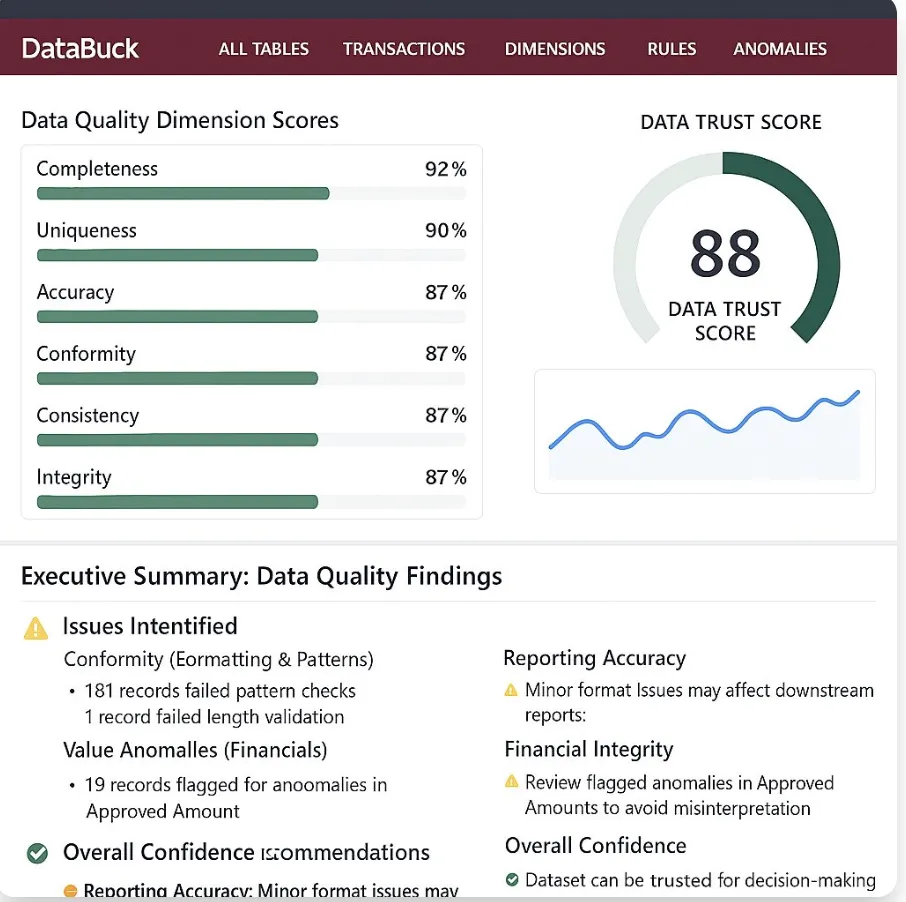
Feature Comparison
| Feature | DataBuck | Validio |
|---|---|---|
| Data-quality workflow | ||
| Validation approach | Profiles data and recommends or runs validation checks without requiring every check to be hand-coded. | Monitors data quality and metrics for anomalies, with investigation context for incidents. |
| Rule extensibility | Supports custom SQL checks and existing dbt tests through its UI or API. | Uses configurable monitors and automated detection; validate the required rule patterns in a proof of concept. |
| Quality signals | Covers completeness, uniqueness, conformity, consistency, drift, and anomaly checks in published materials. | Focuses on anomalies in data and metrics, with alerting and incident investigation workflows. |
| Alert and action integrations | Provides APIs and webhooks, with orchestration and catalog integrations listed by the vendor. | Provides alerts and incident workflows; confirm destination, escalation, and ownership requirements during evaluation. |
| Platform context | ||
| Data estate coverage | Published connector coverage includes Databricks, Snowflake, BigQuery, Redshift, AWS S3, Azure, and Cloudera environments. | Vendor materials position monitoring across streams, lakes, warehouses, transformations, and catalog assets. |
| Lineage and investigation | Published materials emphasize quality validation and integrations; this comparison does not treat those integrations as a documented native lineage map. | Includes a lineage map as part of its investigation and data-context workflow. |
| Catalog and governance connections | Lists integrations with Unity Catalog, Alation, and Collibra. | Includes catalog, glossary, and ownership context in its data-observability positioning. |
| dbt workflow | Can use existing dbt tests alongside its own validation workflow. | Positions dbt lineage and execution context as inputs to observability and investigation. |
| Buying and operations | ||
| Deployment models | Offers SaaS, customer VPC or VNet, and on-premises deployment models. | Offers hosted service and self-hosted VPC deployment options. |
| Trial path | A Microsoft Marketplace free-trial path is listed; duration and limits should be confirmed with the vendor. | Advertises a free trial with full functionality and an onboarding session; confirm its current limits with Validio. |
| Commercial model | Sales-led pricing; request a quote that states asset scope, deployment, support, and implementation assumptions. | Sales-led pricing; request a quote that states monitored scope, deployment, onboarding, and support assumptions. |
| Evaluation emphasis | Test rule recommendation quality, connector fit, and the operating model for data-quality teams. | Test monitoring coverage, lineage context, ownership workflows, and incident triage for the data platform team. |
Data-quality workflow
Validation approach
Rule extensibility
Quality signals
Alert and action integrations
Platform context
Data estate coverage
Lineage and investigation
Catalog and governance connections
dbt workflow
Buying and operations
Deployment models
Trial path
Commercial model
Evaluation emphasis
Which to choose
Choose DataBuck when the evaluation centers on automated data-quality validation, rule discovery, custom SQL checks, dbt test support, and SaaS, private-cloud, or on-premises deployment. Choose Validio when data observability across pipelines and business metrics, lineage context, catalog ownership, and anomaly investigation are central to team operations. DataBuck fits a quality program spanning platforms such as Databricks, Snowflake, BigQuery, Redshift, AWS S3, Azure, and Cloudera. Validio fits teams prioritizing automated monitoring across streams, lakes, warehouses, transformations, and catalogs.
Best-fit scenarios
Choose DataBuck if:
Choose DataBuck for an enterprise quality program that needs no-code validation guidance, custom SQL or dbt test support, and SaaS, private-cloud, or on-premises deployment choices. It is particularly suited to teams needing AI-assisted rule discovery and quality checks across major cloud and data-platform connectors.
Choose Validio if:
Choose Validio for a data platform team that wants observability across data and metrics, with lineage and catalog context to support incident investigation and ownership. Its advertised free trial includes full functionality for up to 10 users, while production pricing requires a sales quote.
These scenarios reflect the available product evidence. Your requirements, existing stack, and team expertise should guide the final decision.
Frequently Asked Questions
Is DataBuck or Validio better for data quality?
Neither is universally better. DataBuck is the more direct fit when rule discovery, validation coverage, and enterprise deployment options lead the evaluation. Validio is the more direct fit when the operating model starts with observability, anomaly investigation, lineage, and catalog context. Test the workflows that your team will run every week.
Do DataBuck and Validio publish pricing?
Both products use contact-sales pricing in the materials reviewed for this page, so public plan amounts should not drive the decision. Ask each vendor for a written quote with the monitored assets, connectors, deployment model, support level, onboarding, implementation work, and contract assumptions made explicit.
Can both products work with dbt and cloud warehouses?
DataBuck documents support for existing dbt tests and lists major warehouse and cloud data-platform connectors. Validio positions its product around modern data-stack observability and documents dbt lineage context. Verify the specific warehouse, orchestration, catalog, and alerting integrations in a proof of concept before selecting either platform.