Decision comparison
Soda vs Validio
Soda and Validio both deliver strong data quality capabilities but serve different team profiles and organizational needs. Soda is the better fit for data engineering teams that want a code-first, open-source approach with collaborative data contracts and transparent pricing starting at $0/mo. Validio is the stronger choice for enterprises that need a comprehensive platform combining data quality, lineage, and catalog with agentic AI, certified security compliance, and self-hosted deployment options. Your decision comes down to whether you prioritize developer-centric data contracts or enterprise-grade observability with built-in lineage and catalog.
Architecture choice. These take different approaches to the same problem. Read the table as a fit question rather than a feature race.
These are different kinds of product — Data Validation Framework and Data Observability.
Quick Comparison
| Decision factor | Soda | Validio |
|---|---|---|
| Best For | Data engineering teams needing collaborative data contracts with AI-powered quality checks, record-level anomaly detection, and a code-first Git workflow | Data-led enterprises needing agentic data quality, lineage, and observability with AI-powered segmented anomaly detection and automated root cause analysis |
| Architecture | Open-source Python core (2,000+ GitHub stars) with SaaS cloud layer; data stays in your cloud for security-by-design compliance | Closed-source SaaS platform with self-hosted VPC deployment option; ISO 27001 and SOC 2 certified; no data stored post-processing |
| Pricing Model | Free tier at $0 per month, Team tier at $750 per month, with enterprise features available | Contact for pricing. Free trial available. |
| Ease of Use | Engineers define checks in YAML via Git; business users collaborate through a no-code UI; AI co-pilot generates data contracts with one click | AI-assisted setup with automatic recommendations for instant time-to-value; multiple interfaces for both data and business teams |
| Scalability | Anomaly detection algorithms scale to 1 billion rows in 64 seconds with 70% fewer false positives than Facebook Prophet | Processes 100M+ records per minute; claims 120x quicker issue detection compared to manual methods |
| Community/Support | Open-source community with 2,000+ GitHub stars; active development with v4.7.0 released April 2026; premium support on Team tier and above | Rated 5.0/5 across 17 reviews on G2; customer success and implementation support included in all plans; Series A funded ($30M) |
Soda
- Best For:
- Data engineering teams needing collaborative data contracts with AI-powered quality checks, record-level anomaly detection, and a code-first Git workflow
- Architecture:
- Open-source Python core (2,000+ GitHub stars) with SaaS cloud layer; data stays in your cloud for security-by-design compliance
- Pricing Model:
- Free tier at $0 per month, Team tier at $750 per month, with enterprise features available
- Ease of Use:
- Engineers define checks in YAML via Git; business users collaborate through a no-code UI; AI co-pilot generates data contracts with one click
- Scalability:
- Anomaly detection algorithms scale to 1 billion rows in 64 seconds with 70% fewer false positives than Facebook Prophet
- Community/Support:
- Open-source community with 2,000+ GitHub stars; active development with v4.7.0 released April 2026; premium support on Team tier and above
Validio
- Best For:
- Data-led enterprises needing agentic data quality, lineage, and observability with AI-powered segmented anomaly detection and automated root cause analysis
- Architecture:
- Closed-source SaaS platform with self-hosted VPC deployment option; ISO 27001 and SOC 2 certified; no data stored post-processing
- Pricing Model:
- Contact for pricing. Free trial available.
- Ease of Use:
- AI-assisted setup with automatic recommendations for instant time-to-value; multiple interfaces for both data and business teams
- Scalability:
- Processes 100M+ records per minute; claims 120x quicker issue detection compared to manual methods
- Community/Support:
- Rated 5.0/5 across 17 reviews on G2; customer success and implementation support included in all plans; Series A funded ($30M)
Public signals
Verified factual signals only. Bars appear only for like-for-like metrics with five weekly assessments for every tool; missing evidence stays explicit. These signals do not establish enterprise adoption, product quality, or total cost.
| Metric | Soda | Validio |
|---|---|---|
| GitHub commits, 90d(Product adoption) | 81 | Not available |
| GitHub stars(Product adoption) | 2,000+ | Not available |
| Search interest(Market interest) | 0 | Unavailable |
| PyPI weekly downloads(Product adoption) | 405.8k | Not available |
| PyPI weekly downloads(Developer adoption) | Not available | 2.8k |
As of September 21, 2026 — updated weekly.
Health & risk evidence
Observed public-source checks for mapped package versions and repositories.
Soda
September 21, 2026Package vulnerabilities
PyPI · soda-core@4.24.0
0 vulnerabilities
across 1 package
Repository security score
Not available
Validio
September 21, 2026Package vulnerabilities
PyPI · validio-sdk@11.0.0
0 vulnerabilities
across 1 package
Repository security score
Not available
Interface Preview
Soda
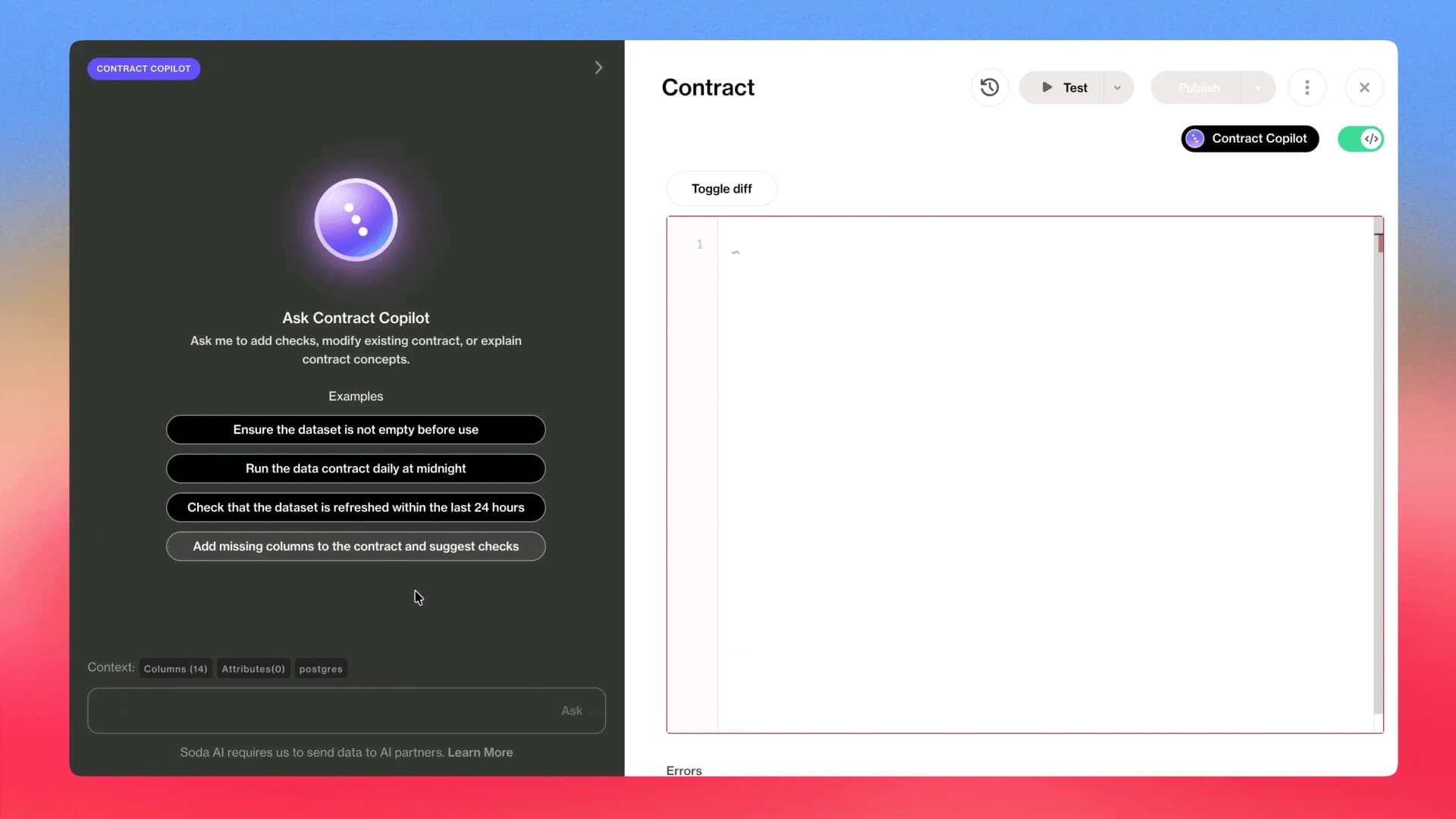
Feature Comparison
| Feature | Soda | Validio |
|---|---|---|
| Data Quality Monitoring | ||
| Anomaly Detection | Record-level anomaly detection with peer-reviewed algorithms published in NeurIPS, JAIR, and ACML; 70% fewer false positives than Facebook Prophet | AI-powered segmented anomaly detection that finds issues across dimensions like markets or products hidden in overall trends |
| Schema and Freshness Monitoring | Schema checks and column-level freshness thresholds defined in YAML-based data contracts with configurable time units | End-to-end validation that automatically monitors freshness, schema, volume, and distributions by learning data behaviors |
| Historical Data Analysis | Built-in backfilling and backtesting analyzes one year of historical data instantly to reveal patterns and trends | Self-learning models adapt to data patterns and seasonal trends using historical data and user input to continuously improve |
| AI and Automation | ||
| AI-Powered Setup and Configuration | AI co-pilot generates full data contracts from plain English with one-click creation and automated check refinement | AI-assisted setup with automatic recommendations for instant time-to-value and agentic data profiling with LLMs for semantic search |
| Root Cause Analysis | Diagnostics warehouse stores all failed records in your data warehouse for root cause investigation and transparent auditing | Agentic root cause analysis with field-level lineage to pinpoint issue origin and downstream impact automatically |
| Automated Issue Management | AI remediation (upcoming) will fix bad records in source systems with AI-generated recommendations | Groups related incidents and filters false alarms; integrated with ServiceNow and alerting tools for automated resolution workflows |
| Data Lineage and Catalog | ||
| Data Lineage | Complete traceability with diagnostics warehouse capturing every log and anomaly for auditing and faster issue resolution | Field-level lineage mapping from streams to BI dashboards with data quality monitoring overlaid directly in the lineage map |
| Data Catalog | Catalog integrations available on paid tiers; focused on quality checks rather than built-in catalog functionality | Built-in data catalog with asset overview showing popularity, utilization rate, quality, and schema coverage with ownership management |
| dbt Integration | Open-source Python core supports integration with dbt and modern data stack tools through pipeline testing | Native dbt integration that imports lineage from dbt, alerts on slow jobs, and provides details on tests and model runs |
| Governance and Security | ||
| Security Certifications | Security-by-design architecture where data stays in your cloud; private deployment option available on Team tier | ISO 27001 and SOC 2 certified; no data stored post-processing; supports EU AI Act and BCBS 239 compliance requirements |
| Deployment Options | SaaS cloud platform with private deployment on Team tier; open-source CLI available for self-hosted pipeline testing | SaaS with fully self-hosted deployment option in customer's Virtual Private Cloud (VPC) |
| Access Control | Audit logs, custom roles, RBAC, and SSO available on Team and Enterprise tiers | Enterprise-grade security and compliance with scalable access controls included in all plans without feature gating |
| Collaboration and Workflows | ||
| Data Contracts | Dedicated data contracts engine with versioned proposals and diffs; engineers work in Git while business users use the UI | No dedicated data contracts feature; focuses on automated monitoring, lineage, and catalog for data governance |
| Business-Engineering Collaboration | Unified workflow where engineers define checks in Git and business users collaborate through the no-code interface | Multiple interfaces built for collaboration to align data and business teams with ownership management in the catalog |
| Alerting and Integrations | Alerting and ticketing integrations included in free tier; catalog integrations available on paid tiers | Issue alerts delivered directly where you work; fully integrated with modern data stack including BI tools and notification platforms |
Data Quality Monitoring
Anomaly Detection
Schema and Freshness Monitoring
Historical Data Analysis
AI and Automation
AI-Powered Setup and Configuration
Root Cause Analysis
Automated Issue Management
Data Lineage and Catalog
Data Lineage
Data Catalog
dbt Integration
Governance and Security
Security Certifications
Deployment Options
Access Control
Collaboration and Workflows
Data Contracts
Business-Engineering Collaboration
Alerting and Integrations
Which approach fits
Soda and Validio both deliver strong data quality capabilities but serve different team profiles and organizational needs. Soda is the better fit for data engineering teams that want a code-first, open-source approach with collaborative data contracts and transparent pricing starting at $0/mo. Validio is the stronger choice for enterprises that need a comprehensive platform combining data quality, lineage, and catalog with agentic AI, certified security compliance, and self-hosted deployment options. Your decision comes down to whether you prioritize developer-centric data contracts or enterprise-grade observability with built-in lineage and catalog.
When each approach fits
Choose Soda if:
Choose Soda when your data engineering team works primarily in code and Git and needs a dedicated data contracts engine that bridges the gap between engineers and business stakeholders. Soda is the right platform if you want an open-source foundation (2,335 GitHub stars, Python-based) with the option to self-host, and you value peer-reviewed AI research published in NeurIPS, JAIR, and ACML backing the anomaly detection algorithms. The transparent pricing structure makes Soda accessible at every stage of growth -- the free tier at $0/mo provides pipeline testing, metrics observability, and alerting integrations, while the Team tier at $750/mo unlocks collaborative data contracts, AI-powered features, RBAC, and SSO. Soda stands out for teams that need record-level anomaly detection scaling to 1 billion rows in 64 seconds, built-in backfilling for historical data analysis, and a diagnostics warehouse that stores all failed records for root cause investigation directly in your data warehouse.
Choose Validio if:
Choose Validio when your organization needs a unified platform that combines data quality monitoring with field-level lineage, a built-in data catalog, and agentic root cause analysis. Validio is the better fit for enterprises operating under regulatory frameworks like the EU AI Act or BCBS 239, given its ISO 27001 and SOC 2 certifications and no-data-stored-post-processing architecture. The platform processes 100M+ records per minute and delivers 120x quicker issue detection than manual methods, making it suitable for large-scale data environments. Validio excels when you need AI-powered segmented anomaly detection that uncovers issues hidden in dimensional segments like markets or product lines, and when you want native dbt integration with automated lineage import. Its self-hosted VPC deployment option and 5.0/5 G2 rating across 17 reviews signal strong enterprise trust. The free trial with full functionality for up to 10 users lets teams evaluate the platform thoroughly before committing.
These scenarios reflect the available product evidence. Your requirements, existing stack, and team expertise should guide the final decision.
Frequently Asked Questions
What is the main difference between Soda and Validio?
Soda is a developer-centric data quality platform built around a dedicated data contracts engine. Engineers define quality checks in YAML through Git workflows while business users collaborate via a no-code interface. It has an open-source Python core with 2,335 GitHub stars and focuses specifically on data quality monitoring, data contracts, and root cause analytics. Validio is an enterprise-grade platform that combines data quality with field-level lineage, a built-in data catalog, and agentic root cause analysis. It uses AI-powered segmented anomaly detection to find issues hidden in data dimensions and provides a unified view from data streams to BI dashboards. The core distinction is that Soda centers on collaborative data contracts with a code-first philosophy, while Validio provides broader data management capabilities including lineage mapping and catalog functionality.
How do Soda and Validio compare on pricing?
Soda offers transparent, tiered pricing. The Free tier at $0/mo includes Soda Processing Units, pipeline testing, metrics observability, alerting integrations, and unlimited users. The Team tier at $750/mo adds collaborative data contracts, a no-code interface, advanced AI features, audit logs, custom roles, RBAC, private deployment, and SSO. Enterprise pricing is custom with annual billing and volume discounts. Validio does not publish specific prices; its pricing model is based on data asset count, segments, and deployment model. Validio requires contacting sales for a quote but offers a free trial with full functionality and access for up to 10 users. All Validio plans include customer success and implementation support with no feature gating. Soda provides a clearer entry point for budget-conscious teams, while Validio bundles comprehensive support into its enterprise-oriented pricing.
Which platform has better AI-powered anomaly detection?
Both platforms offer strong AI-driven anomaly detection with different strengths. Soda's algorithms are peer-reviewed and published in NeurIPS, JAIR, and ACML. Their metrics monitoring delivers 70% fewer false positives than Facebook Prophet and scales to 1 billion rows in 64 seconds. Soda provides record-level anomaly detection that identifies issues at the individual row level and includes built-in backfilling to analyze one year of historical data instantly. Validio uses AI-powered segmented anomaly detection that identifies issues across dimensions like markets or products, catching problems that would be invisible in overall aggregate trends. Validio's self-learning models adapt to data patterns and seasonality, processing 100M+ records per minute. Soda's strength is documented algorithmic precision with academic backing, while Validio's strength is dimensional segmentation that reveals issues hidden within data subsets.
Which tool offers better data lineage capabilities?
Validio has a significant advantage in data lineage. It provides field-level lineage mapping from data streams all the way to BI dashboards, with data quality monitoring overlaid directly in the lineage map. This means teams can see not just where data flows but also where quality issues originate and their downstream impact. Validio also offers native dbt integration that imports lineage automatically and alerts on slow jobs. Soda takes a different approach with its diagnostics warehouse, which stores all failed records and anomaly logs for traceability and auditing. While Soda provides complete visibility into data quality operations, it does not offer the same depth of end-to-end lineage visualization. Organizations that need comprehensive lineage mapping as a core capability will find Validio's offering more mature, while teams focused primarily on data quality traceability will find Soda's diagnostics warehouse sufficient for their needs.
Can Soda and Validio be self-hosted?
Both platforms offer self-hosted options but in different ways. Soda has an open-source core available on GitHub (2,000+ stars, Python-based, latest release v4.7.0 in April 2026) that teams can run independently for pipeline testing and data quality checks. The full Soda platform with the no-code interface and collaborative features is available as SaaS with a private deployment option on the Team tier. Validio offers a fully self-hosted deployment option in the customer's Virtual Private Cloud (VPC), giving organizations complete control over where the platform runs. Validio's approach keeps all data processing within the customer's environment with no data stored post-processing. Soda's open-source model gives more flexibility for custom integrations and community contributions, while Validio's VPC deployment provides a turnkey self-hosted experience with enterprise support.