Decision comparison
Bigeye vs DataBuck
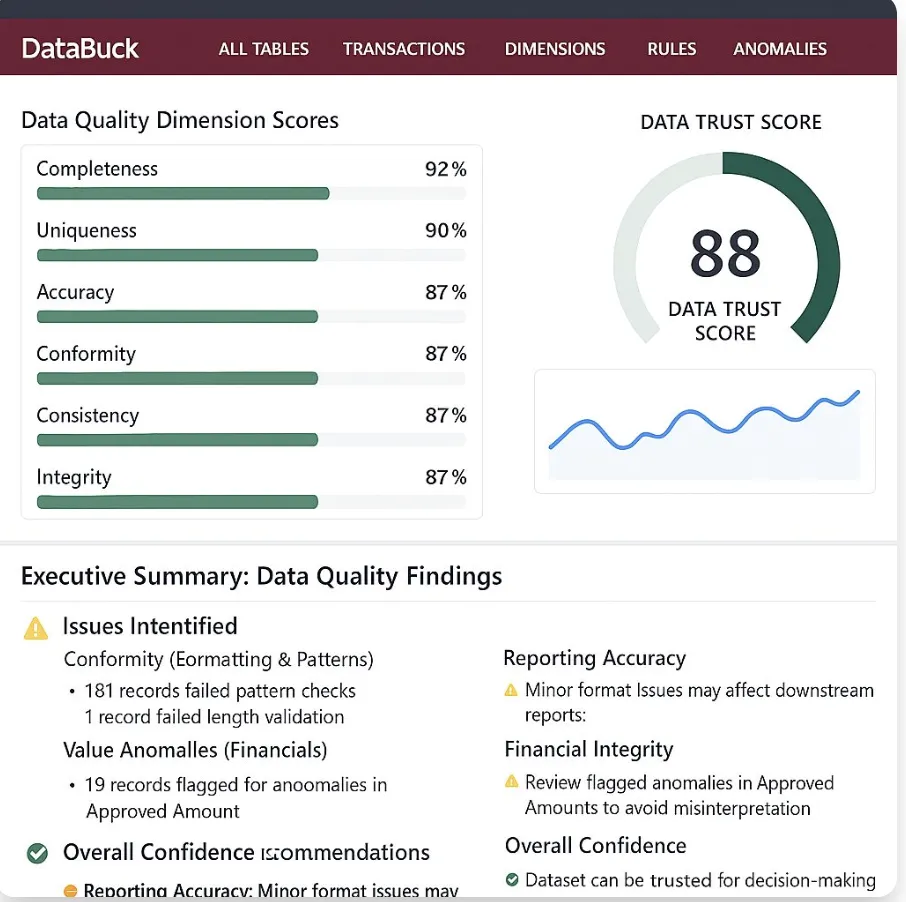
Bigeye and DataBuck both automate the checks a data team would otherwise write by hand. Bigeye adds the operational layer around them: column-level lineage, issue tracking, ownership and reliability targets, aimed at teams running data quality as a discipline. DataBuck concentrates on generating validation coverage quickly across warehouses, files and pipelines, reporting a trust score per dataset.
Direct comparison. These are reviewed substitutes bought for the same job, so the differences below are the ones that decide between them.
All 2 are data observability.
Quick Comparison
| Decision factor | Bigeye | DataBuck |
|---|---|---|
| What it is | A data observability platform combining automatic metric monitoring, lineage and issue management | An automated data quality validation tool that derives checks from the data and scores dataset trust |
| How monitoring starts | Metrics are deployed automatically per column, with thresholds learned from history | Checks are generated from profiling, with manual rules added for business logic |
| Lineage | Column-level lineage across warehouse tables and downstream consumers | Focused on validation results rather than dependency tracing |
| Incident workflow | Issue tracking, ownership and SLA-style targets for data reliability | Alerting on failed checks, with trust scores per dataset |
| Coverage | Warehouse tables across Snowflake, Databricks, BigQuery, Redshift and traditional databases | Warehouse tables plus files in cloud object storage and data in pipelines |
| Who operates it | Data platform and engineering teams managing reliability formally | Data engineering teams validating at scale across heterogeneous systems |
| Best fit | Organisations treating data reliability as an operational discipline with owners and targets | Organisations needing broad validation coverage quickly, including before the warehouse |
Bigeye
- What it is:
- A data observability platform combining automatic metric monitoring, lineage and issue management
- How monitoring starts:
- Metrics are deployed automatically per column, with thresholds learned from history
- Lineage:
- Column-level lineage across warehouse tables and downstream consumers
- Incident workflow:
- Issue tracking, ownership and SLA-style targets for data reliability
- Coverage:
- Warehouse tables across Snowflake, Databricks, BigQuery, Redshift and traditional databases
- Who operates it:
- Data platform and engineering teams managing reliability formally
- Best fit:
- Organisations treating data reliability as an operational discipline with owners and targets
DataBuck
- What it is:
- An automated data quality validation tool that derives checks from the data and scores dataset trust
- How monitoring starts:
- Checks are generated from profiling, with manual rules added for business logic
- Lineage:
- Focused on validation results rather than dependency tracing
- Incident workflow:
- Alerting on failed checks, with trust scores per dataset
- Coverage:
- Warehouse tables plus files in cloud object storage and data in pipelines
- Who operates it:
- Data engineering teams validating at scale across heterogeneous systems
- Best fit:
- Organisations needing broad validation coverage quickly, including before the warehouse
Public signals
Verified factual signals only. Bars appear only for like-for-like metrics with five weekly assessments for every tool; missing evidence stays explicit. These signals do not establish enterprise adoption, product quality, or total cost.
| Metric | Bigeye | DataBuck |
|---|---|---|
| Hacker News mentions, 90d(Community interest) | 0 | Not available |
| PyPI weekly downloads(Developer adoption) | 5.3k | Not available |
As of September 21, 2026 — updated weekly.
Health & risk evidence
Observed public-source checks for mapped package versions and repositories.
Bigeye
September 21, 2026Package vulnerabilities
PyPI · bigeye-sdk@0.11.12
0 vulnerabilities
across 1 package
Repository security score
Not available
DataBuck
Package vulnerabilities
Not available
Repository security score
Not available
Interface Preview
DataBuck
Feature Comparison
| Feature | Bigeye | DataBuck |
|---|---|---|
| Detection | ||
| Automatically deployed metrics | Full support | Full support |
| Learned thresholds from history | Full support | Full support |
| Manual rule authoring | Full support | Full support |
| Schema change detection | Full support | Full support |
| Context | ||
| Column-level lineage | Full support | Partial support |
| Issue tracking and ownership | Full support | Partial support |
| Reliability targets and reporting | Full support | Partial support |
| Data trust scoring | Partial support | Full support |
| Coverage | ||
| Warehouse table monitoring | Full support | Full support |
| File and object storage validation | Partial support | Full support |
| Traditional database support | Full support | Partial support |
| Pipeline and ingestion validation | Partial support | Full support |
| Operations | ||
| Slack and email alerting | Full support | Full support |
| REST API access | Full support | Full support |
| Orchestration integration | Full support | Full support |
| Run in your own cloud account | Full support | Full support |
Detection
Automatically deployed metrics
Learned thresholds from history
Manual rule authoring
Schema change detection
Context
Column-level lineage
Issue tracking and ownership
Reliability targets and reporting
Data trust scoring
Coverage
Warehouse table monitoring
File and object storage validation
Traditional database support
Pipeline and ingestion validation
Operations
Slack and email alerting
REST API access
Orchestration integration
Run in your own cloud account
Which to choose
Bigeye and DataBuck both automate the checks a data team would otherwise write by hand. Bigeye adds the operational layer around them: column-level lineage, issue tracking, ownership and reliability targets, aimed at teams running data quality as a discipline. DataBuck concentrates on generating validation coverage quickly across warehouses, files and pipelines, reporting a trust score per dataset.
Best-fit scenarios
Choose Bigeye if:
Choose Bigeye when data reliability has owners, targets and a review cadence. Automatic metric deployment gives coverage, column-level lineage shows what a failure affects, and issue tracking with reliability targets turns incidents into something that can be reported on rather than a stream of alerts nobody closes.
Choose DataBuck if:
Choose DataBuck when the pressing gap is validation coverage across many systems, including files and raw ingestion before anything reaches the warehouse. Generated checks mean broad coverage in days rather than quarters, and per-dataset trust scores give downstream consumers a signal without asking them to read a monitoring tool.
These scenarios reflect the available product evidence. Your requirements, existing stack, and team expertise should guide the final decision.
Frequently Asked Questions
What does issue management add over alerting?
Alerts tell you something happened. Issue management asks who owns it, whether it is resolved, how long it took, and whether the same table keeps failing. Without that, alerts accumulate in a Slack channel and the honest answer to how reliable your data is becomes nobody knows. With it, you can report reliability the way you report uptime, which is what makes the investment defensible to people outside the data team.
Do we need column-level lineage?
It is worth most when many consumers sit on the warehouse. Tracing which downstream models, dashboards and features depend on a broken column turns a guess into a list, and that list is what you use to decide who to notify. With a handful of dashboards it is a convenience. With hundreds of models and dashboards it is the difference between containing an incident and discovering its reach a week later.
Where should validation run — before or after the warehouse?
Both, and the order of investment depends on where your bad data originates. If it arrives from partners or source systems you do not control, validating files and ingestion catches problems while the fix is still a conversation with the sender. If your failures are transformation logic and schema drift inside your own pipelines, warehouse-level monitoring catches what upstream checks cannot see.
Which needs less ongoing maintenance?
Both automate the bulk of check creation, so neither requires the rule library that sank earlier generations of data quality projects. The ongoing work is the same on either: tuning thresholds that are too sensitive, suppressing checks on tables that are legitimately erratic, and adding business rules the automation cannot infer. Budget a few hours a week during the first quarter regardless of which you pick.
Can they cover databases outside the cloud warehouse?
Bigeye supports traditional databases alongside Snowflake, Databricks, BigQuery and Redshift, which matters when critical data still lives in an operational SQL Server or Oracle system. DataBuck reaches across warehouses, lakes and object storage. List every system you actually need covered and check both against that list, because coverage gaps are the most common reason a data quality rollout stalls.
How should we roll one of these out?
Start with the tables that feed decisions someone would notice being wrong: the revenue model, the executive dashboard, the tables a machine learning feature reads. Monitor those first, tune until the alerts are trusted, and route them to a Slack channel with a named owner. Turning on monitoring for a thousand tables in week one produces noise, and a noisy data quality tool gets muted within a month and never recovers.