Decision comparison
digna vs Monte Carlo
Monte Carlo and digna both catch freshness, volume and schema problems from learned baselines, but they sit at opposite ends of deployment and pricing. Monte Carlo is a hosted platform that also watches ML models and AI agents, bought as credits, with Oracle, SAP HANA and Teradata in its Enterprise tier. digna runs only on your own hosts, checks data inside your database by default, and charges a base fee plus a price per activated table for each module, with all integrations from the first module.
Direct comparison. These are reviewed substitutes bought for the same job, so the differences below are the ones that decide between them.
All 2 are data observability.
Quick Comparison
| Decision factor | digna | Monte Carlo |
|---|---|---|
| Best for | Teams whose data must stay in their own data center or private cloud and who have many warehouse tables to watch. digna lists finance, healthcare, telecommunications and the public sector among the sectors it serves. It runs only inside the customer's infrastructure and, by default, calculates its metrics inside the monitored database, so the data being checked stays where it is. | Teams that want one hosted platform for data, ML model and AI agent observability, bought as credits. Monte Carlo calls itself the Agent Trust Platform for Data + AI Observability, and every tier includes agent, ML and data observability. Its Start tier is meant for a small team that wants to start quickly, with up to 10 users. |
| Where it runs | Only on the customer's own hosts, on-premises or in a private cloud: digna's documentation says no module needs external services or SaaS. The server runs on Linux (Ubuntu 22.04+, Debian 12+ or the RHEL 9 family, x86_64 or arm64), Windows or macOS, needs at least 16 GB RAM and stores its metrics in PostgreSQL 12 or higher. digna supplies a licence file with an expiration date, and release 2026.11 needs a new one. | A hosted platform. Monte Carlo's containerized agent can be deployed in AWS and GCP from Terraform or CloudFormation templates, with images for Cloud Run, Azure and Lambda, and a data collector sends traffic for supported integrations through it. The Scale tier adds Self-Hosted Storage, and Business Critical adds a dedicated instance with disaster recovery to another region. |
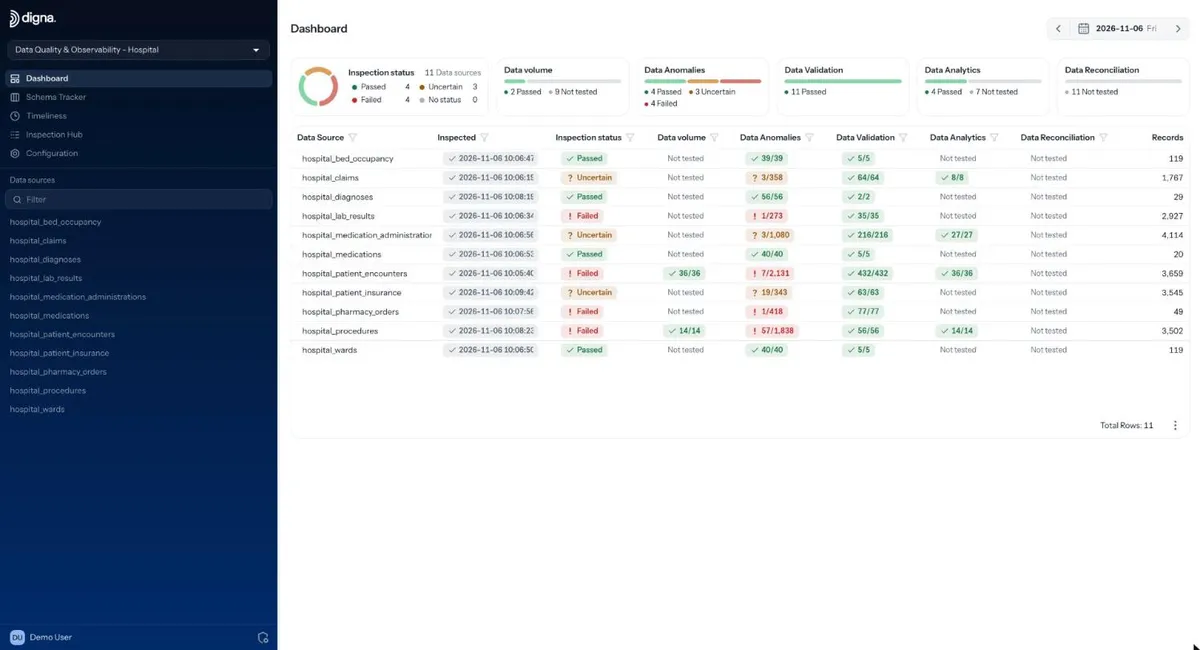
| How it finds problems | Data Anomalies learns the normal volume, distributions and value patterns of each table with no manual rule setup, and Timeliness combines learned arrival times with user-defined schedules to flag late, missing or early loads. Data Validation adds record-level rules (exact values, ranges, thresholds, reference lists) with an audit trail, and Schema Tracker reports added, removed or renamed columns and data type changes. | Out-of-the-box coverage for freshness, volume and schema. Monitors can be deployed from YAML in CI/CD, through a point-and-click UI or created with AI, and a monitoring agent can discover and deploy monitors. Automated profiling shows field types, null rates and cardinality with no SQL, and root cause analysis correlates data changes, system failures and code changes. |
| Data sources | TimescaleDB, Teradata, Snowflake, SAP HANA, PostgreSQL, Oracle, Netezza, Apache Hive, Apache Impala, Databricks, MariaDB, MS SQL Server and MySQL. Checks run inside the source database by default; per connection, the digna Engine can instead export the data and profile it on the digna host, which also allows referential integrity checks between different database technologies. | Start covers data warehouses, BI and ETL, and agents built on Langchain, Snowflake Intelligence and Databricks Genie. Scale adds lakes (Databricks, Hive, Glue, Azure Data Lake) and databases (MySQL, Postgres, SQL Server). Enterprise adds Oracle, SAP HANA, Teradata and Microsoft Fabric, plus bring-your-own integrations. |
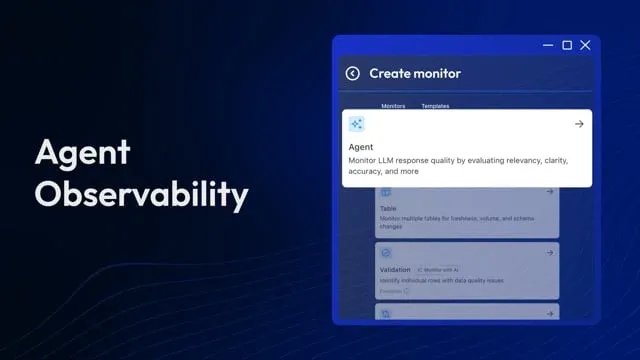
| Alerts, sign-in and AI agents | Alerts go to Slack, Microsoft Teams, Jira Software, Zapier, webhooks and email, and single sign-on works with Microsoft Entra ID, OpenID, SAML or Google. Release 2026.11 adds digna Agentic (beta), an MCP server through which Claude and other AI agents can manage projects, rules and schedules and read inspection results down to a single check. | Alert routing by domain, automated grouping of related incidents by lineage, and field-level lineage from tables to the dashboards, models and agents that use them. Scale adds SSO, SCIM, PII filtering, audit logging and webhooks. The same lineage graph watches AI agents, so a bad answer can be traced to the agent or to its data. |
| Pricing | Quote-based modular subscription: each module has a base fee plus a price per activated table. The first module unlocks the platform, with no separate platform fee. No charges per API call, scan or alert. The pricing page lists no amounts; the vendor states there is no free tier or free trial and evaluation starts with a demo. Official pricing page checked November 11, 2026. | Monte Carlo publishes no amounts. Its tiers are Start, Scale, Enterprise and Business Critical, purchased as credits, and all are quote-only. Every tier includes agent, ML and data observability. |
digna
- Best for:
- Teams whose data must stay in their own data center or private cloud and who have many warehouse tables to watch. digna lists finance, healthcare, telecommunications and the public sector among the sectors it serves. It runs only inside the customer's infrastructure and, by default, calculates its metrics inside the monitored database, so the data being checked stays where it is.
- Where it runs:
- Only on the customer's own hosts, on-premises or in a private cloud: digna's documentation says no module needs external services or SaaS. The server runs on Linux (Ubuntu 22.04+, Debian 12+ or the RHEL 9 family, x86_64 or arm64), Windows or macOS, needs at least 16 GB RAM and stores its metrics in PostgreSQL 12 or higher. digna supplies a licence file with an expiration date, and release 2026.11 needs a new one.
- How it finds problems:
- Data Anomalies learns the normal volume, distributions and value patterns of each table with no manual rule setup, and Timeliness combines learned arrival times with user-defined schedules to flag late, missing or early loads. Data Validation adds record-level rules (exact values, ranges, thresholds, reference lists) with an audit trail, and Schema Tracker reports added, removed or renamed columns and data type changes.
- Data sources:
- TimescaleDB, Teradata, Snowflake, SAP HANA, PostgreSQL, Oracle, Netezza, Apache Hive, Apache Impala, Databricks, MariaDB, MS SQL Server and MySQL. Checks run inside the source database by default; per connection, the digna Engine can instead export the data and profile it on the digna host, which also allows referential integrity checks between different database technologies.
- Alerts, sign-in and AI agents:
- Alerts go to Slack, Microsoft Teams, Jira Software, Zapier, webhooks and email, and single sign-on works with Microsoft Entra ID, OpenID, SAML or Google. Release 2026.11 adds digna Agentic (beta), an MCP server through which Claude and other AI agents can manage projects, rules and schedules and read inspection results down to a single check.
- Pricing:
- Quote-based modular subscription: each module has a base fee plus a price per activated table. The first module unlocks the platform, with no separate platform fee. No charges per API call, scan or alert. The pricing page lists no amounts; the vendor states there is no free tier or free trial and evaluation starts with a demo. Official pricing page checked November 11, 2026.
Monte Carlo
- Best for:
- Teams that want one hosted platform for data, ML model and AI agent observability, bought as credits. Monte Carlo calls itself the Agent Trust Platform for Data + AI Observability, and every tier includes agent, ML and data observability. Its Start tier is meant for a small team that wants to start quickly, with up to 10 users.
- Where it runs:
- A hosted platform. Monte Carlo's containerized agent can be deployed in AWS and GCP from Terraform or CloudFormation templates, with images for Cloud Run, Azure and Lambda, and a data collector sends traffic for supported integrations through it. The Scale tier adds Self-Hosted Storage, and Business Critical adds a dedicated instance with disaster recovery to another region.
- How it finds problems:
- Out-of-the-box coverage for freshness, volume and schema. Monitors can be deployed from YAML in CI/CD, through a point-and-click UI or created with AI, and a monitoring agent can discover and deploy monitors. Automated profiling shows field types, null rates and cardinality with no SQL, and root cause analysis correlates data changes, system failures and code changes.
- Data sources:
- Start covers data warehouses, BI and ETL, and agents built on Langchain, Snowflake Intelligence and Databricks Genie. Scale adds lakes (Databricks, Hive, Glue, Azure Data Lake) and databases (MySQL, Postgres, SQL Server). Enterprise adds Oracle, SAP HANA, Teradata and Microsoft Fabric, plus bring-your-own integrations.
- Alerts, sign-in and AI agents:
- Alert routing by domain, automated grouping of related incidents by lineage, and field-level lineage from tables to the dashboards, models and agents that use them. Scale adds SSO, SCIM, PII filtering, audit logging and webhooks. The same lineage graph watches AI agents, so a bad answer can be traced to the agent or to its data.
- Pricing:
- Monte Carlo publishes no amounts. Its tiers are Start, Scale, Enterprise and Business Critical, purchased as credits, and all are quote-only. Every tier includes agent, ML and data observability.
Public signals
Verified factual signals only. Bars appear only for like-for-like metrics with five weekly assessments for every tool; missing evidence stays explicit. These signals do not establish enterprise adoption, product quality, or total cost.
| Metric | digna | Monte Carlo |
|---|---|---|
| GitHub commits, 90d(Developer adoption) | 14 | 251 |
| GitHub stars(Developer adoption) | 0 | 2 |
| Hacker News mentions, 90d(Community interest) | 0 | 0 |
| PyPI weekly downloads(Developer adoption) | 23 | 40.3k |
As of November 16, 2026 — updated weekly.
Health & risk evidence
Observed public-source checks for mapped package versions and repositories.
digna
November 16, 2026Package vulnerabilities
PyPI · digna-sdk@1.0.1
0 vulnerabilities
across 1 package
Repository security score
Not available
Monte Carlo
November 16, 2026Package vulnerabilities
PyPI · montecarlodata@0.177.0
0 vulnerabilities
across 1 package
Repository security score
Not available
Interface Preview
digna
Monte Carlo
Feature Comparison
| Feature | digna | Monte Carlo |
|---|---|---|
| Deployment | ||
| Delivery model | Self-hosted: on-premises or customer private cloud | Hosted platform with an agent you can deploy in AWS, GCP or Azure; dedicated instance in Business Critical |
| Where data is profiled | Inside the source database by default; optional digna Engine on the digna host | Automated profiling of field types, null rates and cardinality; a data collector routes integration traffic through the agent |
| Where results are stored | PostgreSQL 12 or higher that you run | Self-Hosted Storage from the Scale tier |
| Monitoring | ||
| Freshness, volume and schema | Timeliness, Data Anomalies and Schema Tracker modules | Out-of-the-box freshness, volume and schema coverage |
| Setting up checks | Learned baselines with no manual rule setup; record-level rules in Data Validation | YAML in CI/CD, point-and-click UI, or AI-powered creation by a monitoring agent |
| Investigation | Data Analytics for trends and volatility; Data Reconciliation (beta) compares targets with sources | Field-level lineage and root cause analysis across data, system and code changes |
| AI agents | MCP server for Claude and other AI agents (beta in 2026.11) | Agent observability in every tier, plus a monitoring agent that discovers and deploys monitors |
| Integrations and access | ||
| Enterprise databases | Teradata, Oracle, SAP HANA and Netezza listed; all integrations included from the first module | Oracle, SAP HANA, Teradata and Microsoft Fabric from the Enterprise tier |
| Single sign-on | Microsoft Entra ID, OpenID, SAML and Google | SSO and SCIM from the Scale tier |
| Alert destinations | Slack, Microsoft Teams, Jira Software, Zapier, webhooks and email | Routing by domain and lineage grouping; webhooks from the Scale tier |
| Commercial terms | ||
| Billing unit | Base fee plus a price per activated table, per module | Credits at consumption rates; cost per credit depends on the tier; pay per monitor |
| Usage allowances | No fees per API call, scan, inspection or alert | 10,000 API calls a day on Start, 50,000 on Scale, 100,000 on Enterprise and Business Critical |
| Users | Team collaboration included from the first module | Up to 10 users on Start; unlimited from Scale |
Deployment
Delivery model
Where data is profiled
Where results are stored
Monitoring
Freshness, volume and schema
Setting up checks
Investigation
AI agents
Integrations and access
Enterprise databases
Single sign-on
Alert destinations
Commercial terms
Billing unit
Usage allowances
Users
Which to choose
Monte Carlo and digna both catch freshness, volume and schema problems from learned baselines, but they sit at opposite ends of deployment and pricing. Monte Carlo is a hosted platform that also watches ML models and AI agents, bought as credits, with Oracle, SAP HANA and Teradata in its Enterprise tier. digna runs only on your own hosts, checks data inside your database by default, and charges a base fee plus a price per activated table for each module, with all integrations from the first module.
Best-fit scenarios
Choose Monte Carlo if:
Choose Monte Carlo when a hosted platform is acceptable and you want one view across data pipelines, BI, ML models and AI agents. Its field-level lineage maps tables to the dashboards, models and agents that use them, and its root cause analysis correlates data, system and code changes. Monitors can live in YAML next to your code in CI/CD. Plan the tier carefully: SSO, SCIM and webhooks start at Scale, Oracle, SAP HANA and Teradata start at Enterprise, and Start is capped at 10 users and 1,000 monitors. Credits and tier-dependent credit prices make the bill harder to forecast without a quote, and Monte Carlo publishes no amounts.
Choose digna if:
Choose digna when the platform must run on-premises or in your private cloud, or when your main databases are Teradata, Oracle, SAP HANA or Netezza and you do not want them to decide your tier: digna lists them all and includes every integration with the first module. Its price follows modules and activated tables, with no fees per API call, scan, inspection or alert, so raising check frequency does not change it. In exchange you run the server, its PostgreSQL metrics store and a licence file, digna's AI agent support (an MCP server) is beta in release 2026.11, and its pricing page shows the model but no amounts.
These scenarios reflect the available product evidence. Your requirements, existing stack, and team expertise should guide the final decision.
Frequently Asked Questions
Can Monte Carlo run on-premises like digna?
Monte Carlo is a hosted platform. Its agent can be deployed in your AWS, GCP or Azure environment, the Scale tier adds Self-Hosted Storage, and Business Critical adds a dedicated instance. digna runs entirely on your own hosts, on-premises or in a private cloud.
How do their pricing models differ?
Monte Carlo sells credits consumed at its consumption rates, with a cost per credit that depends on the tier and a pay-per-monitor model; it publishes no amounts. digna charges a base fee plus a price per activated table for each module, with no fees per API call, scan or alert; its pricing page lists no amounts either.
Which one supports Teradata and Oracle?
Both. Monte Carlo lists Oracle, SAP HANA, Teradata and Microsoft Fabric among the integrations its Enterprise tier adds. digna lists Teradata, Oracle, SAP HANA and Netezza on its integrations page, and its pricing page includes all integrations with the first module.
Do they monitor AI agents?
Monte Carlo includes agent observability in every tier and traces a bad agent answer to the agent or its data. digna's release 2026.11 adds an MCP server (beta) that lets Claude and other agents work with digna, which is a different job: agents use digna, rather than digna watching agents.