Decision comparison
Monte Carlo vs Great Expectations
Monte Carlo and Great Expectations represent two distinct approaches to data quality. Monte Carlo is an enterprise data and AI observability platform that monitors your entire data ecosystem using ML-driven anomaly detection, column-level lineage, incident management, and impact analysis. Great Expectations is a developer-focused, open-source framework for codified data validation that gives engineers explicit control over data quality checks within their pipelines. Choose Monte Carlo when you need automated, end-to-end observability across a complex data estate. Choose Great Expectations when you want free, code-first validation with full transparency and no vendor lock-in.
Architecture choice. These take different approaches to the same problem. Read the table as a fit question rather than a feature race.
These are different kinds of product — Data Observability and Data Validation Framework.
Quick Comparison
| Decision factor | Monte Carlo | Great Expectations |
|---|---|---|
| Best For | Enterprise data teams needing end-to-end observability across data pipelines, warehouses, and BI layers | Data engineers who want code-first, explicit data validation embedded in their pipelines |
| Pricing Model | Monte Carlo publishes no amounts. Its tiers are Start, Scale, Enterprise and Business Critical, purchased as credits, and all are quote-only. Every tier includes agent, ML and data observability. | Free and Open-Source, Paid upgrades available |
| Deployment | SaaS platform with deep integrations across the data and AI ecosystem | Self-hosted (GX Core) or SaaS (GX Cloud) |
| Data Quality Approach | ML-driven anomaly detection with automated monitoring, alerting, and root cause analysis | Expectation-based validation with codified rules and auto-generated Data Docs |
| Core Strength | End-to-end data and AI observability with column-level lineage and impact analysis | Fine-grained, developer-controlled data quality checks with full transparency |
| Learning Curve | Low — fast setup with out-of-the-box monitoring and automatic baseline coverage | Steeper — requires Python proficiency and manual expectation definition |
Monte Carlo
- Best For:
- Enterprise data teams needing end-to-end observability across data pipelines, warehouses, and BI layers
- Pricing Model:
- Monte Carlo publishes no amounts. Its tiers are Start, Scale, Enterprise and Business Critical, purchased as credits, and all are quote-only. Every tier includes agent, ML and data observability.
- Deployment:
- SaaS platform with deep integrations across the data and AI ecosystem
- Data Quality Approach:
- ML-driven anomaly detection with automated monitoring, alerting, and root cause analysis
- Core Strength:
- End-to-end data and AI observability with column-level lineage and impact analysis
- Learning Curve:
- Low — fast setup with out-of-the-box monitoring and automatic baseline coverage
Great Expectations
- Best For:
- Data engineers who want code-first, explicit data validation embedded in their pipelines
- Pricing Model:
- Free and Open-Source, Paid upgrades available
- Deployment:
- Self-hosted (GX Core) or SaaS (GX Cloud)
- Data Quality Approach:
- Expectation-based validation with codified rules and auto-generated Data Docs
- Core Strength:
- Fine-grained, developer-controlled data quality checks with full transparency
- Learning Curve:
- Steeper — requires Python proficiency and manual expectation definition
Public signals
Verified factual signals only. Bars appear only for like-for-like metrics with five weekly assessments for every tool; missing evidence stays explicit. These signals do not establish enterprise adoption, product quality, or total cost.
| Metric | Monte Carlo | Great Expectations |
|---|---|---|
| GitHub commits, 90d(Developer adoption) | 231 | Not available |
| GitHub stars(Developer adoption) | 2 | Not available |
| Search interest(Market interest) | 0 | 0 |
| Hacker News mentions, 90d(Community interest) | 0 | 0 |
| PyPI weekly downloads(Developer adoption) | 41.2k | Not available |
| GitHub commits, 90d(Product adoption) | Not available | 169 |
| GitHub stars(Product adoption) | Not available | 11,000+ |
| PyPI weekly downloads(Product adoption) | Not available | 4.5M |
| Stack Overflow questions(Community interest) | Not available | 148 |
As of September 21, 2026 — updated weekly.
Health & risk evidence
Observed public-source checks for mapped package versions and repositories.
Monte Carlo
September 21, 2026Package vulnerabilities
PyPI · montecarlodata@0.175.0
0 vulnerabilities
across 1 package
Repository security score
Not available
Great Expectations
September 21, 2026Package vulnerabilities
PyPI · great-expectations@1.23.1
0 vulnerabilities
across 1 package
Repository security score
Not available
Interface Preview
Monte Carlo
Feature Comparison
| Feature | Monte Carlo | Great Expectations |
|---|---|---|
| Data Quality & Monitoring | ||
| Anomaly Detection | ML-powered anomaly detection that learns baselines automatically across freshness, volume, schema, and distribution | Manual expectation-based checks; no built-in anomaly detection |
| Schema Monitoring | Automatic schema change detection with alerts and impact analysis | Schema expectations must be manually defined per dataset |
| Data Profiling | Automated data profiling with AI-powered quality rules and monitoring agents | Profiling via Expectation Suites and auto-generated Data Docs |
| Observability & Lineage | ||
| Data Lineage | End-to-end column-level lineage tracking across the entire data ecosystem | No built-in lineage; depends on external catalog or orchestration tools |
| Impact Analysis | Assesses downstream impact of data issues on dashboards and business processes | Not available — focused on data validation only |
| Incident Management | Built-in incident management with intelligent alerting, lineage grouping, and root cause analysis | Validation results require manual triage; no native incident management |
| Automation & AI | ||
| AI-Powered Monitoring | Monitoring agent that discovers and deploys the right monitors in minutes using natural language prompts | ExpectAI auto-generates test expectations; no autonomous monitoring agents |
| Alerting | Intelligent alerts with granular routing, automated lineage grouping, and contextual notifications | Basic pass/fail validation results; alerting requires external integration |
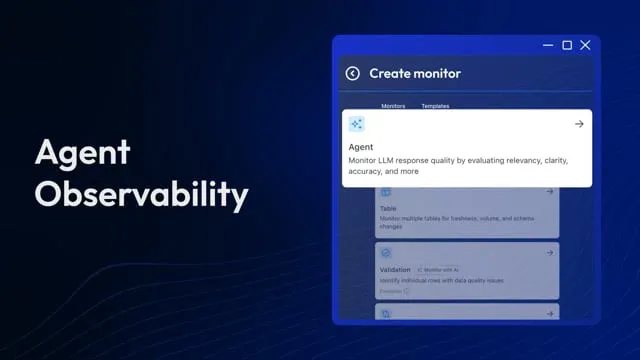
| Agent Observability | Dedicated AI agent observability for monitoring agent inputs, outputs, and behavior in production | Not available — focused on data validation rather than AI system monitoring |
| Integration & Extensibility | ||
| Data Platform Support | Snowflake, Databricks, BigQuery, data lakes, BI tools, and ETL systems from ingestion to consumption | SQL databases, Pandas DataFrames, and Apache Spark |
| Orchestrator Integration | CI/CD deployment via YAML, point-and-click UI, or programmatic AI-powered creation | Native integration with Airflow, Dagster, and Prefect |
| Open Source | Proprietary SaaS platform | Fully open source under Apache-2.0 license with 11,000+ GitHub stars |
| Enterprise Features | ||
| Access Control | SSO, SCIM, self-hosted storage, PII filtering, and audit logging from the Scale tier up | Basic access control via GX Cloud; no built-in RBAC in GX Core |
| Multi-Workspace Support | Multi-workspace support for testing and development environments at the Enterprise tier | Not available natively; teams manage separate GX project configurations |
| API Access | 10,000 to 100,000 API calls per day depending on tier | Python API with full programmatic access; no API call limits in GX Core |
Data Quality & Monitoring
Anomaly Detection
Schema Monitoring
Data Profiling
Observability & Lineage
Data Lineage
Impact Analysis
Incident Management
Automation & AI
AI-Powered Monitoring
Alerting
Agent Observability
Integration & Extensibility
Data Platform Support
Orchestrator Integration
Open Source
Enterprise Features
Access Control
Multi-Workspace Support
API Access
Which approach fits
Monte Carlo and Great Expectations represent two distinct approaches to data quality. Monte Carlo is an enterprise data and AI observability platform that monitors your entire data ecosystem using ML-driven anomaly detection, column-level lineage, incident management, and impact analysis. Great Expectations is a developer-focused, open-source framework for codified data validation that gives engineers explicit control over data quality checks within their pipelines. Choose Monte Carlo when you need automated, end-to-end observability across a complex data estate. Choose Great Expectations when you want free, code-first validation with full transparency and no vendor lock-in.
When each approach fits
Choose Monte Carlo if:
Choose Monte Carlo if you operate an enterprise data platform spanning multiple warehouses, lakes, and BI tools and need automated observability with ML-driven anomaly detection, column-level lineage, incident management, and AI agent monitoring — all in a managed platform that scales from fast setup to full production coverage.
Choose Great Expectations if:
Choose Great Expectations if you are a data engineer or small-to-mid-size team that wants free, open-source, code-first data validation with explicit expectation definitions, native orchestrator integration with Airflow, Dagster, and Prefect, auto-generated documentation, and zero vendor lock-in.
These scenarios reflect the available product evidence. Your requirements, existing stack, and team expertise should guide the final decision.
Frequently Asked Questions
Can Monte Carlo replace Great Expectations for data validation?
Monte Carlo covers data quality monitoring as part of its broader observability platform, using ML-driven anomaly detection to automatically surface freshness, volume, schema, and distribution issues. However, it takes a fundamentally different approach from Great Expectations' explicit, code-defined expectation suites. Monte Carlo excels at detecting unknown issues you did not anticipate, while Great Expectations excels at enforcing specific, known data contracts. Many teams use both tools together for complementary coverage.
Is Great Expectations truly free to use?
Yes. GX Core is fully open source under the Apache-2.0 license and free to download, deploy, and extend with no usage limits. Great Expectations also offers GX Cloud, a managed platform with a free Developer tier and paid Team and Enterprise tiers for teams that want collaboration features, a hosted UI, and managed infrastructure without self-hosting overhead.
How does Monte Carlo's pricing work?
Monte Carlo uses a usage-based credit model across four tiers: Start, Scale, Enterprise, and Business Critical. Teams buy credits and consume them based on published consumption rates. The Start tier supports up to 10 users and 1,000 monitors. The Scale tier adds unlimited users, advanced security features like SSO and SCIM, and Data Mesh support. Enterprise and Business Critical tiers add multi-workspace support, advanced cost attribution, and higher API limits. All tiers include access to Agent Observability, ML Observability, Data Observability, and automation agents.
Which tool is better for small data teams?
Great Expectations is typically the better fit for smaller teams. It is free, Python-native, and integrates directly into existing data pipelines without requiring a separate platform or SaaS subscription. Monte Carlo is built for enterprise-scale environments with complex multi-system data estates, and its usage-based credit pricing reflects that positioning. Teams with limited budgets and straightforward data stacks get more value from Great Expectations' focused validation approach.
Can I use Monte Carlo and Great Expectations together?
Yes, and this is a common pattern in mature data organizations. Great Expectations handles explicit, code-level data validation within pipelines, enforcing known data contracts before data moves downstream. Monte Carlo provides an extensive observability layer, detecting anomalies you did not write tests for, tracking lineage across the entire ecosystem, and managing incidents when issues arise. The two tools address different layers of the data quality stack and complement each other well.