Decision comparison
Monte Carlo vs New Relic
Monte Carlo and New Relic are observability platforms that operate at fundamentally different layers of the technology stack. Monte Carlo specializes in data observability, monitoring pipelines, warehouses, and BI layers to detect data quality incidents before they affect downstream consumers. New Relic is a full-stack application observability platform covering APM, infrastructure, logs, browser performance, mobile apps, and security. The right choice depends entirely on whether your primary concern is data reliability or application performance.
Architecture choice. These take different approaches to the same problem. Read the table as a fit question rather than a feature race.
These are different kinds of product — Data Observability and Observability Platform.
Quick Comparison
| Decision factor | Monte Carlo | New Relic |
|---|---|---|
| Best For | Enterprise data teams needing data and AI observability across pipelines, warehouses, and BI layers | Engineering teams needing full-stack application and infrastructure observability with APM, logs, and security |
| Architecture | SaaS data observability platform with deep integrations across ingestion, warehouses, BI, and AI agents | SaaS observability platform covering APM, infrastructure, logs, browser, mobile, AI monitoring, and security |
| Pricing Model | Monte Carlo publishes no amounts. Its tiers are Start, Scale, Enterprise and Business Critical, purchased as credits, and all are quote-only. Every tier includes agent, ML and data observability. | Free tier available, paid plans start at $19/mo per host, additional costs based on usage and features |
| Ease of Use | Fast out-of-the-box setup with automatic baseline monitoring and agentic monitor creation | 780+ quickstart integrations for fast onboarding; NRQL query language has a learning curve |
| Scalability | Designed for large enterprises with unlimited users on Scale tier and above | Unlimited data ingest with per-GB pricing; serves 16,000+ global brands |
| Community/Support | Self-guided onboarding on Start tier, expert-guided onboarding with 4-8 hour SLA on higher tiers | Free tier with community support; Enterprise tier includes priority routing and 1-hour critical SLA |
Monte Carlo
- Best For:
- Enterprise data teams needing data and AI observability across pipelines, warehouses, and BI layers
- Architecture:
- SaaS data observability platform with deep integrations across ingestion, warehouses, BI, and AI agents
- Pricing Model:
- Monte Carlo publishes no amounts. Its tiers are Start, Scale, Enterprise and Business Critical, purchased as credits, and all are quote-only. Every tier includes agent, ML and data observability.
- Ease of Use:
- Fast out-of-the-box setup with automatic baseline monitoring and agentic monitor creation
- Scalability:
- Designed for large enterprises with unlimited users on Scale tier and above
- Community/Support:
- Self-guided onboarding on Start tier, expert-guided onboarding with 4-8 hour SLA on higher tiers
New Relic
- Best For:
- Engineering teams needing full-stack application and infrastructure observability with APM, logs, and security
- Architecture:
- SaaS observability platform covering APM, infrastructure, logs, browser, mobile, AI monitoring, and security
- Pricing Model:
- Free tier available, paid plans start at $19/mo per host, additional costs based on usage and features
- Ease of Use:
- 780+ quickstart integrations for fast onboarding; NRQL query language has a learning curve
- Scalability:
- Unlimited data ingest with per-GB pricing; serves 16,000+ global brands
- Community/Support:
- Free tier with community support; Enterprise tier includes priority routing and 1-hour critical SLA
Public signals
Verified factual signals only. Bars appear only for like-for-like metrics with five weekly assessments for every tool; missing evidence stays explicit. These signals do not establish enterprise adoption, product quality, or total cost.
| Metric | Monte Carlo | New Relic |
|---|---|---|
| GitHub commits, 90d(Developer adoption) | 231 | 352 |
| GitHub stars(Developer adoption) | 2 | 10 |
| Search interest(Market interest) | 0 | 4 |
| Hacker News mentions, 90d(Community interest) | 0 | 1 |
| PyPI weekly downloads(Developer adoption) | 41.2k | 929.1k |
| npm weekly downloads(Developer adoption) | Not available | 847.6k |
| Product Hunt comments(Community interest) | Not available | 1 |
| Product Hunt reviews(Community interest) | Not available | 0 |
| Product Hunt votes(Community interest) | Not available | 16 |
| Stack Overflow questions(Community interest) | Not available | 1.5k |
As of September 21, 2026 — updated weekly.
Health & risk evidence
Observed public-source checks for mapped package versions and repositories.
Monte Carlo
September 21, 2026Package vulnerabilities
PyPI · montecarlodata@0.175.0
0 vulnerabilities
across 1 package
Repository security score
Not available
New Relic
September 21, 2026Package vulnerabilities
npm · newrelic@14.5.0 · PyPI · newrelic@13.5.0
0 vulnerabilities
across 2 packages
Repository security score
Not available
Interface Preview
Monte Carlo
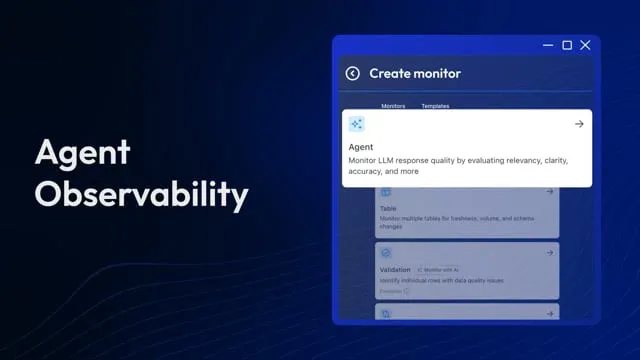
Feature Comparison
| Feature | Monte Carlo | New Relic |
|---|---|---|
| Observability Scope | ||
| Primary Focus | Data pipeline and warehouse observability with ML-driven anomaly detection | Application performance, infrastructure, and full-stack observability |
| AI/Agent Monitoring | Dedicated AI observability for monitoring data inputs and agent outputs in production | AI and agentic monitoring for controlling behavior and token usage across AI stacks |
| Data Lineage | End-to-end column-level lineage across full data ecosystem | Distributed tracing across microservices and application layers |
| Monitoring and Alerting | ||
| Anomaly Detection | ML-driven anomaly detection with automatic baselines for freshness, volume, and schema | AIOps with automated alerting, detection, correlation, and incident resolution |
| Alert Management | Granular routing with automated lineage grouping and root-cause insights | Notification workflows integrated with Slack and other communication tools |
| Root Cause Analysis | Automated root cause analysis with lineage context and impact analysis for dashboards | Code-level diagnostics with distributed tracing and error tracking across full stack |
| Infrastructure and Application | ||
| Infrastructure Monitoring | Monitors data infrastructure health (warehouses, pipelines, ETL jobs) | Full infrastructure monitoring with hybrid visibility across cloud, K8s, and on-premises |
| APM Capabilities | Not an APM tool; focused on data layer observability | Full APM with code-level diagnostics, code profiling, and error tracking |
| Log Management | Incident logs within data observability context | Full log management with logs-in-context tied to APM, infra, and distributed tracing |
| Integration Ecosystem | ||
| Pre-built Integrations | Deep integrations with data warehouses, BI tools, ETL, lakes, and enterprise databases | 780+ quickstart integrations spanning cloud providers, databases, frameworks, and tools |
| OpenTelemetry Support | Not applicable; operates at the data layer rather than application telemetry | Native OpenTelemetry support for metrics, traces, and logs ingestion |
| Cloud Provider Support | Integrates with Snowflake, Databricks, BigQuery, Azure Data Lake, and more | Dedicated AWS, Azure, and GCP monitoring with cloud-specific dashboards |
| Security and Enterprise | ||
| Security Features | SSO, SCIM, self-hosted storage, PII filtering, and audit logging on Scale+ | Enterprise-grade security with FedRAMP Moderate and HIPAA eligibility on Data Plus |
| Vulnerability Management | Focused on data quality incidents rather than application vulnerabilities | Built-in vulnerability management with production impact-based prioritization |
| Digital Experience Monitoring | Not applicable; focused on data stack rather than end-user experience | Browser monitoring, mobile monitoring, session replay, and synthetic monitoring |
Observability Scope
Primary Focus
AI/Agent Monitoring
Data Lineage
Monitoring and Alerting
Anomaly Detection
Alert Management
Root Cause Analysis
Infrastructure and Application
Infrastructure Monitoring
APM Capabilities
Log Management
Integration Ecosystem
Pre-built Integrations
OpenTelemetry Support
Cloud Provider Support
Security and Enterprise
Security Features
Vulnerability Management
Digital Experience Monitoring
Which approach fits
Monte Carlo and New Relic are observability platforms that operate at fundamentally different layers of the technology stack. Monte Carlo specializes in data observability, monitoring pipelines, warehouses, and BI layers to detect data quality incidents before they affect downstream consumers. New Relic is a full-stack application observability platform covering APM, infrastructure, logs, browser performance, mobile apps, and security. The right choice depends entirely on whether your primary concern is data reliability or application performance.
When each approach fits
Choose Monte Carlo if:
Enterprise data teams focused on data quality, pipeline observability, and AI-ready data
Choose New Relic if:
Engineering teams needing full-stack application and infrastructure observability
These scenarios reflect the available product evidence. Your requirements, existing stack, and team expertise should guide the final decision.
Frequently Asked Questions
What is the main difference between Monte Carlo and New Relic?
Monte Carlo is a data observability platform that monitors data pipelines, warehouses, and BI layers to detect data quality incidents. New Relic is a full-stack application observability platform covering APM, infrastructure, logs, browser, mobile, and security. They operate at different layers of the stack: Monte Carlo watches data, while New Relic watches applications and infrastructure.
Can Monte Carlo and New Relic be used together?
Yes. Many enterprise organizations use both platforms simultaneously because they address different observability needs. Monte Carlo monitors the data layer for quality, freshness, and schema issues, while New Relic monitors application performance, infrastructure health, and end-user experience. Together they provide complete coverage across both the data and application stacks.
How do Monte Carlo and New Relic compare on pricing?
Monte Carlo uses a credit-based consumption model across four tiers (Start, Scale, Enterprise, Business Critical) with pay-per-monitor pricing and up to 10 users on the Start tier.
Which platform is better for AI observability?
Both platforms have invested in AI observability, but they focus on different aspects. Monte Carlo monitors AI data inputs and agent outputs to ensure data quality feeding AI systems and to trace agent behavior in production. New Relic monitors AI application performance, token usage, model interactions, and agent behavior from an infrastructure and code perspective. Choose based on whether your AI concern is data quality or application performance.
Do Monte Carlo and New Relic offer free tiers?
New Relic offers a generous free tier with 100 GB of free data ingest per month and unlimited free basic users with no credit card required. Monte Carlo offers a Start tier for small teams, though specific pricing requires contacting their sales team. Both platforms offer demos and guided onboarding to help teams evaluate the platform.