Buying snapshot
Scroll sideways to see all columns. With a keyboard, focus this table and use the arrow keys.
| Decision point | What Google states |
|---|---|
License | Apache 2.0 (google/adk-python repository) |
Languages | Python, TypeScript, Go, Java and Kotlin |
Installation | A library you add to your project: pip install google-adk, npm install @google/adk, go get google.golang.org/adk/v2, or the Maven packages com.google.adk:google-adk and com.google.adk:google-adk-kotlin-core |
Python requirement | Python 3.11+; Google recommends its constraints files (Python 3.11 to 3.15) for transitive dependency protection |
Models | Gemini, plus adapters for other models and model providers, including locally running models |
Deployment | Containerize and run on your own infrastructure, or deploy to Google Cloud via Agent Runtime (Agent Platform), Cloud Run or GKE |
Release cadence (Python) | Roughly bi-weekly stable releases on PyPI |
Our take
Choose ADK if your agent has to live in a Java, Kotlin or Go codebase, or if part of the process must follow fixed, explicit steps while other steps are left to a model. If you run on Google Cloud, its one-command deployment there is a strong reason to pick it. A team that only needs one simple agent will use little of what makes ADK different.
Evaluate Google Agent Development Kit
Comparisons
Where it stands out
Graph-based workflow runtime. In the Python package, the Workflow Runtime composes deterministic execution flows with routing, fan-out/fan-in, loops, retry, state management, dynamic nodes, human-in-the-loop and nested workflows. Approvals or policy checks can follow an explicit path instead of relying on a model to decide.
Multi-agent composition and delegation. Specialized agents can be composed into hierarchies, and the Task API adds structured agent-to-agent delegation, with task agents usable as workflow nodes.
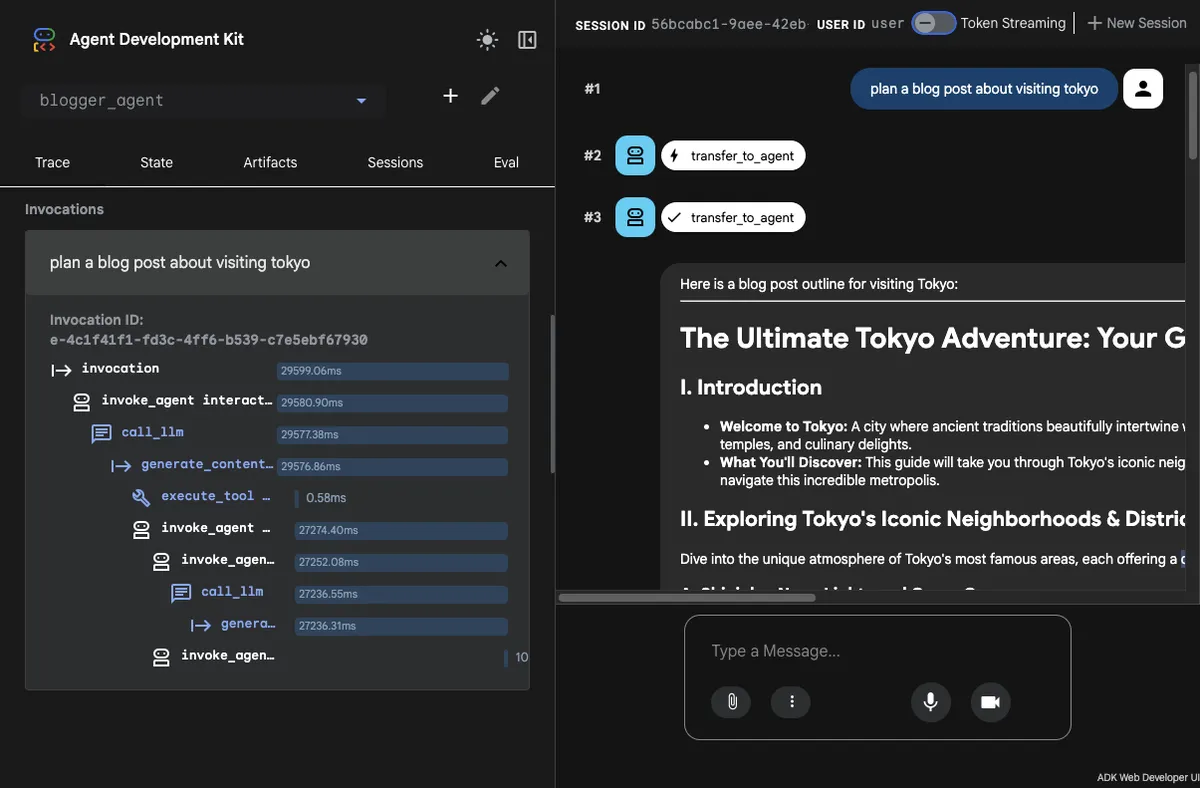
Built-in testing and evaluation. The Python package ships
adk runfor an interactive CLI,adk webfor a development UI to test, evaluate and debug agents, andadk evalfor evaluation runs, so a team can check agent behaviour before deployment. Separately, the Agents CLI lets you scaffold, build, test, evaluate and deploy ADK agents from an AI-enabled developer environment.Open tool options. Agents can use pre-built tools, custom functions, OpenAPI specs and MCP tools, and the homepage examples add Google Search as a tool in one line. A tool confirmation flow can require explicit confirmation before a tool runs.
Managed context. Google says ADK filters irrelevant events, summarizes older conversation turns, lazy-loads artifacts and tracks token usage, while letting you customize how context is managed.
Managed hosting on Google Cloud. According to Google, agents deployed to Agent Runtime, Cloud Run or GKE get managed infrastructure, built-in authentication and Cloud Trace observability without changes to agent code. The Python CLI has
adk deploy cloud_runandadk deploy dockercommands.
Product screenshot

Trade-offs to weigh
The managed extras are Google Cloud's. The managed authentication and Cloud Trace observability Google describes apply to Google Cloud targets. On your own infrastructure, you containerize and run the agent yourself, so plan how you will operate it.
Gemini comes first. The Python repository says ADK is optimized for Gemini, and the homepage examples all use a Gemini model. Other providers connect through adapters, so expect to adapt the examples.
Frequent change. With Python releases about every two weeks and a major 2.0 version, plan time for upgrades. Google warns that the development build from the main branch may contain experimental changes or bugs not in the stable release.
More structure than a single agent needs. Workflows, task delegation, multi-agent hierarchies and deployment commands are useful at scale, but each is another concept to learn when one agent with a few tools would do.
Public signals
About these signals
Verified factual signals from public sources. They indicate observable activity or interest, not total adoption, product quality, or cost.
1.5k GitHub commits 90d22.2k GitHub stars0 vulnerabilities across 1 package
See all signals from 4 sources
PyPI · google-adk@2.14.0
Alternatives to Google Agent Development Kit
The reviewed substitutes for Google Agent Development Kit among the agent frameworks, and what would make each one the better answer.
Direct alternatives
Reviewed substitutes: products bought for the same job, where a team picks one.
- LangGraph
- Both express agent workflows as graphs and are adopted as the primary framework. ADK adds a managed deployment target; the framework decision is still one or the other.
- OpenAI Agents SDK
- The two large model vendors' own agent frameworks. A team building agents adopts one of them or a vendor-neutral framework; it does not adopt both.
Other approaches
A different approach to the same problem. Each substitutes only for the workload named beside it.
- Semantic Kernel
- Two platform-bound frameworks, and the condition is the cloud rather than the capability: Semantic Kernel is the Microsoft-stack answer for .NET and Azure shops, ADK the Google Cloud one, arriving with Vertex AI grounding and Agent Engine. A team evaluates whichever matches its estate and rarely both. Semantic Kernel is superseded: Microsoft merged it and AutoGen into the Microsoft Agent Framework, GA April 2026, and SK v1.x now receives critical bug and security fixes only, with new features built in the successor. It stays a real option because a .NET estate running it today is supported into 2027, and the catalogue records the supersession on its own page -- but the pair is a choice between a live framework and one on a known sunset, and saying so is the point.Applies to: Choosing an enterprise agent framework aligned to an existing cloud. Semantic Kernel stands in for ADK in a Microsoft estate already built on it; ADK stands in inside Google Cloud. A team starting fresh on Microsoft should be looking at the Agent Framework successor rather than either.
- CrewAI
- Both are on the same 2026 shortlist and win different shapes of work. CrewAI models a team of specialists with roles and tasks, which is chosen when the product team has to read the orchestration; ADK is chosen when the deployment target is Google Cloud and managed grounding and Agent Engine matter more than the authoring metaphor. Conditional because neither displaces the other outside its condition: CrewAI has no cloud-managed retrieval, ADK has no role-and-task abstraction.Applies to: Building a multi-step agent system. CrewAI stands in for ADK when the work divides into readable roles and the cloud is not fixed; ADK stands in when the team is on Google Cloud and wants managed grounding and deployment.
- LangChain
- LangChain and Google Agent Development Kit are both frameworks a team can standardise on to build agents, and the choice turns on workload, team language and governance. LangChain offers the broadest tool ecosystem and fast model swaps, while ADK suits a Google Cloud estate, where it arrives with Google's grounding and Agent Engine deployment.Applies to: Standardising one framework for agent development. ADK stands in for LangChain when the team is on Google Cloud and wants grounding and deployment in the box; LangChain stands in when the team needs provider portability or the widest tool ecosystem.
- Agno
- The fork is whether the agent runtime is tied to a cloud. Agno is model-agnostic and self-hosted, shipping its own memory and knowledge layer across 25+ vector stores and 29 embedders; ADK is Google Cloud's framework, arriving with Vertex AI grounding and Agent Engine deployment. A team that has not committed to GCP is choosing Agno for portability, and a team that has is choosing ADK because the managed pieces come free.Applies to: Building an agent with its own knowledge base. Agno stands in for ADK when the deployment must stay portable or self-hosted; ADK stands in when the team is on Google Cloud and wants managed grounding and deployment.
- PydanticAI
- Both are open-source Python agent frameworks with evaluation and deployment stories, and both sit in the same 2026 decision. The condition is the estate: ADK's case rests on Vertex AI grounding and Agent Engine, which are worth nothing off Google Cloud, while PydanticAI's case is idiomatic Python with typed tool interfaces and validated output, which travels anywhere. A team on GCP weighs the managed pieces; a team anywhere else is not comparing them at all.Applies to: Choosing a Python agent framework. ADK stands in for PydanticAI when the team is on Google Cloud and wants managed grounding and deployment; PydanticAI stands in when type safety and provider portability matter more than platform integration.
- Haystack
- Google's own framing is the choice: Vertex AI RAG Engine is a fully managed retrieval system handling upload, embedding, indexing and semantic search behind one API, against a pipeline you own and operate. Haystack is the own-it end of that -- every step serializable, testable and auditable with build-time validation -- and ADK is how a team builds the agent on top of the managed end. Conditional because the substitution holds only inside Google Cloud, and only where a managed pipeline is acceptable in place of an auditable one.Applies to: Grounding an agent in company documents. ADK with Vertex AI RAG Engine stands in for Haystack when the documents are standard types and the team wants turnkey retrieval on GCP; Haystack stands in when the pipeline must be inspectable and testable, or the team is not on Google Cloud.
- LlamaIndex
- Google's own docs frame this as the choice: Vertex AI RAG Engine is a fully managed retrieval system handling upload, embedding, indexing and semantic search behind one API, against a custom vector store built with LlamaIndex or LangChain where you own the pipeline. ADK is how a team builds the agent on top of that managed retrieval, with Agent Engine for deployment, so on GCP it covers the ingestion-to-agent span LlamaIndex covers everywhere. Conditional because the substitution holds only inside Google Cloud; off it, ADK is not on the shortlist.Applies to: Building and deploying an agent grounded in company documents on Google Cloud. ADK with Vertex AI RAG Engine stands in for LlamaIndex when the documents are standard types and the team wants turnkey retrieval without infrastructure work; LlamaIndex stands in when the team wants to own the pipeline or is not on GCP.