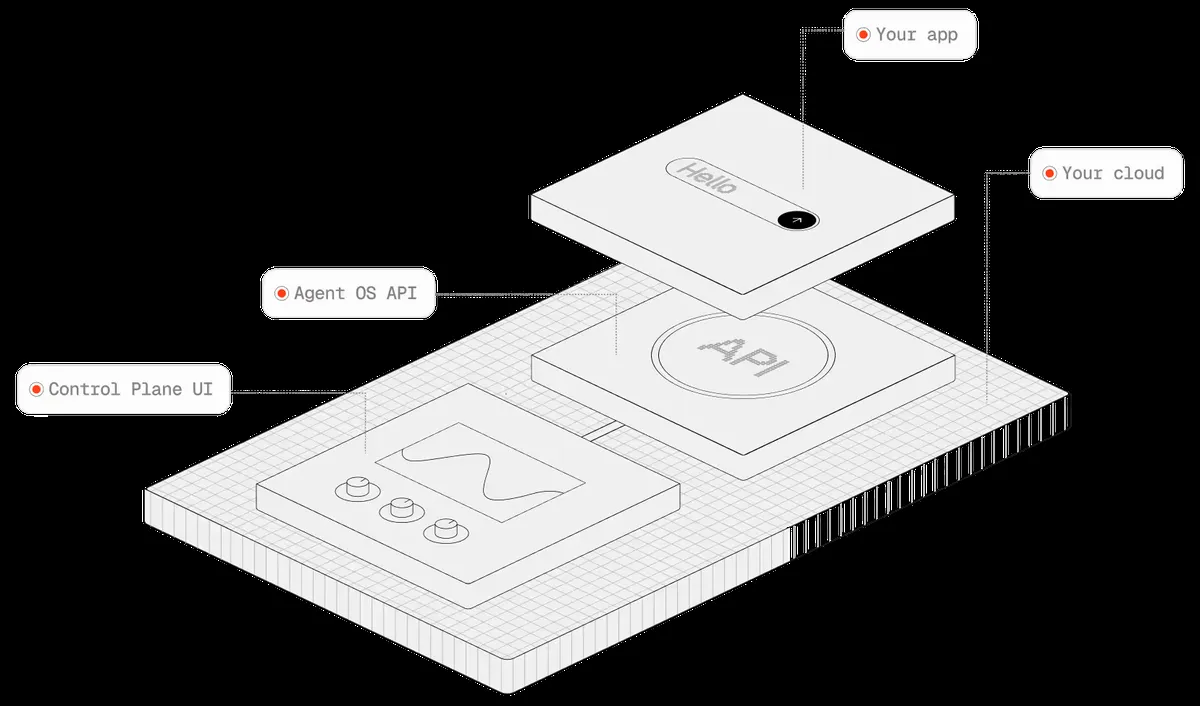
Agno: product and architecture
Our verdict in this Phidata review: Agno is a strong choice for engineering teams that want to build and operate private multi-agent systems in their own cloud, with an explicit path from framework code to a production runtime and browser-based control plane. Its differentiator is not simply agent creation; it is the combination of agents, teams, workflows, operational monitoring, and security controls under the AgentOS positioning. We recommend Agno for teams that value deployment control and data residency more than a minimal, single-purpose agent library.
The important caveat is evidence quality. Agno's public documentation makes clear claims about architecture, security, deployment, and integrations, but it provides no independent performance benchmarks, customer counts, enterprise case studies, or detailed documentation of operational limits. Treat the available public signals and quoted user comments as adoption interest and developer sentiment, not proof that Agno fits every enterprise workload.
Overview
Agno is an AI-agent platform in the ai-agents category that combines an agent framework with AgentOS, which it describes as an enterprise-ready agentic operating system. That positioning matters for data leaders: Agno is aimed at teams that need agents to become managed production services, rather than teams experimenting with isolated prompts or one-off assistants.
The product description centers on self-learning agents with memory, knowledge, and guardrails. It states that teams can use any model and any database, while keeping the deployment in their own cloud. For organizations with strict data-location expectations, Agno’s stated architecture is intentionally different from a hosted service that requires agent interactions to pass through a vendor-operated data plane.
AgentOS extends the framework story with a production runtime and a built-in control plane. The runtime is presented as deployable anywhere, while the control plane supports chat, tracing, and monitoring from a browser. Agno also states that customer data remains in the customer’s system, with no egress or retention costs; that is a meaningful operating-model claim, though teams should validate it against their own infrastructure, model-provider, database, and observability costs.
Security is a first-class part of Agno’s product narrative. Agno's public documentation specifically names JWT, role-based access control (RBAC), and request-level isolation, and says privacy and security are built into the architecture rather than layered on afterward. We see that as the right direction for data teams exposing agents to internal users, but it does not eliminate the need to design permissions, audit processes, and data access boundaries around the specific tools an agent can invoke.
Key Features and Architecture
Agno’s architecture is built around a framework layer, a production runtime, and an operational control plane. The framework is the construction layer for agents, agent teams, tools, and workflows; the runtime is the service layer that turns those systems into deployable production services; and AgentOS is the operating layer for managing them. This is more ambitious than a library that only helps define an agent loop, because it places deployment and operational visibility in the stated product scope.
Key technical capabilities described in Agno's public documentation include:
- Multi-agent construction: Agno supports building individual agents and teams of agents. This makes it suitable for workflows where specialized agents need distinct responsibilities, although Agno's public documentation does not define coordination semantics, scheduling behavior, or failure-handling guarantees.
- Memory, knowledge, and guardrails: The framework is positioned for self-learning agents that retain memory, use knowledge, and operate with guardrails. These are distinct capabilities: memory supports continuity across work, knowledge provides an information layer, and guardrails constrain behavior or access.
- Model and database flexibility: Agno states “any model” and “any database.” That reduces the risk of being tied to a named model or database vendor, but it also transfers integration testing and compatibility ownership to the engineering team.
- Production runtime: Agents can be turned into a production service and deployed anywhere. For platform engineers, this is the feature that makes Agno more than a prototyping framework, since deployment is explicitly part of the platform design.
- Browser control plane: AgentOS includes browser-based chat, tracing, and monitoring. Chat supports interaction, tracing supports inspection of agent activity, and monitoring supports ongoing operational observation; these are concrete controls data and AI teams need once agents leave development.
- Security controls: JWT, RBAC, and request-level isolation are named security mechanisms. JWT supports authenticated requests, RBAC supports permission separation, and request-level isolation is especially relevant when multiple users or workflows share an agent service.
- Interface integrations: The feature documentation names UI, Telegram, Slack, and WhatsApp as connection targets. These are practical channels for deploying agent experiences, though the source does not describe authentication flows, connector maintenance, or individual channel capabilities.
A quoted developer comment says agents can be up and running in “literally 2 minutes,” while another describes Agno as flexible for agents, teams, tools, workflows, and several user interfaces. Those statements are useful indicators of developer enthusiasm, but they are testimonials rather than verified delivery-time or performance measurements. We would not use them to estimate an enterprise implementation timeline.
The design trade-off is straightforward. Agno offers a broad operating surface—agent design, workflows, runtime deployment, monitoring, and access control—which can reduce the need to assemble separate components. In exchange, teams must make deliberate architecture decisions across all those layers, especially around model selection, database selection, data permissions, and deployment ownership.
Ideal Use Cases
Agno is best suited to a data or AI platform team that has enough engineering capacity to own a cloud deployment and wants agent systems to remain within that environment. A team of 4–10 data engineers, analytics engineers, and application engineers can use the framework to build a governed internal assistant while using JWT and RBAC to separate access between employee groups. The useful fit is not the headcount by itself; it is the team’s ability to define which databases, tools, knowledge sources, and users each agent may access.
One strong scenario is an internal analytics or data-operations assistant deployed through Slack or a browser UI. A data team could give distinct agent roles to question intake, knowledge retrieval, workflow execution, and response generation, then use the built-in chat, tracing, and monitoring capabilities to investigate behavior. This is particularly relevant when business users need access through Slack but the organization wants the agent service and its data to remain inside its own cloud boundary.
A second scenario is a multi-agent application that needs a production service rather than a notebook or local demo. Teams building operational workflows can use Agno’s agent framework for agents, teams, tools, and workflows, then use the production runtime to deploy the result. The source data supports deployment flexibility—“deploy anywhere”—but it does not provide throughput, concurrency, latency, or scale limits, so teams planning high-volume workloads should validate those requirements directly in their own environment before committing.
A third scenario is a regulated or privacy-sensitive organization that prioritizes architectural control over a fully hosted agent product. Agno explicitly states that data stays in the customer’s system and includes request-level isolation, JWT, and RBAC in its security story. This makes it a sensible candidate for a data platform handling controlled internal information, provided the team independently verifies how every selected model, database, and channel integration processes data.
Don’t use Agno if your organization wants a fully managed, hands-off agent service with no responsibility for cloud deployment, access design, or operational ownership. Also avoid selecting it solely because a user testimonial says setup takes two minutes: building a secure production system with memory, knowledge, tools, databases, and user channels is a materially larger task than initializing an agent. We recommend Agno for teams that need cloud control and can support the engineering discipline that control requires.
Strengths & Trade-offs
In our evaluation, Agno’s strongest qualities are architectural control and operational scope. It is not merely positioned as a way to create prompts or single agents; it explicitly combines agent construction, multi-agent teams, workflows, a production runtime, and a browser control plane. That breadth is valuable when a data team wants a coherent operating model, but it should be assessed against the team’s ability to own each layer.
Pros
- Runs inside the customer’s cloud:
- Named security mechanisms: JWT, RBAC, and request-level isolation are concrete controls, not vague claims that the platform is “secure.” These are relevant foundations for separating access across internal users and agent requests.
- Production operation is in scope: The production runtime can turn agents into a production service and deploy anywhere, while AgentOS provides browser-based chat, tracing, and monitoring. This makes operational visibility part of the product story.
- Supports multi-agent systems: Agno supports agents, agent teams, tools, and workflows, allowing teams to model specialized responsibilities rather than forcing every task into one general-purpose agent.
- Flexible model and database posture: The “any model” and “any database” claim gives architecture teams room to retain choices already made elsewhere in their data stack.
- Multiple delivery channels are named: UI, Telegram, Slack, and WhatsApp are explicitly identified as interfaces that can connect to Agno-based systems.
Cons
- No published pricing specifics in Agno's public documentation: The pricing model is Open Source, but no figures, plans, limits, or support terms are published. That makes cost forecasting dependent on internal infrastructure and staffing assumptions.
- No published benchmark evidence: Agno calls itself the fastest framework available, but the source data provides no benchmark methodology, latency measurements, throughput figures, or comparative test results. Do not select it on speed claims alone.
- Operational ownership remains with the team: Running in your cloud is a control advantage, but it means the customer must own deployment, access policies, monitoring practice, model connections, and database connections.
- Integration depth is not described: Telegram, Slack, WhatsApp, and UI are named, but Agno's public documentation does not specify connector constraints, security behavior, or feature parity across these channels.
- Enterprise evidence is incomplete: The source describes AgentOS as enterprise-ready, yet it does not provide named enterprise customers, scale metrics, service-level commitments, or compliance attestations.