Buying snapshot
Scroll sideways to see all columns. With a keyboard, focus this table and use the arrow keys.
| Decision point | What OpenAI states |
|---|---|
License | MIT license (openai-agents-python repository) |
Installation | pip install openai-agents or uv add openai-agents; Python 3.10 or newer. Optional extras: 'openai-agents[voice]' for voice, 'openai-agents[redis]' for Redis sessions |
Model providers | Provider-agnostic: OpenAI Responses and Chat Completions APIs plus 100+ other LLMs; the Responses API is the default for OpenAI models. any-llm and LiteLLM are optional dependencies |
Setup | Set the OPENAI_API_KEY environment variable before running any of the README examples |
Contributions | Bug reports and feature requests through GitHub issues; pull requests only from repository collaborators |
Our take
Choose the Agents SDK if you build in Python and want the runtime, not your own code, to manage turns, tool calls, guardrails, handoffs and sessions across several coordinated steps. It fits best when OpenAI models are your default. If your app mostly sends one request and returns the answer, you gain little from it.
Evaluate OpenAI Agents SDK
Comparisons
Where it stands out
Few primitives to learn. The core is agents, agents as tools or handoffs, and guardrails. You chain agents with ordinary Python rather than a new abstraction, which OpenAI says avoids a steep learning curve.
Sandboxed workspaces. Sandbox agents run inside isolated workspaces with manifest-defined files, a choice of sandbox client and resumable sessions. A sandbox agent can inspect files, run commands, apply patches and keep workspace state over longer tasks, which OpenAI positions for coding, review and document agents.
First-party voice. Realtime agents use gpt-realtime-2.1 over WebSocket with automatic interruption detection, context management and guardrails. Separately, a voice pipeline chains speech-to-text, an agent workflow and text-to-speech.
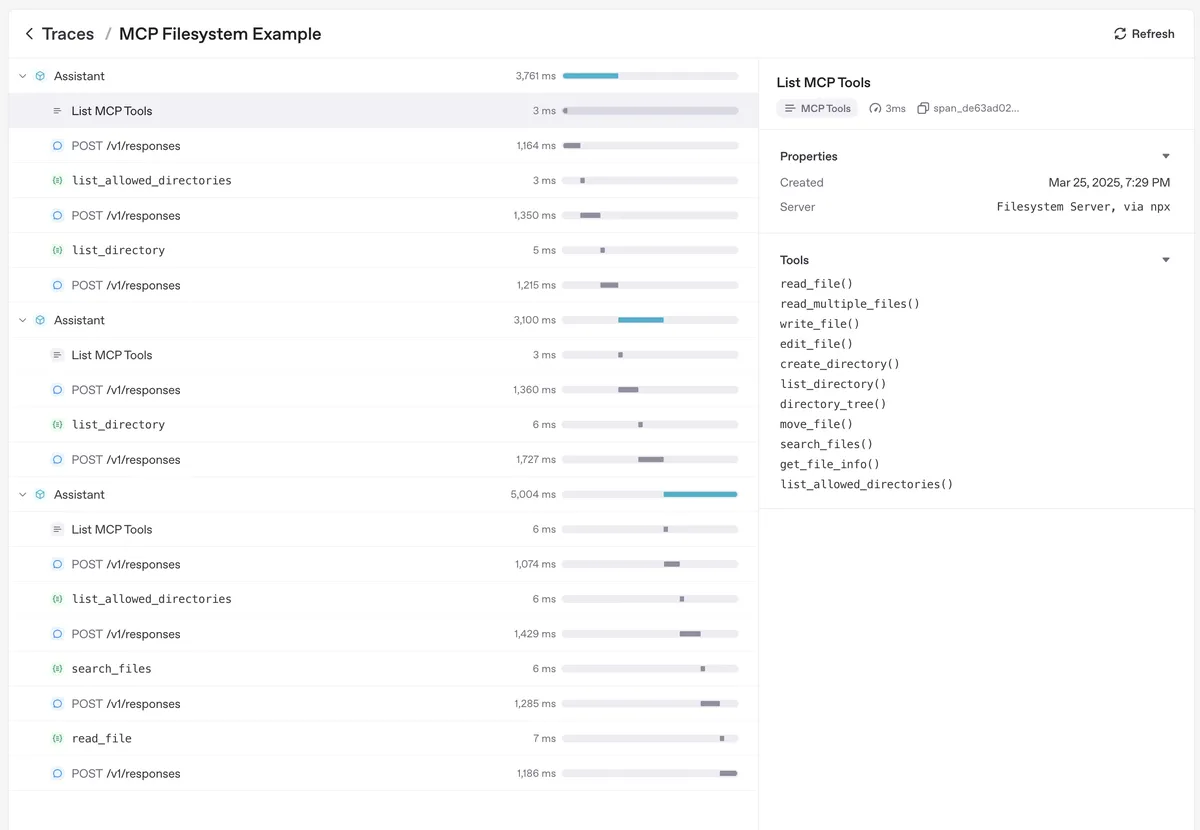
Tools from plain functions and MCP. Any Python function becomes a tool with automatic schema generation and Pydantic-powered validation. Remote MCP server tools sit alongside function tools, and hosted tools are also supported.
Fail-fast guardrails and human in the loop. Input validation and safety checks run in parallel with the agent and stop the run when a check fails. Built-in human-in-the-loop mechanisms bring people into a run.
Conversation memory included. Sessions manage conversation history across agent runs.
Product screenshot
Trade-offs to weigh
Tracing ties into OpenAI's tools. Built-in tracing helps you visualize, debug and monitor runs, and its evaluation, fine-tuning and distillation support is the OpenAI suite. If you use another model provider, plan how those steps fit your setup.
Call volume follows the task. The agent loop keeps going until the task is complete, and guardrails run alongside the agent. The number of model calls in a run therefore depends on the task, so watch model usage on unattended runs.
The Unix sandbox client is macOS and Linux only. The local Unix sandbox client supports macOS and Linux. Windows users need the Docker sandbox client with the
openai-agents[docker]extra, or a hosted sandbox client.
Public signals
About these signals
Verified factual signals from public sources. They indicate observable activity or interest, not total adoption, product quality, or cost.
526 GitHub commits 90d30.6k GitHub stars0 vulnerabilities across 2 packages
See all signals from 5 sources
npm · @openai/agents@0.21.0 · PyPI · openai-agents@0.24.0
Alternatives
The Responses API directly. OpenAI recommends it when you want to own the loop, tool dispatch and state handling yourself, or when the workflow is short-lived and mainly returns the model's response. You do not have to choose one: many applications use the SDK for managed workflows and call the Responses API for lower-level paths.
Agents SDK JS/TS. If your team works in JavaScript or TypeScript, OpenAI offers a separate Agents SDK for those languages.
Alternatives to OpenAI Agents SDK
The reviewed substitutes for OpenAI Agents SDK among the agent frameworks, and what would make each one the better answer.
Direct alternatives
Reviewed substitutes: products bought for the same job, where a team picks one.
- LangGraph
- Both are adopted as the primary agent framework for an application. Handoffs and graphs are two ways to express the same orchestration decision.
- Google Agent Development Kit
- The two large model vendors' own agent frameworks. A team building agents adopts one of them or a vendor-neutral framework; it does not adopt both.
- PydanticAI
- Both are MIT-licensed Python agent frameworks with a small primitive set. The decision between them is provider independence against first-party OpenAI features.
Other approaches
A different approach to the same problem. Each substitutes only for the workload named beside it.
- CrewAI
- CrewAI and the OpenAI Agents SDK are both ways to build multi-agent applications. CrewAI organises role-based crews that a product team can read and carries no model provider commitment, while the OpenAI Agents SDK is the shortest path to production on OpenAI, with agents, handoffs and tracing and less abstraction to learn.Applies to: Coordinating several agents on one task. CrewAI stands in when the division of labour is the design and must be legible; the OpenAI Agents SDK stands in when the team is on OpenAI and wants handoffs and tracing without a new paradigm.
- Agno
- Same fork, different vendor: the OpenAI Agents SDK is the shortest path to production for a team committed to OpenAI models, while Agno is model-agnostic with its own memory and knowledge layer and no provider commitment. Reviewers describe Agno as the simpler development experience for common RAG use cases, which is the same claim the SDK makes for agent loops -- so the choice is which lock-in a team accepts, not which is more capable.Applies to: A Python agent with sessions, memory and a knowledge base. The OpenAI Agents SDK stands in when the models are OpenAI's and hosted retrieval is acceptable; Agno stands in when the team wants to stay model-agnostic and hold its own vector store.
- LangChain
- Both are on the 2026 shortlist and the guidance separates them on what a team is optimising: the OpenAI Agents SDK is described as the simplest path to production, LangChain as the most flexible with the broadest tool ecosystem and the steepest learning curve. Conditional because the SDK's simplicity is bought with provider commitment -- it is OpenAI's own SDK, and a team that needs to swap models freely is choosing LangChain for exactly that.Applies to: Getting an agent into production. The OpenAI Agents SDK stands in for LangChain when the models are OpenAI's and shipping quickly matters most; LangChain stands in when the team needs provider portability or the wider tool ecosystem.
- Semantic Kernel
- Two vendor-aligned frameworks separated by the estate rather than the feature list: Semantic Kernel for .NET and Azure with enterprise process orchestration, the OpenAI Agents SDK for teams committed to OpenAI models wanting the shortest path to production. Semantic Kernel is superseded: Microsoft merged it and AutoGen into the Microsoft Agent Framework, GA April 2026, and SK v1.x now receives critical bug and security fixes only, with new features built in the successor. It stays a real option because a .NET estate running it today is supported into 2027, and the catalogue records the supersession on its own page -- but the pair is a choice between a live framework and one on a known sunset, and saying so is the point.Applies to: Picking an agent framework that matches the stack already in place. Semantic Kernel stands in for a .NET or Azure shop already running it; the OpenAI Agents SDK stands in for a Python team on OpenAI models. A fresh Microsoft build belongs on the Agent Framework successor.
- Dify
- The same cross-class trade one layer over: Dify's visual canvas with branching, loops and a built-in knowledge base delivers the agent-and-RAG application without SDK code, which is the whole of what a team reaches the OpenAI Agents SDK for on a straightforward build. Conditional: the SDK gives handoffs, tracing and programmatic control Dify does not expose, and Dify gives an authoring surface a non-engineer can use.Applies to: Delivering an internal agent or RAG chatbot quickly. Dify stands in for the OpenAI Agents SDK when engineering time is the constraint and the flow fits a canvas; the SDK stands in when the agent needs handoffs, tracing or logic beyond what the builder exposes.
- LlamaIndex
- OpenAI's File Search tool is described as RAG functionality with less work: it parses and chunks documents, creates and stores embeddings, and runs vector plus keyword search with query optimisation and reranking built in, billed at $2.50 per thousand queries and $0.10 per GB per day. Paired with the Agents SDK that covers the agent loop, handoffs and tracing, it removes the reason an OpenAI-committed team would build an ingestion and index layer at all. Conditional: it is a single hosted store with no connector ecosystem, and the substitution ends the moment a second model provider or a self-hosted index is required.Applies to: An agent over a modest document set on OpenAI models only. The Agents SDK with hosted File Search stands in for LlamaIndex when the corpus is standard and hosted retrieval is acceptable; LlamaIndex stands in when the team needs its own index, other providers, or connectors beyond file upload.