Buying snapshot
Scroll sideways to see all columns. With a keyboard, focus this table and use the arrow keys.
| Decision point | What Pydantic states |
|---|---|
Installation | Python package: pip install pydantic-ai or uv add pydantic-ai. Pydantic AI Harness is a second package (pydantic-ai-harness). |
Model providers | Virtually every model and provider (OpenAI, Anthropic, Google, Bedrock, Azure AI Foundry, Groq, Mistral, xAI, Ollama and dozens more), swapped with a string or reached through the Pydantic AI Gateway, one key with failover and cost monitoring |
Companion packages | Pydantic Evals, Pydantic Graph, genai-prices and Monty (a sandboxed Python interpreter for model-written code) are separate open-source packages |
Observability | OpenTelemetry-native: standard OTel spans for every model call and tool call; any OTLP backend works |
Durable execution | Eight engines: Temporal, DBOS, Prefect, Restate, AWS Lambda, Airflow, Absurd and pgtask; the first five are co-maintained with the vendor teams; human-in-the-loop approval built in |
Our take
Pydantic AI is a good fit if your team works in Python, wants every agent run checked against its own types, and wants to keep the model provider and the tracing backend replaceable. If you also want hosted tracing, budget for a Logfire plan or run your own OpenTelemetry backend.
Evaluate PydanticAI
Where it stands out
Typed, validated output. Give the agent an output type and tools, and every run comes back validated and typed. A tool's signature and docstring become its schema, and arguments are checked before your code runs. This turns output shape into a schema question instead of a prompt question. Dependency injection is typed too: a RunContext carries your dependencies into tools.
Testing without a model bill. The built-in
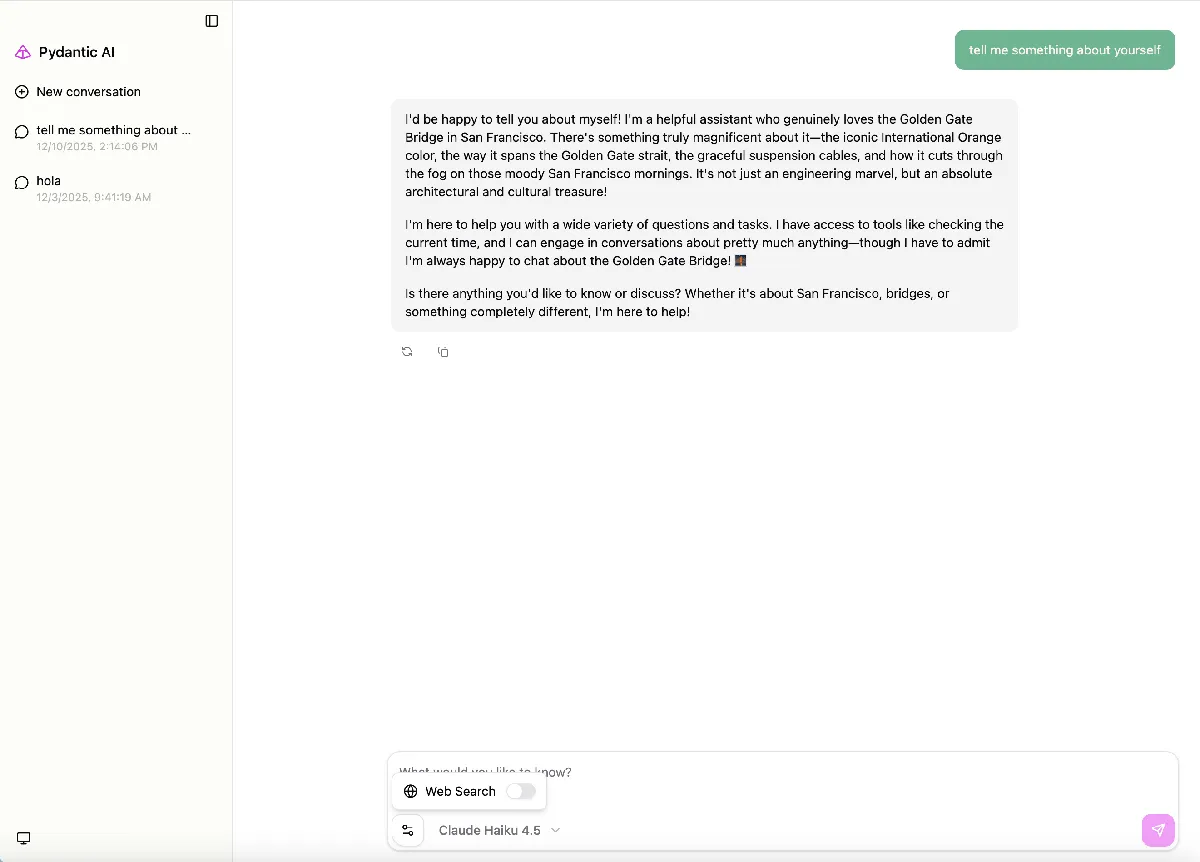
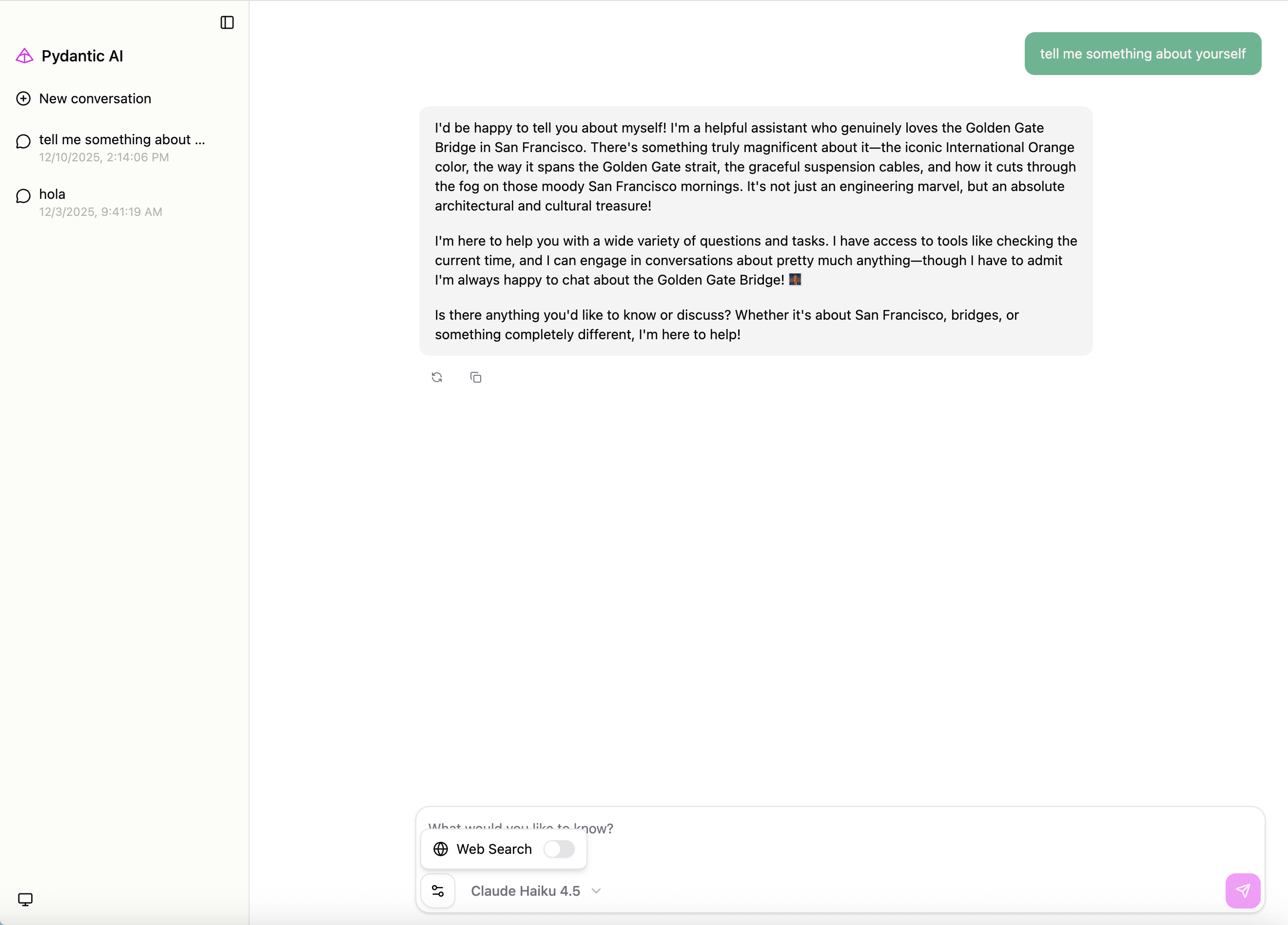
testmodel runs fully offline without calling an LLM, so you can exercise agents, tools and outputs before you set a provider API key.One agent, many front ends. The same agent definition runs as a CLI, a built-in web chat or realtime speech (OpenAI Realtime, Gemini Live, Azure, xAI Grok Voice). AG-UI and Vercel AI event streams connect it to your own frontend, and GitHub Agentic Workflows runs it headless on issues, pull requests or a schedule.
Images and embeddings included. Image generation and embeddings come in the same package. A standalone ImageGenerator API generates an image with a dedicated image model, with no agent run required.
Building blocks you can open. A capability bundles tools, instructions, hooks and model settings. The Coder agent is composed of capabilities, so you can use it whole or take only the blocks you need, such as FileSystem, Shell or RepoContext. Agents can also be written as YAML/JSON specs.
Product screenshot
Trade-offs to weigh
Branching workflows need a second package. When one agent loop is not enough, typed control flow comes from Pydantic Graph, a separate package.
Production features sit in Harness. Core ships fundamentals like MCP and web search. Memory, guardrails, sub-agents, planning, spend limits and the Coder agent come from Pydantic AI Harness, so agents that need memory, guardrails or spend limits add pydantic-ai-harness as a second dependency to version and upgrade.
Some features vary by provider. Provider-native compaction works on OpenAI and Anthropic only; elsewhere you use the model-agnostic Harness version. Web search falls back to local DuckDuckGo where the provider has no native search, and X Search is native only on xAI. Swapping the model string can change how these behave.
Editor integration is early. Serving an agent to editors like Zed over the Agent Client Protocol (ACP) is marked experimental.
Pricing and plan conditions
The framework itself installs as a Python package. The Pydantic pricing page states that its prices apply to Pydantic Logfire only, the vendor's observability platform; because Pydantic AI's instrumentation is plain OpenTelemetry, any backend works instead. All paying Logfire customers can set a spending cap by emailing accounts@pydantic.dev; once the cap is hit, new telemetry is hidden from view, but Pydantic keeps collecting it up to a generous threshold. On Team and Growth, Pydantic offers a refund if you are unsure after your first month, and it also refunds an unexpectedly large first-month bill caused by a volume spike.
Scroll sideways to see all columns. With a keyboard, focus this table and use the arrow keys.
| Plan | Published price | What it adds |
|---|---|---|
Personal | Free | One user, fewer than 3 projects, under 10 million logs/spans/metrics a month. Ingestion pauses at the 10 million cap; ad-hoc payment for extra records is not available. 30-day data retention. |
Team | 5 seats included, $25/extra seat; additional records $2 per million | Hard price cap option; query the last 30 days of traces, logs and metrics; AI Gateway: bring up to 3 provider credentials (no markup), built-in providers with a 5% markup fee. |
Growth | $249/mo; covers 10 million logs, spans and metrics every month, additional records $2 per million | Everything in Team, plus unlimited seats, guests and projects; up to 90-day retention; priority support + boilerplate BAA; AI Gateway: unlimited BYO provider credentials (no markup), built-in providers with a 3% markup fee. |
Enterprise | Custom | Growth-tier capabilities, plus observability SLOs with burn-rate alerts; Cloud, Dedicated or Self-hosted; SSO, SCIM and custom roles; custom retention (unlimited available) and SLA-backed support; volume-discounted rates negotiated against your usage commit. Policy-based redaction requires Full AI Gateway access (add-on). |
Public signals
About these signals
Verified factual signals from public sources. They indicate observable activity or interest, not total adoption, product quality, or cost.
2.5k GitHub commits 90d21.1k GitHub stars0 vulnerabilities across 1 package
See all signals from 3 sources
PyPI · pydantic-ai@2.66.0
Alternatives to PydanticAI
The reviewed substitutes for PydanticAI among the agent frameworks, and what would make each one the better answer.
Direct alternatives
Reviewed substitutes: products bought for the same job, where a team picks one.
- LangGraph
- Both are open-source Python agent frameworks bought for the same job: the loop that drives an LLM through tools and structured output. A team picks one.
- CrewAI
- Both are Python agent frameworks a team adopts as its primary way of building agents. PydanticAI organises around typed output, CrewAI around collaborating roles, but they are alternatives, not layers.
- LangChain
- Both are adopted as the framework an application's LLM calls go through. LangChain offers breadth of integrations, PydanticAI typed output; a team standardises on one.
- OpenAI Agents SDK
- Both are MIT-licensed Python agent frameworks with a small primitive set. The decision between them is provider independence against first-party OpenAI features.
Other approaches
A different approach to the same problem. Each substitutes only for the workload named beside it.
- Agno
- Two modern, model-agnostic Python agent frameworks that answer different first questions. PydanticAI is chosen when typed tool interfaces and validated structured output are non-negotiable and the team wants idiomatic Python; Agno is chosen when the agent needs memory and a knowledge base out of the box, across 25+ vector stores. Conditional: PydanticAI ships no knowledge layer, and Agno does not sell type safety as its reason for existing.Applies to: Picking a Python agent framework with no provider commitment. PydanticAI stands in when validated structured output is the requirement; Agno stands in when built-in memory and retrieval matter more than the type system.
- Google Agent Development Kit
- Google's open agent framework — hierarchical multi-agent composition, graph workflows that mix deterministic code with model reasoning, a local dev UI and evaluation harness, and a deployment path onto Vertex AI Agent Engine. Python, TypeScript, Go, Java and Kotlin.
- Semantic Kernel
- Named together in the 2026 guidance as the answer to one requirement -- 'you want typed tool interfaces and explicit runtime control: Microsoft Agent Framework or PydanticAI' -- which is a two-name shortlist for a stated need. The condition is the stack: PydanticAI is the idiomatic-Python answer, Semantic Kernel the Microsoft-aligned one. Note that the guidance names the *successor*: Semantic Kernel is superseded: Microsoft merged it and AutoGen into the Microsoft Agent Framework, GA April 2026, and SK v1.x now receives critical bug and security fixes only, with new features built in the successor. It stays a real option because a .NET estate running it today is supported into 2027, and the catalogue records the supersession on its own page -- but the pair is a choice between a live framework and one on a known sunset, and saying so is the point.Applies to: An agent loop with typed tool interfaces, validated structured output and explicit runtime control. PydanticAI stands in for a Python team that wants ordinary Python; Semantic Kernel stands in inside a .NET estate already running it, and a new one should evaluate the Microsoft Agent Framework instead.
- LlamaIndex
- The buyer guides put these two on the same side of the fork and then choose between them: 'you want a simple agent + tools + run loop: LlamaIndex or PydanticAI'. PydanticAI is picked when type safety and validated structured output are non-negotiable and the team wants idiomatic Python rather than a new paradigm. Conditional because PydanticAI ships no retrieval or indexing layer: it substitutes on the agent loop, not on the corpus.Applies to: A straightforward agent-plus-tools loop in Python. PydanticAI stands in for LlamaIndex when validated structured output is the requirement; LlamaIndex stands in when the same loop has to retrieve from a document corpus it also ingests and indexes.