Decision comparison
Aqua Security vs Prisma Cloud
Both Aqua Security and Prisma Cloud deliver enterprise-grade cloud-native security, but they serve different organizational priorities. Aqua Security excels in container and Kubernetes runtime protection with deep open-source roots through Trivy, while Prisma Cloud offers the broadest CNAPP coverage with unified CSPM, CWPP, and CIEM capabilities under one platform.
Direct comparison. These are reviewed substitutes bought for the same job, so the differences below are the ones that decide between them.
All 2 are cloud security platforms.
Quick Comparison
| Decision factor | Aqua Security | Prisma Cloud |
|---|---|---|
| Ease of Use | Steeper learning curve with container-first CLI workflows; Trivy open-source scanner simplifies initial vulnerability scanning adoption | Unified web console with guided onboarding wizards; credit-based licensing simplifies procurement but module sprawl adds complexity |
| Security Coverage | Deep container and Kubernetes runtime protection with vShield micro-segmentation; strong shift-left scanning via Trivy integration | Broadest CNAPP coverage spanning CSPM, CWPP, CIEM, and code security modules in a single consolidated platform |
| Cloud Integration | Supports AWS, Azure, GCP, and on-prem Kubernetes clusters; agentless scanning available alongside DaemonSet-based runtime agents | Native Palo Alto Networks ecosystem integration across all major clouds; auto-discovery of cloud assets with 350+ compliance policies |
| Runtime Protection | Industry-leading container runtime security with behavioral profiling, drift prevention, and automated incident response workflows | Prisma Cloud Defender agents provide host and container runtime protection with automated forensics and incident correlation |
| Pricing & Value | Aqua publishes no prices, but does publish the basis: Dev Security is priced by the number of code repositories and Cloud Security by the number of workloads, such as EC2 instances, Fargate containers and Lambda functions. The Aqua Platform is quote-only. Trivy, the open-source scanner Aqua maintains, is free and separate from the commercial platform. | Palo Alto Networks enterprise pricing. Per-credit model: Cloud Security credits from ~$1.20/credit, which is the only rate Palo Alto publishes; module and suite pricing is quoted. Volume discounts available. |
| Compliance & Reporting | Built-in compliance templates for CIS, PCI-DSS, HIPAA, and SOC 2; Kubernetes-native audit logging and policy enforcement | Over 350 pre-built compliance policies covering CIS, NIST, GDPR, HIPAA; automated compliance posture scoring dashboards |
Aqua Security
- Ease of Use:
- Steeper learning curve with container-first CLI workflows; Trivy open-source scanner simplifies initial vulnerability scanning adoption
- Security Coverage:
- Deep container and Kubernetes runtime protection with vShield micro-segmentation; strong shift-left scanning via Trivy integration
- Cloud Integration:
- Supports AWS, Azure, GCP, and on-prem Kubernetes clusters; agentless scanning available alongside DaemonSet-based runtime agents
- Runtime Protection:
- Industry-leading container runtime security with behavioral profiling, drift prevention, and automated incident response workflows
- Pricing & Value:
- Aqua publishes no prices, but does publish the basis: Dev Security is priced by the number of code repositories and Cloud Security by the number of workloads, such as EC2 instances, Fargate containers and Lambda functions. The Aqua Platform is quote-only. Trivy, the open-source scanner Aqua maintains, is free and separate from the commercial platform.
- Compliance & Reporting:
- Built-in compliance templates for CIS, PCI-DSS, HIPAA, and SOC 2; Kubernetes-native audit logging and policy enforcement
Prisma Cloud
- Ease of Use:
- Unified web console with guided onboarding wizards; credit-based licensing simplifies procurement but module sprawl adds complexity
- Security Coverage:
- Broadest CNAPP coverage spanning CSPM, CWPP, CIEM, and code security modules in a single consolidated platform
- Cloud Integration:
- Native Palo Alto Networks ecosystem integration across all major clouds; auto-discovery of cloud assets with 350+ compliance policies
- Runtime Protection:
- Prisma Cloud Defender agents provide host and container runtime protection with automated forensics and incident correlation
- Pricing & Value:
- Palo Alto Networks enterprise pricing. Per-credit model: Cloud Security credits from ~$1.20/credit, which is the only rate Palo Alto publishes; module and suite pricing is quoted. Volume discounts available.
- Compliance & Reporting:
- Over 350 pre-built compliance policies covering CIS, NIST, GDPR, HIPAA; automated compliance posture scoring dashboards
Public signals
Verified factual signals only. Bars appear only for like-for-like metrics with five weekly assessments for every tool; missing evidence stays explicit. These signals do not establish enterprise adoption, product quality, or total cost.
| Metric | Aqua Security | Prisma Cloud |
|---|---|---|
| GitHub commits, 90d(Developer adoption) | 8 | Not available |
| GitHub stars(Developer adoption) | 64 | Not available |
| Search interest(Market interest) | 1 | 0 |
| Hacker News mentions, 90d(Community interest) | 0 | 0 |
As of September 14, 2026 — updated weekly.
Interface Preview
Prisma Cloud
Feature Comparison
| Feature | Aqua Security | Prisma Cloud |
|---|---|---|
| Container Security | ||
| Image Scanning | Trivy-powered scanning detects CVEs, misconfigurations, and secrets in container images across registries and CI/CD pipelines | twistcli and Defender-based image scanning with vulnerability intelligence feed and risk prioritization scoring |
| Runtime Protection | Behavioral profiling with drift prevention blocks unauthorized processes, network connections, and file system modifications at runtime | Defender agents enforce runtime rules with automated forensic snapshots and incident timeline correlation |
| Registry Scanning | Continuous scanning of Docker Hub, ECR, ACR, GCR, and private registries with policy-based image admission controls | Registry scanning supports all major container registries with vulnerability and compliance assessment before deployment |
| Cloud Security Posture | ||
| CSPM Capabilities | Cloud Security Posture Management covers AWS, Azure, and GCP with misconfiguration detection and remediation guidance | Market-leading CSPM with auto-discovery, 350+ policies, and automated remediation across multi-cloud environments |
| Infrastructure as Code | Trivy scans Terraform, CloudFormation, and Kubernetes manifests for misconfigurations before deployment in CI/CD pipelines | Checkov-powered IaC scanning for Terraform, CloudFormation, ARM templates, and Kubernetes with IDE plugins |
| Identity Security | Basic cloud identity analysis focused on over-privileged service accounts and IAM role misconfigurations | Full CIEM module calculates effective permissions, detects excessive access, and recommends least-privilege IAM policies |
| Kubernetes Security | ||
| Cluster Protection | Dedicated Kubernetes security with admission controllers, network micro-segmentation, and namespace-level policy enforcement | Kubernetes Defender DaemonSets provide cluster visibility, admission control, and workload vulnerability scanning |
| Network Policies | vShield provides Kubernetes-native micro-segmentation with automatic network policy generation based on observed traffic | Cloud Network Analyzer visualizes network exposure and enforces micro-segmentation policies across cloud workloads |
| Workload Scanning | Continuous scanning of running workloads detects new CVEs and configuration drift with automated alerting and blocking | Agentless and agent-based workload scanning covers VMs, containers, and serverless functions with unified risk scoring |
| DevSecOps Integration | ||
| CI/CD Pipeline | Native plugins for Jenkins, GitLab CI, GitHub Actions, and Azure DevOps with policy-as-code gates for build pipelines | CI/CD plugins and twistcli integration for Jenkins, GitHub Actions, GitLab, and CircleCI with threshold-based build gating |
| Developer Tools | Trivy IDE extensions for VS Code and JetBrains; open-source CLI tool used by millions of developers worldwide | Checkov open-source IaC scanner plus IDE extensions; Bridgecrew platform provides developer-friendly security feedback |
| API & Automation | REST API and Terraform provider for programmatic management of security policies, scanning, and compliance reporting | Comprehensive REST API with Terraform provider and Cortex XSOAR integration for security orchestration workflows |
| Operations & Compliance | ||
| Compliance Frameworks | Pre-built templates for CIS Benchmarks, PCI-DSS, HIPAA, SOC 2, and NIST with customizable policy authoring | 350+ compliance policies covering CIS, NIST, GDPR, HIPAA, PCI-DSS, SOC 2 with automated posture reporting |
| Alerting & Notifications | Webhook-based alerting integrates with Slack, PagerDuty, Splunk, and SIEM platforms for security event notification | Multi-channel alerting via email, Slack, PagerDuty, Jira, and ServiceNow with configurable severity thresholds |
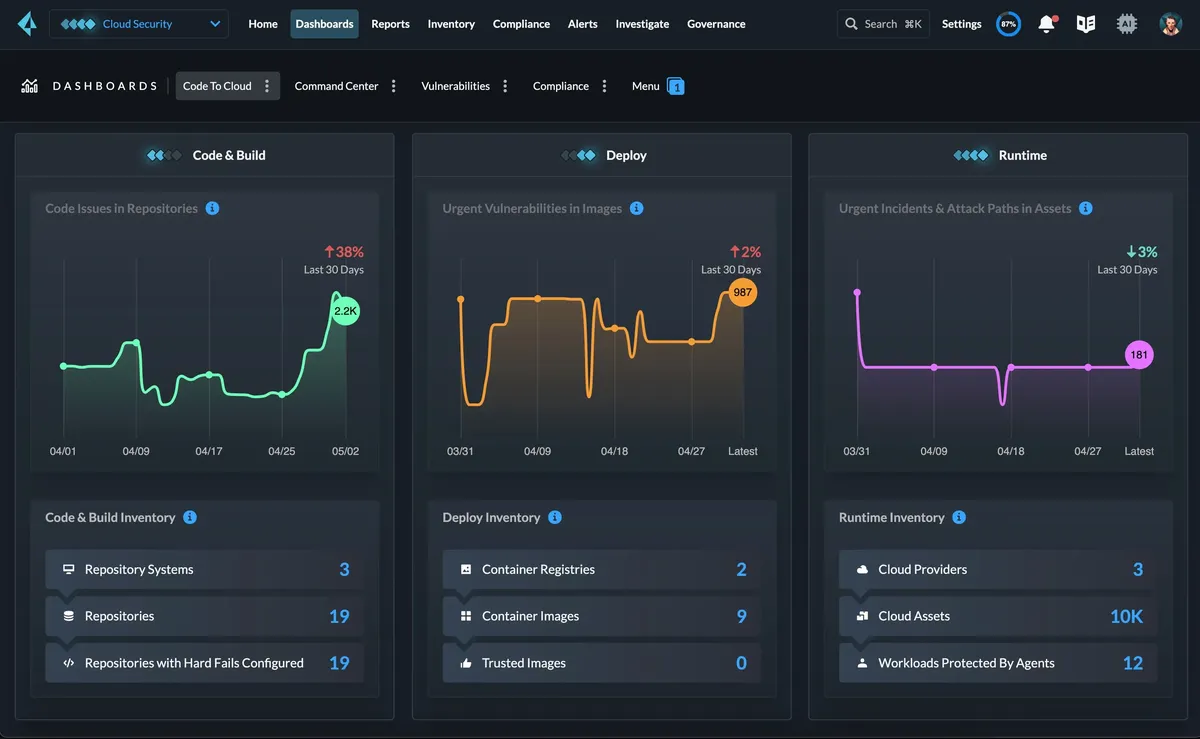
| Reporting & Dashboards | Security dashboards with vulnerability trending, compliance status, and runtime incident views per cluster or namespace | Executive dashboards with compliance posture scoring, attack path visualization, and risk prioritization across all modules |
Container Security
Image Scanning
Runtime Protection
Registry Scanning
Cloud Security Posture
CSPM Capabilities
Infrastructure as Code
Identity Security
Kubernetes Security
Cluster Protection
Network Policies
Workload Scanning
DevSecOps Integration
CI/CD Pipeline
Developer Tools
API & Automation
Operations & Compliance
Compliance Frameworks
Alerting & Notifications
Reporting & Dashboards
Which to choose
Both Aqua Security and Prisma Cloud deliver enterprise-grade cloud-native security, but they serve different organizational priorities. Aqua Security excels in container and Kubernetes runtime protection with deep open-source roots through Trivy, while Prisma Cloud offers the broadest CNAPP coverage with unified CSPM, CWPP, and CIEM capabilities under one platform.
Best-fit scenarios
Choose Aqua Security if:
Choose Aqua Security if your organization is container-first and Kubernetes-centric, requiring deep runtime protection with behavioral profiling and drift prevention. Teams already using Trivy for open-source vulnerability scanning will find a natural upgrade path to the full Aqua Platform. Starting at a current vendor-published rate for small teams, it offers a more accessible entry point for organizations focused primarily on container workload security rather than broad cloud posture management. Aqua is particularly strong for DevSecOps teams that value open-source tooling and need granular Kubernetes-native security controls.
Choose Prisma Cloud if:
Choose Prisma Cloud if your organization needs comprehensive cloud-native application protection across CSPM, CWPP, CIEM, and code security in a single platform. With over 350 built-in compliance policies and native Palo Alto Networks ecosystem integration, it suits enterprises managing complex multi-cloud environments that require unified visibility and posture management. The credit-based pricing model starting from ~a current vendor-published rate for CSPM provides flexibility to expand coverage over time. Prisma Cloud is ideal for security teams that want a single pane of glass across all cloud security domains rather than best-of-breed point solutions.
These scenarios reflect the available product evidence. Your requirements, existing stack, and team expertise should guide the final decision.
Frequently Asked Questions
How do Aqua Security and Prisma Cloud pricing models compare for a mid-size company?
Aqua Security uses per-workload pricing with Cloud Security plans starting at a current vendor-published rate for small teams and full Platform plans from a current vendor-published rate. Prisma Cloud uses a credit-based model where credits cost approximately a current vendor-published rate each, with the CSPM module alone starting around a current vendor-published rate and the full CNAPP suite from a current vendor-published rate. For a mid-size company running 200-500 workloads, expect to spend between a current vendor-published rate and a current vendor-published rate with Aqua Security depending on modules selected. Prisma Cloud for similar coverage typically ranges from a current vendor-published rate to a current vendor-published rate, though volume discounts can reduce this significantly. Both vendors require annual contracts and offer custom quotes based on deployment size.
Can Aqua Security and Prisma Cloud protect both containers and serverless workloads?
Yes, both platforms extend protection beyond containers to serverless functions. Aqua Security provides runtime protection for AWS Lambda, Azure Functions, and Google Cloud Functions through lightweight instrumentation that monitors function behavior and enforces security policies without impacting cold start performance. Prisma Cloud similarly protects serverless workloads through its Defender framework, scanning function code for vulnerabilities and monitoring runtime execution. Aqua Security has historically been stronger in container-specific runtime protection with its behavioral profiling engine, while Prisma Cloud offers broader serverless coverage integrated with its CSPM and CIEM modules. For organizations running mixed workloads, both platforms can secure containers, serverless, and VM-based applications under a single policy framework.
What open-source tools does each platform offer, and how do they compare?
Aqua Security is the creator of Trivy, a widely adopted open-source vulnerability scanner with an active open-source community. Trivy scans container images, filesystems, IaC templates, and Kubernetes clusters for CVEs, misconfigurations, and exposed secrets at no cost. Prisma Cloud benefits from Palo Alto Networks' stewardship of Checkov, an open-source infrastructure-as-code scanner that analyzes Terraform, CloudFormation, and Kubernetes manifests for security misconfigurations. Both open-source tools serve as entry points to their respective commercial platforms. Trivy is more broadly focused on vulnerability scanning across multiple artifact types, while Checkov specializes in IaC and policy-as-code validation. Organizations can use both tools together for free before deciding which commercial platform to adopt.
How do the two platforms handle Kubernetes admission control and policy enforcement?
Aqua Security provides Kubernetes admission controllers that integrate directly with the API server to enforce image assurance policies before pods are scheduled. Policies can block unscanned images, images with critical CVEs, images from untrusted registries, or images that violate custom compliance rules. Aqua also offers vShield for network micro-segmentation that automatically generates and enforces Kubernetes network policies based on observed traffic patterns. Prisma Cloud deploys Defender DaemonSets across Kubernetes clusters that provide admission control, runtime monitoring, and workload scanning. Its admission controller can enforce vulnerability thresholds, compliance standards, and custom Rego policies. Prisma Cloud also integrates with Open Policy Agent for flexible policy authoring, while Aqua uses its own policy engine with Kubernetes-native constructs.