Decision comparison
Prisma Cloud vs Wiz
Prisma Cloud and Wiz represent two leading approaches to cloud-native application protection. Prisma Cloud offers a comprehensive, modular CNAPP backed by Palo Alto Networks' extensive security ecosystem, making it ideal for enterprises that want deep agent-based runtime protection and a single vendor across their entire security stack. Wiz takes an agentless-first approach with a unified security graph that delivers rapid time-to-value and contextual risk prioritization, making it particularly strong for organizations that need immediate cloud visibility without operational overhead from agent deployments.
Direct comparison. These are reviewed substitutes bought for the same job, so the differences below are the ones that decide between them.
All 2 are cloud security platforms.
Quick Comparison
| Decision factor | Prisma Cloud | Wiz |
|---|---|---|
| Best For | Enterprises needing a single CNAPP consolidating CSPM, CWPP, CIEM, and code security under Palo Alto Networks' unified platform | Security teams wanting agentless cloud visibility with a unified security graph connecting code, cloud, and runtime contexts |
| Architecture | Module-based CNAPP platform with per-credit licensing; integrates CSPM, CWPP, CIEM, and code security as separately purchasable modules | Agentless-first CNAPP with unified security graph; connects code, cloud, identities, network, and runtime into a single context model |
| Pricing Model | Palo Alto Networks enterprise pricing. Per-credit model: Cloud Security credits from ~$1.20/credit, which is the only rate Palo Alto publishes; module and suite pricing is quoted. Volume discounts available. | Enterprise-only pricing, custom quotes. Wiz publishes no rate and quotes every deal. Per-workload pricing model. No free tier or self-service plans. |
| Ease of Deployment | Agent-based and agentless options; requires module-by-module configuration that can take weeks for full deployment across large environments | Agentless architecture connects via cloud APIs in minutes; customers report seeing initial findings within 60 minutes of deployment |
| Cloud Coverage | Supports AWS, Azure, GCP, Oracle Cloud, and Alibaba Cloud with deep integrations across all five major cloud providers | Supports AWS, Azure, and GCP with deep multi-cloud analysis; trusted by a sizable 50% of Fortune 100 companies |
| Runtime Protection | Agent-based CWPP module provides container and host runtime protection with vulnerability management and compliance monitoring | eBPF-based Runtime Sensor for real-time threat detection, blocking exploitation attempts, and investigating with full contextual lineage |
Prisma Cloud
- Best For:
- Enterprises needing a single CNAPP consolidating CSPM, CWPP, CIEM, and code security under Palo Alto Networks' unified platform
- Architecture:
- Module-based CNAPP platform with per-credit licensing; integrates CSPM, CWPP, CIEM, and code security as separately purchasable modules
- Pricing Model:
- Palo Alto Networks enterprise pricing. Per-credit model: Cloud Security credits from ~$1.20/credit, which is the only rate Palo Alto publishes; module and suite pricing is quoted. Volume discounts available.
- Ease of Deployment:
- Agent-based and agentless options; requires module-by-module configuration that can take weeks for full deployment across large environments
- Cloud Coverage:
- Supports AWS, Azure, GCP, Oracle Cloud, and Alibaba Cloud with deep integrations across all five major cloud providers
- Runtime Protection:
- Agent-based CWPP module provides container and host runtime protection with vulnerability management and compliance monitoring
Wiz
- Best For:
- Security teams wanting agentless cloud visibility with a unified security graph connecting code, cloud, and runtime contexts
- Architecture:
- Agentless-first CNAPP with unified security graph; connects code, cloud, identities, network, and runtime into a single context model
- Pricing Model:
- Enterprise-only pricing, custom quotes. Wiz publishes no rate and quotes every deal. Per-workload pricing model. No free tier or self-service plans.
- Ease of Deployment:
- Agentless architecture connects via cloud APIs in minutes; customers report seeing initial findings within 60 minutes of deployment
- Cloud Coverage:
- Supports AWS, Azure, and GCP with deep multi-cloud analysis; trusted by a sizable 50% of Fortune 100 companies
- Runtime Protection:
- eBPF-based Runtime Sensor for real-time threat detection, blocking exploitation attempts, and investigating with full contextual lineage
Public signals
Verified factual signals only. Bars appear only for like-for-like metrics with five weekly assessments for every tool; missing evidence stays explicit. These signals do not establish enterprise adoption, product quality, or total cost.
| Metric | Prisma Cloud | Wiz |
|---|---|---|
| Search interest(Market interest) | 0 | 0 |
| Hacker News mentions, 90d(Community interest) | 0 | 0 |
As of September 14, 2026 — updated weekly.
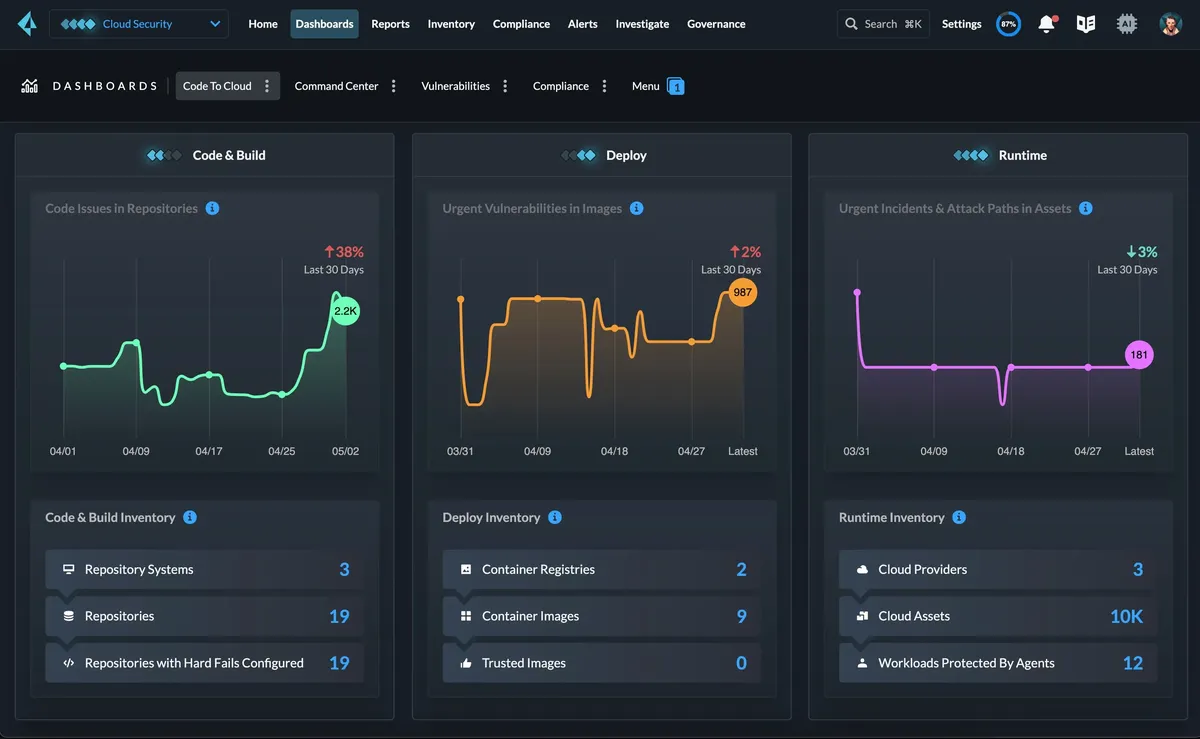
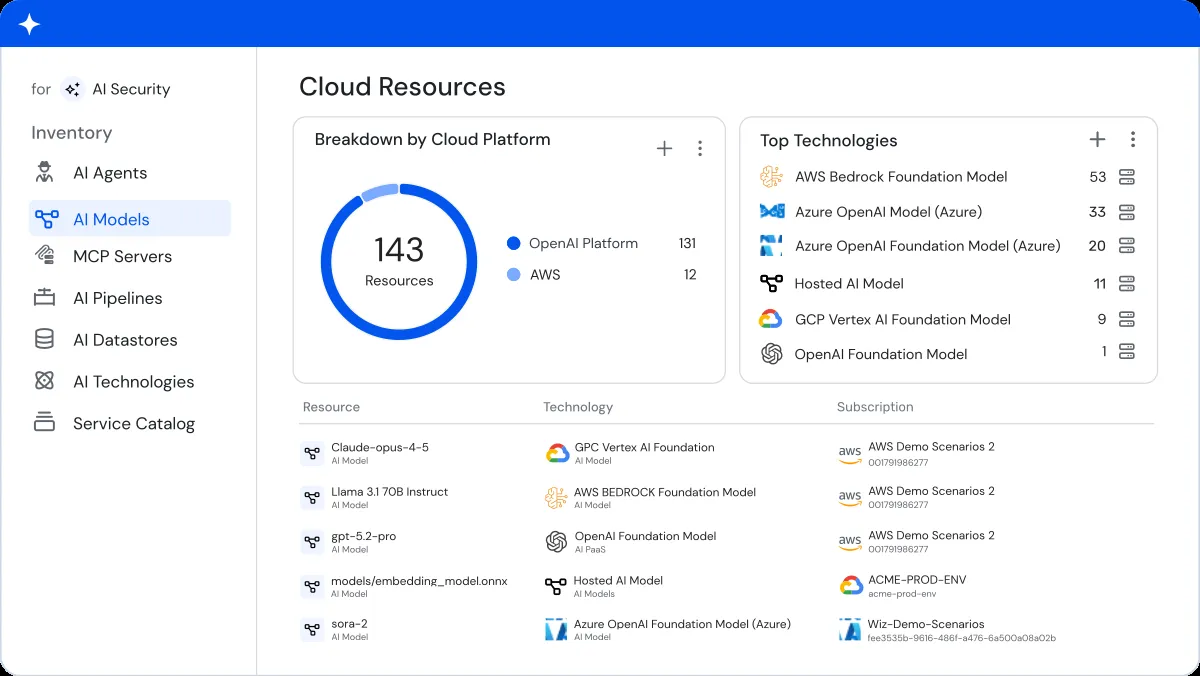
Interface Preview
Prisma Cloud
Wiz
Feature Comparison
| Feature | Prisma Cloud | Wiz |
|---|---|---|
| Cloud Security Posture Management | ||
| Misconfiguration Detection | Dedicated CSPM module scanning across five cloud providers with policy-as-code enforcement and auto-remediation workflows | Agentless scanning connects via cloud APIs to detect misconfigurations and maps them to attack paths through the unified security graph |
| Compliance Frameworks | Pre-built compliance templates for CIS, SOC 2, HIPAA, PCI-DSS, and GDPR with continuous monitoring and reporting dashboards | Named Customers' Choice for CSPM in Gartner Voice of the Customer 2026; provides continuous compliance with contextual risk prioritization |
| Identity Security (CIEM) | Dedicated CIEM module analyzes effective permissions across cloud providers to detect overprivileged identities and enforce least privilege | Identity analysis integrated into the security graph; models privilege escalation chains and data access paths across cloud environments |
| Workload Protection | ||
| Container Security | Full container lifecycle protection from image scanning in CI/CD to runtime defense with Prisma Cloud Defenders deployed as agents | Agentless container scanning discovers and assesses vulnerabilities across Kubernetes clusters without requiring agent deployment on nodes |
| Serverless Security | Dedicated serverless protection module scanning Lambda, Azure Functions, and Cloud Functions with embedded runtime defense agents | Agentless analysis covers serverless functions as part of the unified cloud scan, detecting misconfigurations and vulnerable dependencies |
| Host Vulnerability Management | Agent-based host scanning with Defenders providing real-time vulnerability detection, compliance checks, and runtime protection for VMs | Agentless workload scanning reads disk snapshots to identify vulnerabilities and exposed secrets without deploying software on the hosts |
| Code and Pipeline Security | ||
| Infrastructure as Code Scanning | Bridgecrew-powered IaC scanning for Terraform, CloudFormation, and Kubernetes manifests with shift-left policy enforcement in CI/CD | Code scanning integrated into the security graph; identifies infrastructure misconfigurations before deployment and traces risks to source code |
| Supply Chain Security | Software composition analysis and SBOM generation through the code security module; covers open-source dependency vulnerabilities | Code-to-cloud tracing connects vulnerable packages in source repositories to running workloads, enabling targeted remediation at the code level |
| CI/CD Pipeline Integration | Native integrations with Jenkins, GitHub Actions, GitLab CI, and Azure DevOps; blocks builds that violate security policies at the pipeline | Wiz Green agent opens pull requests with direct code and infrastructure fixes; assigns ownership to the right team, repo, and service automatically |
| Threat Detection and Response | ||
| Attack Path Analysis | Identifies high-risk attack paths combining misconfigurations, vulnerabilities, and excessive permissions across cloud environments | Security graph models full attack chains from external exposure through lateral movement to data access, prioritizing by real exploitability |
| Runtime Threat Detection | Agent-based runtime sensors monitor container and host behavior for anomalous processes, network connections, and file system changes | eBPF Runtime Sensor detects and blocks exploitation attempts in real time; combines cloud logs, SaaS logs, and application context for investigation |
| Incident Investigation | Forensics module captures container snapshots and process-level data for post-incident investigation and root cause analysis workflows | Full contextual lineage from runtime alert through cloud configuration to source code; Wiz Blue agent automates threat hunting and validation |
| AI Security and Innovation | ||
| AI Workload Protection | Emerging AI security capabilities leveraging Palo Alto Networks' broader AI security portfolio and Cortex integration for threat intelligence | Dedicated AI security features discover models, agents, MCP servers, and services; identifies AI-specific risks including data exposure and guardrails |
| Automated Remediation | Auto-remediation workflows with playbooks that fix misconfigurations automatically; integrates with ServiceNow and Jira for ticketing | Wiz Green agent generates direct code fixes and infrastructure patches; Wiz Red agent performs automated penetration testing and risk discovery |
| Security Graph and Context | Risk scoring engine correlates alerts across modules; Prisma Cloud Cortex XSIAM integration provides broader security operations context | Unified security graph connects code, cloud, identities, network, and runtime; provides end-to-end context for AI-speed risk reduction and response |
Cloud Security Posture Management
Misconfiguration Detection
Compliance Frameworks
Identity Security (CIEM)
Workload Protection
Container Security
Serverless Security
Host Vulnerability Management
Code and Pipeline Security
Infrastructure as Code Scanning
Supply Chain Security
CI/CD Pipeline Integration
Threat Detection and Response
Attack Path Analysis
Runtime Threat Detection
Incident Investigation
AI Security and Innovation
AI Workload Protection
Automated Remediation
Security Graph and Context
Which to choose
Prisma Cloud and Wiz represent two leading approaches to cloud-native application protection. Prisma Cloud offers a comprehensive, modular CNAPP backed by Palo Alto Networks' extensive security ecosystem, making it ideal for enterprises that want deep agent-based runtime protection and a single vendor across their entire security stack. Wiz takes an agentless-first approach with a unified security graph that delivers rapid time-to-value and contextual risk prioritization, making it particularly strong for organizations that need immediate cloud visibility without operational overhead from agent deployments.
Best-fit scenarios
Choose Prisma Cloud if:
Choose Prisma Cloud if your organization requires deep, agent-based runtime protection and values having a single security vendor covering network, endpoint, and cloud security. Prisma Cloud excels in environments where you need granular container runtime defense, real-time process monitoring, and tight integration with Palo Alto Networks' broader security operations platform including Cortex XSIAM. The modular pricing model starting at approximately $18,000 per year for CSPM alone lets you start with specific capabilities and expand over time. Enterprises running workloads across five or more cloud providers, including Oracle Cloud and Alibaba Cloud, benefit from Prisma Cloud's broader cloud coverage.
Choose Wiz if:
Choose Wiz if rapid deployment, agentless architecture, and contextual risk prioritization are your top priorities. Wiz connects via cloud APIs and delivers initial findings within 60 minutes, eliminating the weeks-long agent rollout process that traditional CNAPP tools require. The unified security graph that connects code, cloud, and runtime context is particularly valuable for organizations struggling with alert fatigue, as it reduces noise by showing only risks that are actually exploitable through verified attack paths. Wiz's recognition as a Leader in the Forrester Wave CNAPP Q1 2026 and its adoption by over 50% of Fortune 100 companies validate its enterprise readiness. Starting around $30,000 to $50,000 per year for small environments, the per-workload pricing scales predictably.
These scenarios reflect the available product evidence. Your requirements, existing stack, and team expertise should guide the final decision.
Frequently Asked Questions
How do Prisma Cloud and Wiz pricing compare for a mid-size cloud environment?
For a mid-size environment running 200 to 500 cloud workloads, Prisma Cloud pricing depends on which modules you purchase. The CSPM module alone starts at approximately $18,000 per year, while the full CNAPP suite covering CSPM, CWPP, CIEM, and code security starts at approximately $45,000 per year with volume discounts available through Palo Alto Networks' per-credit model at roughly $1.20 per credit. Wiz uses a per-workload pricing model with typical deployments starting around $30,000 to $50,000 per year for focused environments, scaling upward based on the number of workloads scanned. Neither platform offers self-service pricing or a free tier, so both require contacting sales for precise quotes based on your specific cloud footprint.
Can Prisma Cloud and Wiz integrate with existing security tools and SIEM systems?
Both platforms support integration with major security operations tools but take different approaches. Prisma Cloud benefits from native integration with Palo Alto Networks' Cortex XSIAM platform, providing a seamless handoff between cloud security alerts and broader security operations workflows. It also integrates with third-party SIEMs like Splunk and ServiceNow for ticketing and automated response. Wiz provides API-driven integrations that feed contextualized alerts into existing SIEM and SOAR platforms, with the added advantage that its security graph context reduces the volume of raw alerts teams must triage. Both platforms offer webhook-based alerting, Jira integration for developer workflows, and support for CI/CD pipeline integration to shift security left.
What is the deployment timeline for each platform in a large enterprise environment?
Deployment timelines differ significantly between the two platforms due to their architectural approaches. Wiz's agentless model connects through cloud provider APIs, and customers report seeing initial security findings within 60 minutes of connecting their cloud accounts. Full deployment across a large multi-cloud environment typically takes days rather than weeks. Prisma Cloud's deployment timeline is longer because its full capabilities rely on deploying Defenders, which are lightweight agents installed on hosts, containers, and serverless functions. Rolling out agents across hundreds or thousands of workloads can take several weeks depending on change management processes, and the module-by-module configuration requires careful planning to avoid gaps between different security capabilities.
Which platform provides better protection for AI and machine learning workloads?
As of early 2026, Wiz has a more developed AI security offering. Its platform continuously discovers AI models, agents, MCP servers, and services running across cloud and SaaS environments. Wiz identifies AI-specific risks including sensitive data exposure, missing guardrails, and exposed endpoints, then connects those findings to broader infrastructure context through its security graph. The AI posture management feature maps real risk by connecting infrastructure, identity, data, and AI context. Prisma Cloud is building AI security capabilities leveraging Palo Alto Networks' broader AI security portfolio, but the dedicated AI workload discovery and AI-specific risk classification features are less mature compared to Wiz's purpose-built AI security module. Organizations running frontier AI models should weigh Wiz's specialized AI visibility capabilities heavily.