Wiz: product and architecture
This Wiz review examines one of the fastest-growing cloud security platforms on the market today. Wiz has established itself as a cloud-native application protection platform (CNAPP) that connects code, cloud, and runtime into a unified security graph. Trusted by over 50% of Fortune 100 companies, Wiz provides end-to-end context for automating risk reduction and threat response. The platform takes an agentless-first approach to cloud security, enabling security teams to gain comprehensive visibility across multi-cloud environments without deploying agents on every workload. For organizations seeking a single platform to consolidate cloud security posture management, vulnerability scanning, and runtime protection, Wiz presents a compelling but premium option.
Overview
Wiz is a cloud-native application protection platform that unifies code security, cloud security posture management (CSPM), cloud infrastructure entitlement management (CIEM), data security posture management (DSPM), vulnerability management, and runtime protection into a single platform. The platform builds a security graph that connects code, cloud infrastructure, identities, network configurations, and runtime behavior to model attack paths, lateral movement opportunities, and data access chains.
Wiz targets mid-to-large enterprises running workloads across major cloud providers including AWS, Azure, and Google Cloud. The platform has gained recognition from major analyst firms, being named a Leader in The Forrester Wave for Cloud Native Application Protection Solutions (Q1 2026), recognized in the IDC MarketScape for Worldwide Cloud-Native Application Protection Platforms (2025), and named a Customers' Choice for Cloud Security Posture Management Tools in the Gartner Voice of the Customer report (2026). With ratings of 4.7/5 across 772+ reviews and 4.8/5 across 265+ reviews on major platforms, Wiz has built a strong reputation among enterprise security teams.
Key Features and Architecture
Wiz's architecture centers on its unified security graph, which connects data from code repositories, cloud infrastructure, identities, network configurations, and runtime environments. This graph-based approach enables the platform to identify complex attack paths that siloed tools would miss.
Agentless Scanning and Visibility
Wiz provides agentless scanning that maps externally reachable assets and models initial access paths. The attack surface scanner identifies reachable and exploitable resources, analyzes effective internet-exposure of endpoints and services, and incorporates intelligence from Wiz Threat Research. This agentless approach means organizations can achieve visibility across their cloud environments without the overhead of deploying and maintaining agents on every workload.
Security Graph and Deep Analysis
The platform connects code, cloud, identities, network, and runtime data to model lateral movement paths, privilege escalation opportunities, and data access chains. This deep internal analysis provides security teams with the context needed to understand not just individual vulnerabilities, but how they could be chained together in real-world attacks.
Runtime Protection with eBPF Sensor
Wiz offers an eBPF-based Runtime Sensor that detects and blocks exploitation attempts in real time. Combined with analysis of cloud and SaaS logs and application context, the sensor can detect real exploitation attempts, block lateral movement in progress, and support investigation with full contextual lineage from code to cloud to runtime.
AI-Powered Security Agents
Wiz has introduced AI-powered agents for different security functions. The Wiz Green agent automatically turns risks into code fixes by opening pull requests to fix issues at the source and helps write secure code from the start. The Wiz Red agent discovers attack paths with automated penetration testing and risk discovery. The Wiz Blue agent automates SecOps threat hunting and investigation to validate and prioritize real threats.
AI Workload Security
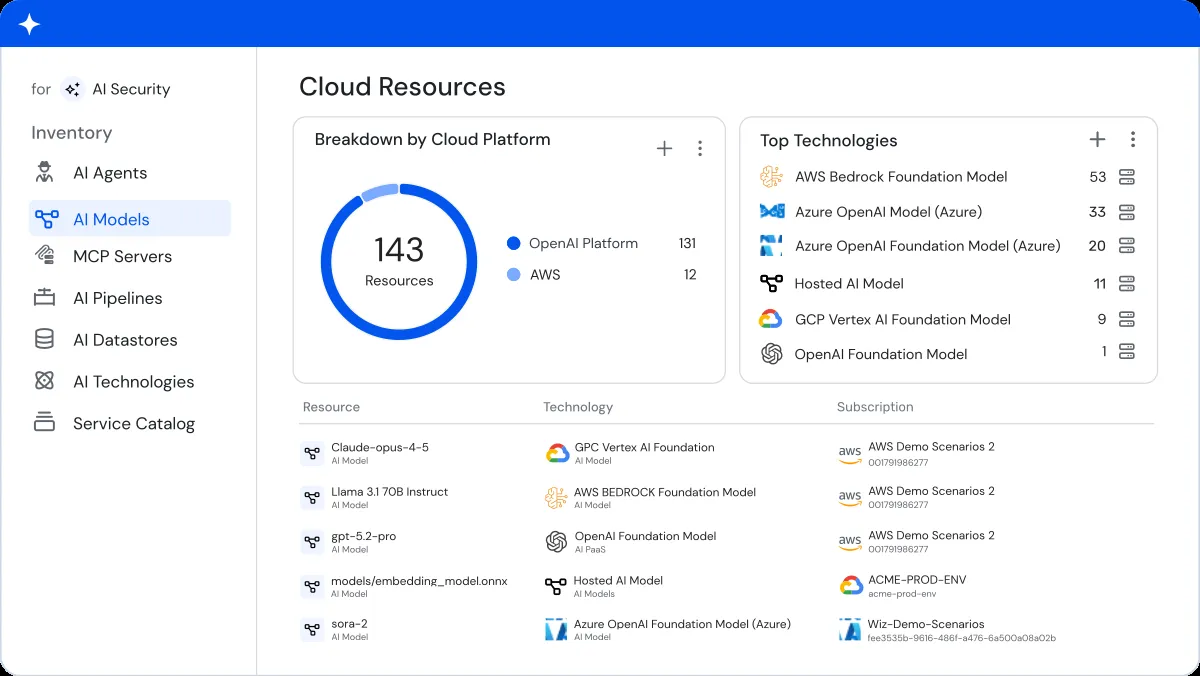
The platform provides specialized capabilities for securing AI workloads, including continuous discovery of AI models, agents, MCP servers, and services across cloud and SaaS environments. It identifies AI-specific risks from sensitive data exposure and guardrails to exposed endpoints, and provides runtime detection and response for AI threats.
Fix at Scale in Code
Using graph context and ownership mapping, Wiz identifies the right place for a fix, assigns the right owner based on team, repository, or service, and generates direct code and infrastructure fixes delivered to code owners. This code-level remediation approach moves security fixes upstream rather than relying on runtime patches.
Ideal Use Cases
Multi-cloud enterprises: Organizations running workloads across AWS, Azure, and Google Cloud benefit most from Wiz's unified security graph, which provides consistent visibility and risk assessment across all cloud providers in a single dashboard.
Compliance-heavy industries: Financial services, healthcare, and government organizations that must meet strict regulatory requirements can leverage Wiz's CSPM and CIEM capabilities to maintain continuous compliance monitoring and generate audit-ready reports.
Security teams consolidating tools: Organizations looking to replace multiple point solutions for vulnerability scanning, CSPM, CIEM, DSPM, and runtime protection with a single platform will find Wiz's comprehensive approach reduces tool sprawl and eliminates the manual correlation work between siloed tools.
Organizations with rapid development cycles: Teams shipping applications frequently can use Wiz's code-to-cloud security approach and AI-powered fix agents to integrate security directly into development workflows, catching and fixing issues before they reach production.
AI-forward enterprises: Companies deploying AI models, agents, and services in the cloud can use Wiz's dedicated AI security capabilities to discover, assess, and protect AI workloads from specialized threats including data exposure and malicious agent actions.
Pros and Cons
Pros
- Unified security graph: Connects code, cloud, identities, network, and runtime into a single context graph, eliminating the need to manually correlate findings across siloed tools and enabling identification of complex multi-step attack paths.
- Agentless-first architecture: Achieves comprehensive visibility and scanning without requiring agent deployment on every workload, significantly reducing operational overhead and enabling rapid initial deployment. Customers report seeing information within 60 minutes of onboarding.
- Strong analyst recognition: Named a Leader in The Forrester Wave for CNAPP (Q1 2026), recognized in the IDC MarketScape for CNAPP (2025), and named a Customers' Choice for CSPM (2026), validated by 772+ reviews with a 4.7/5 rating.
- AI-powered remediation agents: The Green, Red, and Blue agents automate code fixes, penetration testing, and threat hunting respectively, moving from detection to remediation without manual handoffs between security and development teams.
- Comprehensive AI workload security: Provides specialized capabilities for discovering and securing AI models, agents, MCP servers, and services, addressing a growing security domain that many competing platforms have not yet covered.
- Code-to-runtime coverage: Spans the entire application lifecycle from IDE and CI/CD through cloud infrastructure to runtime, reducing gaps that emerge when different tools cover different stages.
Cons
- Enterprise pricing barrier: Wiz publishes no rate and offers no self-service plan, which puts it out of reach for startups, small teams and organizations with constrained security budgets.
- No free tier or trial: The absence of any self-service option means potential customers cannot evaluate the platform independently. Every evaluation requires engaging with the sales team and scheduling demos, which adds friction to the buying process.
- Complex deployment for full value: While agentless scanning provides quick initial visibility, unlocking the full value of the security graph, runtime protection with the eBPF sensor, and AI agents requires significant configuration and integration effort across code repositories, cloud accounts, and CI/CD pipelines.
- Per-workload cost scaling: The per-workload pricing model means costs grow linearly with cloud infrastructure, which can become expensive for organizations with large or rapidly scaling cloud environments where workload counts fluctuate significantly.