Decision comparison
Lacework FortiCNAPP vs Wiz
Both Lacework and Wiz deliver enterprise-grade cloud security, but they take fundamentally different approaches. Lacework excels in behavioral anomaly detection through its Polygraph engine, while Wiz leads with its agentless, graph-based security model and AI-powered automation agents. The right choice depends on your team's deployment preferences, automation maturity, and specific security priorities.
Lacework FortiCNAPP is now sold under new ownership
Fortinet completed its acquisition of Lacework on 1 August 2024. The product is now sold as Lacework FortiCNAPP, generally available since 8 October 2024, and is priced by Fortinet.
Direct comparison. These are reviewed substitutes bought for the same job, so the differences below are the ones that decide between them.
All 2 are cloud security platforms.
Quick Comparison
| Decision factor | Lacework FortiCNAPP | Wiz |
|---|---|---|
| Cloud Security Approach | Polygraph-based anomaly detection that baselines normal cloud behavior and flags deviations across workloads and configurations | Unified security graph connecting code, cloud, and runtime to provide full-stack context for risk prioritization |
| Deployment Model | Agent-based deployment with lightweight collectors installed on workloads for deep runtime visibility and telemetry | Agentless scanning with API-based cloud connector plus optional eBPF runtime sensor for deeper workload protection |
| Threat Detection | Behavioral anomaly detection using machine learning to identify unknown threats without relying on signature-based rules | Graph-based attack path analysis with eBPF runtime sensor for real-time threat detection and lateral movement blocking |
| AI & Automation | Polygraph AI engine automatically correlates alerts and reduces noise by mapping relationships between cloud entities | AI-powered agents (Green, Red, Blue) that automate code fixes, penetration testing, and threat hunting respectively |
| Multi-Cloud Support | Supports AWS, Azure, and Google Cloud with unified visibility across multi-cloud workloads and container environments | Comprehensive AWS, Azure, GCP, and OCI support with unified security graph spanning all cloud environments and SaaS |
| Compliance & Governance | Continuous compliance monitoring with automated checks against CIS benchmarks, PCI-DSS, SOC 2, and HIPAA frameworks | Built-in compliance frameworks with continuous posture management recognized as Customers' Choice for CSPM in 2026 |
Lacework FortiCNAPP
- Cloud Security Approach:
- Polygraph-based anomaly detection that baselines normal cloud behavior and flags deviations across workloads and configurations
- Deployment Model:
- Agent-based deployment with lightweight collectors installed on workloads for deep runtime visibility and telemetry
- Threat Detection:
- Behavioral anomaly detection using machine learning to identify unknown threats without relying on signature-based rules
- AI & Automation:
- Polygraph AI engine automatically correlates alerts and reduces noise by mapping relationships between cloud entities
- Multi-Cloud Support:
- Supports AWS, Azure, and Google Cloud with unified visibility across multi-cloud workloads and container environments
- Compliance & Governance:
- Continuous compliance monitoring with automated checks against CIS benchmarks, PCI-DSS, SOC 2, and HIPAA frameworks
Wiz
- Cloud Security Approach:
- Unified security graph connecting code, cloud, and runtime to provide full-stack context for risk prioritization
- Deployment Model:
- Agentless scanning with API-based cloud connector plus optional eBPF runtime sensor for deeper workload protection
- Threat Detection:
- Graph-based attack path analysis with eBPF runtime sensor for real-time threat detection and lateral movement blocking
- AI & Automation:
- AI-powered agents (Green, Red, Blue) that automate code fixes, penetration testing, and threat hunting respectively
- Multi-Cloud Support:
- Comprehensive AWS, Azure, GCP, and OCI support with unified security graph spanning all cloud environments and SaaS
- Compliance & Governance:
- Built-in compliance frameworks with continuous posture management recognized as Customers' Choice for CSPM in 2026
Public signals
Verified factual signals only. Bars appear only for like-for-like metrics with five weekly assessments for every tool; missing evidence stays explicit. These signals do not establish enterprise adoption, product quality, or total cost.
| Metric | Lacework FortiCNAPP | Wiz |
|---|---|---|
| GitHub commits, 90d(Developer adoption) | 30 | Not available |
| GitHub stars(Developer adoption) | 40 | Not available |
| Search interest(Market interest) | 0 | 0 |
| Hacker News mentions, 90d(Community interest) | 0 | 0 |
As of September 14, 2026 — updated weekly.
Interface Preview
Wiz
Feature Comparison
| Feature | Lacework FortiCNAPP | Wiz |
|---|---|---|
| Cloud Posture Management | ||
| Infrastructure Scanning | Agent-based scanning with Polygraph engine that continuously monitors cloud configurations and identifies misconfigurations across AWS, Azure, and GCP | Agentless API-based scanning that connects directly to cloud accounts and builds a full security graph of all cloud resources and their relationships |
| Identity & Access Analysis | Monitors IAM activity patterns using behavioral baselines to detect unusual privilege usage and potential credential compromise | Maps effective permissions across cloud identities and models privilege escalation paths using the unified security graph |
| Configuration Compliance | Automated compliance checks against CIS, PCI-DSS, SOC 2, and HIPAA with continuous drift detection and remediation guidance | Continuous compliance assessment with pre-built policy packs for CIS, PCI-DSS, GDPR, and SOC 2, named Customers' Choice for CSPM |
| Threat Detection & Response | ||
| Runtime Protection | Lightweight agent monitors runtime behavior on hosts and containers, using Polygraph baselines to detect anomalous process activity | eBPF-based runtime sensor provides real-time workload protection with the ability to detect and block exploitation attempts in progress |
| Attack Path Analysis | Correlates alerts across cloud entities using Polygraph to show relationships between compromised resources and lateral movement potential | Dedicated attack path visualization mapping external exposure through vulnerabilities, misconfigurations, and identities to critical assets |
| Incident Investigation | Temporal analysis of cloud events with Polygraph timeline showing behavioral deviations and related alerts for root cause analysis | Full contextual lineage investigation combining cloud logs, SaaS logs, and runtime context with automated threat hunting via Blue agent |
| Vulnerability Management | ||
| Container Security | Scans container images in registries and runtime, monitors Kubernetes clusters with behavioral detection for container-specific threats | Agentless container and Kubernetes scanning with vulnerability prioritization based on runtime context and internet exposure analysis |
| Code Security | Infrastructure-as-code scanning for misconfigurations in Terraform and CloudFormation templates during CI/CD pipeline stages | Full code-to-cloud security with Green agent that generates direct code and infrastructure fixes and opens PRs to fix issues at source |
| Vulnerability Prioritization | Risk-based prioritization using Polygraph context to rank vulnerabilities by exploitability and environment-specific exposure factors | Graph-powered prioritization that combines vulnerability data with network exposure, identity access, and data sensitivity for risk scoring |
| AI Security & Innovation | ||
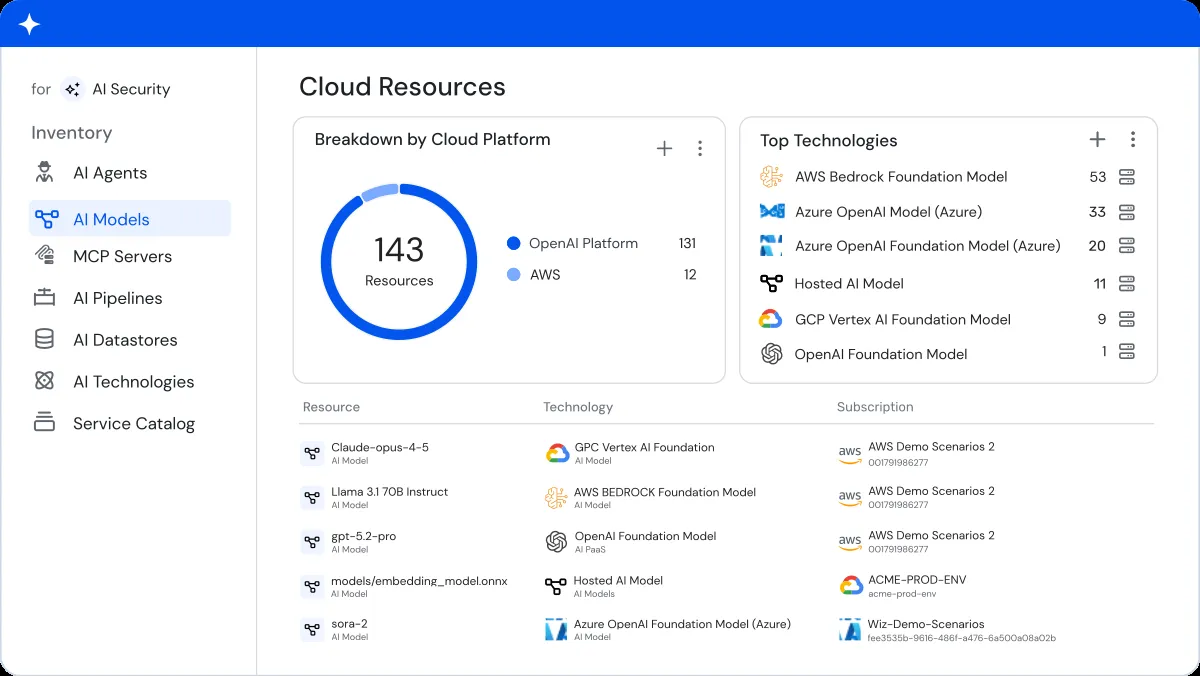
| AI Workload Protection | General workload monitoring extends to AI/ML infrastructure through standard behavioral baselines and anomaly detection capabilities | Purpose-built AI security that discovers AI models, agents, and MCP servers with specific risk assessment for data exposure and guardrails |
| Automated Remediation | Alert-driven remediation workflows with integration to ticketing systems and runbook automation for common security findings | AI-powered Green agent automates code fixes using graph context and ownership mapping, routing fixes to the correct team and repository |
| Security Automation Agents | Polygraph engine serves as the primary automation layer, correlating events and reducing alert noise without dedicated agent workflows | Three specialized AI agents: Green (auto-fix), Red (penetration testing and attack path discovery), and Blue (threat hunting and investigation) |
| Platform & Integration | ||
| Deployment Architecture | Agent-based architecture requiring lightweight collector deployment on each workload for deep runtime visibility and telemetry collection | Primarily agentless via cloud API connectors with optional eBPF sensor, enabling rapid deployment with information visible within 60 minutes |
| API & Integrations | REST API with integrations for SIEM, SOAR, ticketing systems like Jira and ServiceNow, and CI/CD pipeline tools for DevSecOps workflows | Comprehensive API and integration ecosystem connecting to SIEM, SOAR, CI/CD, and developer tools with ownership mapping for code-level fixes |
| Reporting & Analytics | Customizable dashboards with compliance reporting, alert trend analysis, and executive summaries of cloud security posture over time | Security graph-powered analytics with attack path reporting, compliance dashboards, and outcome metrics tracking like critical finding reduction |
Cloud Posture Management
Infrastructure Scanning
Identity & Access Analysis
Configuration Compliance
Threat Detection & Response
Runtime Protection
Attack Path Analysis
Incident Investigation
Vulnerability Management
Container Security
Code Security
Vulnerability Prioritization
AI Security & Innovation
AI Workload Protection
Automated Remediation
Security Automation Agents
Platform & Integration
Deployment Architecture
API & Integrations
Reporting & Analytics
Which to choose
Both Lacework and Wiz deliver enterprise-grade cloud security, but they take fundamentally different approaches. Lacework excels in behavioral anomaly detection through its Polygraph engine, while Wiz leads with its agentless, graph-based security model and AI-powered automation agents. The right choice depends on your team's deployment preferences, automation maturity, and specific security priorities.
Best-fit scenarios
Choose Lacework FortiCNAPP if:
Choose Lacework if your organization prioritizes deep behavioral anomaly detection and runtime monitoring with agent-based telemetry. Lacework's Polygraph engine is particularly strong for teams that want to detect unknown threats through behavioral baselines rather than relying on predefined rules. Organizations with mature DevOps practices that can manage agent deployments across their cloud workloads will benefit most from Lacework's approach to continuous behavioral monitoring and alert correlation.
Choose Wiz if:
Choose Wiz if you need rapid deployment with agentless scanning and want AI-powered automation for remediation workflows. Wiz's unified security graph provides exceptional context for risk prioritization, and its three specialized AI agents (Green, Red, Blue) automate everything from code fixes to penetration testing. Organizations looking for fast time-to-value, comprehensive attack path analysis, and code-to-cloud security coverage will find Wiz's approach particularly compelling, especially for teams managing large multi-cloud environments.
These scenarios reflect the available product evidence. Your requirements, existing stack, and team expertise should guide the final decision.
Frequently Asked Questions
How much does Lacework cost compared to Wiz?
Both Lacework and Wiz use enterprise pricing models with custom quotes based on your cloud environment size. Lacework typically starts around a vendor-specific amount to a vendor-specific amount per year for mid-size deployments, with per-workload pricing based on cloud resource count. Wiz deployments typically start around a vendor-specific amount to a vendor-specific amount per year for small cloud environments, also using a per-workload pricing model. Neither platform offers a free tier or self-service pricing. Annual contracts are standard for both vendors, and final pricing depends on the number of cloud accounts, workloads, and features included in your agreement.
Can Lacework and Wiz work together in the same environment?
While technically possible to run both platforms simultaneously, most organizations choose one as their primary cloud security platform to avoid redundant costs and alert fatigue. Lacework's agent-based approach and Wiz's agentless scanning do not conflict at a technical level, so a phased migration is straightforward. Some enterprises run both during evaluation periods of 30 to 90 days before committing to annual contracts starting at a vendor-specific amount per year for Lacework or a vendor-specific amount per year for Wiz. Running both platforms simultaneously effectively doubles your cloud security budget, making consolidation the more practical long-term strategy for most organizations.
Which platform is easier to deploy and get started with?
Wiz has a significant advantage in deployment speed due to its agentless architecture. By connecting through cloud APIs, Wiz can begin scanning your environment and providing security findings within 60 minutes of initial setup, according to customer testimonials. Lacework requires deploying lightweight agents on each workload, which takes longer for initial setup but provides deeper runtime visibility once installed. For organizations with hundreds or thousands of workloads, Wiz's agentless approach can save weeks of deployment time. Lacework's agent rollout can be automated through configuration management tools like Ansible or Puppet, reducing the operational overhead of agent-based deployments significantly.
How do Lacework and Wiz handle AI and emerging cloud threats?
Wiz has invested heavily in AI security capabilities, offering purpose-built features that discover AI models, agents, MCP servers, and services across cloud and SaaS environments. Wiz identifies AI-specific risks including sensitive data exposure and missing guardrails, with dedicated AI posture management connecting infrastructure, identity, and data context. Wiz's three AI agents (Green, Red, Blue) automate remediation, penetration testing, and threat hunting respectively. Lacework's Polygraph engine applies machine learning for behavioral anomaly detection, which extends to AI workloads through general monitoring capabilities. For organizations deploying AI workloads at scale, Wiz currently offers more specialized AI security coverage with its purpose-built discovery and risk assessment tools.