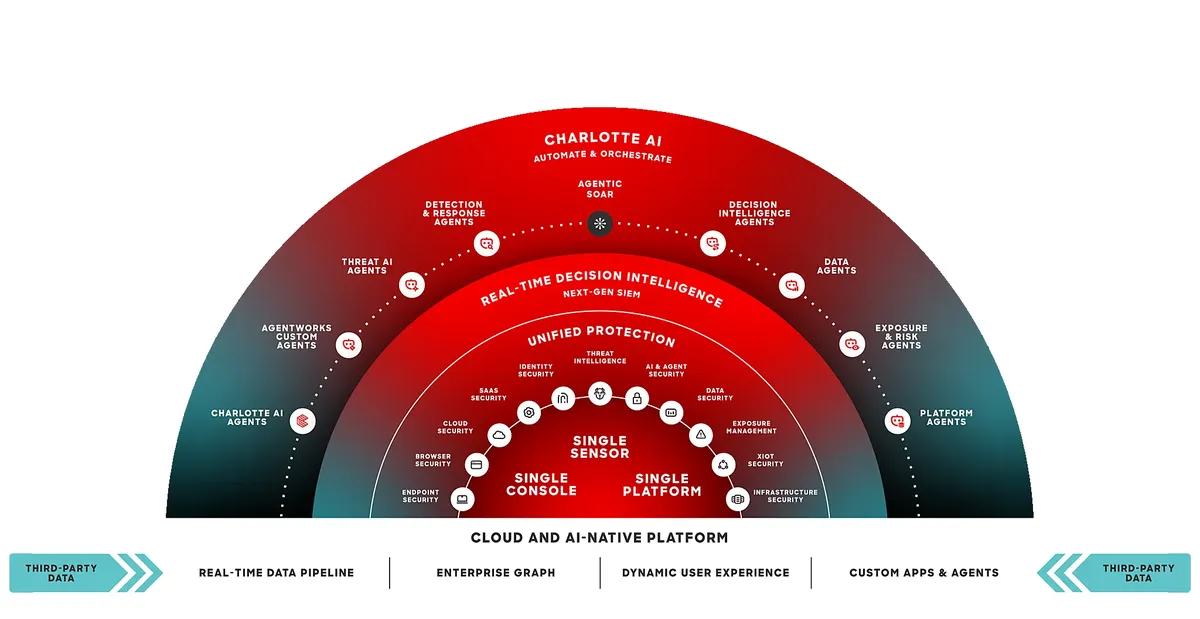
CrowdStrike Falcon: product and architecture
CrowdStrike Falcon has established itself as a dominant force in enterprise cybersecurity, and this CrowdStrike Falcon review breaks down exactly why. Built as an AI-native platform, Falcon consolidates endpoint protection, cloud security, identity protection, and threat intelligence under a single-agent architecture. We have evaluated the platform across real-world deployment scenarios, examining its ability to stop AI-accelerated adversaries, secure modern cloud workloads, and transform security operations center workflows. Here is what security teams need to know before committing to the Falcon ecosystem.
Overview
CrowdStrike describes the Falcon Platform as “one unified platform to secure the agentic enterprise.” It combines security data, AI intelligence, automation, and expert services to help organizations stop breaches.
The platform uses a single lightweight sensor to collect high-fidelity telemetry across domains and enriches it with adversary intelligence. CrowdStrike says this unified data foundation supports AI-driven, real-time protection.
Falcon is positioned to secure AI adoption and autonomous agents across endpoint, SaaS, and cloud, with capabilities for agent discovery, access controls, and runtime threat protection. CrowdStrike also offers Managed Detection and Response, proactive threat hunting, and specialized security services backed by the Falcon platform and real-time intelligence.
Key Features and Architecture
Falcon's architecture centers on a single-agent model that deploys across endpoints, cloud workloads, and identity infrastructure without requiring multiple installations or agents competing for system resources. This lightweight design is critical for organizations that cannot tolerate performance degradation on production systems.
AI-Native Threat Detection and Response The platform uses AI at its core to detect and respond to threats in real time. This is not a bolted-on machine learning layer — the entire detection pipeline is built around AI-driven analysis. Falcon stops AI-accelerated adversaries by matching their speed with automated detection and response capabilities. The AI engine correlates signals across endpoints, cloud workloads, and identity systems simultaneously, surfacing threats that would be invisible to tools examining each domain in isolation.
Charlotte AI and AgentWorks Ecosystem CrowdStrike introduced the Charlotte AI AgentWorks ecosystem for building secure agents. Charlotte AI accelerates SOC transformation by automating analyst workflows, triaging alerts, and providing natural language interaction with security data. Analysts can query the system conversationally rather than writing complex queries, which dramatically reduces investigation time. The AgentWorks ecosystem extends this by enabling organizations to build and deploy secure AI agents within the Falcon platform, creating a foundation for agentic security operations.
Falcon Next-Gen SIEM The Next-Gen SIEM for Defender transforms existing SOC operations without requiring a rip-and-replace migration. Security teams can layer Falcon's advanced analytics and correlation on top of their current infrastructure, dramatically reducing the barrier to adoption. This is a pragmatic approach that acknowledges most enterprises cannot abandon their existing SIEM investments overnight but still need modern detection capabilities.
Secure AI Capabilities Falcon provides shadow AI and agent visibility, governance, and threat detection capabilities. As organizations deploy AI tools internally, Falcon identifies unauthorized AI usage across the enterprise, governs approved AI deployments with policy enforcement, and detects threats specifically targeting AI infrastructure. This feature set addresses one of the fastest-growing risk categories in enterprise security.
Cloud and Identity Protection The unified platform extends across cloud workloads and identity systems, providing consistent policy enforcement and threat detection regardless of where assets reside — on-premises, in public cloud, or in hybrid environments. Identity-based attacks have become a primary vector for breaches, and Falcon's ability to monitor identity infrastructure alongside endpoints closes a gap that many competing platforms leave open.
Ideal Use Cases
CrowdStrike Falcon is purpose-built for mid-size to large enterprises that face sophisticated, persistent threats and need to consolidate their security stack. Organizations running complex hybrid and multi-cloud environments benefit most from Falcon's unified agent architecture, which eliminates the overhead of managing disparate security tools across different infrastructure boundaries.
Security teams looking to accelerate their SOC transformation will find Falcon's Charlotte AI and Next-Gen SIEM capabilities particularly valuable. The platform suits organizations that want to reduce mean time to detect and respond without hiring additional analysts — a practical consideration given the persistent cybersecurity talent shortage.
Companies deploying AI agents and large language models internally should consider Falcon for its shadow AI governance capabilities. Organizations in regulated industries that must demonstrate consistent security controls across their entire technology stack will also benefit from the platform's unified reporting and policy enforcement. Any enterprise that recognizes that siloed security tools create more risk than they mitigate is a strong candidate for the Falcon platform.
Pros and Cons
Pros:
- Single-agent architecture eliminates multi-tool complexity and reduces resource contention on endpoints, meaning less performance impact on production systems
- AI-native detection pipeline keeps pace with AI-accelerated attack techniques by correlating signals across endpoints, cloud, and identity simultaneously
- Charlotte AI and Next-Gen SIEM accelerate SOC operations and reduce analyst workload without requiring a rip-and-replace migration from existing tools
- Shadow AI governance addresses a critical emerging security gap as organizations adopt AI tools and agents across the enterprise
- 15-day free trial available for hands-on evaluation against real production workloads before any financial commitment
- Recognized by major industry analysts and deployed across a wide mix of industries, providing confidence in platform maturity
Cons:
- Enterprise pricing with no transparent public rates makes initial budgeting and comparison shopping difficult for procurement teams
- Full platform value requires broad adoption across endpoints, cloud, and identity — partial deployments limit the correlation and consolidation benefits
- Organizations with compact environments or simpler security requirements may find the platform oversized for their actual needs
- Vendor lock-in risk increases as more security functions consolidate onto a single platform, making future migration more complex