Decision comparison
CrowdStrike Falcon vs Snyk
CrowdStrike Falcon and Snyk address fundamentally different phases of the security lifecycle. CrowdStrike Falcon excels at protecting production environments through endpoint detection and response, cloud workload protection, and identity security with AI-driven threat analysis. Snyk excels at securing the software supply chain by scanning code, dependencies, containers, and infrastructure-as-code during development. Most mature security programs need both capabilities, making these tools complementary rather than competitive. The choice depends on whether your immediate priority is defending running systems or preventing vulnerabilities from reaching production.
Used together. These are normally used together rather than chosen between. The comparison explains what each one does in the stack.
These are different kinds of product — Endpoint Security and Code Security.
Quick Comparison
| Decision factor | CrowdStrike Falcon | Snyk |
|---|---|---|
| Best For | Endpoint protection, threat detection, and incident response across the full attack surface with a single-agent architecture | Securing the software development lifecycle by finding and fixing vulnerabilities in code, dependencies, containers, and IaC |
| Security Focus | Runtime protection of endpoints, cloud workloads, and identities against active threats, breaches, and adversary intrusions | Shift-left application security scanning including SCA, SAST, container scanning, and IaC testing during development |
| Pricing Model | Falcon Go is $7.99 per device billed monthly, or $59.99 per device billed annually. Falcon Pro is $14.99 monthly or $99.99 annually. Falcon Enterprise is $19.99 monthly or $184.99 annually. All three are bought directly from the pricing page. A 15-day Falcon free trial needs no credit card. Larger deployments are quoted. | Free: up to 200 open-source tests/month, 100 container tests/month, 300 IaC tests/month. Team: $25/developer/month (billed annually), unlimited tests, Jira integration, fix PRs. Enterprise: custom pricing, SSO, RBAC, custom policies, SLA. |
| Deployment Approach | Lightweight single-agent deployed on endpoints and cloud workloads; cloud-native platform with centralized management console | Developer-first platform integrated into IDEs, CI/CD pipelines, and source control repositories for inline scanning |
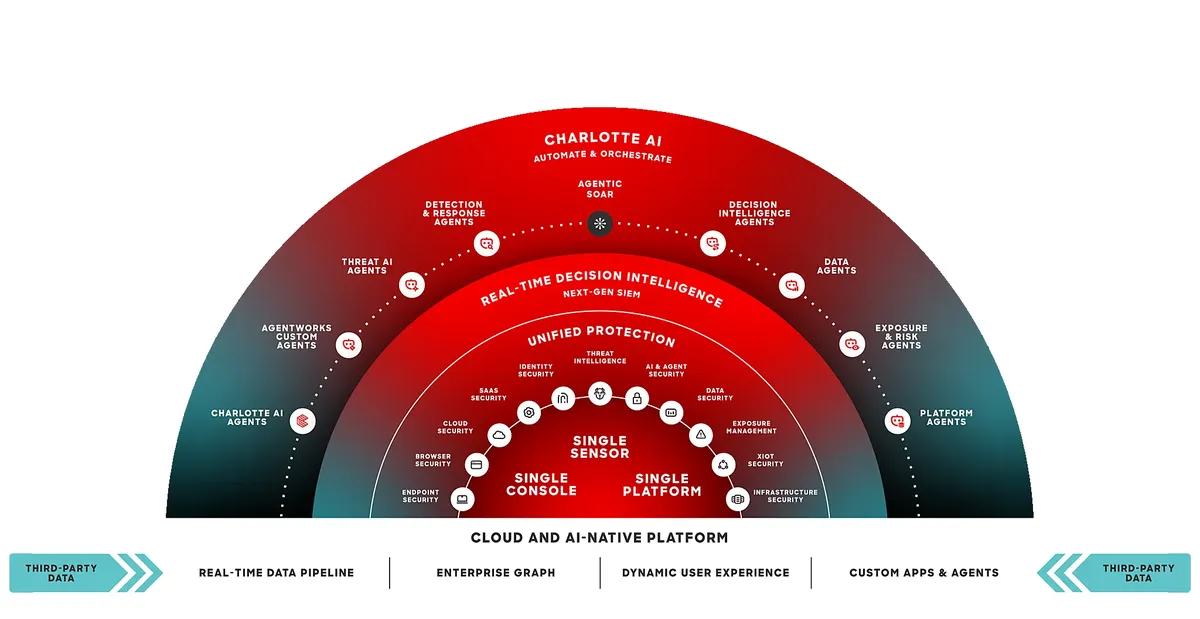
| AI Capabilities | Charlotte AI for agentic SOC transformation; AI-native threat detection that identifies adversary behavior in real time | AI Security Fabric with autonomous defense architecture; AI-powered one-click fixes and Evo agentic security orchestrator |
| Target User | Security operations teams, SOC analysts, and CISOs managing endpoint fleets, cloud infrastructure, and identity protection | Developers, DevSecOps engineers, and application security teams building and shipping software at scale |
CrowdStrike Falcon
- Best For:
- Endpoint protection, threat detection, and incident response across the full attack surface with a single-agent architecture
- Security Focus:
- Runtime protection of endpoints, cloud workloads, and identities against active threats, breaches, and adversary intrusions
- Pricing Model:
- Falcon Go is $7.99 per device billed monthly, or $59.99 per device billed annually. Falcon Pro is $14.99 monthly or $99.99 annually. Falcon Enterprise is $19.99 monthly or $184.99 annually. All three are bought directly from the pricing page. A 15-day Falcon free trial needs no credit card. Larger deployments are quoted.
- Deployment Approach:
- Lightweight single-agent deployed on endpoints and cloud workloads; cloud-native platform with centralized management console
- AI Capabilities:
- Charlotte AI for agentic SOC transformation; AI-native threat detection that identifies adversary behavior in real time
- Target User:
- Security operations teams, SOC analysts, and CISOs managing endpoint fleets, cloud infrastructure, and identity protection
Snyk
- Best For:
- Securing the software development lifecycle by finding and fixing vulnerabilities in code, dependencies, containers, and IaC
- Security Focus:
- Shift-left application security scanning including SCA, SAST, container scanning, and IaC testing during development
- Pricing Model:
- Free: up to 200 open-source tests/month, 100 container tests/month, 300 IaC tests/month. Team: $25/developer/month (billed annually), unlimited tests, Jira integration, fix PRs. Enterprise: custom pricing, SSO, RBAC, custom policies, SLA.
- Deployment Approach:
- Developer-first platform integrated into IDEs, CI/CD pipelines, and source control repositories for inline scanning
- AI Capabilities:
- AI Security Fabric with autonomous defense architecture; AI-powered one-click fixes and Evo agentic security orchestrator
- Target User:
- Developers, DevSecOps engineers, and application security teams building and shipping software at scale
Public signals
Verified factual signals only. Bars appear only for like-for-like metrics with five weekly assessments for every tool; missing evidence stays explicit. These signals do not establish enterprise adoption, product quality, or total cost.
| Metric | CrowdStrike Falcon | Snyk |
|---|---|---|
| GitHub commits, 90d(Developer adoption) | 211 | 526 |
| GitHub stars(Developer adoption) | 513 | 5,500+ |
| Hacker News mentions, 90d(Community interest) | 1 | 6 |
| PyPI weekly downloads(Developer adoption) | 398.0k | Not available |
| Docker Hub pulls(Product adoption) | Not available | 45.7M |
| npm weekly downloads(Product adoption) | Not available | 515.7k |
| Stack Overflow questions(Community interest) | Not available | 105 |
As of September 14, 2026 — updated weekly.
Health & risk evidence
Observed public-source checks for mapped package versions and repositories.
CrowdStrike Falcon
September 14, 2026Package vulnerabilities
PyPI · crowdstrike-falconpy@1.6.5
0 vulnerabilities
across 1 package
Repository security score
Not available
Snyk
September 14, 2026Package vulnerabilities
npm · snyk@1.1307.2
0 vulnerabilities
across 1 package
Repository security score
Not available
Interface Preview
CrowdStrike Falcon
Snyk
Feature Comparison
| Feature | CrowdStrike Falcon | Snyk |
|---|---|---|
| Threat Detection & Prevention | ||
| Endpoint Protection | Industry-leading EDR with real-time behavioral analysis, next-gen antivirus, and automated threat containment on endpoints | Not an endpoint security tool; focuses on securing application code and dependencies before they reach production |
| Vulnerability Scanning | Vulnerability assessment for deployed workloads and endpoints; identifies unpatched software and configuration weaknesses | Deep vulnerability scanning across open-source dependencies, proprietary code, container images, and infrastructure-as-code templates |
| Real-Time Threat Response | Sub-second threat detection with automated containment, quarantine, and remediation driven by AI-native analysis | Continuous monitoring of deployed applications for new vulnerability disclosures; alerts developers when new CVEs affect their code |
| Application Security | ||
| Code Analysis (SAST) | Application security capabilities through acquired technologies; not the platform's primary strength compared to endpoint protection | Native SAST engine that scans proprietary code for security flaws directly in the IDE and pull request workflow |
| Open-Source Dependency Scanning (SCA) | Limited native SCA capabilities; relies on partner integrations for comprehensive software composition analysis | Industry-leading SCA with curated vulnerability database, license compliance checking, and automated fix pull requests |
| Container Security | Runtime container protection monitoring active workloads, detecting threats inside running containers and Kubernetes clusters | Pre-deployment container image scanning with 100 free tests per month; identifies vulnerabilities in base images and packages |
| AI & Automation | ||
| AI-Powered Analysis | Charlotte AI delivers natural language threat investigation and automated triage, transforming SOC analyst productivity | AI Security Fabric weaves autonomous defense into every code creation; AI-powered fix suggestions reduce manual remediation |
| Automated Remediation | Automated endpoint isolation, malware quarantine, and system restoration without requiring manual analyst intervention | One-click AI-powered fix pull requests that patch vulnerable dependencies directly in the developer's repository |
| AI Code Security | Secure AI platform with shadow AI visibility and governance for AI agents deployed across the enterprise | Purpose-built to secure AI-generated code at inception; embedded directly into AI coding assistants to catch issues inline |
| Developer & Operations Integration | ||
| CI/CD Pipeline Integration | API-driven integrations with SIEM and SOAR platforms; focused on security operations rather than development pipelines | Native integrations with GitHub, GitLab, Bitbucket, Jenkins, and all major CI/CD platforms for automated scanning |
| IDE Support | Not designed for IDE integration; operates at the endpoint and cloud infrastructure layer rather than the code editor | Plugins for VS Code, IntelliJ, and other major IDEs providing real-time vulnerability feedback as developers write code |
| Jira & Issue Tracking | Security alerts can be forwarded to ticketing systems through SIEM integrations and API-based workflows | Native Jira integration on Team plan and above; automatically creates tickets for vulnerabilities with remediation guidance |
| Cloud & Infrastructure Security | ||
| Cloud Workload Protection | Full cloud workload protection platform covering AWS, Azure, and GCP with runtime visibility and threat detection | Infrastructure-as-code scanning with 300 free IaC tests per month; catches misconfigurations before cloud deployment |
| Identity Protection | Dedicated identity protection module detecting credential theft, lateral movement, and identity-based attack techniques | Enterprise plan includes SSO and RBAC for platform access; not focused on broader identity threat detection |
| SIEM & SOC Integration | Falcon Next-Gen SIEM transforms SOC operations with unified threat data, automated correlation, and response playbooks | Feeds vulnerability data into existing security dashboards; designed to complement rather than replace SIEM platforms |
Threat Detection & Prevention
Endpoint Protection
Vulnerability Scanning
Real-Time Threat Response
Application Security
Code Analysis (SAST)
Open-Source Dependency Scanning (SCA)
Container Security
AI & Automation
AI-Powered Analysis
Automated Remediation
AI Code Security
Developer & Operations Integration
CI/CD Pipeline Integration
IDE Support
Jira & Issue Tracking
Cloud & Infrastructure Security
Cloud Workload Protection
Identity Protection
SIEM & SOC Integration
How they fit together
CrowdStrike Falcon and Snyk address fundamentally different phases of the security lifecycle. CrowdStrike Falcon excels at protecting production environments through endpoint detection and response, cloud workload protection, and identity security with AI-driven threat analysis. Snyk excels at securing the software supply chain by scanning code, dependencies, containers, and infrastructure-as-code during development. Most mature security programs need both capabilities, making these tools complementary rather than competitive. The choice depends on whether your immediate priority is defending running systems or preventing vulnerabilities from reaching production.
What each one handles
Use CrowdStrike Falcon for:
Choose CrowdStrike Falcon when your primary security challenge is protecting live endpoints, cloud workloads, and identities from active threats. Falcon is the right choice for organizations that need to detect and respond to breaches in real time, manage a large fleet of endpoints across multiple operating systems, or consolidate fragmented security tools into a single-agent platform. Its Charlotte AI capabilities make it particularly valuable for SOC teams overwhelmed by alert volume who need AI-assisted triage and investigation. Falcon also stands out for organizations facing sophisticated adversaries, as its threat intelligence feeds from CrowdStrike's extensive global visibility into adversary tactics provide context that pure-play tools cannot match.
Use Snyk for:
Choose Snyk when your primary security challenge is preventing vulnerabilities from entering production in the first place. Snyk is the right choice for development teams shipping code at high velocity, particularly those using AI coding assistants where 48% of generated code may contain security flaws. Its developer-first approach with IDE plugins, automated fix pull requests, and native CI/CD integration means security happens during development rather than after deployment. The free tier with 200 open-source tests per month makes Snyk accessible for evaluation, and the Team plan at $25 per developer per month provides a clear cost structure. Snyk is especially compelling for organizations adopting DevSecOps practices who want to empower developers to own security without slowing down delivery.
These roles reflect the available product evidence. Most teams run both; which one owns a given job depends on your stack and team.
Frequently Asked Questions
Can CrowdStrike Falcon and Snyk be used together effectively?
Yes, CrowdStrike Falcon and Snyk are highly complementary and many enterprise security programs deploy both. Snyk secures the left side of the development lifecycle by catching vulnerabilities in code, open-source dependencies, container images, and infrastructure-as-code before deployment. CrowdStrike Falcon then protects the right side by monitoring running endpoints, cloud workloads, and identities for active threats that made it past development-time controls. Together they create defense-in-depth coverage spanning from the developer's IDE through to the production runtime. Organizations with mature security postures often integrate both tools into their security data pipeline, with Snyk feeding vulnerability data into the same dashboards where Falcon surfaces runtime threats.
Which tool provides better value for a small or mid-size team with limited budget?
Snyk offers a significantly lower barrier to entry with its free tier that includes 200 open-source tests per month, 100 container tests, and 300 IaC tests at no cost. The Team plan starts at $25 per developer per month, making costs predictable and manageable. CrowdStrike Falcon uses enterprise pricing that typically requires contacting sales for a custom quote, though it does offer a 15-day free trial. For small teams that are primarily shipping software and need to prevent vulnerabilities from reaching production, Snyk's free tier provides immediate value. For small teams managing servers or endpoints that face active threat exposure, CrowdStrike Falcon's consolidated platform can reduce overall security tool spending despite higher per-unit costs.
How do CrowdStrike Falcon and Snyk differ in their approach to AI and automation?
Both platforms have invested heavily in AI but apply it to different security problems. CrowdStrike Falcon's Charlotte AI serves as an AI assistant for security operations, enabling natural language threat investigation, automated alert triage, and what CrowdStrike calls agentic SOC transformation. Its AI analyzes runtime telemetry to detect adversary behaviors that signature-based tools would miss. Snyk's AI Security Fabric takes a different approach, embedding autonomous defense directly into the code creation process. Snyk's Evo agentic security orchestrator provides runtime protection for AI-native applications, while its AI-powered fix suggestions generate remediation code that developers can apply with a single click. In practical terms, CrowdStrike uses AI to help security analysts respond faster, while Snyk uses AI to help developers write more secure code from the start.
What types of vulnerabilities does each platform detect that the other cannot?
CrowdStrike Falcon detects runtime threats that are invisible to pre-deployment scanning, including zero-day exploits targeting running software, credential theft through identity attacks, lateral movement across networks, fileless malware executing in memory, and sophisticated adversary techniques that evade traditional defenses. Snyk detects code-level vulnerabilities that are invisible to runtime monitoring, including insecure coding patterns in proprietary source code, known CVEs in open-source dependencies, misconfigurations in Terraform and CloudFormation templates, vulnerable base images in container builds, and license compliance violations in the software supply chain. Neither tool can fully replace the other because they operate at different layers of the technology stack and address threats at different stages of the application lifecycle.