Decision comparison
Orca Security vs Snyk
Orca Security and Snyk serve fundamentally different security needs. Orca delivers a unified cloud-native application protection platform (CNAPP) built for security teams managing complex multi-cloud environments, while Snyk provides a developer-first application security platform that embeds directly into development workflows. Organizations with large cloud footprints and dedicated security operations teams benefit most from Orca, whereas development-led organizations that prioritize shifting security left into the coding process get more value from Snyk.
Used together. These are normally used together rather than chosen between. The comparison explains what each one does in the stack.
These are different kinds of product — Cloud Security Platform and Code Security.
Quick Comparison
| Decision factor | Orca Security | Snyk |
|---|---|---|
| Best For | Enterprise cloud security teams needing unified CNAPP | Developer-first application security across the SDLC |
| Pricing Model | Enterprise-only pricing, custom quotes based on cloud workload count. No free tier or self-service plans. Orca publishes no rate: orca.security/pricing is a 404 and every contract is quoted. | Free: up to 200 open-source tests/month, 100 container tests/month, 300 IaC tests/month. Team: $25/developer/month (billed annually), unlimited tests, Jira integration, fix PRs. Enterprise: custom pricing, SSO, RBAC, custom policies, SLA. |
| Starting Price | $36,000/year | $0 (Free), $25/dev/month (Team) |
| Deployment | Agentless SaaS with optional eBPF sensor | SaaS with CLI and IDE integrations |
| Free Tier | No | Yes — 200 open-source tests/month |
| Core Approach | Agentless SideScanning with Unified Data Model | AI-native developer security platform |
Orca Security
- Best For:
- Enterprise cloud security teams needing unified CNAPP
- Pricing Model:
- Enterprise-only pricing, custom quotes based on cloud workload count. No free tier or self-service plans. Orca publishes no rate: orca.security/pricing is a 404 and every contract is quoted.
- Starting Price:
- $36,000/year
- Deployment:
- Agentless SaaS with optional eBPF sensor
- Free Tier:
- No
- Core Approach:
- Agentless SideScanning with Unified Data Model
Snyk
- Best For:
- Developer-first application security across the SDLC
- Pricing Model:
- Free: up to 200 open-source tests/month, 100 container tests/month, 300 IaC tests/month. Team: $25/developer/month (billed annually), unlimited tests, Jira integration, fix PRs. Enterprise: custom pricing, SSO, RBAC, custom policies, SLA.
- Starting Price:
- $0 (Free), $25/dev/month (Team)
- Deployment:
- SaaS with CLI and IDE integrations
- Free Tier:
- Yes — 200 open-source tests/month
- Core Approach:
- AI-native developer security platform
Public signals
Verified factual signals only. Bars appear only for like-for-like metrics with five weekly assessments for every tool; missing evidence stays explicit. These signals do not establish enterprise adoption, product quality, or total cost.
| Metric | Orca Security | Snyk |
|---|---|---|
| GitHub commits, 90d(Developer adoption) | 0 | 526 |
| GitHub stars(Developer adoption) | 14 | 5,500+ |
| Search interest(Market interest) | 0 | Not available |
| Hacker News mentions, 90d(Community interest) | 0 | 6 |
| Docker Hub pulls(Product adoption) | Not available | 45.7M |
| npm weekly downloads(Product adoption) | Not available | 515.7k |
| Stack Overflow questions(Community interest) | Not available | 105 |
As of September 14, 2026 — updated weekly.
Health & risk evidence
Observed public-source checks for mapped package versions and repositories.
Orca Security
Package vulnerabilities
Not available
Repository security score
Not available
Snyk
September 14, 2026Package vulnerabilities
npm · snyk@1.1307.2
0 vulnerabilities
across 1 package
Repository security score
Not available
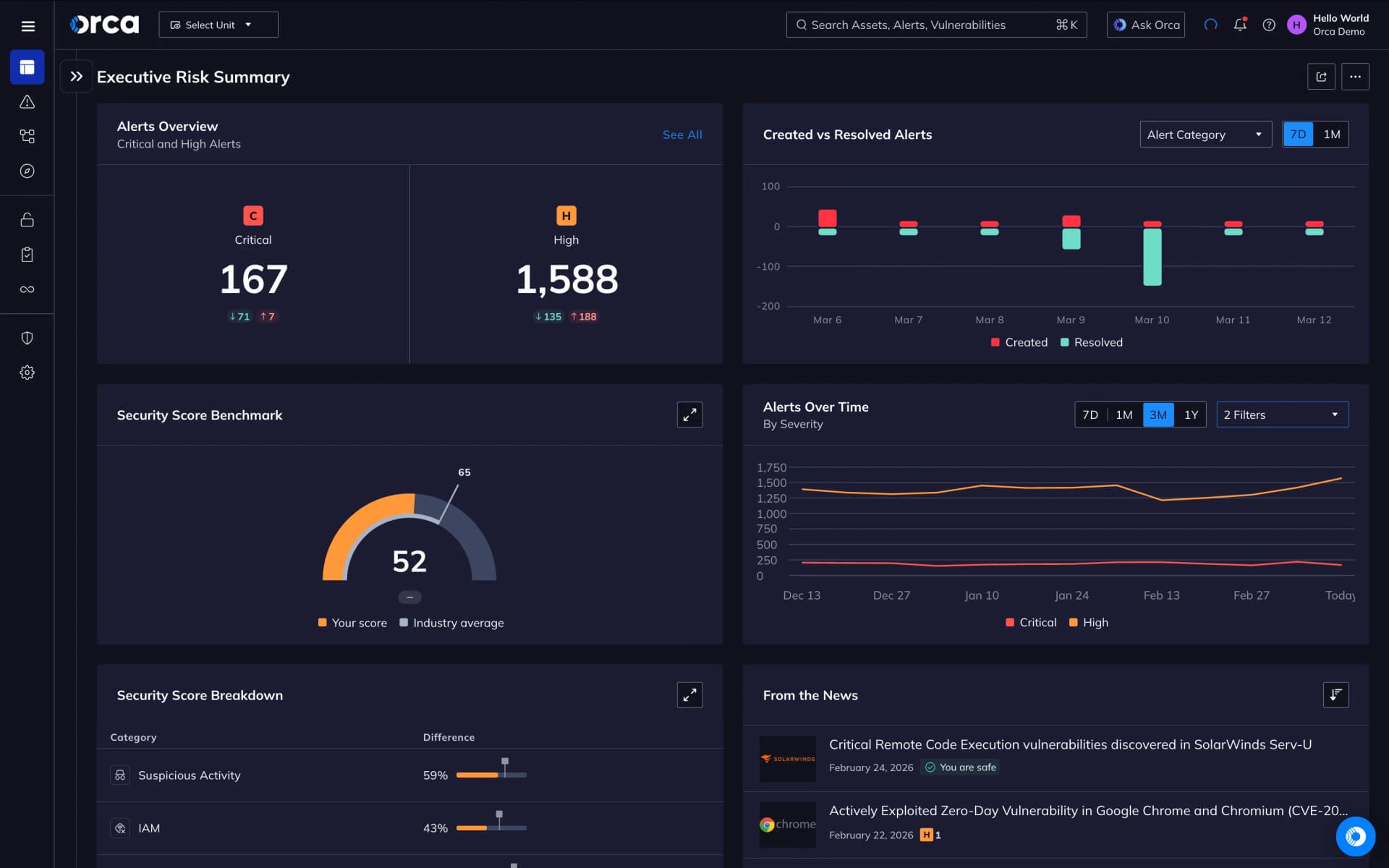
Interface Preview
Orca Security
Snyk
Feature Comparison
| Feature | Orca Security | Snyk |
|---|---|---|
| Scanning Capabilities | ||
| Open-Source Dependency Scanning (SCA) | Supported via integrated SCA engine | Industry-leading SCA with deep dependency tree analysis |
| Static Application Security Testing (SAST) | Built-in SAST across CI/CD pipelines | Native SAST with AI-assisted triage |
| Container Image Scanning | Agentless container scanning via SideScanning | 100 container tests/month on free tier, unlimited on paid |
| Infrastructure as Code (IaC) Scanning | Full IaC scanning with misconfiguration detection | 300 IaC tests/month on free tier, unlimited on paid |
| Secrets Detection | Integrated secrets scanning across cloud workloads | Built-in secrets detection in code repositories |
| Cloud Security | ||
| Cloud Security Posture Management (CSPM) | Full CSPM with 200+ compliance frameworks | Limited — focused on application layer rather than cloud posture |
| Cloud Workload Protection (CWPP) | Comprehensive CWPP with real-time eBPF sensor | Not a core capability |
| Runtime Protection | Real-time detection via Orca Sensor (eBPF-based) | Runtime monitoring for vulnerability prioritization |
| Attack Path Analysis | Advanced attack path visualization with crown jewel mapping | Not verified |
| Multi-Cloud Support | AWS, Azure, GCP, Alibaba Cloud, Oracle Cloud | Cloud-agnostic — integrates with any cloud via code scanning |
| Developer Experience | ||
| CI/CD Integration | CI/CD pipeline scanning with shift-left capabilities | Deep CI/CD integration with automated fix PRs |
| IDE Plugins | Limited IDE integration | VS Code, IntelliJ, Eclipse, and other major IDEs |
| Automated Fix Pull Requests | AI-driven one-click PR generation | Automated fix PRs with dependency upgrade recommendations |
| Developer Onboarding | Security team-driven; developers access via integrations | Self-service signup, instant scanning in under 5 minutes |
| AI and Intelligence | ||
| AI-Powered Triage | AI agents for analysis and remediation plans | AppSec Triage Agent for false positive reduction |
| AI-Generated Code Security | Scans AI-generated code as part of workload analysis | Dedicated AI Security Fabric for AI-generated code governance |
| Reachability Analysis | Three types: agentless, dynamic, and code-level reachability | Reachability analysis for prioritizing exploitable vulnerabilities |
Scanning Capabilities
Open-Source Dependency Scanning (SCA)
Static Application Security Testing (SAST)
Container Image Scanning
Infrastructure as Code (IaC) Scanning
Secrets Detection
Cloud Security
Cloud Security Posture Management (CSPM)
Cloud Workload Protection (CWPP)
Runtime Protection
Attack Path Analysis
Multi-Cloud Support
Developer Experience
CI/CD Integration
IDE Plugins
Automated Fix Pull Requests
Developer Onboarding
AI and Intelligence
AI-Powered Triage
AI-Generated Code Security
Reachability Analysis
How they fit together
Orca Security and Snyk serve fundamentally different security needs. Orca delivers a unified cloud-native application protection platform (CNAPP) built for security teams managing complex multi-cloud environments, while Snyk provides a developer-first application security platform that embeds directly into development workflows. Organizations with large cloud footprints and dedicated security operations teams benefit most from Orca, whereas development-led organizations that prioritize shifting security left into the coding process get more value from Snyk.
What each one handles
Use Orca Security for:
Choose Orca Security when your organization runs large multi-cloud environments across AWS, Azure, and GCP and needs a single CNAPP that covers CSPM, CWPP, runtime protection, and attack path analysis. Orca is the stronger choice for enterprise security teams that require deep cloud infrastructure visibility, compliance automation across 200+ frameworks, and agentless deployment that delivers full coverage within 24 hours.
Use Snyk for:
Choose Snyk when your priority is embedding security directly into developer workflows with minimal friction. Snyk excels for organizations that want a free tier to get started, per-developer pricing transparency, and deep IDE and CI/CD integration. It is the better fit for application security programs driven by development teams rather than centralized security operations.
These roles reflect the available product evidence. Most teams run both; which one owns a given job depends on your stack and team.
Frequently Asked Questions
Can Orca Security and Snyk be used together?
Yes, many enterprises deploy both tools in complementary roles. Orca Security handles cloud infrastructure security including CSPM, CWPP, and runtime protection, while Snyk covers application-layer security with SCA, SAST, and container scanning embedded in developer workflows. This combination provides defense-in-depth across both infrastructure and application layers.
Which tool is better for securing AI-generated code?
Snyk has a more focused offering for AI-generated code security through its AI Security Fabric, which provides autonomous defense specifically designed for AI-generated and AI-native applications. Orca Security scans AI models and AI-related workloads as part of its broader cloud security platform. For teams shipping large volumes of AI-generated code, Snyk provides more targeted protection at the code level.
How do Orca Security and Snyk differ in deployment complexity?
Orca Security uses agentless SideScanning technology that reads cloud workload data without installing agents, achieving full visibility within 24 hours of connecting cloud accounts. Snyk is even simpler for developers — a free account can be created and scanning started within minutes through CLI, IDE plugins, or repository integrations. Orca requires cloud account-level access, while Snyk operates at the code repository level.
What is the total cost difference between Orca Security and Snyk?
The cost structures are fundamentally different. Orca Security uses enterprise-only pricing with custom quotes, typically starting at $36,000-$60,000 per year depending on cloud asset count. Snyk offers a free tier with 200 open-source tests per month, a Team plan at $25 per developer per month billed annually, and a custom-priced Enterprise tier. For small teams, Snyk can cost nothing; for large enterprises, both tools require custom negotiations.
Which tool provides better compliance reporting?
Orca Security provides significantly more comprehensive compliance capabilities with support for over 200 customizable compliance frameworks, automated report exporting, and continuous compliance monitoring across cloud infrastructure. Snyk focuses on application-level compliance, helping organizations demonstrate that their open-source dependencies and code pipelines meet security standards. For cloud infrastructure compliance (SOC 2, HIPAA, PCI DSS), Orca is the stronger choice.