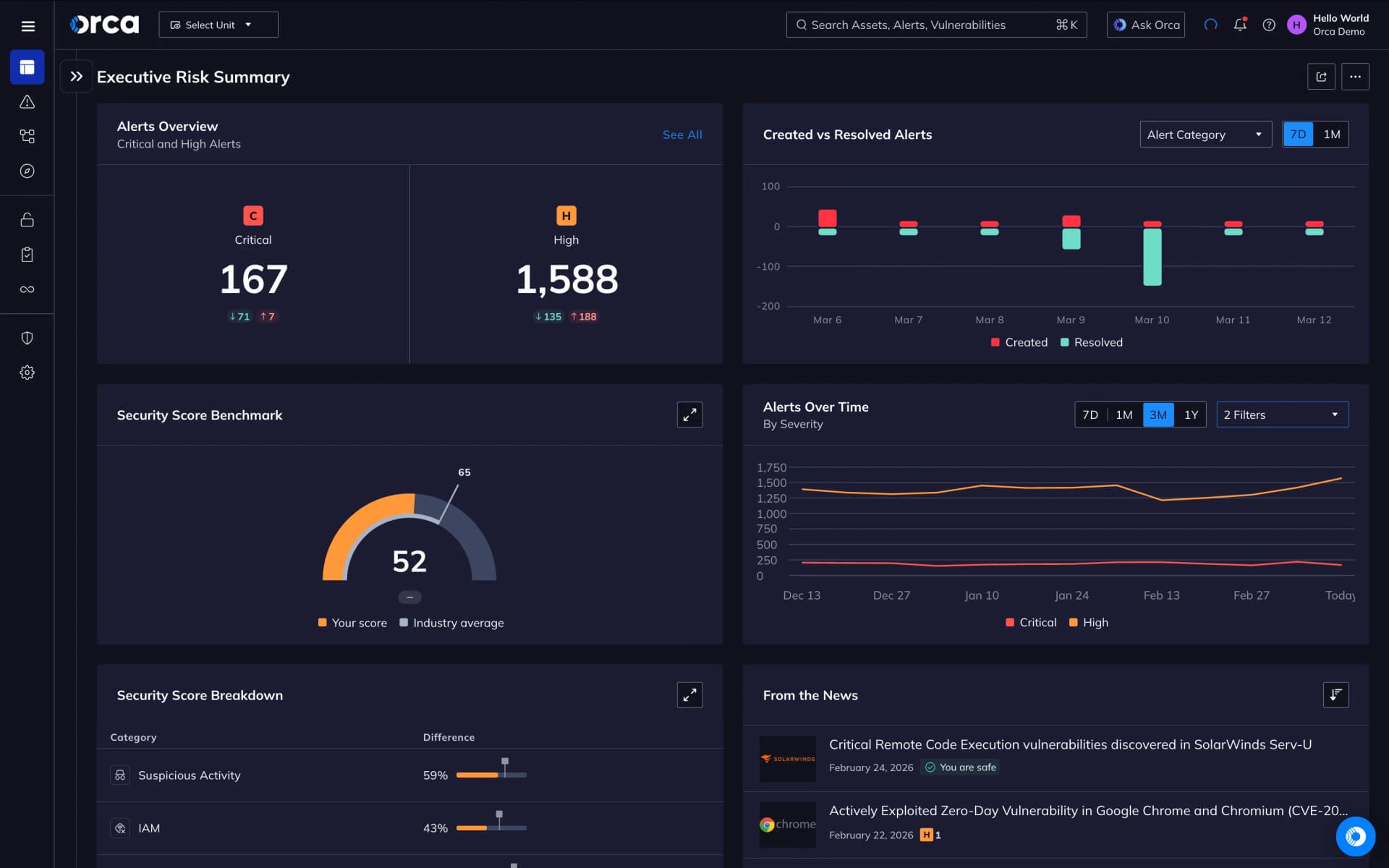
Orca Security: product and architecture
This Orca Security review covers one of the most established cloud-native application protection platforms (CNAPPs) on the market today. Orca Security delivers agentless, full-stack cloud security that scans workloads, configurations, identities, and data risks across AWS, Azure, and Google Cloud without deploying a single agent. The platform is built around its patented SideScanning technology, which reads cloud workload runtime block storage out-of-band to achieve deep visibility without performance impact. For security teams managing complex multi-cloud environments, Orca offers a consolidated platform that replaces six or more legacy point solutions. The company is recognized in the 2025 Gartner Market Guide for CNAPP and is rated highly across major peer review platforms, with scores of 4.6 to 4.8.
Overview
Orca Security is an enterprise-grade CNAPP that provides comprehensive cloud security coverage from build time through runtime. The platform combines cloud security posture management (CSPM), cloud workload protection (CWPP), vulnerability management, identity and access management security, API security, data security posture management (DSPM), and shift-left developer security into a single unified console. Orca's core differentiator is its agentless architecture: rather than requiring agents installed on every workload, the platform uses its patented SideScanning technology to read workload data directly from cloud provider APIs and storage snapshots. This means full visibility into operating systems, applications, containers, serverless functions, and AI models without any runtime overhead or deployment friction. The platform's Unified Data Model aggregates all collected telemetry into a single graph that maps relationships between cloud resources, identities, network paths, and vulnerabilities. This enables Orca to identify and prioritize the riskiest attack paths to critical assets rather than presenting teams with thousands of isolated, context-free alerts.
Key Features and Architecture
Orca Security's architecture is anchored by several core capabilities that set it apart from traditional cloud security tools.
SideScanning Technology. Orca's patented SideScanning reads the runtime block storage of cloud workloads out-of-band, meaning it captures a full snapshot of the operating system, installed packages, application dependencies, and running processes without deploying any agent. This eliminates the operational burden of agent lifecycle management and avoids any performance impact on production workloads. SideScanning covers VMs, containers, Kubernetes clusters, serverless functions, and managed services.
Cloud Security Posture Management (CSPM). The platform continuously monitors cloud configurations across all three major cloud providers, checking for misconfigurations, overly permissive network rules, unencrypted storage, and deviations from security baselines. Orca checks against over 200 customizable compliance frameworks including SOC 2, PCI DSS, HIPAA, NIST, CIS Benchmarks, and ISO 27001, with automated report exporting.
Vulnerability Management with Reachability Analysis. Orca goes beyond standard CVE scanning by offering three types of reachability analysis: agentless reachability analysis for container-level insight, dynamic reachability analysis that confirms runtime access paths, and code reachability analysis that assesses function-level exploitability. This approach eliminates up to 90% of alert noise by deprioritizing vulnerabilities that exist but cannot actually be reached by an attacker.
Identity and Access Security. The platform maps IAM policies, roles, and permissions across cloud accounts to identify excessive privileges, dormant accounts, and lateral movement paths that attackers could exploit.
API Security. Orca discovers and inventories APIs across cloud environments, identifying shadow APIs, misconfigured endpoints, and data exposure risks.
Orca Sensor for Real-Time Detection. For organizations that need runtime detection and response, Orca offers an optional lightweight eBPF-based sensor that detects fileless attacks, zero-day exploits, and suspicious runtime behavior in real time. This supplements the agentless scanning with continuous runtime visibility.
AI Security. The platform includes AI-powered agents for AppSec triage, AI-generated code fixes, and natural language querying of your cloud environment. Orca also scans for risks in deployed AI models and LLM pipelines.
Developer Integration. Orca integrates into CI/CD pipelines to scan code, container images, and infrastructure-as-code templates before deployment. It traces production risks back to the exact line of source code and developer who committed it, and can generate one-click pull requests with AI-driven fixes.
Ideal Use Cases
Orca Security is built for specific organizational profiles and cloud security challenges.
Multi-cloud enterprises. Organizations running workloads across AWS, Azure, and Google Cloud that need a single pane of glass for security visibility and posture management. Orca's agentless approach means you get consistent coverage across all three providers without managing separate agent deployments per cloud.
Compliance-driven industries. Financial services, healthcare, and SaaS companies that must demonstrate continuous compliance with SOC 2, PCI DSS, HIPAA, or similar frameworks. Orca's 200+ built-in compliance frameworks and automated report generation reduce audit preparation time significantly.
Security teams consolidating toolchains. Teams that are spending budget and operational cycles maintaining separate CSPM, CWPP, SAST, SCA, container scanning, and secrets detection tools. Orca replaces six or more of these point solutions with a single platform, delivering reported annual operating savings of $1.5 million for representative enterprises.
Cloud-native organizations with large container footprints. Companies running thousands of containers and Kubernetes clusters where agent-based security creates unacceptable overhead. Orca's SideScanning delivers full container visibility without any runtime performance impact.
Teams needing fast time-to-value. Orca claims zero to full visibility in 24 hours through a three-step onboarding process: connect cloud accounts, SideScanning begins automatically, and a full inventory with prioritized risks is available within hours.
Do not use Orca Security if your infrastructure is primarily on-premises or in private data centers. The platform is designed for public cloud environments and does not provide meaningful value for traditional data center security. Also avoid Orca if you are a small team or startup looking for a self-service security tool with a free tier or low entry cost -- this is an enterprise platform with enterprise pricing.
Pros and Cons
Pros
- Truly agentless deployment. SideScanning technology means no agents to install, manage, update, or troubleshoot across your cloud workloads. This removes a significant operational burden and eliminates runtime performance concerns.
- Unified platform replacing multiple tools. Orca consolidates CSPM, CWPP, vulnerability management, DSPM, identity security, API security, and shift-left scanning into a single console, reducing tool sprawl and context-switching.
- Fast time-to-value. The three-step onboarding delivers full cloud visibility within 24 hours, compared to weeks or months for agent-based alternatives.
- Advanced risk prioritization. Three types of reachability analysis (agentless, dynamic, and code-level) eliminate up to 90% of alert noise, so security teams focus on vulnerabilities that are actually exploitable.
- Strong compliance automation. Over 200 customizable compliance frameworks with automated checking and report exporting streamline audit preparation.
- Full SDLC integration. CI/CD pipeline scanning, code-to-cloud tracing, AI-generated fixes, and one-click PRs bring security directly into developer workflows.
Cons
- Enterprise pricing with no free tier. Every contract is quoted and no rate is published, which puts Orca out of reach for startups, small teams and organizations with limited cloud security budgets.
- No self-service onboarding. Every deployment requires engaging with sales for a custom quote, which adds procurement friction and makes quick evaluation difficult.
- Limited on-premises coverage. Orca is purpose-built for public cloud (AWS, Azure, GCP). Organizations with significant on-premises or hybrid data center infrastructure will still need separate tooling for those environments.
- Optional sensor adds complexity. While the core platform is agentless, the Orca Sensor for real-time runtime detection reintroduces an agent-like component that requires deployment and management.