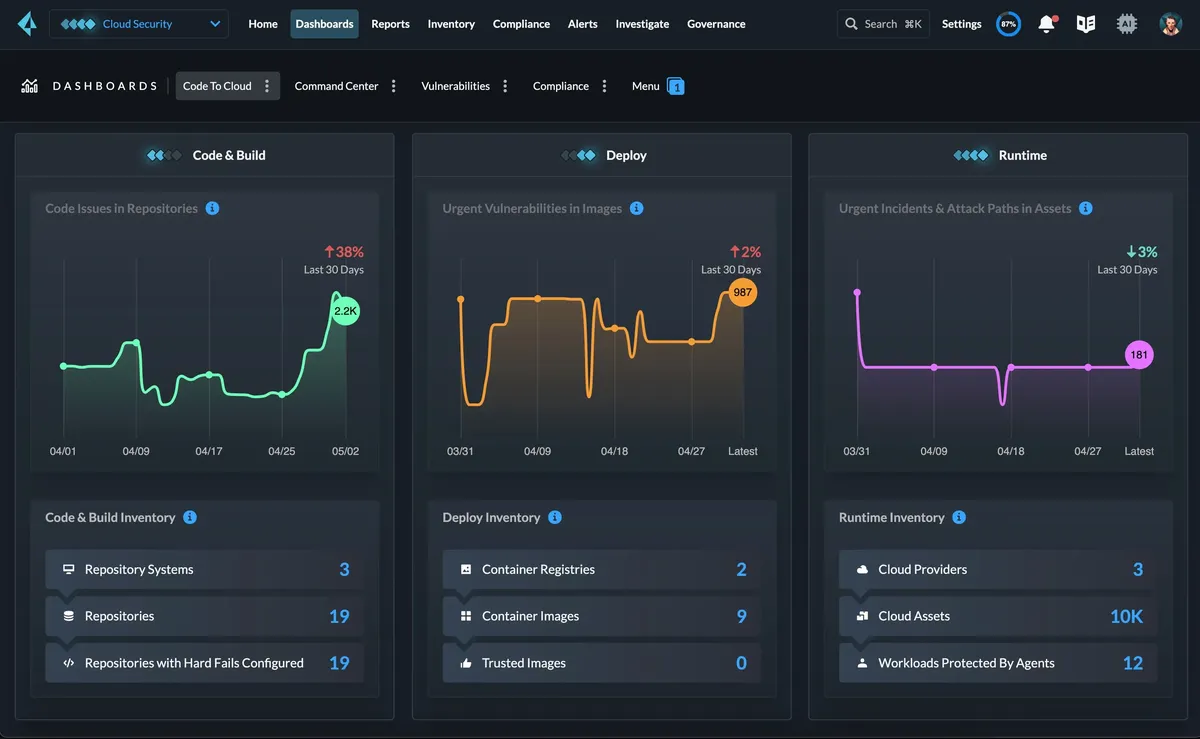
Prisma Cloud: product and architecture
This Prisma Cloud review examines Palo Alto Networks' flagship cloud-native application protection platform (CNAPP) and whether it delivers on its promise to unify cloud security under one roof. Prisma Cloud bundles CSPM, CWPP, CIEM, and code security into a single product, targeting organizations that run workloads across AWS, Azure, and GCP. After spending significant time evaluating the platform against real-world multi-cloud environments, the verdict is clear: Prisma Cloud is one of the most capable cloud security platforms on the market, but its complexity and cost structure make it a poor fit for smaller teams. This review breaks down what works, what falls short, and who should actually buy it.
Overview
Prisma Cloud is Palo Alto Networks' answer to the sprawling cloud security market. Built through a series of acquisitions — Evident.io for CSPM, Twistlock for container security, Bridgecrew for infrastructure-as-code scanning, and others — it stitches these capabilities into a unified console. The platform monitors cloud infrastructure configurations, protects runtime workloads, manages identity entitlements, and scans code repositories for security issues before deployment.
The platform covers the full application lifecycle from code commit to production runtime. It ingests cloud API metadata, analyzes network flows, inspects container images, and correlates findings across these data sources to surface attack paths rather than isolated alerts. Palo Alto positions it as a "code to cloud" security platform, and that framing is accurate. The breadth is genuinely impressive — few competitors cover this much ground in a single product. The tradeoff is that each individual module may not match a dedicated point solution in depth, a tension that runs throughout the product.
Key Features and Architecture
Prisma Cloud is organized into several distinct security modules that share a common data model and policy engine.
Cloud Security Posture Management (CSPM) continuously monitors cloud account configurations against compliance frameworks including CIS, NIST, SOC 2, PCI-DSS, and HIPAA. It detects misconfigurations like publicly exposed S3 buckets, overly permissive security groups, and unencrypted databases. The policy library contains over 1,500 predefined rules, and custom policies can be written using Prisma Cloud's RQL query language — a SQL-like syntax for querying cloud resource metadata.
Cloud Workload Protection (CWPP) handles runtime security for VMs, containers, and serverless functions. It provides vulnerability scanning for container images, runtime defense with behavioral monitoring, and host-based firewalls. The Defender agent deploys as a DaemonSet in Kubernetes clusters and monitors process activity, network connections, and file system changes against learned behavioral baselines.
Cloud Infrastructure Entitlement Management (CIEM) analyzes IAM policies across cloud providers to identify excessive permissions. It calculates a "net effective permissions" model that resolves the interactions between IAM policies, resource policies, and permission boundaries — a genuinely difficult problem that most organizations handle poorly with manual reviews.
Code Security integrates with CI/CD pipelines and scans infrastructure-as-code templates (Terraform, CloudFormation, Kubernetes manifests), open-source dependencies for known CVEs, and secrets embedded in repositories. This module originated from the Bridgecrew acquisition and retains Checkov, the open-source IaC scanner, as its scanning engine.
Attack Path Analysis correlates findings across all modules to identify exploitable chains — for example, a publicly exposed VM running a container with a critical CVE and excessive IAM permissions. This cross-module correlation is where the unified platform approach pays off most clearly.
Ideal Use Cases
Prisma Cloud fits best in mid-to-large enterprises running multi-cloud environments with dedicated security teams. Organizations with 500+ cloud assets across two or more providers will get the most value from the unified visibility. Teams that have outgrown a patchwork of point solutions — one tool for CSPM, another for container scanning, a third for IaC checks — and want to consolidate will appreciate the single-pane-of-glass approach.
Regulated industries (finance, healthcare, government) benefit from the built-in compliance frameworks and automated evidence collection for audits. DevSecOps teams embedding security into CI/CD pipelines will use the code security and shift-left scanning features daily. Kubernetes-heavy organizations get strong value from the container security capabilities, which handle image scanning, admission control, and runtime protection in one workflow. Small teams with fewer than 100 cloud assets or single-cloud deployments should look elsewhere — the operational overhead and cost do not justify the investment at that scale.
Pros and Cons
Pros:
- Broadest feature coverage of any CNAPP on the market, reducing tool sprawl
- Attack path analysis that correlates findings across CSPM, CWPP, and CIEM is genuinely valuable
- Strong Kubernetes and container security with granular runtime policies
- RQL query language gives security teams real investigative power over cloud metadata
- Compliance framework coverage is deep, with automated evidence mapping for audits
- Active acquisition strategy keeps the platform current with emerging threat categories
Cons:
- Credit-based pricing is deliberately opaque and makes cost forecasting difficult
- Console UI is cluttered — the result of bolting together acquired products shows in navigation inconsistencies
- Steep learning curve requires dedicated staff; expect 2-3 months for full operational proficiency
- Individual modules sometimes trail dedicated point solutions in depth (e.g., Wiz for CSPM visibility, Snyk for developer-facing code scanning)