Decision comparison
AWS Kinesis vs Azure Event Hubs
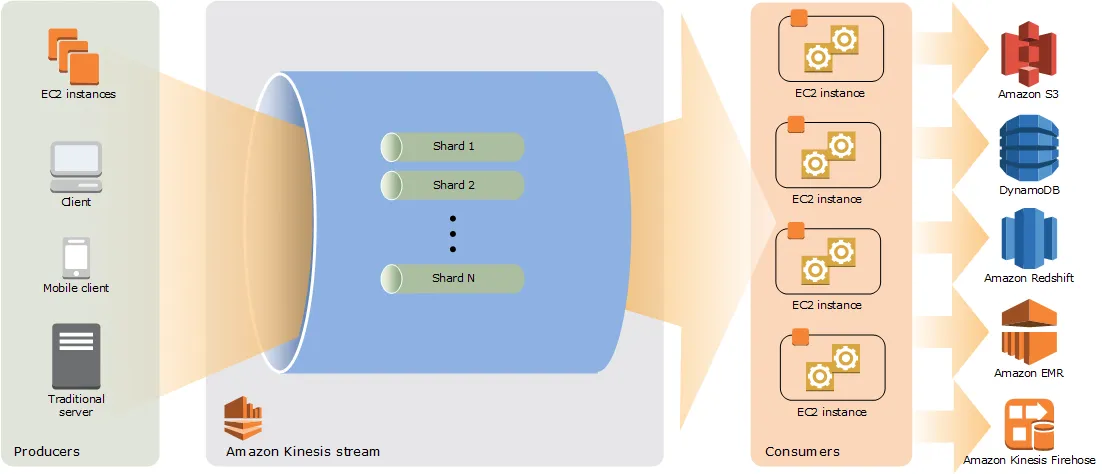
Kinesis Data Streams and Event Hubs are the AWS and Azure answers to the same requirement, and the cloud an organisation already runs on usually decides. The one genuine technical difference is protocol: Event Hubs exposes a Kafka-compatible endpoint so standard Kafka clients work, while Kinesis requires AWS SDK code. Kinesis offers longer retention on standard tiers, up to 365 days.
Architecture choice. These take different approaches to the same problem. Read the table as a fit question rather than a feature race.
Applies to: AWS-native real-time ingestion and analytics workloads
All 2 are event streaming platforms.
Quick Comparison
| Decision factor | AWS Kinesis | Azure Event Hubs |
|---|---|---|
| What it is | AWS's managed streaming service for ingesting and processing event data | Azure's managed event ingestion service, with a Kafka-compatible endpoint |
| Cloud | AWS, integrated with Lambda, Firehose, Glue, S3 and IAM | Azure, integrated with Functions, Stream Analytics, Data Lake Storage and Entra |
| Capacity model | Shards you provision, or on-demand mode that scales automatically | Throughput units, or processing units on Premium and Dedicated tiers |
| Protocol | AWS SDK and Kinesis Client Library; no Kafka protocol | AMQP, HTTPS and a Kafka protocol endpoint that standard Kafka clients can use |
| Retention | 24 hours by default, extendable up to 365 days | 1 to 7 days on standard tiers, up to 90 days on Premium and Dedicated |
| Archiving | Firehose delivers to S3, Redshift or OpenSearch | Capture writes automatically to Blob Storage or Data Lake Storage |
| Best fit | Event pipelines inside AWS, especially feeding Lambda and S3 | Event pipelines inside Azure, or teams wanting Kafka clients on a managed Azure service |
AWS Kinesis
- What it is:
- AWS's managed streaming service for ingesting and processing event data
- Cloud:
- AWS, integrated with Lambda, Firehose, Glue, S3 and IAM
- Capacity model:
- Shards you provision, or on-demand mode that scales automatically
- Protocol:
- AWS SDK and Kinesis Client Library; no Kafka protocol
- Retention:
- 24 hours by default, extendable up to 365 days
- Archiving:
- Firehose delivers to S3, Redshift or OpenSearch
- Best fit:
- Event pipelines inside AWS, especially feeding Lambda and S3
Azure Event Hubs
- What it is:
- Azure's managed event ingestion service, with a Kafka-compatible endpoint
- Cloud:
- Azure, integrated with Functions, Stream Analytics, Data Lake Storage and Entra
- Capacity model:
- Throughput units, or processing units on Premium and Dedicated tiers
- Protocol:
- AMQP, HTTPS and a Kafka protocol endpoint that standard Kafka clients can use
- Retention:
- 1 to 7 days on standard tiers, up to 90 days on Premium and Dedicated
- Archiving:
- Capture writes automatically to Blob Storage or Data Lake Storage
- Best fit:
- Event pipelines inside Azure, or teams wanting Kafka clients on a managed Azure service
Public signals
Verified factual signals only. Bars appear only for like-for-like metrics with five weekly assessments for every tool; missing evidence stays explicit. These signals do not establish enterprise adoption, product quality, or total cost.
| Metric | AWS Kinesis | Azure Event Hubs |
|---|---|---|
| GitHub commits, 90d(Developer adoption) | 19 | Not available |
| GitHub stars(Developer adoption) | 667 | Not available |
| Search interest(Market interest) | 1 | 0 |
| Hacker News mentions, 90d(Community interest) | 0 | Not available |
| npm weekly downloads(Developer adoption) | 1.9M | 189.9k |
| Stack Overflow questions(Community interest) | 1.8k | 2.1k |
| PyPI weekly downloads(Developer adoption) | Not available | 2.0M |
As of September 14, 2026 — updated weekly.
Health & risk evidence
Observed public-source checks for mapped package versions and repositories.
AWS Kinesis
September 14, 2026Package vulnerabilities
npm · @aws-sdk/client-kinesis@3.1131.0
0 vulnerabilities
across 1 package
Repository security score
Not available
Azure Event Hubs
September 14, 2026Package vulnerabilities
npm · @azure/event-hubs@6.0.4 · PyPI · azure-eventhub@5.15.1
0 vulnerabilities
across 2 packages
Repository security score
Not available
Interface Preview
AWS Kinesis
Feature Comparison
| Feature | AWS Kinesis | Azure Event Hubs |
|---|---|---|
| Protocol | ||
| Kafka client compatibility | Not verified | Full support |
| Native cloud SDK | Full support | Full support |
| HTTP ingestion endpoint | Full support | Full support |
| Exactly-once processing support | Partial support | Partial support |
| Capacity | ||
| Provisioned capacity units | Full support | Full support |
| Automatic scaling mode | Full support | Full support |
| Long retention beyond 7 days | Full support | Partial support |
| Ordered partitions | Full support | Full support |
| Integration | ||
| Serverless function triggers | Full support | Full support |
| Automatic archive to object storage | Full support | Full support |
| Managed stream processing service | Full support | Full support |
| Cloud-native identity and access control | Full support | Full support |
| Operations | ||
| Fully managed, no brokers to run | Full support | Full support |
| Cross-region replication | Partial support | Full support |
| Schema registry | Partial support | Full support |
| Available outside its own cloud | Not verified | Not verified |
Protocol
Kafka client compatibility
Native cloud SDK
HTTP ingestion endpoint
Exactly-once processing support
Capacity
Provisioned capacity units
Automatic scaling mode
Long retention beyond 7 days
Ordered partitions
Integration
Serverless function triggers
Automatic archive to object storage
Managed stream processing service
Cloud-native identity and access control
Operations
Fully managed, no brokers to run
Cross-region replication
Schema registry
Available outside its own cloud
Which approach fits
Kinesis Data Streams and Event Hubs are the AWS and Azure answers to the same requirement, and the cloud an organisation already runs on usually decides. The one genuine technical difference is protocol: Event Hubs exposes a Kafka-compatible endpoint so standard Kafka clients work, while Kinesis requires AWS SDK code. Kinesis offers longer retention on standard tiers, up to 365 days.
When each approach fits
Choose AWS Kinesis if:
Choose Kinesis Data Streams when the pipeline lives in AWS. Lambda triggers directly from a stream, Firehose delivers to S3, Redshift or OpenSearch without code, IAM handles access, and retention extends to 365 days when replay matters. On-demand mode removes shard planning if you would rather not forecast throughput.
Choose Azure Event Hubs if:
Choose Event Hubs when the pipeline lives in Azure, or when you want to write Kafka client code against a managed service. The Kafka endpoint means standard Java, Python and Go clients connect without change, Capture archives automatically to Blob Storage or Data Lake Storage, and Functions, Stream Analytics and Entra integrate natively.
These scenarios reflect the available product evidence. Your requirements, existing stack, and team expertise should guide the final decision.
Frequently Asked Questions
How much does Kafka API compatibility matter?
It decides how much code you own. Applications written against the Kafka protocol use standard clients in Java, Python, Go and the rest, and the same code runs against any compatible broker, so switching platforms is a configuration change rather than a rewrite. A proprietary API means SDK-specific producer and consumer code, and migrating later means touching every service that reads or writes the stream.
How do the capacity models work?
Both offer a provisioned unit you plan for and an automatic mode that removes the planning. Provisioned capacity suits predictable throughput: you pay for the units you reserve, under-provisioning throttles producers, and over-provisioning spends money on headroom. Automatic modes carry a per-unit premium and adjust without forecasting, which is the trade when a daily peak runs several times the average.
How long can we keep data?
Kinesis retains 24 hours by default and can be extended to 365 days, which makes replay of historical events practical without a separate archive. Event Hubs retains 1 to 7 days on standard tiers and up to 90 days on Premium and Dedicated. If your recovery story depends on replaying weeks of events, check the tier you would actually buy rather than the maximum the service supports.
What happens when a consumer falls behind?
It reads older data until it catches up, provided the data is still within the retention window. If it is not, those events are gone and recovery means going to whatever archive you built. This is the practical reason retention length matters more than it appears: it is the size of the mistake you can recover from. Both services archive automatically to object storage, which is the safety net.
Can either run outside its own cloud?
Neither can. Both are managed services of a single cloud provider, and the reasons to cross clouds are the usual ones: egress charges, federated identity, and the latency between producer and broker. If your producers and consumers run in one cloud, use that cloud's service unless a specific requirement says otherwise.
Do we need a schema registry?
As soon as more than one team consumes a stream, yes. Without one, a producer changing a field breaks consumers silently, and the failure appears downstream hours later. Event Hubs has a schema registry in Azure; on AWS the usual pairing is Glue Schema Registry with Kinesis. Plan for it during design rather than after the first incident.