Decision comparison
AWS Kinesis vs Redpanda
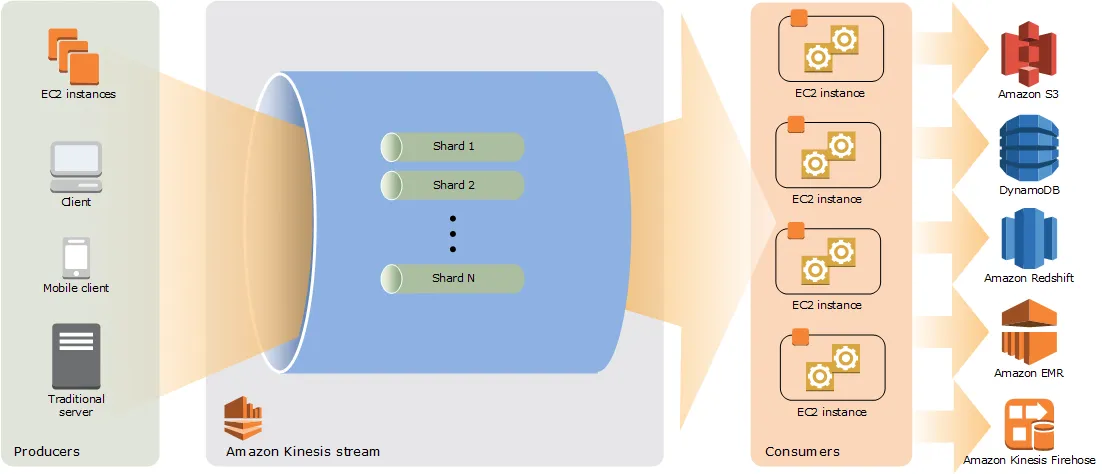
Kinesis and Redpanda differ on protocol and portability. Kinesis is AWS-only and fully managed, with Lambda, Firehose and IAM integration and no brokers to run, but producer and consumer code is written against the AWS SDK. Redpanda speaks the Kafka API, so standard clients and tooling work, and it runs self-hosted, in your own cloud account, or as a managed service.
Architecture choice. These take different approaches to the same problem. Read the table as a fit question rather than a feature race.
Applies to: Kafka-compatible streaming workloads that need ZooKeeper-free and JVM-free operations
All 2 are event streaming platforms.
Quick Comparison
| Decision factor | AWS Kinesis | Redpanda |
|---|---|---|
| What it is | AWS's managed streaming service, using shards and the AWS SDK | A Kafka-compatible streaming platform written in C++, with no JVM and no ZooKeeper |
| Protocol | AWS SDK and Kinesis Client Library only | Kafka API, so standard Kafka clients and tooling work unchanged |
| Where it runs | AWS only, fully managed | Self-hosted anywhere, in your own cloud account, or as Redpanda Cloud |
| Operating model | No brokers to run; provision shards or use on-demand mode | Brokers you run, or a managed service; one binary per node, no separate coordination service |
| Retention | 24 hours by default, up to 365 days | Tiered storage offloads older segments to S3 or compatible object storage, so retention is effectively unbounded |
| Latency | Well suited to high-throughput ingestion with typical managed-service latency | Designed for low and predictable tail latency, with no garbage collection pauses |
| Best fit | AWS-native pipelines feeding Lambda, Firehose and S3 | Teams wanting Kafka compatibility, portability, or tighter latency control |
AWS Kinesis
- What it is:
- AWS's managed streaming service, using shards and the AWS SDK
- Protocol:
- AWS SDK and Kinesis Client Library only
- Where it runs:
- AWS only, fully managed
- Operating model:
- No brokers to run; provision shards or use on-demand mode
- Retention:
- 24 hours by default, up to 365 days
- Latency:
- Well suited to high-throughput ingestion with typical managed-service latency
- Best fit:
- AWS-native pipelines feeding Lambda, Firehose and S3
Redpanda
- What it is:
- A Kafka-compatible streaming platform written in C++, with no JVM and no ZooKeeper
- Protocol:
- Kafka API, so standard Kafka clients and tooling work unchanged
- Where it runs:
- Self-hosted anywhere, in your own cloud account, or as Redpanda Cloud
- Operating model:
- Brokers you run, or a managed service; one binary per node, no separate coordination service
- Retention:
- Tiered storage offloads older segments to S3 or compatible object storage, so retention is effectively unbounded
- Latency:
- Designed for low and predictable tail latency, with no garbage collection pauses
- Best fit:
- Teams wanting Kafka compatibility, portability, or tighter latency control
Public signals
Verified factual signals only. Bars appear only for like-for-like metrics with five weekly assessments for every tool; missing evidence stays explicit. These signals do not establish enterprise adoption, product quality, or total cost.
| Metric | AWS Kinesis | Redpanda |
|---|---|---|
| GitHub commits, 90d(Developer adoption) | 19 | Not available |
| GitHub stars(Developer adoption) | 667 | Not available |
| Search interest(Market interest) | 1 | 1 |
| Hacker News mentions, 90d(Community interest) | 0 | 3 |
| npm weekly downloads(Developer adoption) | 1.9M | Not available |
| Stack Overflow questions(Community interest) | 1.8k | 36 |
| Docker Hub pulls(Product adoption) | Not available | 37.1M |
| GitHub commits, 90d(Product adoption) | Not available | 1.3k |
| GitHub stars(Product adoption) | Not available | 12,000+ |
| npm weekly downloads(Ecosystem adoption) | Not available | 2.6M |
As of September 14, 2026 — updated weekly.
Health & risk evidence
Observed public-source checks for mapped package versions and repositories.
AWS Kinesis
September 14, 2026Package vulnerabilities
npm · @aws-sdk/client-kinesis@3.1131.0
0 vulnerabilities
across 1 package
Repository security score
Not available
Redpanda
September 14, 2026Package vulnerabilities
npm · kafkajs@2.2.4
0 vulnerabilities
across 1 package
Repository security score
Not available
Interface Preview
AWS Kinesis
Redpanda

Feature Comparison
| Feature | AWS Kinesis | Redpanda |
|---|---|---|
| Protocol | ||
| Kafka client compatibility | Not verified | Full support |
| Kafka ecosystem tooling | Not verified | Full support |
| Native AWS SDK integration | Full support | Partial support |
| Schema registry | Partial support | Full support |
| Deployment | ||
| Fully managed option | Full support | Full support |
| Self-hosted on your own hardware | Not verified | Full support |
| Run in your own cloud account | Not verified | Full support |
| Runs outside AWS | Not verified | Full support |
| Storage | ||
| Tiered storage to object storage | Partial support | Full support |
| Retention beyond 30 days | Full support | Full support |
| Ordered partitions | Full support | Full support |
| Automatic archive to a data lake | Full support | Partial support |
| Operations | ||
| No brokers to operate | Full support | Partial support |
| Serverless function triggers | Full support | Partial support |
| Cloud-native identity integration | Full support | Partial support |
| Predictable tail latency | Partial support | Full support |
Protocol
Kafka client compatibility
Kafka ecosystem tooling
Native AWS SDK integration
Schema registry
Deployment
Fully managed option
Self-hosted on your own hardware
Run in your own cloud account
Runs outside AWS
Storage
Tiered storage to object storage
Retention beyond 30 days
Ordered partitions
Automatic archive to a data lake
Operations
No brokers to operate
Serverless function triggers
Cloud-native identity integration
Predictable tail latency
Which approach fits
Kinesis and Redpanda differ on protocol and portability. Kinesis is AWS-only and fully managed, with Lambda, Firehose and IAM integration and no brokers to run, but producer and consumer code is written against the AWS SDK. Redpanda speaks the Kafka API, so standard clients and tooling work, and it runs self-hosted, in your own cloud account, or as a managed service.
When each approach fits
Choose AWS Kinesis if:
Choose Kinesis Data Streams when the pipeline is AWS-native and you want nothing to operate. Lambda triggers directly from the stream, Firehose delivers to S3, Redshift or OpenSearch without code, IAM handles access, and on-demand mode removes capacity planning. Retention extends to 365 days when replay matters.
Choose Redpanda if:
Choose Redpanda when Kafka compatibility, portability or latency control matter. Standard Kafka clients and the surrounding ecosystem work unchanged, a single binary per node with no JVM and no ZooKeeper reduces what there is to operate, and tiered storage to S3 makes long retention affordable. It runs on your own hardware or in any cloud.
These scenarios reflect the available product evidence. Your requirements, existing stack, and team expertise should guide the final decision.
Frequently Asked Questions
How much does Kafka API compatibility matter?
It decides how much code you own. Applications written against the Kafka protocol use standard clients in Java, Python, Go and the rest, and the same code runs against any compatible broker, so switching platforms is a configuration change rather than a rewrite. A proprietary API means SDK-specific producer and consumer code, and migrating later means touching every service that reads or writes the stream.
Is Redpanda harder to operate than a managed service?
Harder than nothing, easier than a traditional Kafka cluster. There is one binary per node, no JVM to tune and no separate coordination service to keep healthy, which removes a large share of the operational surface. But you still own upgrades, capacity and on-call. Redpanda Cloud exists for teams that want the protocol and the portability without the operations.
What does tiered storage change?
It separates retention from disk. Older log segments move to S3 or compatible object storage while staying readable through the same Kafka API, so keeping 90 days costs roughly what object storage costs rather than what provisioned disk costs. That makes replay a normal operation rather than an expensive one, and it is the main reason long retention is practical.
Does latency actually differ in practice?
It can at the tail. Redpanda's design — C++ with no garbage collector, a thread per core, and direct handling of the storage path — targets predictable p99 latency rather than peak throughput alone. Whether that is worth anything depends on your workload: for analytics ingestion feeding a warehouse it rarely matters, and for interactive or trading-adjacent systems it can be the deciding factor.
What do we give up by leaving Kinesis?
Direct Lambda triggers, Firehose delivery to S3 and Redshift without code, and IAM access control that matches the rest of your AWS estate. Each is replaceable — connectors, consumer services, separate authentication — but each replacement is a component you build and run. Count them honestly before treating portability as free.
Which is cheaper?
It depends on fan-out and retention, not on throughput alone. Every additional consumer group reads the stream again, so a managed service charging for reads scales with consumers. Long retention on tiered object storage is inexpensive; long retention on provisioned capacity is not. Price one real workload — peak throughput in and out, consumer group count, and required retention — against both.