Decision comparison
ClearML vs SkyPilot
For scheduling GPU training jobs across shared clusters, SkyPilot is the direct choice when multi-cloud, Kubernetes, Slurm, gang scheduling, binpacking, and GPU fleet operations are the central problem. ClearML is the stronger choice when those scheduled jobs also require first-class experiment lineage, dataset versioning, pipeline automation, dashboards, and Triton-backed model serving in one platform.
Direct comparison. These are reviewed substitutes bought for the same job, so the differences below are the ones that decide between them.
All 2 are ML platforms.
Quick Comparison
| Decision factor | ClearML | SkyPilot |
|---|---|---|
| Best For | Teams needing a unified ML lifecycle platform for tracked experiments, versioned data, pipelines, scheduling, and production model serving. | Frontier AI teams scheduling GPU training jobs across shared Kubernetes, Slurm, multi-cluster, and 20-plus-cloud compute environments. |
| Architecture | Three-layer AI infrastructure platform combining control plane, development center, and scalable deployment services across on-premises, cloud, and hybrid GPU clusters. | Compute orchestration layer unifying Kubernetes, Slurm, multi-cloud capacity, intelligent scheduling, monitoring, quotas, endpoints, and sandbox workloads. |
| Pricing Model | Open Source free, $15/unknown tier | Open source under the Apache-2.0 license; source code at https://github.com/skypilot-org/skypilot. |
| Ease of Use | Two-line Python integration converts repositories into orchestrated workflows, with automatic capture of experiments, artifacts, logs, and code changes. | CLI-driven platform abstracts fragmented infrastructure, while intelligent scheduling, GPU health checks, quotas, and endpoints centralize operational control. |
| Scalability | Manages distributed training, hyperparameter optimization, queues, fractional GPUs, hybrid clusters, and Nvidia Triton-backed optimized GPU model serving. | Supports gang scheduling, multi-cluster execution, workload binpacking, and shared GPU fleets spanning Kubernetes, Slurm, and 20-plus clouds. |
| Community/Support | Apache-2.0 Python project with 6,934 GitHub stars; managed and enterprise options add multi-tenancy, RBAC, billing, and platform support. | Apache-2.0 Python project with 10,809 GitHub stars; official site offers demos and references frontier-team infrastructure deployments. |
ClearML
- Best For:
- Teams needing a unified ML lifecycle platform for tracked experiments, versioned data, pipelines, scheduling, and production model serving.
- Architecture:
- Three-layer AI infrastructure platform combining control plane, development center, and scalable deployment services across on-premises, cloud, and hybrid GPU clusters.
- Pricing Model:
- Open Source free, $15/unknown tier
- Ease of Use:
- Two-line Python integration converts repositories into orchestrated workflows, with automatic capture of experiments, artifacts, logs, and code changes.
- Scalability:
- Manages distributed training, hyperparameter optimization, queues, fractional GPUs, hybrid clusters, and Nvidia Triton-backed optimized GPU model serving.
- Community/Support:
- Apache-2.0 Python project with 6,934 GitHub stars; managed and enterprise options add multi-tenancy, RBAC, billing, and platform support.
SkyPilot
- Best For:
- Frontier AI teams scheduling GPU training jobs across shared Kubernetes, Slurm, multi-cluster, and 20-plus-cloud compute environments.
- Architecture:
- Compute orchestration layer unifying Kubernetes, Slurm, multi-cloud capacity, intelligent scheduling, monitoring, quotas, endpoints, and sandbox workloads.
- Pricing Model:
- Open source under the Apache-2.0 license; source code at https://github.com/skypilot-org/skypilot.
- Ease of Use:
- CLI-driven platform abstracts fragmented infrastructure, while intelligent scheduling, GPU health checks, quotas, and endpoints centralize operational control.
- Scalability:
- Supports gang scheduling, multi-cluster execution, workload binpacking, and shared GPU fleets spanning Kubernetes, Slurm, and 20-plus clouds.
- Community/Support:
- Apache-2.0 Python project with 10,809 GitHub stars; official site offers demos and references frontier-team infrastructure deployments.
Public signals
Verified factual signals only. Bars appear only for like-for-like metrics with five weekly assessments for every tool; missing evidence stays explicit. These signals do not establish enterprise adoption, product quality, or total cost.
| Metric | ClearML | SkyPilot |
|---|---|---|
| Docker Hub pulls(Product adoption) | 107.8k | Not available |
| GitHub commits, 90d(Product adoption) | 28 | 503 |
| GitHub stars(Product adoption) | 6,500+ | 10,000+ |
| Search interest(Market interest) | 0 | Not available |
| PyPI weekly downloads(Product adoption) | 158.0k | Not available |
| Stack Overflow questions(Community interest) | 54 | Not available |
| PyPI weekly downloads(Developer adoption) | Not available | 442.1k |
As of November 23, 2026 — updated weekly.
Health & risk evidence
Observed public-source checks for mapped package versions and repositories.
ClearML
November 23, 2026Package vulnerabilities
PyPI · clearml@2.2.0
0 vulnerabilities
across 1 package
Repository security score
Not available
SkyPilot
November 23, 2026Package vulnerabilities
PyPI · skypilot@0.14.3
0 vulnerabilities
across 1 package
Repository security score
Not available
Interface Preview
ClearML
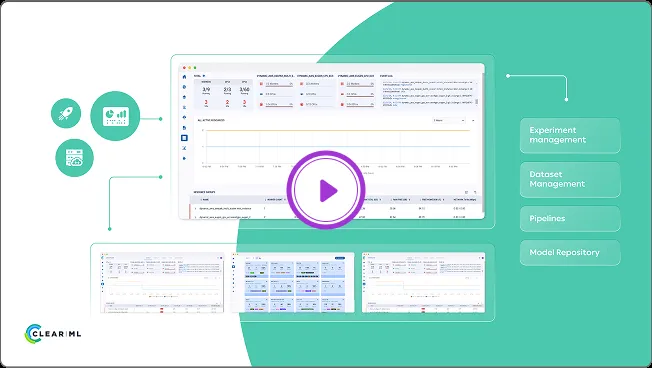
Feature Comparison
| Feature | ClearML | SkyPilot |
|---|---|---|
| Compute orchestration | ||
| GPU cluster management | Control plane connects on-premises, cloud, and hybrid GPU clusters | Unifies Kubernetes, Slurm, and 20-plus cloud compute environments |
| Shared-cluster scheduling | Queues and orchestration automate ML, DL, and GenAI job execution | Intelligent scheduler places jobs across shared multi-cluster capacity |
| GPU resource optimization | Fractional GPUs and cost optimization are managed through infrastructure control | Workload binpacking and GPU health checks improve fleet utilization |
| Training workflow | ||
| Experiment tracking | Automatically tracks metrics, artifacts, logs, code, and hyperparameters | Not available as a native experiment-tracking feature in provided data |
| Pipeline automation | Python functions become pipeline steps with dependencies, caching, and parallel execution | Schedules compute workloads but provided data does not describe pipeline authoring |
| Distributed training | Scalable distributed training and hyperparameter optimization are built in | Gang scheduling coordinates multi-resource workloads across shared infrastructure |
| Data and model lifecycle | ||
| Dataset versioning | Differentiable data version control runs on object storage and NAS | Not available as a native data-versioning feature in provided data |
| Artifact management | Project dashboards compare experiment, dataset, model, and artifact records | Not available as a native artifact-management feature in provided data |
| Model serving | Cloud-ready serving uses optimized GPU support backed by Nvidia Triton | SkyPilot Endpoints expose deployed AI workloads through platform endpoints |
| Infrastructure controls | ||
| Multi-cluster operation | Single control plane manages connected clusters across deployment locations | Multi-cluster support schedules workloads across fragmented compute estates |
| Access and tenancy | Built-in multi-tenancy, role-based access control, and billing controls | Quotas provide infrastructure allocation controls in the supplied feature set |
| GPU fleet health | Infrastructure control plane emphasizes GPU-cluster performance management | GPU health checks monitor accelerator availability before and during scheduling |
| Deployment and operational interface | ||
| Primary workflow interface | Project and orchestration dashboards manage lifecycle work visually | CLI provides an operational entry point to infrastructure scheduling |
| Interactive environments | Development center supports developing, training, and testing AI workloads | SkyPilot Sandboxes provide isolated environments for AI workload execution |
| Production workload focus | Tracks training through deployment within one MLOps and LLMOps platform | Provides endpoints and scheduling for compute-intensive frontier AI workloads |
Compute orchestration
GPU cluster management
Shared-cluster scheduling
GPU resource optimization
Training workflow
Experiment tracking
Pipeline automation
Distributed training
Data and model lifecycle
Dataset versioning
Artifact management
Model serving
Infrastructure controls
Multi-cluster operation
Access and tenancy
GPU fleet health
Deployment and operational interface
Primary workflow interface
Interactive environments
Production workload focus
Which to choose
For scheduling GPU training jobs across shared clusters, SkyPilot is the direct choice when multi-cloud, Kubernetes, Slurm, gang scheduling, binpacking, and GPU fleet operations are the central problem. ClearML is the stronger choice when those scheduled jobs also require first-class experiment lineage, dataset versioning, pipeline automation, dashboards, and Triton-backed model serving in one platform.
Best-fit scenarios
Choose ClearML if:
Choose ClearML when ML engineers need reproducible training runs, automatic experiment capture, dataset and model comparison, Python-authored pipelines, and production serving alongside GPU orchestration. It fits teams consolidating the ML lifecycle into one self-hostable platform.
Choose SkyPilot if:
Choose SkyPilot when infrastructure teams must schedule training across Kubernetes, Slurm, multiple clusters, and 20-plus clouds, especially where gang scheduling, binpacking, quotas, and GPU health checks determine throughput and utilization.
These scenarios reflect the available product evidence. Your requirements, existing stack, and team expertise should guide the final decision.
Frequently Asked Questions
What is the main difference between ClearML and SkyPilot?
ClearML is an end-to-end MLOps and LLMOps platform: it automatically tracks experiments, manages artifacts and datasets, orchestrates pipelines, schedules workloads, and supports Nvidia Triton-backed model serving. SkyPilot is primarily an AI compute orchestration platform. It unifies Kubernetes, Slurm, multi-cluster capacity, and more than 20 clouds, with capabilities such as gang scheduling, workload binpacking, GPU health checks, quotas, endpoints, and sandboxes. ClearML centers the ML lifecycle; SkyPilot centers shared AI compute.
Which is better for small teams?
A small ML team that needs experiment reproducibility and minimal instrumentation will usually get more immediate value from ClearML. Its two-line Python integration, automatic logging of metrics, artifacts, logs, hyperparameters, and code changes, plus project dashboards reduce the need to assemble separate tracking and orchestration tools. A small team whose primary challenge is cheaply scheduling GPU jobs across several clouds or an existing Slurm or Kubernetes estate should favor SkyPilot, but it will need separate systems for experiment tracking and dataset lineage.
Can I migrate from ClearML to SkyPilot?
You can move the compute-execution portion of a workflow, but this is not a one-for-one platform migration. SkyPilot can take responsibility for scheduling and operating jobs across Kubernetes, Slurm, clusters, and clouds. ClearML-specific records such as experiment histories, project dashboards, artifacts, datasets, model comparisons, and pipeline definitions are lifecycle capabilities that SkyPilot's provided feature set does not replace. Plan migration as a refactor: retain ClearML for lineage or adopt separate tracking, data-versioning, and model-management components.
What are the pricing differences?
ClearML offers open-source self-hosting and publishes Open Source, Free/Pro, and Scale/Enterprise tier names. The supplied pricing information includes $15, but does not identify the exact tier or billing interval; it also signals per-seat and usage-based commercial pricing. SkyPilot is Apache-2.0 open source and free to self-host according to the supplied data. No paid SkyPilot tier, public rate card, usage meter, or dollar amount is provided, so infrastructure costs would depend on the underlying Kubernetes, Slurm, and cloud resources a team operates.