Decision comparison
Collibra vs Foundational
Choose Foundational when the first problem is engineering change safety: lineage derived from code and checked in the pull request. Choose Collibra when the first problem is an enterprise governance workspace for data and AI. The two are also built to work together: Foundational documents an export of its table- and column-level lineage into Collibra.
Architecture choice. These take different approaches to the same problem. Read the table as a fit question rather than a feature race.
All 2 are data catalogs.
Quick Comparison
| Decision factor | Collibra | Foundational |
|---|---|---|
| Best for | Organizations that want one governed workspace for data and AI: Collibra describes the Collibra Platform as unified governance for data and AI, with a data catalog, data privacy, data governance, data quality and observability, data lineage and a data marketplace as listed platform areas. It names regulated organizations as its audience and says it powers 100+ of the Fortune 500. | Data and platform engineering teams whose immediate problem is technical lineage and change safety: knowing which dashboards, models and owners a code change touches before it merges. Foundational builds a deterministic knowledge graph of code and data movement across repositories, applications, databases and on-prem systems. |
| Where lineage comes from | Collibra lists Data Lineage as a platform area and a semantic graph that links raw data to business meaning. Its semantic mapping and model generation (GA March 2026) generates a semantic layer that connects physical data with business terms, and its cross-platform automated traceability (GA March 2026) links data, models and use cases across Vertex AI, SageMaker and Databricks. | Foundational builds column-level lineage from source code: SQL, Python, Java, Scala, COBOL, TypeScript, Go and more, with dbt, Spark, Airflow and SQLAlchemy, and BI tools such as Looker, Tableau and Power BI. For systems that are not defined in code, such as warehouses and BI tools, scheduled scans of metadata, query logs and schema information are merged into the same lineage graph. |
| Change control | Collibra's data contracts (GA March 2026) are meant to promote alignment across teams and deliver consistent data products through visibility and automation. The workflow lives in the Collibra Platform, where stewards and data owners work. | Foundational runs impact analysis on pull requests. Each relevant pull request gets a post in git and CI/CD that lists affected assets, severity and suggested owners before the change merges. Foundational supports GitHub, GitLab, Bitbucket and Azure DevOps. |
| Governance and AI scope | Collibra lists these governance areas: data governance, privacy, catalog, quality and observability, lineage and marketplace, plus a unified AI registry (preview, March 2026) that connects use cases, models and agents. Data quality jobs can run in a Spark engine on Edge (Pullup support, GA April 2026). | Every plan includes cross-platform lineage, impact analysis, data quality, data contracts and AI governance. Foundational also tracks asset usage and cost from connected warehouses and BI tools, and generates audit-ready reports on what changed and how it affects critical data assets. |
| Setup and access | Collibra runs through Edge sites, which can be self-hosted or Collibra-managed Cloud sites. Collibra offers an interactive tour and a personalized demo with a Collibra expert as the way to see the platform. | Foundational states that setup takes under an hour: authenticate it to the relevant code repositories and any BI tools, with no code changes. It reads code and metadata by default; its architecture documentation says it accesses customer data only if you turn on data observability checks that validate the underlying data. |
| Pricing | Collibra publishes no prices on its website. Buyers can explore the platform in an interactive tour or request a personalized demo from a Collibra expert. Verified 2026-10-26 against https://www.collibra.com and https://www.collibra.com/products/collibra-platform. | Priced by the number of tracked objects in the lineage graph, not by seats; cost grows with the overall complexity of the systems represented in that graph. Foundational's pricing page says every plan includes the full platform and lists no amounts; a form collects contact details. Official pricing page checked November 9, 2026. |
Collibra
- Best for:
- Organizations that want one governed workspace for data and AI: Collibra describes the Collibra Platform as unified governance for data and AI, with a data catalog, data privacy, data governance, data quality and observability, data lineage and a data marketplace as listed platform areas. It names regulated organizations as its audience and says it powers 100+ of the Fortune 500.
- Where lineage comes from:
- Collibra lists Data Lineage as a platform area and a semantic graph that links raw data to business meaning. Its semantic mapping and model generation (GA March 2026) generates a semantic layer that connects physical data with business terms, and its cross-platform automated traceability (GA March 2026) links data, models and use cases across Vertex AI, SageMaker and Databricks.
- Change control:
- Collibra's data contracts (GA March 2026) are meant to promote alignment across teams and deliver consistent data products through visibility and automation. The workflow lives in the Collibra Platform, where stewards and data owners work.
- Governance and AI scope:
- Collibra lists these governance areas: data governance, privacy, catalog, quality and observability, lineage and marketplace, plus a unified AI registry (preview, March 2026) that connects use cases, models and agents. Data quality jobs can run in a Spark engine on Edge (Pullup support, GA April 2026).
- Setup and access:
- Collibra runs through Edge sites, which can be self-hosted or Collibra-managed Cloud sites. Collibra offers an interactive tour and a personalized demo with a Collibra expert as the way to see the platform.
- Pricing:
- Collibra publishes no prices on its website. Buyers can explore the platform in an interactive tour or request a personalized demo from a Collibra expert. Verified 2026-10-26 against https://www.collibra.com and https://www.collibra.com/products/collibra-platform.
Foundational
- Best for:
- Data and platform engineering teams whose immediate problem is technical lineage and change safety: knowing which dashboards, models and owners a code change touches before it merges. Foundational builds a deterministic knowledge graph of code and data movement across repositories, applications, databases and on-prem systems.
- Where lineage comes from:
- Foundational builds column-level lineage from source code: SQL, Python, Java, Scala, COBOL, TypeScript, Go and more, with dbt, Spark, Airflow and SQLAlchemy, and BI tools such as Looker, Tableau and Power BI. For systems that are not defined in code, such as warehouses and BI tools, scheduled scans of metadata, query logs and schema information are merged into the same lineage graph.
- Change control:
- Foundational runs impact analysis on pull requests. Each relevant pull request gets a post in git and CI/CD that lists affected assets, severity and suggested owners before the change merges. Foundational supports GitHub, GitLab, Bitbucket and Azure DevOps.
- Governance and AI scope:
- Every plan includes cross-platform lineage, impact analysis, data quality, data contracts and AI governance. Foundational also tracks asset usage and cost from connected warehouses and BI tools, and generates audit-ready reports on what changed and how it affects critical data assets.
- Setup and access:
- Foundational states that setup takes under an hour: authenticate it to the relevant code repositories and any BI tools, with no code changes. It reads code and metadata by default; its architecture documentation says it accesses customer data only if you turn on data observability checks that validate the underlying data.
- Pricing:
- Priced by the number of tracked objects in the lineage graph, not by seats; cost grows with the overall complexity of the systems represented in that graph. Foundational's pricing page says every plan includes the full platform and lists no amounts; a form collects contact details. Official pricing page checked November 9, 2026.
Public signals
Verified factual signals only. Bars appear only for like-for-like metrics with five weekly assessments for every tool; missing evidence stays explicit. These signals do not establish enterprise adoption, product quality, or total cost.
| Metric | Collibra | Foundational |
|---|---|---|
| GitHub commits, 90d(Developer adoption) | 43 | Not available |
| GitHub stars(Developer adoption) | 37 | Not available |
| Hacker News mentions, 90d(Community interest) | 0 | 0 |
| Stack Overflow questions(Community interest) | 10 | Not available |
As of November 9, 2026 — updated weekly.
Interface Preview
Collibra
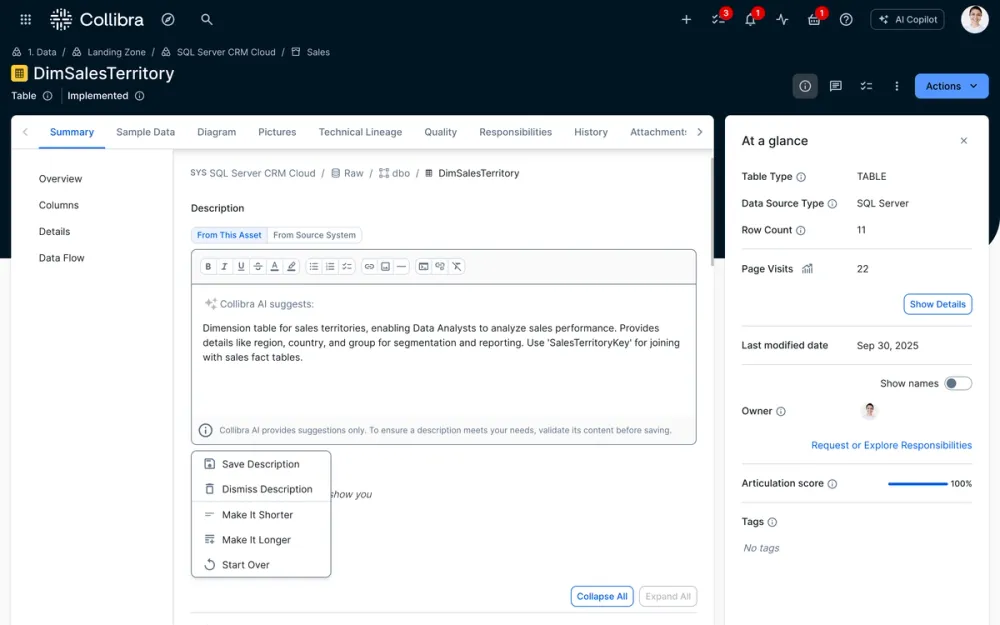
Feature Comparison
| Feature | Collibra | Foundational |
|---|---|---|
| Lineage and change control | ||
| Lineage source | Platform lineage plus a semantic graph; cross-platform traceability for AI across Vertex AI, SageMaker and Databricks | Source code (SQL, Python, Java, Scala, COBOL, dbt, Spark, Airflow, SQLAlchemy), with scheduled scans of warehouse and BI metadata, query logs and schema merged into the same graph |
| Column-level lineage | Receives Foundational's table- and column-level lineage through Edge OpenLineage (Cloud), alongside existing Collibra assets | Maps transformations, joins and aggregations from field to field |
| Pull request checks | Data contracts (GA March 2026) align teams on data products inside the platform | Impact analysis on each relevant pull request: affected assets, severity and suggested owners |
| Data contracts | Data contracts, GA March 2026, listed under Data Catalog | Contracts kept in source control, with PR checks that can block invalid merges and monitoring of contracts |
| Governance and catalog | ||
| Business context | Semantic mapping and model generation (GA March 2026) generates a semantic layer connecting physical data with business terms | Reads the business logic that defines what data means from code; field search shows each field's context |
| AI governance | Unified AI registry (preview, March 2026) connecting use cases, models and agents | AI governance included in every plan; the knowledge graph is exposed to agents, with an MCP server announced at Dreamforce 2026 |
| Data quality | Data Quality and Observability, with Spark-engine jobs on Edge (Pullup support, GA April 2026) | Data quality included in every plan, with data contract monitoring |
| Privacy and compliance | Data Privacy is a listed platform area | Audit-ready compliance documentation showing what changed and its effect on critical data assets |
| Setup and commercial | ||
| How it connects | Edge sites, self-hosted or Collibra-managed Cloud | Authentication to code repositories and BI tools; reads code and metadata by default, and customer data only for optional data observability checks |
| Working together | A Healthy Edge site, the Technical Lineage permission and an S3 bucket let it read Foundational's exported lineage | Exports lineage into Collibra; Foundational's setup guide estimates about 40 minutes and needs an AWS S3 bucket and IAM role |
| Pricing model | No published prices; interactive tour or demo request | Priced by tracked objects in the lineage graph, not seats; no amounts listed, and a contact form on the pricing page |
Lineage and change control
Lineage source
Column-level lineage
Pull request checks
Data contracts
Governance and catalog
Business context
AI governance
Data quality
Privacy and compliance
Setup and commercial
How it connects
Working together
Pricing model
Which approach fits
Choose Foundational when the first problem is engineering change safety: lineage derived from code and checked in the pull request. Choose Collibra when the first problem is an enterprise governance workspace for data and AI. The two are also built to work together: Foundational documents an export of its table- and column-level lineage into Collibra.
When each approach fits
Choose Foundational if:
Pick Foundational when the people who break things are engineers changing dbt models, Spark jobs, SQL, COBOL and application code, and you want them to see downstream impact before merge. Its lineage is built from source code, so it covers pipelines and application logic that never ran in a warehouse, and it posts affected assets, severity and suggested owners on the pull request in GitHub, GitLab, Bitbucket or Azure DevOps. It reads code and metadata by default, and every plan includes lineage, impact analysis, data quality, data contracts and AI governance. The cost of this choice is scope: Foundational frames its value around technical lineage and change checks, so a team whose first need is a stewardship workspace with business terms, policies and approvals should look at Collibra first and treat Foundational as the engineering layer beside it.
Choose Collibra if:
Pick Collibra when governance itself is the project: a regulated organization that needs a shared place for business terms, a semantic layer that ties physical data to those terms, privacy, data quality and observability, a data marketplace and a unified AI registry, run by stewards and data owners rather than by the engineers who change code. Collibra's data contracts and semantic mapping (both GA March 2026) bring some of that alignment into the platform. The cost of this choice is that the change-safety check at pull request time is a separate concern: Foundational describes adding code-derived lineage beside Collibra and exporting it through Edge OpenLineage (Cloud), which is the route to take when Collibra is already in place and engineers need pre-merge checks.
These scenarios reflect the available product evidence. Your requirements, existing stack, and team expertise should guide the final decision.
Frequently Asked Questions
Can Foundational and Collibra be used together?
Yes. Foundational's setup guide describes exporting its computed table- and column-level lineage into a Collibra data catalog. The export uses Collibra's OpenLineage (Cloud) technical-lineage capability, which reads files from an Amazon S3 bucket through a Collibra Edge site. You need a Healthy Edge site, the Technical Lineage global permission, and an AWS account where you can create a bucket and an IAM role. The guide estimates about 40 minutes.
How does each tool get its lineage?
Foundational analyzes source code directly: SQL, Python, Java, Scala, COBOL, TypeScript, Go and more, with dbt, Spark, Airflow and SQLAlchemy, and it merges scheduled scans of warehouse and BI metadata, query logs and schema into the same lineage graph. Collibra lists Data Lineage as a platform area within its governance platform, with a semantic graph that connects raw data to business meaning and cross-platform traceability for AI.
Do Foundational and Collibra publish prices?
Neither publishes a price list. Collibra's website lists no prices and offers an interactive tour or a personalized demo. Foundational's pricing page lists no amounts either; it says it prices by the number of tracked objects in the lineage graph, not by seats, and asks for contact details. Compare them by requesting a quote from each for the same environment.
Which tool checks changes before they merge?
Foundational. It runs impact analysis on pull requests in GitHub, GitLab, Bitbucket and Azure DevOps and posts affected assets, severity and suggested owners before the merge. Collibra's closest listed feature is data contracts (GA March 2026), which align teams on data products inside the Collibra Platform.