Decision comparison
Collibra vs Monte Carlo
Collibra and Monte Carlo serve fundamentally different roles in the modern data stack. Collibra is a comprehensive data governance and catalog platform that helps organizations manage data policies, enforce compliance, and maintain a trusted semantic layer across the enterprise. Monte Carlo is a data and AI observability platform that detects pipeline anomalies, manages data incidents, and ensures data reliability from ingestion to consumption. Organizations that need to govern data assets, enforce regulatory compliance, and build a unified data catalog should choose Collibra. Teams focused on detecting data quality issues in real time, reducing pipeline downtime, and monitoring AI agent outputs should choose Monte Carlo. Many enterprises deploy both platforms together, using Collibra for governance policies and Monte Carlo for operational monitoring.
Architecture choice. These take different approaches to the same problem. Read the table as a fit question rather than a feature race.
These are different kinds of product — Data Catalog and Data Observability.
Quick Comparison
| Decision factor | Collibra | Monte Carlo |
|---|---|---|
| Primary Focus | Data governance and catalog | Data and AI observability |
| Pricing Model | Contact for pricing | Monte Carlo publishes no amounts. Its tiers are Start, Scale, Enterprise and Business Critical, purchased as credits, and all are quote-only. Every tier includes agent, ML and data observability. |
| Best For | Regulated enterprises needing unified data governance | Data teams monitoring pipeline reliability at scale |
| Data Lineage | Cross-platform automated traceability with semantic graph | End-to-end column-level lineage for incident root-cause analysis |
| Deployment | Cloud-based SaaS platform | Cloud-based SaaS platform |
| User Rating | 8/10 (18 reviews) | 9/10 (4 reviews) |
Collibra
- Primary Focus:
- Data governance and catalog
- Pricing Model:
- Contact for pricing
- Best For:
- Regulated enterprises needing unified data governance
- Data Lineage:
- Cross-platform automated traceability with semantic graph
- Deployment:
- Cloud-based SaaS platform
- User Rating:
- 8/10 (18 reviews)
Monte Carlo
- Primary Focus:
- Data and AI observability
- Pricing Model:
- Monte Carlo publishes no amounts. Its tiers are Start, Scale, Enterprise and Business Critical, purchased as credits, and all are quote-only. Every tier includes agent, ML and data observability.
- Best For:
- Data teams monitoring pipeline reliability at scale
- Data Lineage:
- End-to-end column-level lineage for incident root-cause analysis
- Deployment:
- Cloud-based SaaS platform
- User Rating:
- 9/10 (4 reviews)
Public signals
Verified factual signals only. Bars appear only for like-for-like metrics with five weekly assessments for every tool; missing evidence stays explicit. These signals do not establish enterprise adoption, product quality, or total cost.
| Metric | Collibra | Monte Carlo |
|---|---|---|
| GitHub commits, 90d(Developer adoption) | 107 | 231 |
| GitHub stars(Developer adoption) | 36 | 2 |
| Search interest(Market interest) | 0 | 0 |
| Hacker News mentions, 90d(Community interest) | 0 | 0 |
| Stack Overflow questions(Community interest) | 10 | Not available |
| PyPI weekly downloads(Developer adoption) | Not available | 41.2k |
As of September 21, 2026 — updated weekly.
Health & risk evidence
Observed public-source checks for mapped package versions and repositories.
Collibra
Package vulnerabilities
Not available
Repository security score
Not available
Monte Carlo
September 21, 2026Package vulnerabilities
PyPI · montecarlodata@0.175.0
0 vulnerabilities
across 1 package
Repository security score
Not available
Interface Preview
Monte Carlo
Feature Comparison
| Feature | Collibra | Monte Carlo |
|---|---|---|
| Data Governance | ||
| Data Catalog | Full enterprise data catalog with semantic graph | Not a primary feature; focuses on observability |
| Data Contracts | Native data contracts support | Not verified |
| Policy Management | Automated workflow designer for governance processes | Not verified |
| Data Observability | ||
| Anomaly Detection | Limited; not a core capability | ML-driven anomaly detection across pipelines |
| Incident Management | Not a primary feature | Full incident management with alerting and root-cause analysis |
| Pipeline Monitoring | Not a primary feature | End-to-end monitoring from ingestion to consumption |
| Data Lineage | ||
| Lineage Scope | Cross-platform automated traceability | End-to-end column-level lineage |
| Impact Analysis | Available through semantic graph relationships | Impact analysis for dashboards and downstream consumers |
| AI and Automation | ||
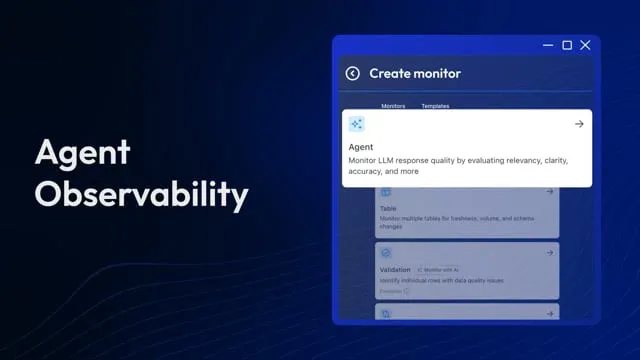
| AI Registry | Unified AI registry for model governance | Agent observability for monitoring AI agents in production |
| Automated Monitoring | Automated governance workflows | AI-powered monitoring agent with auto-scaling coverage |
| Semantic Layer | Automatically generated semantic layer | Not verified |
| Integration and Deployment | ||
| BI Tool Integration | Tableau, Salesforce, Databricks, Slack via Collibra Everywhere | Deep integrations across the full data and AI ecosystem |
| CI/CD Support | API-based integration | YAML-based CI/CD monitor deployment |
| Salesforce Integration | Available via Collibra Everywhere extension | Native monitoring for Salesforce and Data Cloud |
Data Governance
Data Catalog
Data Contracts
Policy Management
Data Observability
Anomaly Detection
Incident Management
Pipeline Monitoring
Data Lineage
Lineage Scope
Impact Analysis
AI and Automation
AI Registry
Automated Monitoring
Semantic Layer
Integration and Deployment
BI Tool Integration
CI/CD Support
Salesforce Integration
Which approach fits
Collibra and Monte Carlo serve fundamentally different roles in the modern data stack. Collibra is a comprehensive data governance and catalog platform that helps organizations manage data policies, enforce compliance, and maintain a trusted semantic layer across the enterprise. Monte Carlo is a data and AI observability platform that detects pipeline anomalies, manages data incidents, and ensures data reliability from ingestion to consumption. Organizations that need to govern data assets, enforce regulatory compliance, and build a unified data catalog should choose Collibra. Teams focused on detecting data quality issues in real time, reducing pipeline downtime, and monitoring AI agent outputs should choose Monte Carlo. Many enterprises deploy both platforms together, using Collibra for governance policies and Monte Carlo for operational monitoring.
When each approach fits
Choose Collibra if:
We recommend Collibra for enterprises in regulated industries that need a unified data governance platform. Collibra excels at data cataloging, policy management, and compliance automation. Its semantic graph technology connects raw data to business meaning, making it easier for both technical and business users to discover and trust data assets. With features like data contracts, automated governance workflows, and a unified AI registry, Collibra is the stronger choice for organizations that need to enforce data standards across departments, manage regulatory compliance at scale, and build a single source of truth for their data estate. Collibra powers over 100 Fortune 500 companies and is particularly well-suited for financial services, healthcare, and life sciences organizations where data governance is a regulatory requirement.
Choose Monte Carlo if:
We recommend Monte Carlo for data and analytics engineering teams that need to ensure pipeline reliability and reduce data downtime. Monte Carlo provides ML-driven anomaly detection that automatically identifies data quality issues before they reach downstream consumers. Its incident management system routes alerts to the right team members with root-cause analysis powered by end-to-end column-level lineage. The platform's monitoring agent can deploy coverage in minutes rather than weeks, and its AI-powered recommendations help teams scale observability across hundreds of tables without manual configuration. Monte Carlo is the better choice for teams that generate thousands of reports daily, operate complex multi-source pipelines, or need to monitor AI agent outputs in production environments.
These scenarios reflect the available product evidence. Your requirements, existing stack, and team expertise should guide the final decision.
Frequently Asked Questions
Can Collibra and Monte Carlo be used together?
Yes. Collibra and Monte Carlo address different layers of the data stack and complement each other well. Collibra handles data governance, cataloging, and policy enforcement, while Monte Carlo monitors data quality and pipeline reliability in real time. Many enterprise teams use Collibra to define data standards and Monte Carlo to detect when those standards are violated in production pipelines.
Which platform is better for data lineage?
Both platforms offer data lineage but with different goals. Collibra provides cross-platform automated traceability through its semantic graph, connecting data assets to business context and governance policies. Monte Carlo provides end-to-end column-level lineage focused on incident root-cause analysis, helping teams trace data quality issues back to their source. Collibra lineage is governance-oriented, while Monte Carlo lineage is operations-oriented.
What is the pricing difference between Collibra and Monte Carlo?
Collibra uses an enterprise pricing model that requires contacting their sales team for a quote. Monte Carlo publishes no amounts either: its Start, Scale, Enterprise and Business Critical tiers are all purchased as consumption credits and quoted on request. Monte Carlo also uses usage-based pricing signals, meaning costs may scale with the volume of monitored tables and data assets.
Which tool should we choose for AI governance?
For AI model governance and registry management, Collibra is the stronger choice with its unified AI registry that tracks AI models alongside data assets under a single governance framework. For monitoring AI agents and LLM outputs in production, Monte Carlo is better suited with its agent observability features that trace agent context, performance, and behavior. The right choice depends on whether your primary concern is governing AI development or monitoring AI operations.